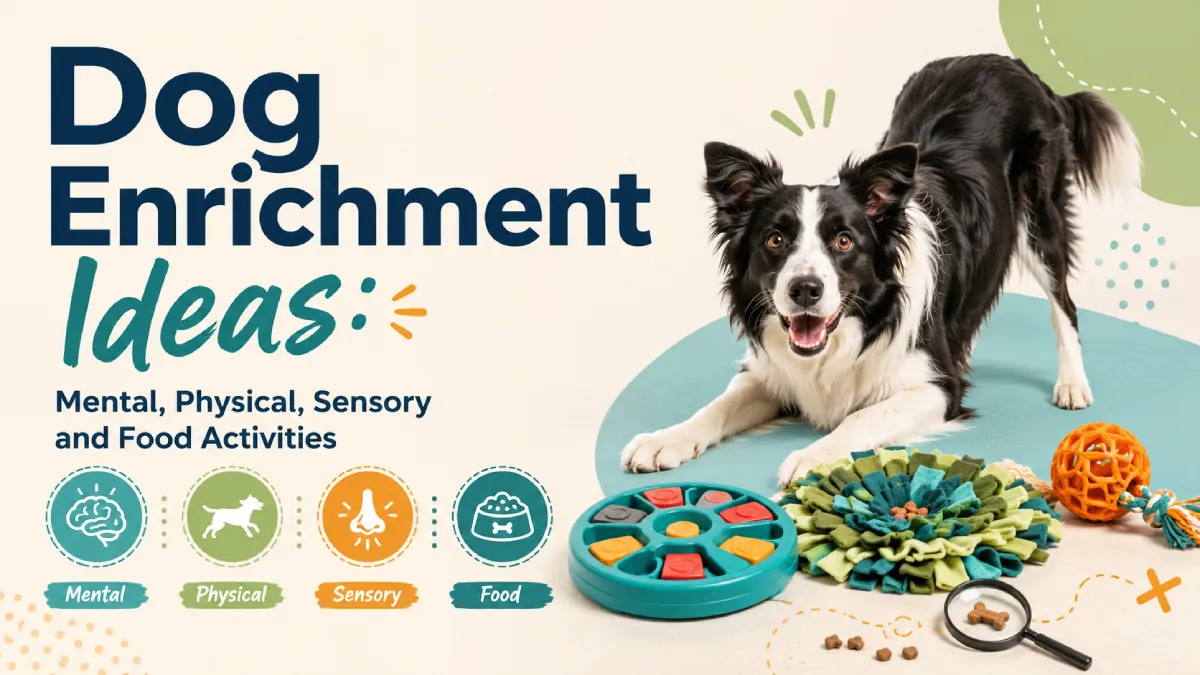
Dog Enrichment Ideas: Mental, Sensory & Food Activities
Dog enrichment is about creating safe opportunities to use the brain, senses and body in ways the individual dog finds rewarding. A good routine can include sniffing, searching, food foraging, reward-based training, chewing, exploration, play, social contact and calm observation. It does not have to mean buying more toys.
The best dog enrichment ideas are matched to the dog rather than copied from a generic list. Puppies, seniors, high-drive dogs, apartment dogs and dogs recovering from injury may all need different activities. Preferences also matter: a dog that loves searching may ignore a puzzle toy, while another may prefer tug or quiet chewing.
Quick Answer
Use several types of enrichment across the week rather than repeating one activity. Mix cognitive work, sniffing and sensory exploration, appropriate physical play, social interaction and food-foraging activities. Start easy, supervise anything that can be chewed or swallowed, count food calories, and stop or simplify an activity that creates fear, frustration or excessive arousal.
What Enrichment Means
VCA describes enrichment as positive mental and physical stimulation intended to support health and emotional well-being. It should provide choices and opportunities for normal behaviours rather than simply keeping a dog busy. Enrichment is successful when the dog can engage comfortably and the activity fits the dog’s physical and behavioural abilities.
Enrichment Is Not the Same as Exercise
A sprint and a scent search can both be tiring, but they challenge the dog in different ways. Physical exercise primarily loads muscles, joints and the cardiovascular system. Cognitive and sensory activities can add engagement without requiring the same repetitive impact. A balanced routine usually includes both movement and opportunities to think, explore and recover.
Why Dogs Need Different Types of Enrichment
Dogs differ in genetics, experience, confidence, health and preferences. A terrier may find digging highly rewarding, a retriever may enjoy carrying and searching for objects, and a scent-oriented dog may prefer tracking odors to chasing a ball. These are tendencies rather than guarantees.
VCA and AAHA both emphasize individual preferences and breed-related behaviour. Use those tendencies as ideas, then observe what your own dog chooses to repeat.
Cognitive Enrichment
Cognitive activities ask the dog to solve a problem or learn something. Reward-based training, object discrimination, simple tricks, food puzzles and search games can all serve this role. The task should be achievable; a puzzle that repeatedly blocks access to food can create frustration rather than useful mental work.
Food and Foraging Enrichment
Foraging toys can encourage sniffing, seeking, licking and manipulating. Options include scatter feeding, snuffle mats, food-dispensing toys and stuffed feeders. Use part of the dog’s normal food allowance when practical so enrichment does not silently add a large number of calories.
Supervision depends on the dog and item. A toy that is appropriate for a gentle user may be unsafe for a destructive chewer.
Sensory Enrichment
Dogs gather enormous amounts of information through smell. Sniff walks, scent searches, safe outdoor exploration and novel but non-threatening environments can provide sensory variety. Visual observation from a safe place can also be enriching for dogs that enjoy watching people or wildlife without becoming over-aroused.
Physical Enrichment
Physical enrichment can include tug, controlled fetch, climbing over safe low obstacles, digging in an approved area or exploring different surfaces. Match intensity to age, fitness and health. Activities that involve jumping, sprinting or sharp turns should not be treated as interchangeable with low-impact movement.
Social Enrichment
Social enrichment can involve people, familiar dogs or both. Not every dog enjoys daycare, dog parks or close greetings with unfamiliar dogs. Blue Cross notes that enrichment should fit the individual dog’s preferences. For some dogs, a quiet walk with a trusted person is more rewarding than group play.
Sniffing and Searching
Letting a dog investigate odors at its own pace is a simple form of enrichment. At home, hide a familiar toy or pieces of the dog’s meal in easy locations. Outdoors, use safe areas where the dog can pause without being pulled away from every scent.
See Sniff Walks for Dogs and Scent Games for Dogs for dedicated progressions.
Problem Solving and Training
Short reward-based training sessions can build useful skills while providing mental engagement. AVSAB recommends reward-based methods and advises against aversive training. Teach behaviours in small steps so the dog understands how to earn reinforcement rather than using frustration or physical correction.
Puzzle Toys and Food-Dispensing Toys
Choose size and construction for the individual dog. Start with an easy setup so the dog learns how the toy works. If the dog becomes frantic, chews off pieces or abandons the toy repeatedly, simplify the task or use another activity.
Scatter Feeding and Snuffle Mats
Scatter feeding can turn part of a meal into a search. A snuffle mat can serve a similar purpose indoors. Both require calorie awareness and supervision when a dog may chew or swallow fabric or other materials.
Chewing and Licking
Chewing and licking can be calm activities for some dogs, but safety depends on the specific item, size, chewing style and supervision. No chew or homemade object should be described as universally safe. Discard damaged items before loose pieces become a swallowing hazard.
Tug and Fetch
Tug can provide social and physical engagement when the game includes pauses and the dog can release on cue. Fetch should be managed to avoid endless high-speed repetitions with repeated sharp turns. Some dogs love these games; others do not.
Hide and Seek
Hide-and-seek can combine scenting, recall and social play. Begin where the dog can succeed easily. Blue Cross recommends avoiding a level of difficulty that makes the dog panic because they cannot find the person or toy.
Novel Environments and Safe Observation
Novelty does not have to mean crowded events. A different quiet walking route, safe woodland path, new patch of grass or short car trip to a calm sniffing area may be enough. An anxious dog may benefit more from predictability and gradual novelty than constant change.
Digging Opportunities
For dogs that naturally dig, an approved digging area can redirect the behaviour. Use clean, safe material and avoid hidden sharp objects, garden chemicals or toxic plants. Do not punish a breed-typical behaviour without first providing an appropriate outlet and management.
Life-Stage Adjustments
Puppies
Keep activities short, simple and safe for developing bodies. Use exploration, easy searches, training and age-appropriate play rather than repetitive high-impact exercise.
Adults
Healthy adults may enjoy the widest activity range. Rotate different forms rather than making every day identical.
Seniors
Seniors can still benefit from cognitive and sensory work. Adjust surfaces, reaching, climbing and duration to mobility and medical needs.
High-Drive and Apartment Dogs
High-drive dogs often benefit from purposeful work plus calm recovery, not simply more intense exercise. Apartment dogs can receive excellent enrichment through scent work, training, indoor searches and well-planned walks. Space matters, but quality and variety matter too.
See Managing a High-Drive Dog for a balanced routine.
Dogs on Activity Restriction or Recovering From Injury
Do not improvise vigorous enrichment when a veterinarian has prescribed activity restriction. Ask which forms of movement, food puzzles, scent work or training are compatible with the medical plan. A physically quiet activity can still be inappropriate if it requires twisting, jumping or repeated standing.
Food Calories Still Count
Food used in puzzles, training and scatter feeding contributes to daily energy intake. Using part of the normal meal is often easier than continuously adding treats. Dogs on therapeutic or elimination diets also need compatible ingredients.
Supervision and Toy Safety
Before any activity, consider choking, swallowing, destructive chewing, resource guarding, allergies, mobility and the level of supervision available. Cardboard, towels, plastic bottles, tennis balls, food toys and chews are not automatically suitable for every dog.
For homemade options, use DIY Dog Enrichment Toys.
Rotate Activities Instead of Escalating Difficulty Forever
A dog does not need a harder puzzle every week. Rotation can preserve interest without turning enrichment into a constant test. Reuse simple activities in different rooms, on different walks or with a different toy when the dog still enjoys them.
Avoiding Overstimulation
More enrichment is not always better. A dog that becomes frantic, mouthy, unable to disengage or unable to settle may need a quieter environment and recovery rather than another game. See Signs of an Overstimulated Dog and How to Teach a Dog to Settle.
Building a Weekly Enrichment Schedule
A useful schedule balances active and calm choices. Instead of trying to complete every category every day, rotate activities and note the dog’s response. A weekly view makes it easier to see if the routine is dominated by high-intensity play or food-based games.
Internal Links
- Indoor Activities for Dogs
- Sniff Walks for Dogs
- Scent Games for Dogs
- DIY Dog Enrichment Toys
- Signs of a Bored Dog
- Managing a High-Drive Dog
- How to Teach a Dog to Settle
How to Choose the Right Enrichment Activity
Start with three questions: what does the dog enjoy, what can the dog physically do, and what can you supervise safely? A food-motivated dog may enjoy searching for part of a meal, while a toy-driven dog may prefer retrieval or tug. A senior with arthritis may benefit from floor-level scent work rather than obstacle climbing.
The same activity can be enriching for one dog and frustrating for another. Observe whether the dog engages willingly, can solve the task without escalating frustration and can disengage when the session ends.
Challenge Versus Frustration
Useful enrichment usually sits between “so easy it has no novelty” and “so hard the dog gives up or becomes frantic.” Signs that difficulty may be too high include persistent barking at the puzzle, biting or throwing the object, leaving repeatedly, frantic pawing or escalating arousal.
Make the problem easier before adding more complexity. Open the lid farther, reduce the number of hiding places, make food more visible or shorten the search area. Success teaches the dog how the activity works.
Multi-Dog Household Safety
Food puzzles, chews and high-value toys can create conflict in households where dogs compete over resources. Separate dogs with barriers or into different rooms when necessary. Do not assume dogs that normally share space comfortably should work on high-value food enrichment side by side.
Observe the dogs after the activity too. One dog hovering over another’s empty puzzle or guarding discarded packaging may still create tension after the food is gone.
Food Allergies and Therapeutic Diets
Dogs on elimination trials, kidney diets, gastrointestinal diets or other veterinary nutrition plans should not receive random treats simply because they are used for enrichment. Use approved portions of the prescribed diet or ask the veterinary team which ingredients are compatible with the plan.
Supervised Versus Independent Activities
Some enrichment can continue with minimal interaction once safety is established, while other activities require active supervision. A sturdy food toy that a particular dog uses gently may be different from a towel puzzle that the same dog tears and swallows.
When deciding whether an activity can be left with a dog, consider what happens after the food is gone. Dogs may begin chewing the container only once the original task is finished.
Low-Cost and Non-Food Enrichment
Enrichment does not need to rely on purchased toys or treats. Useful low-cost options can include a new walking route, a find-a-person game, training with normal meal pieces, safe observation from a window, toy rotation, a permitted digging area or a supervised search for a familiar object.
Non-food options are particularly useful when calorie intake is tightly controlled or the dog has dietary restrictions.
How to Measure Whether Enrichment Is Working
Do not judge success only by how long an activity occupies the dog. Track whether the dog chooses to engage, solves the task comfortably, shows appropriate body language and can transition to normal behaviour afterward.
A useful activity may last only a few minutes. A puzzle that occupies the dog for forty minutes because the dog is frustrated is not automatically better.
Enrichment for Dogs That Guard Resources
If a dog growls, freezes, blocks access or becomes defensive around food toys or chews, do not repeatedly remove items by force to “teach sharing.” Manage access and seek qualified reward-based behaviour support. Use lower-value or non-food enrichment when appropriate.
Enrichment for Dogs That Become Over-Aroused
Some activities increase arousal rather than reduce it. Repetitive ball play, high-speed chase games or very exciting social play may be poor choices immediately before a period when the dog needs to rest. Build calmer options such as scent searches, chewing or settle practice into the schedule if the dog enjoys them.
Example Weekly Rotation by Dog Profile
| Dog profile | Possible emphasis |
|---|---|
| Food-motivated adult | Meal-based searching, short training, sniff walk, controlled physical play and quiet recovery. |
| Toy-driven high-drive dog | Structured tug/retrieval, scent work, skill training, free exploration, settle work and rest. |
| Senior with reduced mobility | Floor-level searches, gentle sniffing, cooperative handling, calm food puzzle and social interaction. |
| Dog on temporary activity restriction | Veterinarian-approved stationary training, safe scent tasks and feeding enrichment compatible with restrictions. |
When to Retire or Change an Activity
Stop using an enrichment item when it becomes damaged, the dog starts swallowing material, the activity repeatedly triggers guarding, or the dog no longer engages willingly. Rotation should be based on safety and interest, not a rule that every toy must stay in use until physically destroyed.
Enrichment Should Include an Off Switch
Dogs do not need a task every waking minute. A rich routine includes opportunities to do nothing, sleep and recover. Constantly offering activities can accidentally create a dog that expects continuous engagement from people.
Use the weekly planner to make quiet time visible rather than leaving it out because it looks less productive than exercise or training.
What a Balanced Enrichment Week Looks Like
A balanced week usually contains more than food puzzles. Include opportunities to sniff and explore, learn with people, move physically, interact socially where the dog enjoys it, and rest. If every activity is food-based, the plan may create excess calories. If every activity is high-speed play, it may create excessive physical or arousal load.
Use the rotation planner to spot gaps rather than create a checklist the dog must complete. A dog that receives excellent scent work and training may not need a puzzle toy simply because another dog enjoys one.
When Enrichment Needs Professional Input
Ask a veterinarian before adapting activities for significant mobility restrictions, pain or medical diets. Seek qualified behaviour help when enrichment repeatedly triggers aggression, guarding, panic or compulsive behaviour. The activity should support welfare, not become a way to work around an untreated medical or behaviour problem.
Keep Enrichment Voluntary
Dogs should be able to opt out. Do not repeatedly place a fearful dog inside a novel puzzle setup or insist on group play because it is labelled enrichment. Choice is part of what makes many activities valuable.
Review the Plan When the Dog Changes
Enrichment needs can change after injury, aging, a move, a new household pet or a change in confidence. Revisit the weekly plan instead of assuming a favorite activity will always remain suitable. A good rotation is flexible enough to follow the dog’s current abilities and interests.
Keep the Environment Predictable Enough to Feel Safe
Novelty can be enriching, but constant novelty can be stressful. Familiar resting areas, predictable meal times and known walking routes can coexist with occasional new activities. Enrichment is not a requirement to surprise the dog every day.
Original Practical Tool
| Day | Cognitive | Sensory | Physical | Food/foraging | Training/social | Calm activity | Dog response |
|---|---|---|---|---|---|---|---|
| Monday | |||||||
| Tuesday | |||||||
| Wednesday | |||||||
| Thursday | |||||||
| Friday | |||||||
| Saturday | |||||||
| Sunday |
Record what the dog actually enjoyed and how easily they settled afterward. The goal is variety and suitability, not filling every cell.
FAQs
What is the best enrichment for dogs?
There is no single best activity. Choose from sniffing, searching, training, play, foraging, social interaction and calm activities according to the individual dog’s preferences and abilities.
Does enrichment tire a dog out?
Mental and sensory work can be engaging and tiring, but enrichment should not be used only as a strategy to exhaust the dog. Quality, choice and recovery matter.
How often should I change enrichment activities?
Rotate when interest drops or when the routine becomes too repetitive. There is no requirement to make activities harder every day.
Are food puzzles safe to leave alone with a dog?
Not automatically. Safety depends on construction, dog size, chewing style and swallowing risk. Supervision may be necessary.
Can enrichment help a bored dog?
It may help when understimulation is part of the problem, but behaviour alone cannot prove boredom. Anxiety, pain, adolescence and other factors should also be considered.