
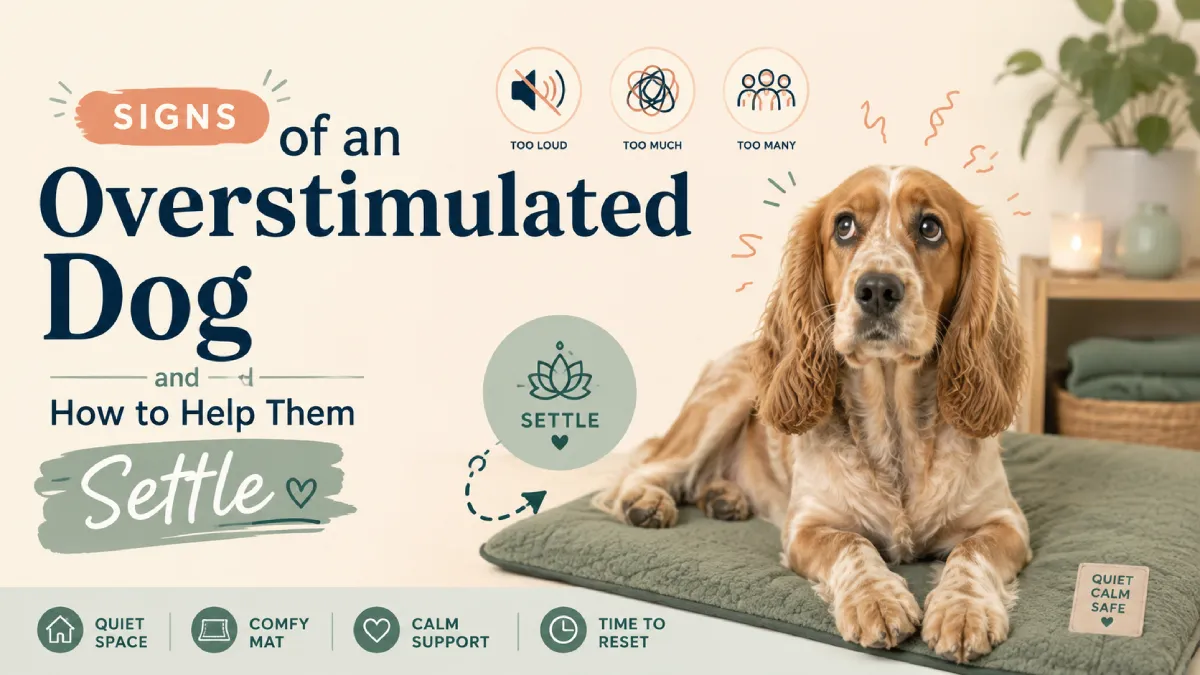
Signs of an Overstimulated Dog and How to Help Them Settle
An overstimulated dog may look energetic, frantic or unable to switch off, but those behaviours are not specific enough to diagnose the cause. Pacing, barking, jumping, mouthing, grabbing the leash or rough play can occur with high arousal, frustration, fear, adolescence, fatigue, pain or learned behaviour.
The useful question is therefore not simply “Is my dog overstimulated?” but “What happened before the behaviour, how intense was the environment, and how long did recovery take?” Reducing stimulation, adding predictable routines and teaching calm behaviour can help many dogs, while persistent or severe problems may need veterinary or qualified behaviour assessment.
Direct Answer
Possible signs of excessive arousal include frantic movement, repeated jumping or mouthing, barking, difficulty disengaging, poor response to familiar cues and inability to settle after activity. Context matters. Reduce environmental intensity, create distance from triggers, offer quiet recovery, and avoid punishment. If behaviour changes suddenly or pain/anxiety is suspected, seek professional guidance.
What Arousal Means
Arousal describes activation of the nervous system. It is not automatically bad. A dog needs some arousal to play, train and explore. Problems arise when the level is too high for the dog to respond flexibly or recover comfortably.
Excitement Versus Distress
Excited dogs can still show loose bodies, take breaks and reorient to the handler. Distressed dogs may show avoidance, tension, inability to disengage or escalating behaviour. A loud or fast dog is not necessarily happy, and a quiet dog is not necessarily relaxed.
Why Context Matters
Ask what happened before the behaviour. Was the dog at daycare for hours, playing intense fetch, walking through a crowded festival, meeting visitors or encountering several triggers in succession? The same jumping behaviour can mean different things in different situations.
Pacing
Repeated pacing after an activity can reflect arousal, but it can also occur with pain, gastrointestinal discomfort or anxiety. If pacing is new, persistent or accompanied by physical symptoms, do not treat it as a training issue alone.
Jumping and Mouthing
Some dogs jump or mouth more as arousal rises, especially adolescents. Reduce interaction intensity, create space and reinforce alternative behaviours rather than shouting, kneeing or using physical corrections.
Barking
Barking can increase when a dog is frustrated, excited, fearful or seeking access to something. Look for the trigger and what happens after the barking instead of assuming boredom or insufficient exercise.
Frantic Movement
Rapid switching between activities, racing around and inability to pause can signal that the environment has become too intense. Move to a calmer space when possible and allow time for recovery.
Difficulty Disengaging
A dog that cannot leave a ball, another dog or a moving trigger may be functioning at a level of arousal where training becomes difficult. Increase distance or end the activity before expecting advanced cue performance.
Zoomies After Activity
Zoomies can be normal playful behaviour and do not automatically prove overstimulation. Look at frequency, context, body language and whether the dog can settle afterward.
Reduced Response to Familiar Cues
When arousal is high, dogs may respond less consistently to cues they know in easy environments. That does not justify stronger punishment. Reduce difficulty and reinforce behaviour at a level where the dog can succeed.
Grabbing the Leash
Leash grabbing can be associated with frustration, excitement or play. Stop moving, reduce conflict over the leash and redirect to a trained behaviour or appropriate toy when safe. Persistent episodes may benefit from trainer or behaviourist assessment.
Rough Play
Play can become more intense as arousal rises. Build pauses into social play and watch whether both dogs voluntarily re-engage. See Dog Play Styles.
Trigger Stacking
Trigger stacking describes several stimulating or stressful events occurring before the dog has fully recovered from earlier ones. A crowded walk, visitor arrival and intense play might each be manageable alone but difficult when combined closely.
Busy Environments
Markets, festivals, crowded trails and busy patios are not enriching for every dog. A dog that cannot eat, sniff, rest or disengage may need more distance or a quieter outing.
Daycare and Dog Parks
Some dogs enjoy group social activity; others become highly aroused or stressed. Do not assume daycare or dog parks are necessary socialization. Observe recovery at home and the dog’s willingness to attend.
Long Walks and Intense Fetch
A dog that becomes hyper after a long walk may be tired and highly aroused rather than underexercised. Intense repetitive fetch can also keep arousal high. More duration is not automatically the solution.
Visitors
Predictable visitor routines can reduce chaos. Use gates, leashes or distance when needed, and reinforce calm behaviour away from the door rather than forcing greetings.
Puppies and Adolescents
Young dogs often have limited self-regulation and need substantial sleep. Repeated evening “wildness” can be worsened by fatigue, busy schedules and inconsistent routines. Do not punish age-typical behaviour without considering rest and management.
High-Drive Dogs
High-drive dogs can become intensely focused on activity. Include calmness training and recovery in the routine rather than using harder exercise every time arousal rises. See Managing a High-Drive Dog.
How to Reduce Stimulation
- leave or create distance from the busy environment
- reduce sound, movement and social pressure
- stop repetitive high-intensity play
- provide a predictable quiet area
- offer water and normal recovery
- use calm reward-based routines
Sniffing, Chewing and Licking
These activities can be calming for some dogs, but they are not universal treatment. Choose safe materials, supervise swallowing risk and count food calories. If the dog refuses the activity, do not force it.
Rest and Predictable Routine
Dogs need quiet periods where no one is constantly asking for play or training. Regular meal, walk and rest patterns can make the day easier to predict without making it rigid.
Settle Training
Teach calm behaviour when the dog is already capable of learning, not in the middle of extreme arousal. See How to Teach a Dog to Settle.
Pain and Medical Considerations
Restlessness, irritability and inability to settle can occur with pain or illness. A sudden behaviour change, especially with appetite, movement or sleep changes, should be discussed with a veterinarian.
When Behaviour-Professional Support Helps
Seek qualified reward-based help when arousal routinely leads to aggression, unsafe mouthing, repeated loss of control around triggers or major disruption of daily life. AVSAB recommends reward-based methods and discourages aversive training.
An Arousal Continuum Is More Useful Than a Label
Think of arousal as changing rather than as a dog being either “calm” or “overstimulated.” At lower levels the dog can explore, take food and respond to familiar cues. As intensity rises, the dog may move faster, scan more, pull harder and respond less reliably. At very high levels, learning and safe handling become much more difficult.
A Practical Decompression Sequence
- leave or create distance from the stimulating environment
- reduce social interaction and requests
- offer water and a familiar quiet area
- allow the dog time to recover without repeatedly testing cues
- when the dog is able to engage calmly, use a familiar low-intensity activity if wanted
“Decompression” here means reducing demands and environmental intensity, not a guaranteed treatment for anxiety.
Example of Trigger Stacking
Imagine a dog that begins the morning with a busy daycare drop-off, spends several hours in group play, encounters construction noise on the way home and then greets visitors at the door. The barking or mouthing that occurs during the visitor greeting may reflect the cumulative day, not simply that final event.
Daycare and Dog-Park Recovery Check
After group activity, record whether the dog sleeps normally, remains restless for hours, develops diarrhea, becomes unusually irritable or appears physically sore. A dog that repeatedly struggles after daycare may need shorter attendance, fewer visits or a different form of social enrichment.
Calm Activities Can Also Be Poor Choices
A chew or food toy is not automatically calming. A dog that guards the item, destroys and swallows it, or becomes frantic when food is trapped may become more aroused. Select the activity according to the individual response.
Boredom, Anxiety and Overstimulation Can Look Similar
| Possible factor | Questions to ask |
|---|---|
| Understimulation | Are there few appropriate physical, sensory or cognitive outlets? |
| Anxiety/fear | Does behaviour occur around specific triggers, separation or avoidance? |
| Overstimulation | Does difficult behaviour follow a dense sequence of exciting or stressful events? |
| Pain | Are movement, sleep, appetite or handling tolerance also changing? |
How Long Should Recovery Take?
There is no universal number. Use the dog’s normal baseline. A dog that usually settles within a short period but remains unable to rest for hours after a particular activity is giving useful information about the intensity of that activity.
Reintroducing Activity After a Quiet Period
When the dog has recovered, begin with a familiar low-pressure routine rather than immediately restarting the highest-arousal game. If intense behaviour returns quickly, the trigger may still be too close or the dog may need more recovery.
When to Involve a Veterinarian First
Sudden nighttime restlessness, new pacing, panting at rest, reluctance to lie down, appetite loss or sensitivity to touch can reflect pain or illness. Behaviour training should not delay medical assessment of a new physical change.
When to Involve a Behaviour Professional
Seek qualified help when the dog repeatedly becomes unsafe, cannot recover around ordinary triggers, shows aggression or severe fear, or the household is restructuring daily life around uncontrolled arousal. A professional can help distinguish management needs from training goals.
Reduce Demands Before Adding Cues
When a dog is highly aroused, repeatedly asking for sit, down, heel and eye contact can add frustration. First create distance and lower stimulation. Use familiar cues only when the dog is again capable of responding.
Track Recovery Across Different Activities
A dog may settle easily after scent work but remain frantic after daycare or repetitive fetch. Record those differences. The goal is not to label one activity universally good or bad; it is to identify which combinations fit the individual dog.
Do Not Confuse Suppression With Calmness
A dog that becomes very still after punishment may be inhibited or fearful rather than relaxed. Reward-based calmness work should preserve choice and soft body language.
Prevent Trigger Stacking Where Possible
When a demanding event is unavoidable, keep the rest of the day simpler. After a veterinary visit or busy class, for example, a quiet evening may be more appropriate than a crowded dog park.
Make Recovery Predictable
Use the same calm sequence after demanding events: leave the busy environment, provide water, reduce interaction and allow quiet rest. Predictability can make transitions easier without turning the routine into a rigid ritual.
Look at Frequency, Not One Episode
One excitable evening after visitors does not establish a chronic problem. Repeated patterns across similar situations are more useful. Use the trigger log to compare what happened before the behaviour and how long recovery took.
Change the Environment, Not Just the Dog
Use gates, quieter walking times, greater distance, shorter social sessions and predictable visitor routines to reduce unnecessary arousal. Management is not a failure of training; it creates conditions where learning can occur.
Measure Progress by Recovery
A useful management plan should help the dog return to ordinary behaviour more easily after stimulation. Track whether recovery becomes faster and safer rather than expecting every exciting behaviour to disappear.
Consistent observation over several similar situations is more useful than labelling one energetic episode.
When the environment is consistently too difficult, changing location or timing may produce more progress than repeatedly practicing cues in the same overwhelming situation.
Original Practical Tool
| Trigger | Environment | Activity | Duration | Behaviour | Recovery time | What helped | What made it worse |
|---|---|---|---|---|---|---|---|
Use patterns in the log to adjust environment and recovery. The log is not a diagnostic test.
FAQs
Why is my dog hyper after a long walk?
Possible reasons include high arousal, trigger stacking, fatigue or frustration. A longer walk is not automatically the answer.
Are zoomies a sign of overstimulation?
Not by themselves. Zoomies can be normal play. Consider context, frequency, body language and how easily the dog settles.
Can a tired dog become more mouthy?
Yes, fatigue and arousal can contribute to mouthing in some dogs, especially puppies and adolescents, but pain and learned behaviour are also possible factors.
Should I punish a dog for being overstimulated?
No. Reduce stimulation and use reward-based management and training rather than physical or psychological punishment.
When should I get professional help?
Seek help when behaviour becomes unsafe, persistent, involves aggression, or changes suddenly enough to suggest pain or another medical issue.