
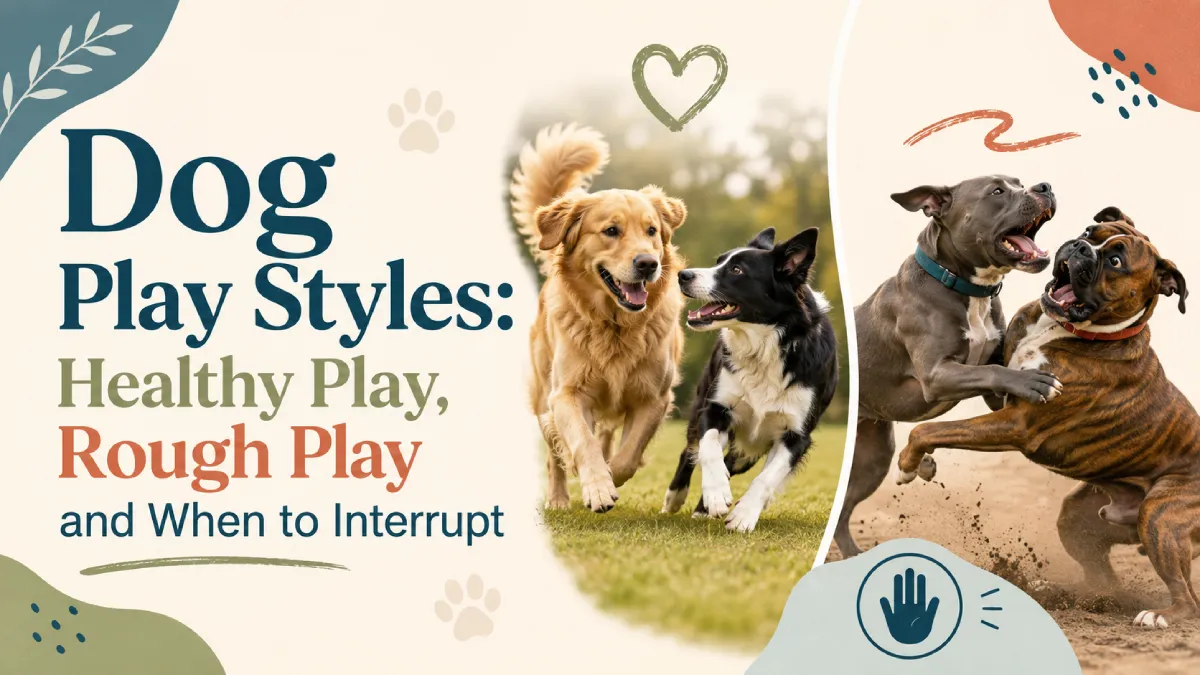
Dog Play Styles: Healthy Play, Rough Play & When to Interrupt
Dog play can look noisy, physical and surprisingly rough without being a fight. Chasing, wrestling, mouth play, body contact and tug may all be normal when both dogs remain comfortable, can pause and choose to re-engage. The most useful signs are not one bark or growl but the overall pattern of body language and whether the interaction remains mutual.
Play styles also differ between individuals. A dog that enjoys wrestling may overwhelm a dog that prefers chase or parallel exploration. Good supervision means noticing when intensity rises, one dog repeatedly tries to leave, or the interaction stops being reciprocal.
Quick Answer
Healthy dog play usually includes loose movement, pauses, role reversal, voluntary re-engagement and opportunities for either dog to move away. Pause the interaction when arousal keeps escalating, one dog repeatedly avoids or hides, body language becomes stiff, or there is a meaningful size or strength mismatch. If a true fight begins, do not put your hands between the dogs.
Why Play Styles Differ
Genetics, age, social history, confidence and individual preference all influence play. Breed tendencies can shape interest in chasing, retrieving or body contact, but they do not predict every dog. VCA recommends tailoring play to the individual dog’s preferences and skills.
Play Bows
A classic play bow places the front of the body low while the rear remains raised. It can invite play or signal playful intent during an interaction. Context matters because one body posture should not be interpreted without the rest of the dog’s behaviour.
Chase
Chase can be healthy when roles switch and the chased dog keeps re-engaging. Concern rises when one dog is consistently pursued, tries to hide or escape, or cannot create distance.
Wrestling
Wrestling can include rolling, pawing and body contact. Look for loose bodies, pauses and self-handicapping rather than assuming all physical contact is aggression.
Mouth Play
Dogs may use open mouths around faces, necks and legs during play. Appropriate mouth play is usually inhibited enough that injury does not occur and the other dog remains willing to participate.
Body Contact
Some dogs enjoy shoulder bumps and body slams. Others find them threatening. Size, age and orthopedic health matter because a playful collision can still injure a smaller or frail dog.
Tug
Dogs can play tug with people or sometimes with each other. Supervise shared-toy play when resource guarding is possible. Build pauses into the game and avoid using the toy to whip dogs into escalating arousal.
Role Reversal
Role reversal is one useful sign of reciprocity. A dog that chases may later become the dog being chased; a stronger dog may spend time underneath during wrestling. Play does not need perfect equality, but repeated one-way interactions deserve attention.
Self-Handicapping
Large, strong or socially skilled dogs may soften their play by slowing down, lying down or reducing force around a smaller partner. The absence of self-handicapping is not automatically aggression, but a large mismatch can increase injury risk.
Pauses
Brief pauses allow dogs to reset and choose whether to continue. During supervision, you can create a short pause by calling dogs apart and rewarding calm behaviour. If both dogs return with loose bodies, that supports the interpretation that play remains mutual.
Re-Engagement
A dog that repeatedly returns after having an easy opportunity to leave is different from a dog that is cornered. Watch what happens after pauses rather than judging only the most dramatic moment.
Loose Body Language
Healthy play commonly includes curved movement, bouncy steps and variable speed. Stiff posture, freezing and prolonged hard staring are more concerning, particularly when followed by escalation.
Escalating Arousal
As play becomes more intense, dogs may bark more, move faster and respond less to interruptions. If they stop taking breaks or the interaction becomes increasingly rough, pause before the situation becomes difficult to manage.
See Signs of an Overstimulated Dog.
One-Sided Interactions
Watch for one dog repeatedly pinning, chasing or body-checking another while the second dog turns away, hides, stays close to people or repeatedly attempts to leave. “They need to work it out” is not a good supervision strategy when one dog is uncomfortable.
Size Differences
Even socially appropriate play can create accidental injury when partners differ greatly in size or strength. Choose compatible partners and use more frequent pauses when needed.
Puppy Play
Puppies are learning social skills and may be clumsy or overly persistent. Match them with suitable play partners and interrupt repeated bullying rather than assuming every interaction teaches good socialization.
Adult Play
Adults often have clearer preferences and may be more selective. A dog that enjoyed dog parks as an adolescent may prefer fewer familiar partners later.
Senior Dogs
Seniors may have less tolerance for impact or persistent puppy behaviour. Protect mobility and provide easy escape routes from younger dogs.
Multi-Dog Households
Household play should be voluntary. Manage valuable toys or tight spaces if they trigger conflict, and provide separate resting areas so dogs can disengage.
Dog Parks
Dog parks are not necessary for every dog. Unknown play partners, size differences and crowded entrances can make supervision difficult. If your dog is uncomfortable or overwhelmed, another type of social or enrichment activity may be better.
When to Pause Play
- arousal rises continuously
- dogs stop taking natural breaks
- one dog keeps trying to leave
- one dog repeatedly hides behind people or furniture
- body movement becomes stiffer
- the dogs stop responding to familiar interruption cues
When to Separate Dogs
Separate when there is escalating stiffness, repeated snapping with avoidance, injury risk, resource guarding or a pattern where one dog cannot escape. Use barriers, leashes or previously trained recalls where safe.
Play Versus Conflict
Growling alone does not distinguish play from conflict. Consider body looseness, reciprocity, pauses, choice and escalation. A veterinarian or qualified behaviour professional can help when interactions are repeatedly difficult to interpret.
Safe Interruption
Practice recall or break cues outside intense play so dogs have a familiar way to pause. Reinforce separation rather than punishing dogs for being called away.
Why Hands Should Not Go Between Fighting Dogs
If dogs are actively fighting, reaching between their heads can result in serious redirected bites. Prioritize human safety, use barriers or remote interruption methods when feasible, and seek professional guidance for recurring conflict.
When Professional Help Is Appropriate
Seek qualified behaviour help if play repeatedly turns into aggression, injuries occur, one dog lives in avoidance, or resource guarding and household conflict are increasing. Use reward-based professionals consistent with AVSAB guidance.
Related Pawnium Guides
Use Consent Checks During Play
A simple consent check can help when you are unsure whether both dogs still want to continue. Briefly call or guide the more intense dog away, creating space without punishment. Watch what the other dog does. If that dog moves back toward the partner with loose body language and restarts play, the interaction is more likely to remain voluntary. If the dog uses the pause to leave, hide, shake off and stay away, extend the break.
This is not a perfect diagnostic test, but it puts choice back into the interaction and gives arousal a chance to drop.
Vocal Play Can Still Be Healthy
Some dogs growl, bark or make exaggerated noises while playing. Vocalization should be interpreted with movement, facial tension, pauses and reciprocity. A noisy wrestling match with loose bodies and frequent breaks may be less concerning than a silent interaction with freezing, hard staring and one dog blocking the other.
Watch the Face and Mouth Without Fixating on Teeth
Open mouths and visible teeth can occur in play. Look for inhibited mouth contact, changing roles and whether both dogs remain willing. Concern rises when biting becomes harder, contact causes injury, the receiving dog repeatedly escapes, or facial and body tension escalates.
Play With Toys Can Change Social Dynamics
A pair of dogs that plays comfortably without objects may become tense around balls, chews or tug toys. Introduce shared toys carefully and remove high-value items if they create guarding. Dogs do not need to share a single toy to have healthy social interactions.
Leashed Play Is Often Awkward
Leashes can restrict normal movement, tangle around legs and prevent dogs from creating distance. Brief on-leash greetings may be appropriate for selected dogs, but wrestling while tethered can increase frustration and injury risk. Use open safe environments for compatible social play rather than encouraging rough play at the end of a tight leash.
Introductions Are Not the Same as Play
When dogs first meet, the goal does not need to be immediate play. Parallel walking, brief sniffing and calm coexistence can be successful outcomes. Forcing interaction because both dogs are “friendly” can create unnecessary social pressure.
Protect Escape Routes
A dog should not have to squeeze past the other dog to leave. Avoid play in narrow hallways, corners, beneath tables or small enclosed spaces when intensity is high. Open space makes voluntary disengagement easier.
When One Dog Is Much Older
Puppies and adolescents may repeatedly solicit play from seniors that would rather rest. Protect the older dog from constant interruption and provide the younger dog with alternative outlets. A senior snapping after repeated ignored warnings should not be treated as the only dog with a problem.
Post-Play Recovery Matters
Observe dogs after social play. Normal recovery may include drinking, resting and returning to usual behaviour. Persistent pacing, irritability, soreness or inability to settle can mean the session was too intense or physically demanding.
Minor Scrapes Still Matter
Even friendly play can cause torn nails, paw injuries or skin wounds. Stop play when an injury occurs and inspect the dog safely. Bite wounds can be deeper than they initially appear and may require veterinary assessment.
Do Not Punish Communication
Growling, moving away and other distance-increasing signals provide useful information. Punishing a dog for communicating discomfort can suppress warning behaviour without making the dog more comfortable. Instead, create space and adjust the interaction.
After a Conflict
Do not immediately force dogs back together to “make up.” Separate them, check for injuries and allow arousal to fall. If conflict is repeated, seek qualified behaviour support before arranging more unsupervised interaction.
A Practical Play-Supervision Routine
- Choose compatible dogs and adequate space.
- Observe the first minute for loose movement and mutual engagement.
- Create brief pauses before intensity becomes extreme.
- Check whether both dogs re-engage voluntarily.
- Remove toys if they create tension.
- End before one dog becomes exhausted or irritated.
- Check recovery and any injuries afterward.
Play Preferences Can Change Over Time
A dog may become more selective with age, after injury or after a negative social experience. Do not force a dog to continue rough play because it enjoyed that style as a puppy. Adjust partners and activities to the dog’s current comfort.
End While Play Is Still Going Well
Stopping before exhaustion or escalation can preserve positive interactions. Call dogs apart, reward calm behaviour and offer water and rest rather than waiting for conflict to end the session.
Check Compatibility, Not Just Friendliness
Two friendly dogs may still have incompatible play preferences. One may want repeated chase while the other prefers brief sniffing and parallel movement. Choose partners whose intensity, size and communication style allow both dogs to participate comfortably.
Compatible play is defined by the dogs’ ongoing choices, not by whether the owners believe both dogs are friendly. Continue supervising even when partners know each other well.
If dogs play frequently, periodically reassess compatibility as puppies mature, adults age or health changes. A previously comfortable wrestling style may become too physical after orthopedic pain, surgery or reduced mobility.
Original Practical Tool
| Feature | Healthy/mutual play | Concerning interaction |
|---|---|---|
| Body looseness | Loose, bouncy, curved movement | Increasing stiffness or freezing |
| Role reversal | Roles change at least sometimes | One dog consistently controls the interaction |
| Pauses | Natural breaks occur | Little or no interruption in intensity |
| Re-engagement | Both choose to return | One avoids or tries to leave |
| Escape opportunities | Both can move away | One is cornered or repeatedly blocked |
| Vocalisation | May occur with loose behaviour | Considered with stiffness and escalation |
| Escalation | Intensity rises and falls | Intensity continuously increases |
| Injury risk | Low and well matched | Size mismatch, impact or biting raises risk |
FAQs
How can I tell if dogs are playing or fighting?
Look at the overall pattern: loose movement, pauses, role reversal and voluntary re-engagement support play. Stiffness, repeated avoidance and escalating one-sided behaviour are more concerning.
Is growling during dog play normal?
It can be. Vocalization alone does not determine whether play is healthy; body language and reciprocity matter.
When should I stop rough play?
Pause when intensity keeps rising, one dog tries to leave, bodies become stiff or dogs stop responding to interruptions.
Can a big dog safely play with a small dog?
Sometimes, but size and strength differences increase accidental injury risk. Choose compatible partners and supervise closely.
Should I put my hands between fighting dogs?
No. Reaching between actively fighting dogs can result in serious redirected bites.


