
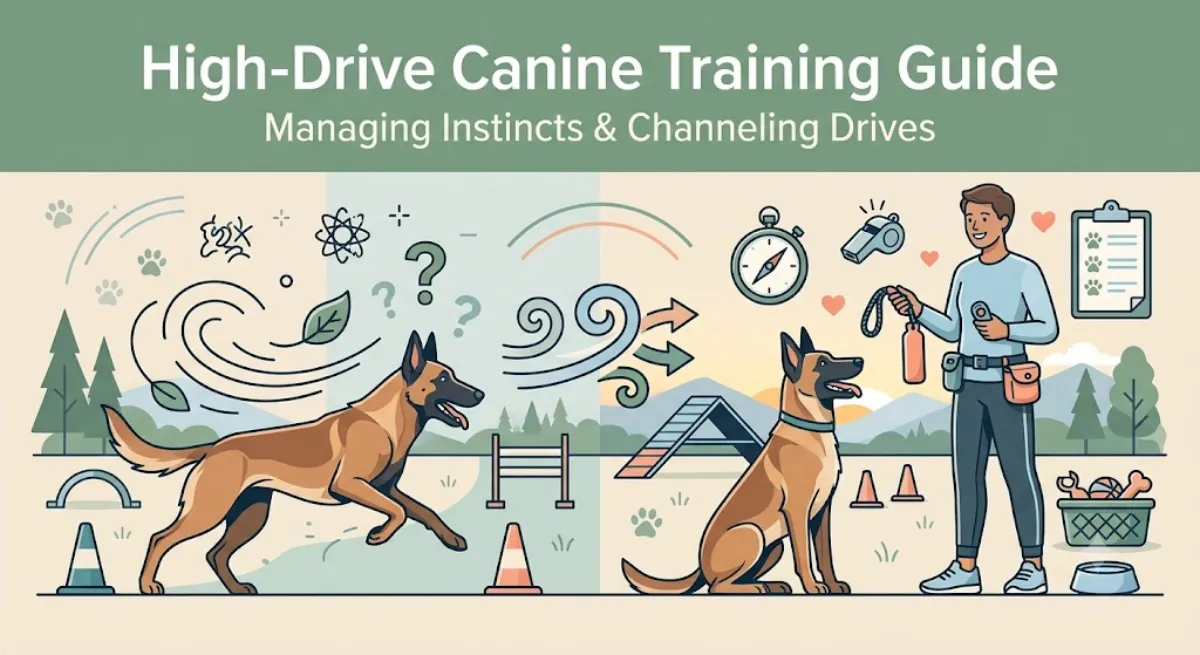
Managing a High Drive Dog Without Creating More Arousal
Managing a High Drive Dog: Exercise, Enrichment, Training and Rest
A high-drive dog can be intensely motivated to chase, retrieve, search, herd, tug, work or repeat a task long after the average companion dog would stop. The solution is not simply to “tire out” the dog with more running. Repeated intense exercise can improve physical fitness while leaving the dog just as motivated—and sometimes harder to settle.
A better routine combines appropriate physical work with scenting, training, breed-relevant outlets, free exploration, calmness skills, sleep and recovery. Drive is also individual: breed history can suggest likely interests, but one dog may love retrieval while another of the same breed prefers scent work or social interaction.
Quick Answer
Managing a high-drive dog requires balance, not exhaustion. Provide purposeful physical exercise, scent work, reward-based training and appropriate outlets, then deliberately include quiet time, settle skills, sleep and recovery. Track which activities improve focus and recovery instead of continually increasing duration or intensity whenever the dog appears energetic.
What “Drive” Means
Drive is an informal term often used for strong motivation toward a category of behaviour, such as chasing, retrieving, searching or engaging with a toy. It is not a veterinary diagnosis or standardized energy score.
Drive Versus General Activity
A dog can be physically active without showing intense task motivation, and a high-drive dog can appear calm when no relevant trigger is present. Distinguish general restlessness from focused motivation.
Breed Tendencies Versus Individuals
Herding, hunting, retrieving and terrier histories can suggest activities a dog may enjoy. AAHA encourages realistic expectations around breed-related behaviour while emphasizing individual needs. Do not force a dog into a sport simply because the breed is known for it.
Physical Exercise
High-drive dogs often enjoy substantial physical activity when healthy and conditioned. Walking, running, swimming, hiking, retrieval and dog sports may be options, but intensity should be built gradually and matched to weather and medical status.
Why More Exercise Is Not Always the Solution
If a dog becomes fitter, the same run may stop being challenging. Adding distance every time the dog has energy can create a cycle of increasing conditioning without teaching disengagement. Restlessness may also come from frustration, anxiety, pain, adolescence or lack of sleep rather than insufficient exercise.
Fitness Adaptation
The body adapts to repeated workload. That is useful for sport dogs but important for pet owners to understand. A program designed only to produce exhaustion can keep escalating as the dog’s endurance improves.
Scent Work
Searching and scent games can provide purposeful mental work with different physical demands from sprinting. Use Scent Games for Dogs and Sniff Walks for Dogs.
Training
Reward-based skill training can channel motivation into useful behaviours: recalls, object searches, targeting, cooperative handling or sport foundations. AVSAB recommends reward-based methods rather than aversive equipment.
Food Enrichment
Foraging and puzzle feeding can add mental work, but calories count. Use part of normal meals when practical and avoid food activities that trigger resource guarding or destructive ingestion.
Controlled Tug
Tug can be valuable for toy-driven dogs when there are clear start, release and pause skills. The goal is controlled engagement, not pushing arousal until the dog cannot disengage.
Retrieval
Retrieval can satisfy strong toy or carrying motivation, but repetitive high-speed fetch creates sprinting, turning and stopping load. Blue Cross recommends avoiding endless repetitions that dogs may continue beyond sensible limits.
Breed-Appropriate Outlets
Appropriate outlets might include scent work for dogs that love searching, controlled retrieval for retrievers, digging areas for terrier-type behaviour or structured herding/sport activities with qualified instruction. “Breed appropriate” should still mean safe for the individual.
Structured Walks
A steady walk can support physical conditioning and training. Not every walk needs to become a high-intensity workout. Use Dog Walking Schedule to balance purposes across the day.
Sniff Walks
Slower exploration can add choice and sensory engagement to a routine dominated by tasks. Let the dog investigate safe scents without claiming a fixed sniffing-to-running equivalence.
Calmness
Calmness is a skill and an environmental state, not merely the absence of energy. Reinforce quiet behaviour throughout the day rather than asking for stillness only after the dog is exhausted.
Settle Training
Use How to Teach a Dog to Settle to build voluntary relaxation. Do not force body position or punish the dog for getting up.
Rest
Plan lower-intensity periods just as deliberately as training. A dog that constantly receives stimulation may never practice switching off.
Sleep
Protect undisturbed sleep. A dog that becomes increasingly mouthy or frantic late in the day may be tired or overstimulated, not necessarily asking for another workout.
Recovery
After hard running, hiking or sport, check movement, appetite, energy and willingness to exercise the next day. See Do Dogs Need Rest Days?.
Overstimulation
High-drive dogs can become highly aroused around toys, movement and busy environments. Frantic behaviour and poor cue response can mean the session has gone beyond useful engagement. See Signs of an Overstimulated Dog.
Trigger Stacking
A busy walk, training class, visitors and intense play may each be manageable alone but difficult when combined closely. Plan recovery between demanding events.
Adolescence
Adolescence can amplify apparent energy because physical capability increases before mature impulse control is established. Use management and training rather than assuming the dog needs unlimited exercise.
Working Dogs
Actual working dogs may have job-specific conditioning and recovery needs. Their plan should reflect task, environment, heat exposure and veterinary sports-medicine input where appropriate.
Sport Dogs
Sport dogs benefit from conditioning specific to their activity, warm-up and recovery. Recreational pet routines should not copy elite sport workloads without preparation.
Household Routine
Predictable meal, activity, training and rest periods can help a high-energy dog understand when engagement is available and when the household is quiet.
Destructive Behaviour
Destruction may reflect unmet outlets, but also separation distress, anxiety, pain, adolescence or learned behaviour. Do not automatically prescribe harder exercise. Use Signs of a Bored Dog to consider other causes.
Behaviour Evaluation
If arousal, aggression, compulsive behaviour or inability to settle significantly disrupts daily life, seek qualified behaviour help. Track triggers, recovery and the activities that precede difficult episodes.
Medical Rule-Outs
Sudden restlessness, increased activity, sleep changes or altered behaviour can occur with medical problems. Veterinary assessment is appropriate when behaviour changes unexpectedly or is accompanied by physical signs.
Example Balanced Routine
| Part of day | Possible focus |
|---|---|
| Morning | Purposeful walk or training plus sniffing |
| Midday | Meal-based foraging or short scent work |
| Afternoon | Rest/sleep |
| Evening | Controlled play or skill training, then calm settle period |
| After demanding activity | Recovery-focused day or lighter session as needed |
This is an example balance, not a universal timetable.
Related Pawnium Guides
- How Much Exercise Does a Dog Need?
- Dog Enrichment Ideas
- How to Teach a Dog to Settle
- Signs of an Overstimulated Dog
- Do Dogs Need Rest Days?
What High Drive Is Not
High drive is not the same as anxiety, hyperactivity or an inability to rest. A driven dog may show exceptional focus around a toy, scent or task yet relax normally at other times. Conversely, a restless dog may have fear, pain, poor sleep or frustration without strong task motivation.
Identify the Dog’s Strongest Motivators
Watch what the dog repeatedly chooses. Some dogs work intensely for toys, others for scent, food, access to movement or social interaction. Knowing the strongest motivators helps you build training and enrichment around activities that are meaningful rather than simply physically exhausting.
Use Drive as Reinforcement
Access to tug, retrieval or sniffing can reinforce trained behaviour. Ask for a brief recall, release or check-in, then return the dog to the valued activity. This channels motivation without trying to suppress it.
Build Skills Around Starting and Stopping
High-drive dogs benefit from clear transitions: start a game, pause, release the toy, re-engage and finish. Stopping should be trained gradually, not introduced only after the dog is over-aroused.
Weekly Load Planning
Look at the entire week. Several hard sport sessions, daycare, long runs and weekend hiking can stack physical and arousal load even if each event seems reasonable alone. Place recovery and lower-intensity work between demanding sessions.
High-Drive Puppies
Energetic puppies should not be conditioned like adult sport dogs. Use short training, exploration, age-appropriate play and sleep. Avoid repetitive forced running or jumping simply because the puppy appears tireless.
High-Drive Adolescents
Adolescents often combine increasing physical ability with immature impulse control. Predictable routines, reinforcement for disengagement and appropriate outlets can be more productive than increasing exercise after every difficult behaviour.
The “Off Switch” Is Not Just Obedience
A dog can lie on a mat while remaining tense and hyper-focused. True recovery also requires an environment where the dog can sleep, move away from stimulation and stop anticipating the next task. Settle training supports this, but household routine matters too.
Competitive Sport Versus Pet Life
Sport training has specific conditioning goals, while a companion dog’s routine must also fit family life. Do not copy an elite working-dog schedule simply because your dog shares a breed or shows enthusiasm for the same activity.
Signs the Routine May Be Too Intense
- persistent stiffness or lameness
- increasing inability to settle after activity
- sleep disruption
- declining performance despite more training
- irritability or avoidance around equipment
- repeated paw or nail injuries
These signs may have medical or behavioural causes and should not automatically be called “overtraining.”
Heat and Driven Dogs
Highly motivated dogs may continue working despite heat. Monitor conditions, breathing, gait and responsiveness rather than waiting for the dog to stop voluntarily. Brachycephalic, overweight and cardiopulmonary-compromised dogs need additional caution.
Use Different Kinds of Work
| Need/outlet | Possible activity | Balancing element |
|---|---|---|
| Physical conditioning | Appropriate walk, run, hike or sport | Recovery and gradual progression |
| Search motivation | Scent games or sniff walks | Calm end cue and rest |
| Toy drive | Controlled tug or retrieval | Release, pauses and limited repetitions |
| Cognitive work | Reward-based skill training | Short sessions and clear finish |
| Foraging | Meal-based puzzle/search | Calorie accounting |
Use Recovery Data, Not Guesswork
Track stiffness, appetite, sleep, energy, movement and arousal after demanding sessions. A dog that consistently takes longer to recover from one activity may need less intensity, better conditioning or medical assessment.
When High Drive Masks Pain
A motivated dog may continue fetching or working with a minor injury. Check gait and body use rather than assuming continued participation proves comfort. Sudden performance changes, lameness or reluctance to perform a familiar movement deserves veterinary evaluation.
Household Boundaries Are Compatible With Drive
A dog can have strong outlets without controlling every household transition. Teach waiting at doors, releasing toys, resting during meals and responding to recall through reinforcement. Structure should help the dog succeed, not rely on intimidation.
Managing Drive Around Children or Vulnerable Adults
Use barriers and controlled routines when high-speed play or toy fixation could knock someone over. Do not expect a child to manage an intensely motivated dog during tug, retrieval or doorway excitement.
Multi-Dog Homes
Separate high-value training and food enrichment when competition is possible. One dog’s drive can monopolize toys or handler attention, so individual sessions may provide better learning and reduce conflict.
When Professional Support Is Appropriate
Seek veterinary advice for sudden behaviour or exercise changes and qualified behaviour support when drive-related arousal becomes unsafe, aggression occurs, or the dog cannot disengage around ordinary household triggers. For sport goals, a veterinary rehabilitation or sports-medicine professional can help with conditioning.
What Success Looks Like
A balanced high-drive dog does not need to become low energy. Success means the dog has safe, satisfying outlets, can work with focus, can disengage when the activity ends and receives enough recovery to remain physically and behaviourally healthy.
Protect Recovery After High-Value Work
Dogs can remain physiologically and behaviourally activated after sport, intense tug or repeated retrieval. Build a predictable transition: easy walking, water, quiet environment and undisturbed rest. Avoid immediately stacking another stimulating event because the dog still looks eager.
Separate Physical Fitness From Behaviour Goals
If the goal is calmer behaviour around visitors, running farther may have little direct effect. Train the visitor routine itself while separately meeting exercise needs. This prevents owners from trying to solve every behaviour challenge through conditioning.
Track What Produces Useful Fatigue
Useful activity should leave the dog able to recover and participate normally later. Record which activities improve focus and settling and which produce soreness or frantic behaviour. Use those patterns to adjust the balance planner.
Keep Expectations Realistic
A high-drive dog may always be highly motivated. Management is not about removing drive. The practical goal is a dog with appropriate outlets, reliable skills, safe physical conditioning and enough recovery to live comfortably in the household.
Balance Motivation With Physical Capacity
Drive can make a dog ask for more work than the body is prepared to perform. This is particularly important after time off, injury or seasonal inactivity. Rebuild conditioning gradually even when motivation returns immediately.
Use Rest as Part of Training, Not a Reward Withdrawal
Quiet periods should not feel like the dog has lost access to everything valued. Provide a comfortable predictable environment where nothing is demanded, and reinforce calm choices during ordinary life. Recovery becomes part of the routine rather than something imposed only after the dog is exhausted.
Reassess the Plan When Behaviour Changes
A routine should evolve with age, health, sport demands and household changes. If a previously manageable dog becomes suddenly restless, irritable or exercise-intolerant, investigate medical and environmental causes before adding more work.
A sustainable plan should make the dog easier to live and work with without requiring daily exhaustion.
Review the balance planner every few weeks and after any major change in health, work or household routine.
Original Practical Tool
| Routine area | Current plan | Dog response | Adjustment |
|---|---|---|---|
| Physical exercise | |||
| Sniffing/free exploration | |||
| Scent work | |||
| Training | |||
| Food enrichment | |||
| Breed-appropriate outlets | |||
| Calm activities | |||
| Sleep | |||
| Recovery |
Use the planner to balance categories. Do not score the dog’s “energy level” or assign a fixed minutes requirement.
FAQs
How do you tire out a high-energy dog?
Do not make exhaustion the main goal. Combine appropriate physical work with scenting, training, breed-relevant outlets, calmness, sleep and recovery.
Does a high-drive dog need more exercise than other dogs?
Often these dogs enjoy substantial purposeful activity, but the appropriate amount still depends on health, fitness, age and the type of work.
Why does my dog get fitter but not calmer?
Repeated intense exercise improves conditioning. If the routine lacks calmness skills, mental work and recovery, endurance may rise without changing home behaviour.
What is good enrichment for working breeds?
Choose activities that fit the individual—scent work, retrieval, controlled tug, training, exploration or sport foundations may be useful depending on preference and health.
Can a high-drive dog learn to settle?
Yes. Calm behaviour can be trained and reinforced independently of physical exhaustion.