
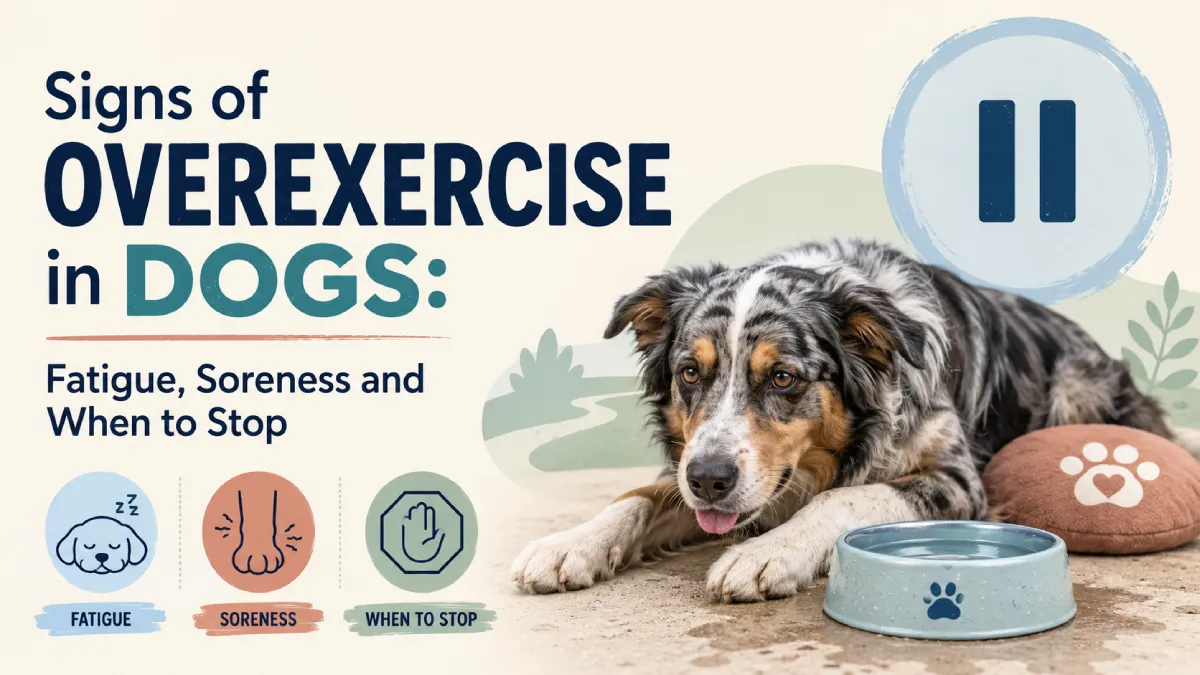
Signs of Overexercise in Dogs: Fatigue, Soreness & When to Stop
Exercise should leave a dog appropriately tired, not unable to move comfortably or recover. Warning signs can appear during activity—slowing, lagging, refusing to continue, abnormal gait or excessive panting—or afterward as stiffness, soreness, paw injury and unusual fatigue.
The same signs can also occur with heat illness, orthopedic injury, heart or lung disease and other medical problems, so “overexercise” should not be used as a diagnosis. What matters most is recognizing when to stop, allow recovery and seek veterinary help.
Direct Answer
Stop or reduce exercise when a dog is repeatedly slowing, lagging, refusing to continue, moving abnormally, panting excessively for the conditions, or showing stiffness or unusual fatigue. Significant lameness, severe weakness, confusion, collapse or breathing difficulty is more concerning and may require urgent veterinary care rather than simple rest at home.
Normal Tiredness Versus Concerning Fatigue
A normally tired dog should recover toward its usual breathing, movement and behaviour after activity. Concerning fatigue is disproportionate, prolonged, associated with abnormal movement or accompanied by weakness, vomiting, confusion or respiratory difficulty.
Slowing Down
Changing from an eager pace to persistent slowing can be an early sign that the current workload is no longer comfortable. Consider terrain, heat, humidity and how far the dog still has to travel back.
Lagging Behind
A dog that usually walks beside or ahead of you but begins trailing may be fatigued, overheated or painful. Do not keep increasing leash pressure to force the original pace.
Refusing to Continue
Stopping, lying down or turning home can be meaningful information. Fear and environmental stress can also cause refusal, so evaluate context rather than assuming laziness.
Excessive Panting
Panting is normal during activity, but intensity and recovery matter. Cornell lists heavy panting and drooling among heat-related warning signs, with weakness, confusion, vomiting, seizures and collapse indicating more serious heat illness.
Stiffness and Soreness
Stiffness after demanding exercise may reflect muscle fatigue, orthopedic strain or underlying arthritis. Recurrent stiffness deserves evaluation, particularly in seniors and dogs that recently increased activity.
Limping
Limping is not normal exercise fatigue. Stop the activity and check for obvious paw injuries, but avoid repeatedly manipulating a painful limb. Persistent or significant lameness warrants veterinary assessment.
Paw-Pad Injury
Hot surfaces, ice, rough terrain and long distances can injure paw pads. Check for abrasions, cracks, burns, bleeding or foreign material. Prevent further walking on an injured pad when possible.
Muscle Injury Considerations
Sudden sprinting, slipping or unfamiliar intense activity can strain muscle or soft tissue. Pain may not be obvious while the dog is highly aroused. New reluctance to move or be handled afterward is a reason to slow down and seek advice.
Heat-Related Signs
Heat risk depends on humidity, sun, surface temperature, body condition, coat, airway anatomy, fitness and intensity—not one air-temperature cutoff. Brachycephalic, overweight, older and cardiopulmonary-compromised dogs are at higher risk.
Dehydration
Exercise and heat increase water needs, but dehydration cannot be reliably judged by one home sign. Provide regular water opportunities and take persistent weakness or illness seriously.
Vomiting
Vomiting during or after strenuous activity can occur with heat illness and other medical problems. Repeated vomiting, especially with weakness or abnormal breathing, is not a normal training response.
Weakness and Collapse
Marked weakness or collapse is a red flag. Stop activity and seek urgent veterinary assessment. Do not assume the dog simply “ran too hard” when a serious heat, cardiac, respiratory or neurologic problem could be present.
Puppies
Puppies need activity but should not be pushed through repetitive forced exercise because they appear energetic. Development, surfaces, free play, fatigue and recovery all matter.
Senior Dogs
Seniors may fatigue sooner because of arthritis, muscle loss or chronic disease. A sudden decline in stamina is not an inevitable part of aging and deserves assessment.
Overweight Dogs
Excess body condition increases workload and heat risk. Weight-management exercise should be progressed carefully rather than using long intense sessions as a rapid-calorie strategy.
Brachycephalic Dogs
Short-nosed dogs may have structural airway limitations and difficulty cooling. Increased noise, breathing effort or exercise intolerance should not be normalized because of breed appearance.
Heart or Lung Disease
Dogs with diagnosed cardiopulmonary disease need activity plans from their veterinary team. Coughing, fainting, exercise intolerance or breathing difficulty requires appropriate medical evaluation.
Sudden Activity Increases
A dog can be enthusiastic without being conditioned. Increase running, hiking and sport work gradually. Fitness in one activity does not guarantee readiness for another movement pattern.
The Weekend-Warrior Pattern
Long inactive weekdays followed by an intense weekend hike can exceed current conditioning. Build regular baseline activity and scale special outings to what the dog has actually practiced.
Starting a New Hiking or Running Routine
Change one variable at a time—distance, speed, elevation or surface—rather than increasing everything together. Check recovery later that day and the next day.
Rest and Recovery
A lighter day may be appropriate after unusually hard exercise. See Do Dogs Need Rest Days? for individualized recovery planning.
When Veterinary Assessment Is Needed
Seek veterinary advice for persistent lameness, repeated stiffness, ongoing fatigue, declining exercise tolerance or pain. A veterinarian may need to rule out orthopedic, cardiopulmonary, neurologic or systemic disease.
Seek Urgent Veterinary Care If…
- the dog collapses
- there is severe breathing difficulty
- the dog is confused or poorly responsive
- there is severe weakness
- significant lameness prevents normal weight bearing
- heatstroke is suspected
Prevention
Match exercise to current conditioning, choose appropriate weather and surfaces, carry water when needed, include recovery and stop before the dog reaches severe fatigue. Do not use excitement as the only measure of readiness.
Related Pawnium Guides
What Overexercise Can Look Like the Next Day
Not every problem appears during the activity. The following morning, a dog may rise slowly, hesitate on stairs, shorten the stride, resist jumping into the car or show less interest in a normal walk. These changes deserve attention even if the dog seemed enthusiastic the previous day.
Medical Problems Can Mimic “Too Much Exercise”
Exercise intolerance can occur with orthopedic pain, heart disease, respiratory disease, anemia, infection and other conditions. A dog that repeatedly becomes exhausted during previously easy activity should not simply have the schedule reduced indefinitely without veterinary investigation.
What Not to Do
- do not force a limping dog to “walk it off”
- do not give human painkillers
- do not continue exercise to hit a distance target
- do not use excitement as proof the dog is physically fine
- do not cool a collapsed or severely ill dog and then skip veterinary care
Heat-Related Exercise Needs Faster Escalation
When heat illness is possible, weakness, confusion, collapse, seizures or severe breathing difficulty should be treated as an emergency. Move the dog out of the hot environment and contact emergency veterinary care. Do not delay transport because the dog appears to improve briefly.
Returning to Activity After Mild Fatigue
If the dog simply had an unusually demanding day and returns fully to normal with rest, restart with a familiar lower workload. Avoid immediately repeating the same long distance or intense fetch session. If fatigue recurs, reassess conditioning and health.
Exercise Context Comparison
| Context | Common overload factor | What to monitor |
|---|---|---|
| Long walk | Duration, heat, hard surface | Pace, paw condition, next-day stiffness |
| Fetch | Repeated sprint/turn cycles | Movement quality, arousal, lameness |
| Run | Speed and repetitive impact | Gait, breathing, recovery time |
| Hike | Elevation, uneven terrain, return distance | Paws, willingness, hydration, gait |
| Hot-weather outing | Humidity, sun, airway limits | Heavy panting, weakness, confusion |
Use a Training Log Instead of Memory
Record activity type, duration or route, weather, surface and recovery. The purpose is not to calculate a perfect threshold. It is to notice whether problems consistently follow one kind of exercise or a sudden increase in workload.
Paw and Nail Checks After Demanding Activity
Inspect pads, nails and between the toes after rough trails or long outings. Foreign material, torn nails and pad damage can make a dog look generally “sore after exercise” when the discomfort is localized to the feet.
When a Rehabilitation Professional May Help
Dogs returning from orthopedic injury, major surgery or chronic mobility problems may benefit from a veterinarian with rehabilitation or sports-medicine expertise. Conditioning can then be progressed around the diagnosed problem rather than by trial and error.
Watch the Dog During the Return Half of an Outing
Owners often notice fatigue only after reaching the farthest point of a route. Plan hikes and walks so the dog still has enough capacity to return comfortably. Turn around before the dog is visibly exhausted rather than using exhaustion as the turnaround signal.
Excitement Can Hide Warning Signs
Ball-focused, hunting or sporting dogs may remain highly motivated despite rising heat or soreness. Cornell’s work with sporting dogs reinforces that drive can compete with self-preservation. Owners therefore need to monitor breathing, gait and conditions rather than relying only on willingness to continue.
Overexercise Is Not a Fitness Test
Do not deliberately push a dog until it slows down to discover its “limit.” Conditioning should build from successful work below the point of distress. A safe progression produces adaptation without needing severe fatigue as feedback.
Consider the Whole Week
Exercise load can accumulate. A long run, active daycare and weekend hike may each seem reasonable in isolation but create little recovery when scheduled close together. Review the weekly pattern when stiffness or fatigue keeps returning.
Emergency Signs Are Not Home-Recovery Signs
Collapse, severe weakness, altered awareness, seizures or significant breathing difficulty require urgent veterinary care. Do not wait for a recovery tracker to show a trend before acting on these signs.
Do Not Ignore Repeated Minor Warning Signs
A single slow evening after unusual activity may resolve normally, but repeated mild stiffness, recurring paw soreness or consistent lagging deserves attention. Small signs that return after the same workload can indicate that the exercise plan is exceeding current conditioning or that an underlying problem needs assessment.
Dogs Returning After a Break Need a New Baseline
After illness, surgery, winter inactivity or several quiet weeks, start below the dog’s previous workload. Enthusiasm can return faster than conditioning. Increase gradually and watch the following day for stiffness or fatigue.
Conditioning Should Be Specific to the Goal
A dog prepared for steady walking may not be prepared for repeated sprinting, and a swimmer may still struggle with steep hiking. Build the movement pattern the dog will actually perform and progress it gradually.
Use Veterinary Guidance for Repeated Exercise Intolerance
If a dog repeatedly cannot complete ordinary activity that was previously comfortable, a veterinary examination is appropriate. Heart, lung, orthopedic and systemic conditions can all reduce stamina, and home exercise changes cannot identify the cause.
Use the First Warning Sign as Information
You do not need to wait for collapse or severe lameness before changing the plan. Repeated slowing, longer recovery or mild stiffness can justify a lower workload and closer monitoring. Early adjustment is safer than deliberately pushing until the dog reaches a clear physical limit.
When in doubt, stop the demanding activity early and reassess rather than using severe fatigue as the endpoint of a successful session.
Owners should also review footwear and surface conditions where relevant: rough ground, hot pavement, ice and repetitive hard-surface work can contribute to discomfort even when total distance appears modest.
Original Practical Tool
| Zone | What you may observe | Action |
|---|---|---|
| Green | Comfortable movement, normal responsiveness, normal recovery | Continue while monitoring conditions. |
| Yellow | Slowing, longer recovery, mild stiffness, unusual fatigue | Reduce or stop activity; reassess recovery and workload. |
| Red | Collapse, severe breathing difficulty, significant lameness, confusion, severe weakness | Stop immediately and seek urgent veterinary care. |
This chart supports triage; it does not diagnose the cause.
FAQs
How can I tell if my dog is just tired or overexercised?
Normal tiredness improves with reasonable rest. Persistent stiffness, abnormal gait, unusual fatigue or slow recovery is more concerning.
Why is my dog sore after a long walk?
Possible causes include deconditioning, soft-tissue strain, paw injury or underlying orthopedic disease. Recurrent soreness deserves veterinary assessment.
Should I walk a dog that is limping after exercise?
Do not continue normal exercise on a painful limb. Significant or persistent lameness should be assessed.
Can too much fetch hurt a dog?
Repeated sprinting, sharp turning and sudden stopping can create substantial physical load, especially when performed to exhaustion.
When is exercise fatigue an emergency?
Collapse, severe breathing difficulty, confusion, seizures or severe weakness requires urgent veterinary care.