
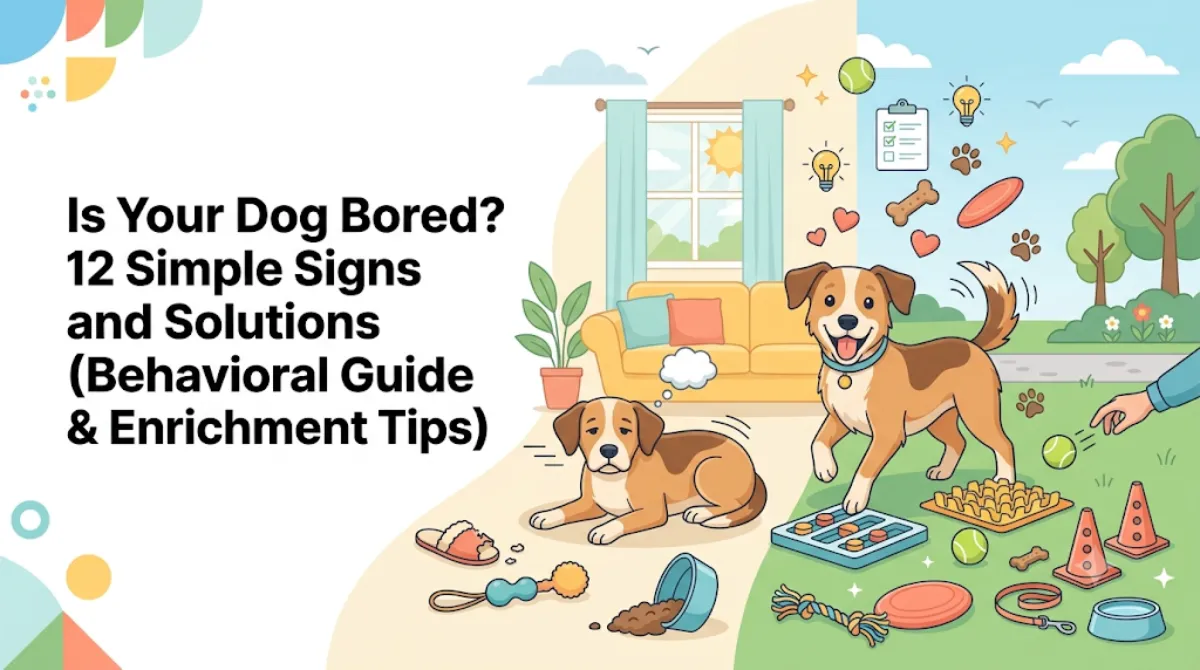
Signs of a Bored Dog: Behavioural Clues and Enrichment Solutions
Signs of a Bored Dog: Behaviour Clues and Better Enrichment
Destructive chewing, barking, digging, stealing objects and restlessness are often described as signs of a bored dog, but behaviour alone cannot prove boredom. The same patterns can occur with anxiety, fear, adolescence, pain, lack of sleep, separation-related distress, frustration or learned behaviour.
A better approach is to look at when the behaviour happens, what the dog’s daily routine contains and whether adding appropriate physical, cognitive or sensory activity changes the pattern. If behaviour appears suddenly, is severe or occurs with physical changes, veterinary assessment should come before assuming the dog simply needs more entertainment.
Quick Answer
Possible boredom clues include repeated object stealing, destructive chewing, digging, attention seeking, scavenging and restlessness when the dog has few appropriate outlets. These behaviours are not diagnostic. Compare exercise, enrichment, sleep, social contact and context, then rule out anxiety, pain and separation-related problems when the pattern does not fit simple understimulation.
What Boredom Means
Boredom is an unpleasant state associated with insufficient or unvarying stimulation and lack of opportunity to engage in rewarding behaviour. In dogs, it is inferred from context and behavioural patterns rather than confirmed by one symptom.
Why Behaviour Alone Cannot Prove Boredom
A dog that chews the door only when left alone may have a different problem from a dog that shreds cardboard while people are present. A dog pacing because of abdominal discomfort needs medical attention, not a more difficult puzzle feeder.
Destructive Chewing
Chewing can be normal, particularly in young dogs, but destruction may increase when suitable outlets are limited. Provide safe, appropriate chew options while considering whether anxiety, teething, dietary issues or pain contribute.
Digging
Digging can be intrinsically rewarding and common in some breed types. Rather than assuming every hole indicates boredom, look at location, triggers and whether a designated digging area can provide a suitable outlet.
Barking
Barking has many functions: alerting, frustration, fear, social communication and attention seeking. More exercise is not a universal cure. Identify what happens immediately before and after the barking.
Attention Seeking
Repeated pawing, nudging or bringing objects may occur because the dog has learned it works. Enrichment can help, but so can teaching predictable times for interaction and reinforcing calm independent behaviour.
Restlessness
Restlessness can reflect understimulation, but also pain, nausea, anxiety or high arousal. If a dog cannot settle even after a balanced day, consider the whole health and behaviour picture.
Stealing Objects
Dogs may steal socks or household objects because carrying and chewing are rewarding or because people chase them. Prevent access to unsafe items and reinforce exchanges rather than turning stealing into a repeated game.
Scavenging
Food seeking is normal canine behaviour. Safe foraging opportunities can provide an outlet, but persistent scavenging can also be shaped by access to rewarding rubbish or human food.
Repetitive Behaviour
Repeated pacing, spinning or licking should not be casually labelled boredom. Repetitive behaviour can have medical or behavioural causes and deserves professional assessment when persistent.
Breed Tendencies
Breed history can suggest preferred outlets such as digging, scenting, retrieving or herding-style tasks, but individuals vary. Use tendencies to generate ideas, not to prescribe one routine for every dog of a breed.
Adolescence
Young dogs often show increased exploration, chewing and inconsistent impulse control. A richer routine can help, but age-appropriate management and training are also necessary.
Lack of Physical Activity
Some dogs simply need more suitable movement than they are getting. Assess the current routine against age, fitness and health rather than applying one daily-minutes target.
Lack of Cognitive Activity
Dogs can receive long walks yet have few opportunities to learn, search or solve problems. Reward-based training and scent work can add cognitive variety without always increasing physical intensity.
Anxiety Versus Boredom
Anxious behaviour often includes specific triggers, avoidance, vocalization, destruction near exits or difficulty eating when distressed. Boredom and anxiety can coexist, but enrichment alone should not be presented as treatment for an anxiety disorder.
Separation-Related Behaviour
Destruction or vocalization that occurs specifically during absences deserves separate evaluation. Do not “exercise the dog harder” before leaving as the sole response.
Pain and Medical Causes
Pain can cause restlessness, irritability and changes in sleep or activity. A sudden new behaviour, reduced mobility, appetite change or sensitivity to touch should be discussed with a veterinarian.
Build a Better Routine
Exercise
Use How Much Exercise Does a Dog Need? to individualize movement rather than relying on one breed formula.
Mental Enrichment
Training, puzzle tasks and simple problem solving can help dogs that have little cognitive variety. See Dog Enrichment Ideas.
Sensory Enrichment
Sniff walks and search games can provide a different form of engagement from running or fetch.
Food Enrichment
Use part of the dog’s normal meal in food puzzles or scatter feeding when appropriate. Calories still count, and food games are not suitable for every dog.
Training
Reward-based training can teach useful alternatives to attention-seeking or object stealing while providing interaction.
Rest
Do not schedule activities continuously. Lack of sleep and overstimulation can make a dog look more restless, not less.
Sample Enrichment Rotation
| Day | Main variation | Calm component |
|---|---|---|
| Monday | Sniff-focused walk | Quiet chew or rest |
| Tuesday | Short training and food search | Settle practice |
| Wednesday | Normal walk plus toy play | Long rest period |
| Thursday | Indoor scent game | Calm observation |
| Friday | Novel quiet route | Sleep/recovery |
Use this as an example of variety, not a mandatory schedule.
When Professional Help Is Useful
Seek veterinary or qualified behaviour support when behaviour is sudden, severe, causes injury, appears linked to absences or fear, or does not improve when the routine becomes more balanced.
Related Pawnium Guides
- Dog Enrichment Ideas
- Indoor Activities for Dogs
- Managing a High-Drive Dog
- Signs of an Overstimulated Dog
Create a Behaviour Baseline Before Changing Everything
For several ordinary days, record when chewing, barking, stealing or restlessness occurs and what the dog was doing beforehand. Also record walks, training, sleep and time alone. This provides a baseline so you can tell whether a routine change actually helps.
Behaviour While Alone Versus While People Are Home
Timing is especially important. Destruction that happens only after everyone leaves may point toward a different problem from chewing that occurs during long quiet evenings with the family present. Separation-related distress can involve vocalization, pacing, house-soiling or attempts to escape, and deserves specific assessment.
Pet Cameras Have Limits
A camera can reveal when behaviour begins and whether the dog settles during absences, but it cannot diagnose boredom or anxiety. Video is most useful as context to share with a veterinarian or qualified behaviour professional.
Multi-Dog Homes Can Still Have Bored Dogs
Another dog does not automatically provide adequate enrichment. Housemates may sleep separately, compete over resources or have different play preferences. Each dog still needs suitable individual outlets and opportunities to rest without interruption.
Match Enrichment to Preference
A dog that ignores puzzle toys may love scent work. A dog that becomes over-aroused by fetch may settle well after a sniff walk. Rotate categories and record what actually improves engagement rather than assuming the most complicated activity is best.
Use One Change at a Time
If you simultaneously double walk duration, add daycare, introduce three puzzles and start a new training class, you will not know which change influenced behaviour. Make one or two manageable adjustments and observe for a reasonable period.
Do Not Fill Every Quiet Moment
A dog lying down is not necessarily bored. Rest is part of a healthy routine. Constantly presenting toys and activities can teach a dog to expect human entertainment whenever awake.
When Food Enrichment Backfires
Food games may be inappropriate when the dog guards the toy, destroys and swallows it, has a restricted diet or becomes frantic when food is difficult to access. Use non-food enrichment or professional guidance rather than insisting that food puzzles are necessary.
Boredom and Overstimulation Can Coexist
A dog can have an unvaried daily life yet become overwhelmed during occasional intense events. The answer is not simply “more stimulation.” Aim for a predictable balance of appropriate activity, novelty, calmness and recovery.
Breed-Typical Outlets as Ideas, Not Prescriptions
Retrieving, scenting, digging, carrying and herding-related tendencies can suggest activities. A retriever does not have to enjoy fetch, and a terrier does not need uncontrolled digging. Offer safe choices and follow the individual dog’s response.
When Destruction Is Dangerous
Chewing electrical cords, swallowing fabric, destroying doors or ingesting household material requires immediate management because injury can occur regardless of the cause. Restrict access safely while the underlying behaviour is assessed.
Medical Changes That Can Look Like Behaviour Problems
Pain, gastrointestinal discomfort, skin disease, urinary problems and cognitive changes can alter sleep, movement and restlessness. New behaviour in a previously settled dog deserves a health review, especially when it appears with appetite, toileting or mobility changes.
How to Evaluate a New Enrichment Plan
Ask whether the dog engages willingly, can stop without distress, shows fewer problematic patterns in the relevant context and continues to sleep and recover normally. A successful plan should improve the dog’s overall routine, not simply make the dog physically exhausted.
When a Trainer or Behaviourist Is Useful
Seek qualified support when behaviour involves aggression, severe destruction, separation distress, compulsive patterns or major household disruption. Choose professionals who use reward-based methods and coordinate with veterinary care when medical factors may be involved.
Use a One-Week Boredom Review
For one week, record exercise, sniffing, training, time alone, sleep and the problem behaviour. The purpose is not to create an “enrichment score.” Look for context: perhaps chewing occurs only on long absences, barking follows window triggers, or restlessness appears after very busy evenings.
Those patterns help you decide whether the first change should be more appropriate activity, environmental management, medical assessment or behaviour support.
When Increasing Exercise Makes Behaviour Worse
Some dogs become more aroused after long fast walks, daycare or repetitive ball play. If the dog returns home more frantic and sleeps poorly, adding yet more physical exercise may worsen the pattern. Try a more balanced mix with sensory work and recovery.
Provide Legal Chewing and Digging Outlets
When the dog enjoys chewing or digging, provide materials and locations where those behaviours are permitted. Management works better when it includes an acceptable alternative rather than only blocking access to furniture or gardens.
Change the Environment Too
Window film, closed curtains, secure rubbish storage, gates and toy rotation can reduce repeated triggers and opportunities for unwanted behaviour. Enrichment works best alongside practical management.
Do Not Use Daycare as the Default Fix
Daycare can suit some social dogs but can overwhelm others. It is not required for preventing boredom. Consider the dog’s social preferences, recovery afterward and the quality of supervision before adding group play.
Give Independent Activities as Well as Human-Led Ones
If every enriching event requires the owner to participate, the dog may have few ways to occupy itself appropriately during ordinary quiet periods. Safe independent chewing, observation or foraging can complement walks and training when suitable.
Review Sleep Before Adding More
A dog that sleeps poorly can become restless, irritable or over-aroused. Protect quiet sleep and recovery before interpreting every evening burst of activity as a request for more exercise.
Improvement should be judged by the specific problem context. If object stealing decreases but separation distress remains unchanged, the enrichment plan may be helping one issue without addressing the other. Keep the causes separated rather than calling every remaining behaviour boredom.
Keep enrichment realistic for the household. A routine that can be maintained consistently is more useful than an elaborate schedule followed for only a few days. Regular walks, scent opportunities, short training and protected rest can provide meaningful variety without constant novelty.
Original Practical Tool
| Possible factor | Clues to investigate | Next step |
|---|---|---|
| Understimulation | Few outlets; behaviour improves with suitable activity | Add varied exercise/enrichment and track response. |
| Separation-related distress | Behaviour clusters around owner absence | Seek veterinary/behaviour assessment. |
| Fear | Specific environmental triggers and avoidance | Reduce exposure pressure and get reward-based support. |
| Pain | Mobility, sleep, handling or appetite changes | Veterinary assessment. |
| Adolescence | Young dog, exploration, inconsistent impulse control | Management, training and age-appropriate enrichment. |
| Habit/learning | Behaviour reliably earns attention/access | Change reinforcement pattern and teach alternatives. |
| Overstimulation | Frantic behaviour after intense/busy activity | Reduce stimulation and improve recovery. |
FAQs
How can I tell if my dog is bored?
Look for a pattern of understimulation and whether suitable activity improves behaviour. No single behaviour proves boredom.
Is destructive chewing always boredom?
No. Chewing can be normal, learned, anxiety-related, pain-related or associated with adolescence.
Can more exercise fix dog boredom?
Sometimes physical activity helps, but cognitive, sensory and social enrichment plus rest may also be needed.
Why is my dog restless even after a long walk?
Possible causes include arousal, fatigue, pain, anxiety or an unbalanced routine. A longer walk is not automatically the solution.
When should I see a behaviourist?
When behaviour is unsafe, severe, linked to fear or absences, or persists despite appropriate management and enrichment.