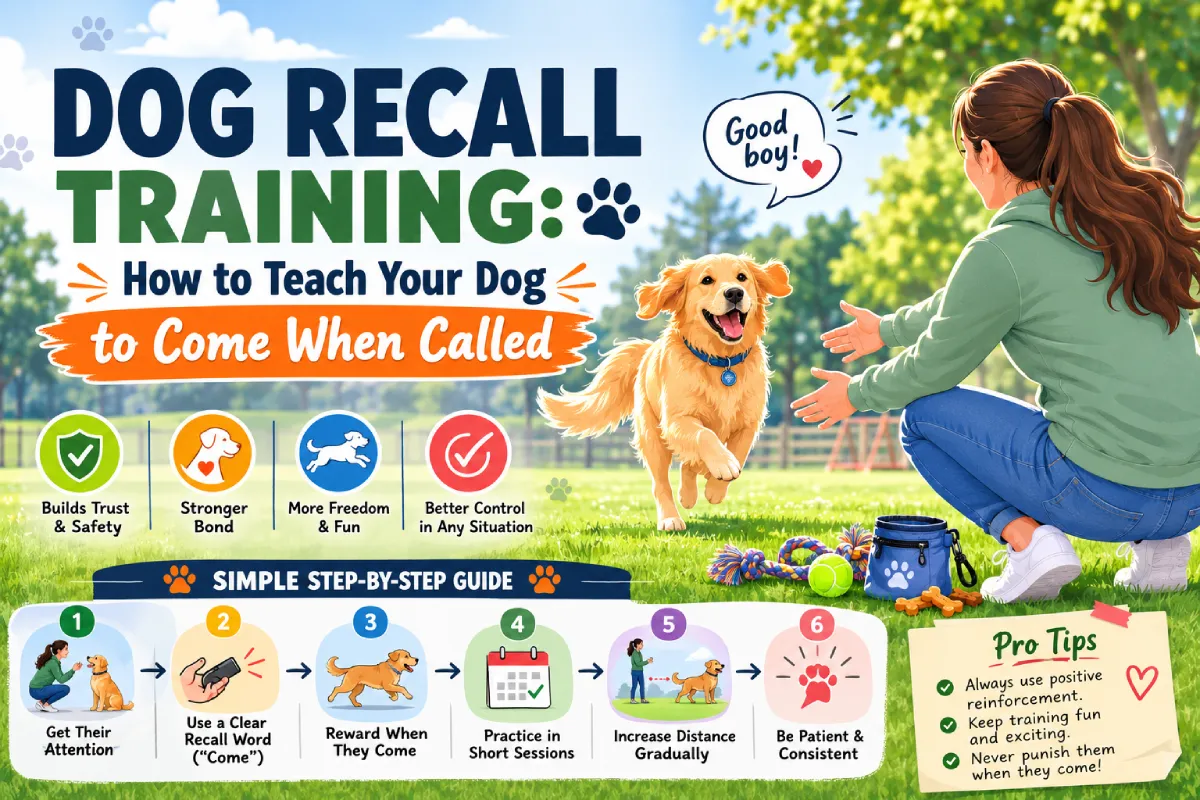
Dog Recall Training: How to Teach Your Dog to Come When Called
Of all the commands you can teach your canine companion, none is more critical to their safety, freedom, and overall well-being than a reliable recall. Whether your dog bolts toward a bustling street, spots wildlife across an open field, or simply needs to come inside as evening falls, a dependable response to your call is a literal lifesaver. Yet, “come” is frequently one of the most poorly executed commands in pet ownership. Many owners accidentally train their dogs to ignore them by calling their pet only to end fun activities, bathing them, trimming their nails, or punishing them upon their return.
Mastering dog recall training requires shifting your mindset from demanding obedience to building a powerful, positive conditioned reflex. Whether you are learning how to teach a dog to come, troubleshooting why your dog will not come when called, exploring puppy recall training, establishing an emergency recall for dogs, practicing recall training with distractions, or mastering long-line recall training, this comprehensive pillar guide covers everything you need to build a bombproof recall.
Direct Answer
A reliable dog recall is built on positive reinforcement, high-value rewards, and systematic environmental progression. To teach a dog to come when called, you must first pair your chosen verbal cue exclusively with extraordinary rewards (such as roast chicken or cheese) in zero-distraction indoor environments. From there, you systematically build difficulty across four distinct levels—moving from indoor rooms to secure gardens, utilizing a long training line attached to a body harness in open spaces, and finally proofing the behavior around real-world distractions. Crucially, you must never punish a dog when they return, and you should regularly practice “recall-and-release” drills so your dog learns that coming when called does not automatically mean fun time is over. No recall is entirely failure-proof; biological drives and intense environmental stimuli can occasionally override training, which is why safety management remains essential.
What Recall Training Means
Recall training is the process of conditioning your dog to execute an immediate, enthusiastic sprint back to you the moment they hear a specific verbal cue or whistle.
In behavioral science terms, a successful recall relies on classical and operant conditioning. The recall cue becomes a conditioned stimulus that predicts a massive, jackpot reward. When the dog executes the physical behavior of returning to you, that behavior is heavily reinforced, making them statistically driven to repeat it with lightning speed next time. It is not about submission; it is about making the choice to return the most rewarding option available.
Choosing One Recall Cue
Clarity is essential in dog training (as outlined in foundational principles found in our Dog-training basics guide). You must designate one specific word exclusively for recall.
-
Avoid using everyday conversational words like “Come here,” “Let’s go,” or your dog’s name interchangeably as your primary recall cue, as these words get diluted through casual overuse.
-
Choose a crisp, distinct, high-energy word like “Come,” “Here,” or “Touch.”
-
Ensure every member of your household uses this exact word and nothing else when practicing recall.
Choosing a High-Value Reward
During recall training, your ordinary dry kibble will not cut it. If you are competing against the scent of a rabbit or the sight of another playing dog, your reward must be irresistible.
-
The Jackpot Standard: Use exceptionally high-value food items that your dog rarely receives otherwise—such as cubes of roasted chicken, warm steak, tripe treats, or squirt cheese from a tube.
-
Play Rewards: For toy-driven dogs, a favorite tug toy or squeaky ball can serve as an even greater motivator than food.
Teaching Recall Indoors (Level 1)
Never start recall training outdoors in an open park. Start in a quiet hallway or living room with zero distractions.
-
Stand a few feet away from your dog.
-
Say your recall cue once in a bright, enthusiastic, welcoming tone.
-
The moment your dog turns and takes a step toward you, mark the action with a cheerful “Yes!” or a clicker.
-
Deliver the high-value reward directly at your toes (or hand-feed them while holding their collar).
Moving to the Garden (Level 2)
Once your dog returns instantly indoors across short distances, move to a securely fenced garden or a quiet, enclosed outdoor space.
-
Keep initial distances short.
-
Practice when your dog is already slightly relaxed, calling them, rewarding lavishly, and immediately releasing them back to sniffing (“Go play!”).
Using a Long Training Line Safely
When moving to open public spaces where fences are absent, never allow off-leash practice near roads. Safety is paramount.
-
The Long-Line Setup: Attach a 15- to 30-foot lightweight nylon or biothane long line to a well-fitted body harness, rather than relying on a standard neck collar. Pulling hard against a neck collar during a training error can cause severe tracheal, thyroid, or spinal damage.
-
Line Management: Let the long line trail on the ground or hold it loosely. If your dog ignores your cue, you have a physical safety tether to guide them back gently without screaming, lunging, or chasing them.
Adding Distance
Gradually increase distance in low-traffic parks using your long line. If your dog succeeds at 10 feet, push to 15 feet, then 25 feet, and eventually the full length of your long line. Ensure your tone remains upbeat and welcoming at greater distances, as your voice may sound softer or distorted to your dog from afar.
Adding Distractions
Once distance is established, systematically introduce controlled environmental distractions. Start with mild distractions, such as tossing a toy across the grass before calling them, then graduate to practicing near rustling leaves, blowing trash, or distant park visitors.
Rewarding Collar Handling
Many owners make the mistake of calling their dog, giving a treat, and immediately letting them go. Eventually, the dog realizes that coming when called means the fun ends.
-
To prevent this, practice collar grabs: Call your dog, reward them with a treat while gently holding their collar, praise them, and then release them.
-
This desensitizes your dog to having their collar touched, ensuring they don’t dodge your hands when you need to leash them in public.
Releasing the Dog After Recall
Never make your dog’s life revolve around being leashed the second they return. Use the “Come, Treat, Go Play” formula 80% of the time. Call your dog, give them a delicious treat, and immediately say a release cue like “Free!” or “Go play!” This teaches your dog that coming to you is a quick pit stop, not a trap that ends their freedom. Do not call the dog only to end enjoyable activities.
Avoiding Repeated Cue Use
Never repeat your recall cue multiple times (“Come… Fido, come… Come here!”). Repeating a word teaches your dog that the first, second, or third time you say it carries no urgency. Say your cue once. If your dog ignores it, use your long line to guide them in, reset, and try again later with an easier distance or better reward.
What to Do When the Dog Ignores the Cue
If your dog freezes or ignores your recall outdoors:
-
Do not chase them (dogs view chasing as an incredible game of tag).
-
Do not yell or sound angry.
-
Use your long line to gently reel them in, reward them the moment they reach you, and evaluate why the distraction was too high. Do not punish a dog after it eventually returns. Punishing a returning dog teaches them that coming back brings unpleasant consequences.
Why Dogs Stop Responding Outdoors
Outdoors, the world presents sensory competition that indoor environments cannot match. Smells, sights, and sounds stimulate a dog’s predatory and exploratory instincts. If training has not been systematically generalized across varied environments, the dog’s brain prioritizes the environment over the handler.
Recall Around Other Dogs
Other dogs represent the ultimate social distraction.
-
Practice distance management. Start far enough away from other dogs that your pet can still notice you and accept a treat.
-
Gradually close the distance over weeks of training. (If your dog struggles with reactivity or pulling toward peers, review techniques in our guide on Loose-leash walking).
Recall Around Wildlife
High-drive breeds possessing intense predatory instincts (terriers, sighthounds, hounds) require specialized management.
-
Never trust an off-leash recall in wildlife-dense areas unless your dog’s foundation is thoroughly proofed.
-
Utilize impulse-control cues like the Leave-it command alongside recall management. (For deeper insights into driving instincts, read our guide on Managing a high-drive dog).
Recall During Play
If your dog is wrestling with another dog, their arousal levels are sky-high. Practice interrupting play by calling them away for a high-value treat, immediately releasing them back to play so they learn that coming away from fun things still yields amazing rewards.
Recall for Adolescent Dogs
Adolescence (6 to 18 months) is the canine equivalent of human teenage rebellion. Hormones surge, brains undergo massive rewiring, and previously reliable dogs may suddenly act deaf. Do not panic or abandon training; simply dial back your expectations, return to Level 2 or Level 3 training environments with a long line, and raise the value of your rewards.
Puppy Recall Training
Puppies possess a natural biological “following instinct.” Capitalize on this during their first few weeks at home by running away from them in a playful voice, calling your recall cue, and throwing a party with treats when they bound after you.
Adult Rescue-Dog Recall
Rescue dogs require extra patience. They may carry past trauma or lack trust in human handlers. Spend your first month building engagement indoors before ever testing off-leash recall outdoors. (Observe subtle stress indicators by consulting our Dog body-language guide). Hand signals can also enhance distance communication; learn more via our guide on Dog-training hand signals.
Emergency Recall Cue
Establish a distinct emergency recall word (such as “Jackpot” or “Bacon”) that is never used under normal circumstances. Practice this word only 3 to 4 times a year, always pairing it with an absolute explosion of the highest-value food imaginable (e.g., an entire rotisserie chicken breast). Save this secret weapon strictly for true life-or-death emergencies.
Whistle Recall
A training whistle (like a silent or pea-less whistle) is a phenomenal tool. Whistles carry sound further than human voices, remain emotionally neutral (no frustration or anger transmitted in the tone), and sound identical every single time.
When Not to Allow Off-Leash Freedom
Never allow your dog off-leash in unsecure areas if:
-
They have not mastered Level 3 and Level 4 of the progression chart.
-
You are within 100 feet of active roads or traffic.
-
They are in active adolescent rebellion and ignoring basic commands.
-
You do not have your emergency jackpot treats with you.
Unique Content Asset: Four-Level Recall Progression Chart
Use this structured four-level framework to guide your training progression. The dog should only progress after showing consistent success at the previous level.
| Progression Level | Training Environment | Maximum Distance | Distraction Level | Equipment Required | Progression Criteria (When to Advance) |
| Level 1 | Indoor environment with no distractions | 3 to 10 feet | Zero (no other people/pets) | Standard leash or loose indoor space | 100% success rate across 20 consecutive repetitions over 3 days. |
| Level 2 | Secure garden or quiet enclosed space | 15 to 30 feet | Low (familiar backyard smells) | Standard leash / dragging drag-line | Dog pivots and sprints back instantly without hesitation, 9 out of 10 times. |
| Level 3 | Long line in a quiet outdoor area | 30 to 50 feet | Medium (distant dogs, birds, wind) | Long training line attached to body harness | Reliable return even when sniffing grass or mildly engaged elsewhere. |
| Level 4 | Controlled real-world distractions | Maximum long-line reach | High (wildlife scents, active parks, people) | Long line + high-value jackpot food | Flawless, enthusiastic return despite competing environmental triggers. |
Common Recall-Training Mistakes
-
Poisoning the Cue: Calling your dog only to clip their leash and leave the park, or calling them to administer medication or a bath.
-
Punishing the Return: Yelling at or scolding a dog when they finally return after taking 5 minutes to come back. (If you punish them, you teach them that coming to you equals punishment).
-
Chasing the Dog: Running after a loose dog, turning recall into an exciting game of catch-me-if-you-can.
-
Failing to Proof Distractions: Expecting a dog that listens in the living room to magically obey at a crowded dog beach.
Four-Week Recall Plan
| Week & Phase | Daily Focus & Environment | Session Duration | Key Drill / Objective | Reward Used |
| Week 1 | Indoor rooms (Level 1) | 5 mins (2x daily) | Say cue once, reward at toes immediately; build enthusiastic response. | Roast chicken / Cheese |
| Week 2 | Secure garden or yard (Level 2) | 5 to 7 mins (2x daily) | Introduce light movement; practice collar grabs and immediate releases. | High-value meat strips |
| Week 3 | Open park on long line and harness (Level 3) | 10 mins (daily) | Practice recalls past mild distractions; reinforce focus on handler. | Jackpot treats (Squeeze cheese) |
| Week 4 | Controlled real-world areas (Level 4) | 10 to 15 mins (daily) | Proofing around moderate environmental triggers; solidify emergency cue. | Ultimate jackpot rewards |
When to Seek Professional Help
If your dog displays severe running away behavior (bolting through doors and refusing to return), severe prey drive that puts wildlife or livestock at risk, or panic-induced flight responses, consult a qualified, force-free professional dog trainer or certified behaviorist (CPDT-KA).
Frequently Asked Questions
Why does my dog run away when I call them?
If your dog runs away, they likely associate coming when called with something negative (like leaving the park, nail trims, or being yelled at). Recondition the cue by offering jackpot rewards without ending the fun.
Should I punish my dog if they take too long to come back?
Never. If your dog takes five minutes to return and you scold them, you teach them that returning is what brings punishment. Always praise and reward enthusiastically no matter how long it took them to reach you.
Can every dog achieve a 100% reliable off-leash recall?
No recall is completely failure-proof. Biological drives, severe fright, or extreme prey stimuli can occasionally override training in any animal. That is why safety management and long lines remain vital tools.
How do I stop my dog from playing “catch me if you can”?
Stop running toward your dog. Instead, turn around, make high-pitched, excited noises, run away from them, and drop low to the ground. Your dog’s natural predatory chase instinct will cause them to chase you.
Is a whistle better than a verbal recall?
Whistles are fantastic because they carry sound over long distances and never reflect frustration or anger in your tone of voice.
Conclusion
Dog recall training is the ultimate test of teamwork, trust, and communication between you and your canine companion. By committing to positive reinforcement, respecting the four-level progression framework, utilizing a long line safely attached to a body harness, and ensuring that coming when called always pays off brilliantly, you unlock a life of safe, joyful freedom for your dog. Take your next step by grabbing your treat pouch, stepping into your hallway, and practicing your very first distraction-free recall today!
Expert Review Note
This article was reviewed and approved by a certified professional dog trainer (CPDT-KA) specializing in advanced off-leash reliability, recall mechanics, and positive reinforcement methodology.