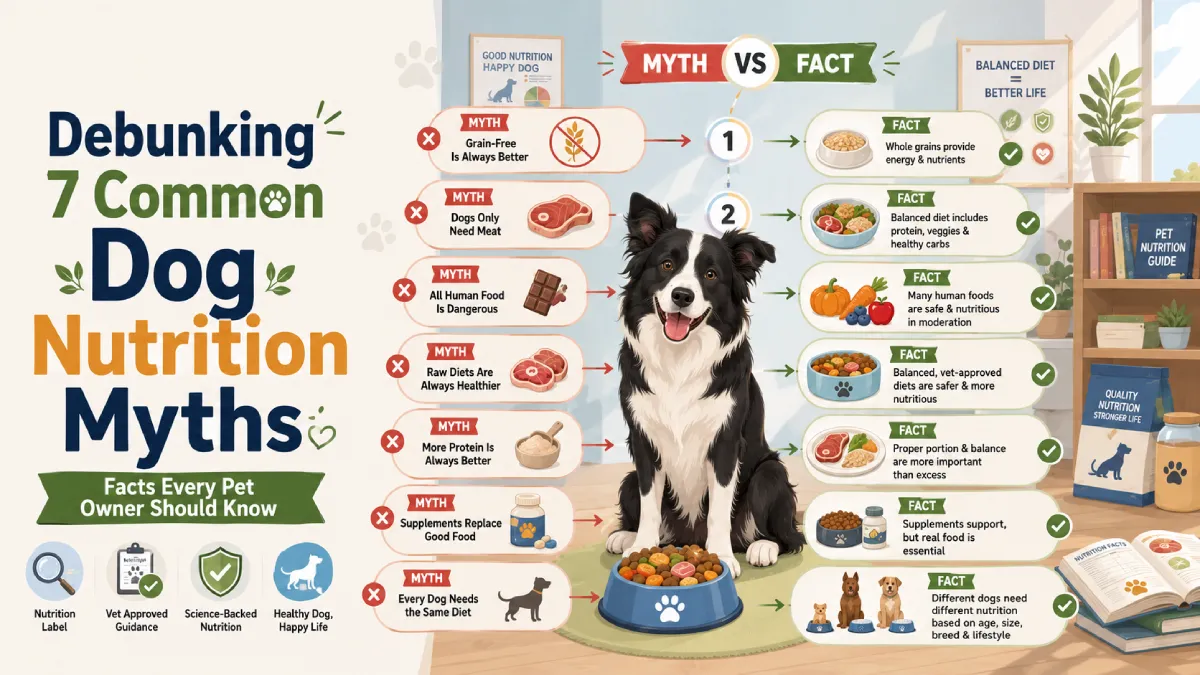
Dog Nutrition Myths: Evidence-Based Answers to Common Feeding Claims
Feeding our dogs seems like it should be simple: open a bag, fill the bowl, and watch them enjoy their meal. Yet, when you turn to the internet, social media forums, or pet store aisles, you are immediately met with a dizzying barrage of conflicting advice. One source claims grain-free is the only way to prevent disease, while another insists raw meat is the secret to eternal youth. With so much noise, pet parents are frequently left doubting their choices and worrying whether everyday decisions are harming their beloved companions.
Navigating pet nutrition requires separating emotional marketing and internet folklore from peer-reviewed veterinary science. Examining common dog nutrition myths—ranging from widespread dog-food myths, the persistent grain-free dog food myth, scary raw dog-food myths, misunderstood dog protein myths, general dog feeding misinformation, and confusing healthy dog-food claims—helps us return to evidence-based care. Grounded in clinical veterinary nutrition, this comprehensive guide debunks twenty of the most widespread feeding falsehoods, empowering you to make confident, informed decisions for your dog.
1. Dogs Should Eat Like Wolves
The Claim
Because domestic dogs share a common genetic ancestor with wolves (Canis lupus), their diet should mimic a wild wolf’s carnivorous prey model: raw meat, organs, bones, and zero carbohydrates.
Why People Believe It
It sounds intuitive and evolutionary. After all, wolves live in the wild and eat raw meat without human intervention, so modern dogs must possess the exact same biological requirements.
What Available Evidence Suggests
While dogs and wolves share 99% of their mitochondrial DNA, millennia of domestication alongside human agricultural societies have fundamentally altered canine genetics and metabolism. Landmark genomic studies published in Nature reveal that dogs have undergone massive genetic adaptations, developing multiple copies of the amylase gene (AMY2B). This allows domestic dogs to digest and metabolize starches and carbohydrates up to five times more efficiently than wolves. Dogs are biological omnivores, not obligate carnivores.
Important Exceptions
While dogs process carbohydrates efficiently, individual dogs with specific medical conditions (such as severe diabetes or food intolerances) may require specialized nutrient ratios.
Practical Owner Takeaway
Do not feel guilty for feeding a high-quality commercial diet containing wholesome grains and starches. Your dog’s digestive system is evolutionarily adapted to process them safely.
Reliable Source
Studies published by peer-reviewed genetic research teams in journals like Nature regarding canine domestication and starch digestion adaptations.
2. Grain-Free Food Is Always Healthier
The Claim
Grains like corn, wheat, and soy are cheap, inflammatory “fillers” that cause allergies, obesity, and systemic illness, making grain-free diets superior for all dogs.
Why People Believe It
Aggressive marketing campaigns by boutique pet food brands popularized the narrative that grain-free equals holistic, natural, and premium.
What Available Evidence Suggests
The grain-free dog food myth was heavily scrutinized when the U.S. Food and Drug Administration (FDA) investigated a potential link between certain grain-free diets—particularly those heavy in peas, lentils, and potatoes (pulses)—and canine Dilated Cardiomyopathy (DCM) in non-predisposed breeds. Grains are rarely the enemy; true canine food allergies are overwhelmingly driven by animal proteins (like beef or chicken), not grains. (Explore ingredient facts in our Dog-food ingredients guide).
Important Exceptions
Dogs diagnosed with specific, confirmed grain sensitivities (which are exceedingly rare) benefit from grain-free formulas under veterinary guidance.
Practical Owner Takeaway
Unless your veterinarian has diagnosed a specific grain allergy, high-quality commercial diets containing wholesome grains are safe, balanced, and backed by robust safety data.
Reliable Source
FDA Veterinary Investigations into Canine Dilated Cardiomyopathy and peer-reviewed veterinary cardiology journals.
3. Corn Is Only a “Filler”
The Claim
Corn provides zero nutritional value to dogs and is simply included by manufacturers as a cheap ingredient to bulk up the bag.
Why People Believe It
Marketing buzzwords popularized the term “filler,” teaching owners to scan ingredient lists and reject any food containing corn.
What Available Evidence Suggests
In scientific reality, there is no such thing as a nutritional filler. When corn is ground, cooked, and processed correctly, it is highly digestible (often exceeding 90% digestibility). It provides clean energy, essential fatty acids, linoleic acid for coat health, and clean carbohydrates. (Review label realities in our Dog-food label guide).
Important Exceptions
Dogs with rare, diagnosed corn allergies should avoid corn-containing diets.
Practical Owner Takeaway
Do not dismiss corn on an ingredient list. When formulated by a veterinary nutritionist, it is a safe and nutrient-dense component of a complete diet.
Reliable Source
Textbooks on canine clinical nutrition, such as Small Animal Clinical Nutrition (Markevics et al.).
4. By-Products Are Always Bad
The Claim
Animal by-products (such as organs, liver, lungs, and kidneys) are diseased, unhygienic waste products used by pet food companies to cut manufacturing costs.
Why People Believe It
Images of slaughterhouse leftovers create visceral disgust in human consumers, leading to the false assumption that what humans reject, dogs shouldn’t eat either.
What Available Evidence Suggests
In legitimate commercial pet food, animal by-products refer to clean, non-rendered internal organs and tissues. In nature, wild canids and wolves consume organs first because they are exceptionally rich in vitamins (A, B-complex), iron, copper, and trace minerals. By-products are nutritional powerhouses, not waste.
Important Exceptions
Sourcing matters; pet foods must come from reputable manufacturers with strict quality control.
Practical Owner Takeaway
By-product meals and organ meats provide vital micronutrients that muscle meat alone cannot supply.
Reliable Source
Association of American Feed Control Officials (AAFCO) ingredient definitions and veterinary nutritional standards.
5. The First Ingredient Determines Food Quality
The Claim
If fresh meat (like chicken or beef) is listed as the first ingredient on a bag, the food is automatically superior to a food where a meal or grain is listed first.
Why People Believe It
Pet food marketing encourages scanning the top of the ingredient list, banking on the consumer’s assumption that position equals total nutritional dominance.
What Available Evidence Suggests
Ingredients are listed by weight prior to cooking. Fresh whole meats contain 75% water, which evaporates during cooking, dropping fresh meat down the dry-matter scale. Meanwhile, meat meals (like chicken meal) have moisture removed beforehand, meaning they consist of nearly 100% concentrated protein. A food with grain first can easily deliver more actual protein than a food with fresh meat first.
Important Exceptions
Evaluating the entire guaranteed analysis and nutritional adequacy statement matters far more than obsessing over ingredient order.
Practical Owner Takeaway
Look past the first ingredient. Evaluate the complete formula, AAFCO statement, and guaranteed analysis.
Reliable Source
WSAVA (World Small Animal Veterinary Association) Nutritional Assessment Guidelines.
6. High Protein Damages Every Senior Dog
The Claim
Older dogs have failing kidneys, so you must restrict protein in their senior years to prevent kidney failure.
Why People Believe It
Human medicine historically restricted protein for kidney disease patients, leading to the erroneous belief that the same rule applies universally to all aging dogs.
What Available Evidence Suggests
Unless a senior dog has been diagnosed with advanced, end-stage renal disease by a veterinarian, healthy senior dogs actually require higher dietary protein than younger adults. As dogs age, they experience muscle wasting (sarcopenia). Restricting protein accelerates muscle loss and weakness. (Explore senior nutrition in our Life-stage food comparison).
Important Exceptions
Dogs with confirmed chronic kidney disease or liver failure require specialized, vet-prescribed protein restriction.
Practical Owner Takeaway
Do not restrict protein in a healthy senior dog. High-quality, digestible protein is vital for preserving their strength and mobility.
Reliable Source
Geriatric veterinary medicine and clinical nutrition studies published in the Journal of Veterinary Internal Medicine.
7. Wet Food Is Bad for Teeth
The Claim
Feeding canned wet dog food coats the teeth in sticky residue, causing severe tartar buildup, periodontal disease, and tooth decay.
Why People Believe It
Because wet food is soft and moist, people assume it behaves like human junk food, clinging to teeth and rotting them.
What Available Evidence Suggests
Neither wet nor dry food magically cleans teeth through casual chewing. Standard dry kibble shatters instantly upon contact with teeth, offering zero mechanical scraping action at the gumline. Periodontal disease is driven primarily by genetics, saliva pH, and bacterial plaque accumulation, not food texture.
Important Exceptions
Specialized VOHC-certified dental kibbles exist, but standard kibble and wet food both require active dental hygiene (like brushing) to prevent tartar.
Practical Owner Takeaway
Feel confident feeding wet food (especially for hydration or senior dental comfort) as part of a balanced diet, paired with regular home tooth brushing.
Reliable Source
Veterinary Oral Health Council (VOHC) clinical findings and veterinary dental research.
8. Dry Food Automatically Cleans Teeth
The Claim
Crunchy dry kibble acts like a toothbrush, scrubbing plaque and tartar off your dog’s teeth as they chew.
Why People Believe It
It is a widespread marketing myth repeated for decades to make kibble seem functionally superior to canned food.
What Available Evidence Suggests
Clinical studies show that standard kibble shatters immediately upon impact, providing little to no abrasive friction against the tooth surface where plaque accumulates. Without brushing, dogs eating exclusively dry kibble develop severe periodontal disease just as frequently as dogs eating other formats.
Important Exceptions
Unless a diet is specially engineered with a fibrous matrix proven to resist immediate shattering, kibble does not brush teeth.
Practical Owner Takeaway
Do not rely on dry food for dental health. Implement daily tooth brushing or veterinary dental chews.
Reliable Source
American Veterinary Dental College (AVDC) oral health guidelines.
9. Homemade Food Is Always Healthier
The Claim
Cooking fresh meals for your dog at home using human-grade ingredients is automatically superior and healthier than processed commercial kibble.
Why People Believe It
Fresh food looks, smells, and feels wholesome to humans, fostering the belief that natural ingredients eliminate the risks of commercial manufacturing.
What Available Evidence Suggests
Veterinary nutritional studies analyzing hundreds of home-cooked recipes (including those found in popular books and online blogs) reveal that over 90% of unformulated homemade diets are severely deficient in essential vitamins, minerals, amino acids, or calcium-to-phosphorus ratios. Without professional formulation by a veterinary nutritionist, home-cooking can cause severe nutritional deficiencies.
Important Exceptions
Homemade diets formulated by a board-certified veterinary nutritionist (DACVN) using precise vitamin and mineral supplements are safe and effective.
Practical Owner Takeaway
Never cook random meals for your dog from internet recipes without veterinary nutrition oversight.
Reliable Source
Peer-reviewed studies on nutritional adequacy of home-prepared diets in veterinary journals (e.g., JAVMA).
10. Raw Food Is Always More Natural and Nutritious
The Claim
Feeding a raw BARF (Biologically Appropriate Raw Food) diet provides superior nutrition because cooking destroys natural enzymes and nutrients.
Why People Believe It
The “back-to-nature” movement promotes the idea that raw meat is the pristine, unaltered diet nature intended for canines.
What Available Evidence Suggests
While raw diets retain raw enzymes, peer-reviewed veterinary studies highlight two massive risks: severe nutritional imbalances (especially in calcium/phosphorus) and profound microbiological contamination. Raw meat frequently harbors live Salmonella, E. coli, and Listeria, posing severe zoonotic infection risks to both the dog and human family members, particularly children and immunocompromised individuals.
Important Exceptions
Commercial raw diets that undergo high-pressure processing (HPP) reduce pathogen loads, but nutritional balance remains a critical hurdle.
Practical Owner Takeaway
Weigh the significant microbiological and nutritional risks of raw feeding carefully before adopting raw diets.
Reliable Source
FDA Center for Veterinary Medicine reports on raw pet food safety and WSAVA warnings against raw feeding.
11. Dogs Need Constant Food Variety
The Claim
Just like humans, dogs get bored eating the exact same food every day and need constant flavor rotation to stay happy.
Why People Believe It
We project our own human psychology—boredom with monotony—onto our dogs.
What Available Evidence Suggests
Dogs do not possess the psychological need for culinary variety; their sense of taste is far less complex than ours, relying heavily on smell. Constantly rotating commercial foods or adding rich table scraps disrupts the canine gastrointestinal microbiome, frequently triggering chronic digestive upset, soft stools, and selective eating behaviors.
Important exceptions
Dogs prescribed rotational elimination diets by a veterinarian for allergy testing require controlled food changes.
Practical Owner Takeaway
Find a high-quality, complete food your dog thrives on and stick with it. Consistency keeps their digestion stable.
Reliable Source
Canine behavioral and gastrointestinal physiology research.
12. Food Allergies Are Usually Caused by Grains
The Claim
If a dog is itchy, licking their paws, or having digestive trouble, they have a grain allergy.
Why People Believe It
Popular media has vilified grains as the universal culprit behind canine sensitivities and skin disorders.
What Available Evidence Suggests
True food allergies in dogs are relatively rare. When a dog does develop a food allergy, clinical dermatological studies prove that the overwhelming majority are caused by animal proteins—specifically beef, chicken, dairy, lamb, or egg—rather than corn, wheat, or soy.
Important Exceptions
Diagnosed grain sensitivities exist, but they represent a tiny fraction of total canine allergy cases.
Practical Owner Takeaway
If your dog has itchy skin or allergies, investigate animal proteins first with your veterinarian before blaming grains.
Reliable Source
Veterinary Dermatology clinical consensus statements on canine cutaneous adverse food reactions.
13. All Dogs Need Nutritional Supplements
The Claim
Commercial dog food is insufficient, so every dog requires daily multivitamins, joint powders, and health supplements to thrive.
Why People Believe It
Supplement manufacturers market heavily, convincing owners that optimal health requires expensive extra pills and powders.
What Available Evidence Suggests
If you are feeding a commercial diet certified as “complete and balanced” by AAFCO, that food already contains 100% of the vitamins, minerals, and micronutrients your dog requires. Adding unprescribed multivitamins can actually create dangerous nutrient toxicities (such as Vitamin D or calcium excess, especially in growing puppies).
Important Exceptions
Dogs with specific, diagnosed medical needs (such as omega-3s for arthritis or probiotics for gut health, as explored in our Probiotics guide) benefit from targeted supplementation under veterinary guidance.
Practical Owner Takeaway
Do not add random supplements to a balanced commercial diet unless recommended by your veterinarian.
Reliable Source
AAFCO Nutrient Profiles for dogs and clinical veterinary nutrition guidelines.
14. Expensive Food Is Always Better
The Claim
The most expensive boutique dog food on the shelf is automatically the healthiest, and cheap supermarket brands are toxic junk.
Why People Believe It
Price signaling leads consumers to equate high financial cost with superior ingredient quality and safety.
What Available Evidence Suggests
Price has zero correlation with nutritional adequacy or safety. Some ultra-expensive boutique brands invest heavily in flashy marketing, exotic ingredients, and cute packaging while skipping feeding trials, veterinary nutritionists, and rigorous quality control. Conversely, legacy brands backed by WSAVA guidelines invest millions in scientific research, rigorous facility inspections, and board-certified nutritionists.
Important Exceptions
Budget foods using substandard ingredient sourcing or lacking AAFCO validation should be avoided, but high cost does not guarantee scientific formulation.
Practical Owner Takeaway
Judge a food by manufacturing standards, AAFCO adequacy, and nutritional science, not by its price tag.
Reliable Source
WSAVA guidelines for selecting pet foods.
15. “Natural” Means Safer
The Claim
If a pet food label says “Natural,” it means the ingredients are pure, organic, pesticide-free, and inherently safer than standard foods.
Why People Believe It
The word “natural” evokes pristine, wholesome imagery that reassures consumers.
What Available Evidence Suggests
In regulatory terms (like AAFCO definitions), “natural” simply means the product has been derived from plant, animal, or mined sources without chemically synthesized additives. It does not mean organic, pesticide-free, or nutritionally superior. Furthermore, many natural ingredients (like certain mushrooms or plants) are profoundly toxic.
Important Exceptions
Human-grade organic certifications carry stricter standards, but the generic term “natural” is loosely regulated.
Practical Owner Takeaway
Look beyond the word “natural” on the front panel and examine the nutritional adequacy and ingredient panels.
Reliable Source
Regulatory definitions established by AAFCO and federal trade commissions.
16. Dogs Cannot Digest Carbohydrates
The Claim
Dogs are pure carnivores whose digestive tracts cannot process or break down carbohydrates.
Why People Believe It
The persistence of the wolf-ancestor myth convinces people that carbs pass right through a dog untouched.
What Available Evidence Suggests
As established by canine genomic research, dogs possess multiple copies of the amylase gene enabling them to produce pancreatic amylase, an enzyme specifically designed to break down starches and complex carbohydrates into digestible glucose. Digestibility trials prove that cooked carbohydrates boast digestibility rates exceeding 90% in dogs.
Important Exceptions
Dogs with specific pancreatic or metabolic disorders may require low-carb formulations.
Practical Owner Takeaway
Carbohydrates are safely digested and utilized by dogs as an efficient energy source when cooked and processed correctly.
Reliable Source
Nature genetics studies and comparative canine digestive physiology literature.
17. A Dog Eating Grass Always Has a Nutritional Deficiency
The Claim
When a dog grazes on lawn grass, it means their diet is missing vital nutrients, fiber, or vitamins.
Why People Believe It
Old folklore taught that dogs instinctively eat grass to self-correct nutritional imbalances or induce vomiting when sick.
What Available Evidence Suggests
Veterinary behavioral studies show that the vast majority of dogs who eat grass do so simply because they enjoy the taste, texture, or out of normal exploratory behavior. Only a small percentage of grass-eating dogs vomit afterward, and surveys indicate most grass-eating dogs show zero signs of nutritional deficiency or underlying illness.
Important Exceptions
If grass grazing becomes obsessive, destructive, or is accompanied by lethargy and weight loss, investigate underlying gastrointestinal distress with a vet.
Practical Owner Takeaway
Occasional lawn grazing is normal canine behavior and rarely signals a nutritional deficiency.
Reliable Source
Veterinary behavioral studies published in journals like Applied Animal Behaviour Science.
18. Table Scraps Are Harmless in Small Amounts
The Claim
Giving your dog a tiny bite of your dinner, a piece of cheese, or a scrap of steak is a harmless act of love with zero consequences.
Why People Believe It
Puppy-dog eyes at the dinner table make sharing food feel like an irresistible bonding ritual.
What Available Evidence Suggests
While a plain green bean is harmless, many common table scraps—such as fatty meats, butter, gravy, onions, garlic, and seasoned foods—are dangerous. High-fat scraps routinely trigger acute, excruciating, and potentially fatal pancreatitis (inflammation of the pancreas), while hidden ingredients like cooked bones splinter and puncture internal organs.
Important Exceptions
Plain, unseasoned vegetables (like carrots or pumpkin) in strict moderation can make safe treats.
Practical Owner Takeaway
Keep human table scraps away from your dog to prevent acute medical emergencies like pancreatitis.
Reliable Source
Veterinary emergency hospital intake statistics and clinical toxicology reports.
19. Senior Dogs Automatically Need Senior-Labelled Food
The Claim
The moment your dog turns 7 years old, you must immediately switch them to a bag labeled “Senior.”
Why People Believe It
Pet food marketing creates rigid age milestones, making owners feel negligent if they don’t buy age-specific labels.
What Available Evidence Suggests
Nutrition should be prescribed based on individual clinical need and body condition, not calendar age. A vibrant 10-year-old terrier mix maintaining perfect muscle mass on an adult maintenance diet does not need a senior label. Conversely, a sedentary 7-year-old Lab prone to weight gain benefits from a lower-calorie senior diet. (Review feeding frameworks in our Dog-feeding pillar).
Important Exceptions
Seniors showing signs of early organ decline, cognitive changes, or joint stiffness require tailored veterinary diets.
Practical Owner Takeaway
Evaluate your senior dog’s body condition score and energy levels rather than following arbitrary calendar age milestones.
Reliable Source
Geriatric veterinary nutrition guidelines (WSAVA).
20. Online Calorie Calculators Are Exact
The Claim
If an online calculator or bag chart tells you to feed exactly 2.5 cups of food, that number is a guaranteed, mathematically precise prescription.
Why People Believe It
Numbers feel authoritative and precise, creating blind faith in automated formulas.
What Available Evidence Suggests
Online calculators and bag charts provide educated starting estimates, not exact biological guarantees. Every individual dog possesses a unique metabolic efficiency, activity variation, and hormonal status. Two dogs weighing 50 pounds can require vastly different calorie counts. Monthly body condition scoring must guide adjustments. (Calculate baselines using our Dog calorie calculator).
Important Exceptions
Weight management requires real-world tracking, not blind adherence to calculators.
Practical Owner Takeaway
Use calculators as a Week 1 starting baseline, then fine-tune portions based on your dog’s actual body condition and weight trends.
Reliable Source
Canine clinical nutrition and energy requirement formulas (RER/MER).
Unique Content Asset: Myth-Verdict Table
Use this master reference matrix to evaluate common dog nutrition myths, examine what is partly true versus misleading, and review practical advice:
| Myth | Verdict | What Is Partly True | What Is Misleading | Practical Advice |
| 1. Dogs = Wolves | False | Dogs share a common genetic ancestry with wolves. | Ignores 10,000+ years of genetic adaptation to starch digestion. | Feed balanced omnivorous diets suited to modern dogs. |
| 2. Grain-Free = Better | False | Helps rare dogs with specific grain allergies. | Implies grains are harmful toxins causing widespread disease. | Feed grain-inclusive diets unless a vet diagnoses an allergy. |
| 3. Corn Is a Filler | False | Inexpensive ingredient. | Claims corn provides zero nutritional value or digestibility. | Recognize corn as a digestible source of energy and nutrients. |
| 4. By-Products Are Bad | False | Poor-quality rendering exists in unregulated brands. | Labels all organ meats and clean by-products as toxic waste. | Trust reputable brands that utilize nutrient-dense organ meats. |
| 5. 1st Ingredient Rule | Misleading | Identifies the heaviest pre-cooked ingredient. | Ignores water weight and nutrient concentration after cooking. | Evaluate the entire guaranteed analysis and AAFCO statement. |
| 6. High Protein Hurts Seniors | False | Dogs with end-stage kidney failure need protein restriction. | Assumes all senior dogs need low protein, causing muscle loss. | Feed high-quality protein to healthy seniors to preserve muscle. |
| 7. Wet Food Ruins Teeth | False | Wet food has a softer texture. | Claims canned food rots teeth faster than dry kibble. | Practice daily tooth brushing regardless of food format. |
| 8. Dry Food Cleans Teeth | False | Kibble requires chewing. | Claims standard dry kibble scrubs plaque off teeth. | Do not rely on kibble for dental hygiene; brush teeth daily. |
| 9. Homemade = Healthier | False | Uses fresh, human-grade ingredients. | Assumes unformulated home recipes provide complete nutrition. | Consult a veterinary nutritionist before home-cooking. |
| 10. Raw = Better | False | Preserves raw enzymes. | Ignores severe microbiological and nutritional imbalance risks. | Weigh pathogen and nutritional risks carefully before raw feeding. |
| 11. Dogs Need Variety | False | Dogs appreciate novel flavors. | Projects human boredom onto canine digestive systems. | Maintain dietary consistency to protect gut microbiome health. |
| 12. Grain Causes Allergies | False | Food allergies cause skin itching. | Blames grains when animal proteins are the primary allergen. | Investigate animal proteins first if food allergies occur. |
| 13. All Dogs Need Supplements | False | Specific supplements help targeted conditions. | Claims commercial complete food is nutritionally insufficient. | Avoid unprescribed multivitamins on balanced commercial diets. |
| 14. Expensive = Better | False | Premium brands invest in scientific research. | Assumes high price guarantees scientific formulation and safety. | Judge brands by scientific standards and AAFCO adequacy. |
| 15. “Natural” = Safer | Misleading | Derived from natural plant or animal sources. | Implies safety and organic purity, which are not legally guaranteed. | Examine ingredient panels rather than relying on front-panel buzzwords. |
| 16. Dogs Can’t Digest Carbs | False | Wolves eat mostly meat. | Ignores canine amylase gene adaptations for starch digestion. | Accept cooked carbohydrates as a safe, digestible energy source. |
| 17. Grass Eating = Deficiency | False | Dogs explore their environment. | Claims grass eating always indicates a vitamin or fiber deficiency. | View casual grass grazing as normal, harmless canine behavior. |
| 18. Scraps Are Harmless | False | Provides a tasty treat. | Ignores risks of acute pancreatitis and toxic seasonings. | Avoid rich table scraps to protect against digestive emergencies. |
| 19. Seniors Need Senior Food | Misleading | Seniors experience slower metabolisms. | Implies age 7 requires an automatic diet switch regardless of health. | Base diet choices on individual body condition and vet advice. |
| 20. Calculators Are Exact | False | Based on scientific RER/MER formulas. | Treats estimates as rigid mathematical guarantees. | Use calculators as a starting baseline, adjusting via body condition. |
Expert Review Note
This comprehensive analysis of canine nutrition myths, scientific evidence, and veterinary clinical guidelines was reviewed and approved by a licensed doctor of veterinary medicine (DVM) and a board-certified veterinary nutrition specialist.