Senior Dog Mobility: Home Adaptations, Support Aids and Daily Care
Watching your loyal canine companion transition from an energetic, bounding adult into a slower-moving senior is a deeply moving experience. As dogs age—a journey explored in our master Senior-dog care pillar—their physical bodies undergo gradual structural shifts. You may notice subtle hesitation before they rise from their bed, a slight wobble on hardwood floors, or a reluctance to leap into the car. Preserving senior dog mobility is one of the most impactful ways pet parents can protect their dog’s dignity, comfort, and independence during their golden years.
Navigating mobility challenges requires a proactive combination of environmental modifications, appropriate support aids, targeted daily care, and veterinary guidance. Whether you are searching for effective senior dog mobility aids, learning how to help old dog walk comfortably, exploring reliable mobility support for old dogs, implementing dog arthritis home adaptations, solving problems with a senior dog slipping on floors, or supporting an old dog weak back legs condition, this comprehensive guide provides a veterinary- and rehabilitation-reviewed framework.
Quick Answer
Senior dog mobility care requires a multifaceted approach focused on environmental safety, mechanical support, and medical management. As dogs age, physical decline is typically driven by joint discomfort, muscle loss, neurological changes, and sensory loss. To protect and support mobility, owners should install non-slip flooring runners, utilize supportive harnesses or slings, provide orthopedic bedding, manage body weight to reduce joint load, and incorporate low-impact exercise (as outlined in our Exercise guide). Equipment aids and home modifications are supportive tools designed to enhance comfort and accessibility rather than act as medical cures. If your senior dog experiences sudden weakness, acute paralysis, or signs of severe pain, immediate veterinary intervention is required.
Why Mobility Changes Occur in Older Dogs
Mobility loss in senior dogs is rarely caused by a single isolated factor. Instead, it is usually the result of cumulative physiological wear across several interconnected systems:
1. Joint Discomfort (Osteoarthritis)
Degenerative joint disease affects the vast majority of senior dogs over the age of eight. Cartilage cushioning the hips, stifles (knees), elbows, and spine wears down over time, leading to painful bone-on-bone friction, inflammation, and stiffness.
2. Muscle Loss (Sarcopenia)
Age-related muscle wasting robs senior dogs of the core and hind-limb strength required to propel their body weight upward and maintain stable locomotion.
3. Neurological Problems
Conditions such as degenerative myelopathy, lumbosacral stenosis (cauda equina syndrome), or intervertebral disc disease (IVDD) disrupt nerve communication between the brain and the limbs, leading to weakness, dragging paws, or ataxia (incoordination).
4. Vision Loss
Fading vision (caused by cataracts, nuclear sclerosis, or retinal degeneration) causes dogs to hesitate before moving, misjudge steps, or become disoriented on uneven ground.
5. Nail and Paw Factors
Overgrown nails act like ice skates on smooth indoor flooring, while long fur between the paw pads lifts the leather pads away from the surface, completely destroying natural grip. (Review paw maintenance in our Home-setup guide).
Recognising Subtle Mobility Changes Early
Dogs are master maskers of pain. They rarely whine or cry out when their joints ache; instead, they display subtle behavioral and biomechanical shifts that owners must learn to read:
-
Difficulty Standing: Taking multiple attempts or struggling to push up from a lying position, particularly on tile or hardwood floors.
-
Difficulty Using Stairs: Hesitating at the base of a staircase, refusing to go upstairs, or scrambling clumsily while coming down.
-
Slipping on Floors: Hind legs splaying outward or paws sliding when trying to walk across smooth indoor surfaces.
-
Reduced Willingness to Jump: Stopping before leaping onto couches, beds, or vehicle tailgates, or whining when lifted.
-
Shortened Stride: Walking with a stiff, choppy gait, dragging the rear toenails (wearing down the center nails unevenly), or exhibiting a swaying pelvis.
Home Flooring and Environmental Adaptations
Eliminating physical hazards in your living space is the first line of defense in preserving senior mobility.
1. Flooring Adaptations
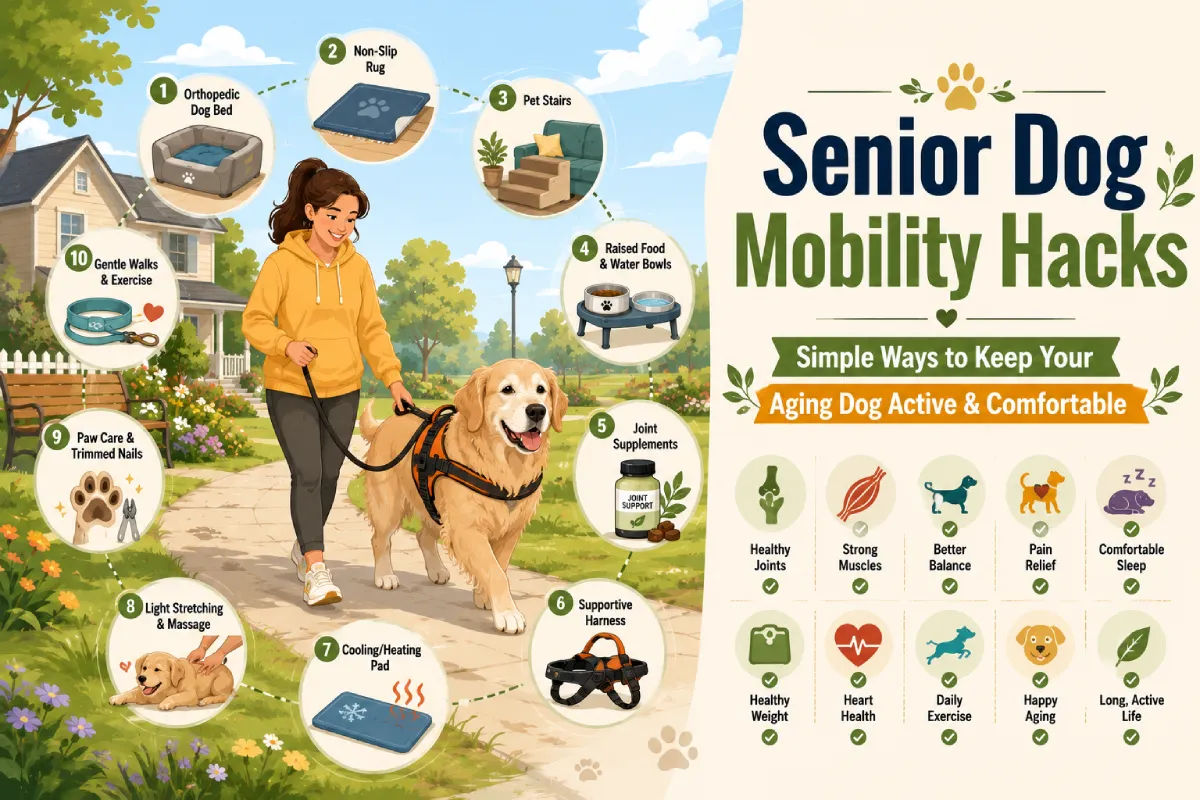
Slippery hardwood, tile, and laminate floors are treacherous for weak or arthritic dogs. Cover high-traffic pathways and resting zones with heavy, rubber-backed runners, yoga mats, or interlocking foam tiles to create a continuous highway of traction. Always secure loose scatter rugs with non-skid rug pads or double-sided rug tape.
2. Ramps Versus Stairs
Stairs pose a severe fall risk. Block access to staircases using sturdy baby gates. For couches, beds, or low porches, install wide, high-traction pet ramps that eliminate vertical impact concussions on skeletal joints.
3. Supportive Bedding
Provide multi-layer, high-density orthopedic memory foam beds in every room your dog frequents. Good bedding relieves pressure points on sore hips and elbows, ensuring restorative rest.
4. Raised Feeding Stations and Limitations
Elevate food and water bowls using a stable stand to reduce neck and front-wrist strain while eating. Note on limitations: While raised bowls reduce bending discomfort, they do not treat underlying joint pathology or prevent conditions like bloat in deep-chested breeds.
Support Aids: Harnesses, Slings, and Traction
When environmental modifications are no longer sufficient, external support aids help bridge the gap.
1. Support Harnesses
A well-fitted support harness with rear lifting handles allows you to share your dog’s body weight safely. Rear-end lift harnesses support the pelvis and hind legs, while full-body harnesses provide control at both shoulders and hips for dogs experiencing generalized weakness.
2. Slings
A temporary towel sling (folded lengthwise and placed beneath the abdomen or pelvis) or a professional neoprene lifting sling helps lift a struggling dog into a standing position. (Note: Slings require correct placement and are temporary physical aids, not medical cures).
3. Paw-Grip Products and Nail Maintenance
Non-slip rubber toe grips or disposable adhesive paw pads can provide temporary traction on smooth floors. Simultaneously, maintain short, trimmed nails and clipped interdigital fur to maximize natural gripping power.
Navigating Daily Obstacles
1. Vehicle Access
Jumping into high vehicle trunks accelerates joint degradation. Use a wide, lightweight folding aluminum pet ramp paired with rear-end harness support to guide your dog safely into cars. (Learn safe lifting mechanics in our guide on How to help an old dog stand up).
2. Toilet Access
Ensure the pathway from your senior dog’s bed to the exterior exit door is 100% free of clutter, cords, or narrow bottlenecks. If mobility fails completely during winter or stormy nights, establish an indoor synthetic grass potty patch.
3. Managing Stairs
Whenever possible, prevent senior dogs from using stairs entirely. If a split-level home makes stairs unavoidable, use a full-body support harness to guide them step-by-step with balanced control.
Daily Movement, Weight Management, and Long-Term Care
1. Daily Movement
Complete inactivity causes rapid muscle atrophy. Maintain regular, low-impact physical activity tailored to your dog’s current capacity. (Design balanced routines using our comprehensive Exercise guide).
2. Weight Management
Every excess pound places four pounds of pressure on a dog’s front joints and knees. Working with your veterinarian to keep a senior dog lean is the single most effective intervention for reducing joint pain and preserving mobility.
3. Rehabilitation Support
Certified canine rehabilitation professionals (CCRPs) offer advanced therapeutic modalities—including underwater treadmill hydrotherapy, therapeutic laser therapy, and custom home conditioning exercises—that rebuild muscle strength and joint flexibility safely.
Mobility Tracking and Monitoring Changes
Because mobility decline can be gradual, maintaining a daily tracking log helps you evaluate whether your current management plan is working or if disease progression requires veterinary adjustment. Track how easily your dog rises, their walking stamina, and their response to activity. (Integrate tracking data into your broader assessments using our Quality-of-life checklist).
When Sudden Weakness Is Urgent
While gradual age-related stiffness allows for planned home adaptations, acute mobility failure is a medical emergency. Seek immediate veterinary care if your senior dog exhibits:
-
Sudden, unremitting paralysis or inability to bear weight on their hind legs.
-
Acute collapse accompanied by signs of severe pain (crying out, heavy panting, rigid posturing).
-
Sudden loss of bladder or bowel control alongside weakness.
Unique Content Asset: Senior Mobility Assessment Chart
Use this structured diagnostic matrix to evaluate your senior dog across ten core mobility parameters and determine when veterinary or rehabilitation intervention is required:
| Mobility Parameter | Normal Senior Baseline | Mild Concern (Monitor & Adapt) | Moderate Concern (Support Aid Needed) | Urgent / Severe (Veterinary Assessment) |
| 1. Rising | Rises smoothly within 1–2 attempts. | Takes 2–3 tries on tile/wood floors. | Needs physical lift assistance or sling support. | Sudden inability to push up or stand. |
| 2. Standing | Stands squarely with balanced weight. | Occasional mild weight shifting. | Noticeable trembling or wide-based stance. | Total collapse or inability to bear weight. |
| 3. Walking | Steady, coordinated stride. | Slight slowing or hesitation. | Swaying rear end, crossing legs, or knuckling paws. | Ataxia (incoordination) or paralysis. |
| 4. Turning | Pivots fluidly in tight spaces. | Takes wider circles when turning. | Stumbles or loses balance during tight turns. | Falls over when attempting to turn. |
| 5. Stairs | Navigates stairs confidently. | Hesitates or climbs cautiously. | Refuses stairs or slips while descending. | Total inability to manage stairs; high fall risk. |
| 6. Toileting | Eliminates with stable posture. | Slight squatting hesitation. | Struggles to maintain posture while urinating/defecating. | Collapses during elimination or loses control. |
| 7. Vehicle Access | Enters vehicle with minor help. | Reluctant to jump; needs a boost. | Requires a pet ramp and harness lift support. | Completely unable to enter vehicle. |
| 8. Recovery After Activity | Bounces back after short rest. | Sleeps longer after walks. | Exhibits pronounced next-day stiffness. | Severe exhaustion, pain flare-up, or refusal to move. |
| 9. Pain Signals | Bright, relaxed posture. | Occasional mild morning stiffness. | Heavy panting, restlessness, roached back. | Crying out, extreme agitation, or biting when touched. |
| 10. Falls or Slips | Rare or none. | Occasional paw slide on floors. | Frequent slips resulting in falls or minor strains. | Severe fall resulting in acute trauma or injury. |
Frequently Asked Questions
How can I help my senior dog walk better?
You can help your dog walk better by installing non-slip runners over slick floors, using a rear-support harness or sling to share their weight, keeping their nails and paw fur trimmed, maintaining a lean body weight, and engaging in low-impact veterinary-approved exercises.
Are support harnesses a cure for canine arthritis?
No. Support harnesses, slings, and ramps are mechanical support aids designed to improve accessibility and safety; they do not treat or cure underlying joint diseases like osteoarthritis.
Why are my old dog’s back legs suddenly shaking or giving out?
Hind-leg shaking or collapsing can be caused by advanced osteoarthritis, muscle wasting, neurological conditions (like degenerative myelopathy or IVDD), or systemic weakness. Sudden weakness requires immediate veterinary evaluation.
When should I consult a canine rehabilitation professional?
You should consult a canine rehabilitation professional (CCRP) whenever your dog shows signs of mobility decline, chronic joint stiffness, muscle loss, or is recovering from orthopedic surgery to develop a targeted physical therapy plan.
Expert Review Note
This guide on senior dog mobility, home adaptations, support aids, and rehabilitation protocols was reviewed and approved by a licensed doctor of veterinary medicine (DVM) and a certified canine rehabilitation practitioner (CCRP).