Is Pet Insurance Worth It? Costs, Coverage and Questions to Compare
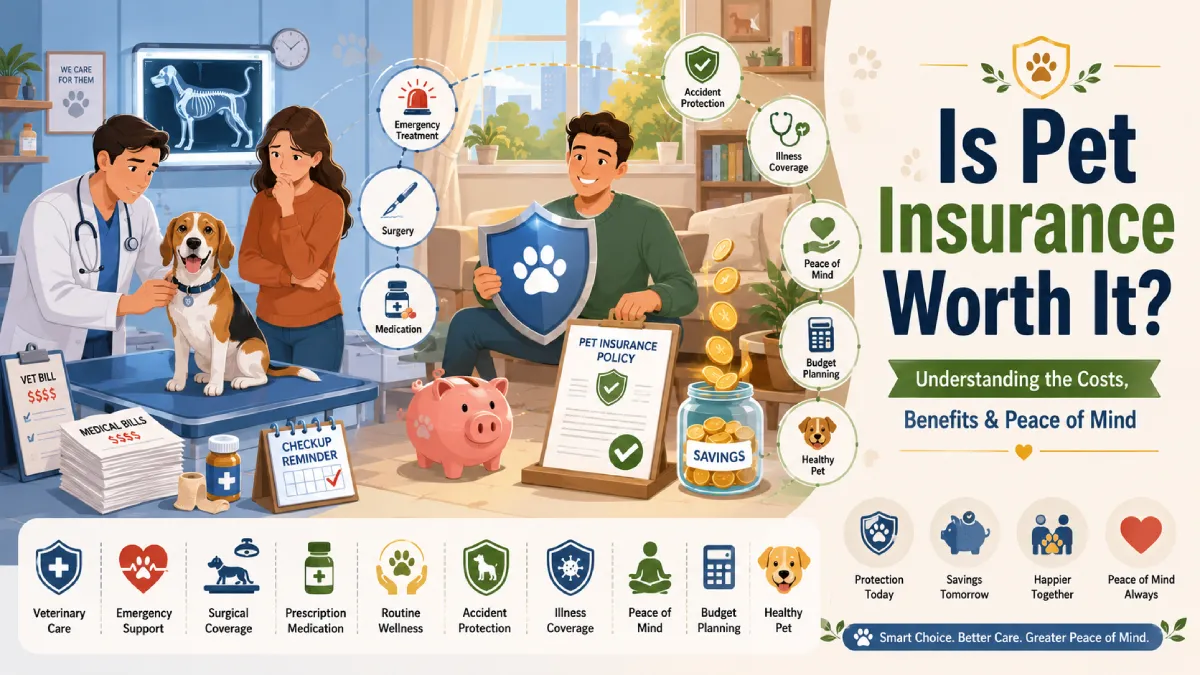
If you’re asking is pet insurance worth it, the answer depends less on finding the cheapest monthly premium and more on what financial risk you want the policy to absorb. Two policies with similar prices can differ substantially in deductibles, reimbursement, annual limits, waiting periods, exclusions and what treatments qualify for payment.
Pet insurance can reduce the financial impact of eligible unexpected veterinary bills, but buying a policy does not guarantee that every treatment will be covered. U.S. insurance regulators recommend comparing benefits, deductibles, limits and exclusions carefully and reading the actual policy terms before purchasing.
Quick Answer
Pet insurance may provide value if you want protection against eligible large or unexpected veterinary expenses and would find a major bill difficult to absorb from savings. It may be less attractive if you have substantial dedicated savings and prefer to accept that financial risk yourself. Before deciding, compare the premium, deductible, reimbursement method, limits, waiting periods and exclusions—not just the monthly price.
What Pet Insurance Actually Is
Pet insurance is designed to pay or reimburse eligible veterinary expenses according to the contract you purchase.
In the United States, the National Association of Insurance Commissioners describes the main product categories as:
- accident-only
- accident and illness
- wellness coverage or benefits
Policies contain their own covered services, exclusions, deductibles and payment limits.
Unlike many human health-insurance arrangements, pet policies often use a reimbursement model: the owner pays the veterinarian and later submits an eligible claim. Some arrangements can pay veterinary providers more directly, but this should be confirmed before assuming you will not need funds available at treatment time.
Accident Coverage
Accident coverage is intended for eligible unexpected injuries rather than ordinary illness.
The exact definition of an accident belongs in the individual policy. Do not assume that every injury automatically qualifies.
When comparing plans, ask whether accident coverage includes eligible expenses for:
- emergency examinations
- diagnostic imaging
- surgery
- hospitalisation
- prescriptions
- specialist treatment
- follow-up rehabilitation
Then check whether any separate deductible, limit or waiting period applies.
NAIC notes that policies may cover expenses such as surgeries, X-rays, prescriptions, hospitalisation and emergency treatment, but coverage differs by contract.
Illness Coverage
Accident-and-illness plans add eligible diseases and medical conditions to accident protection.
This can be important because an owner planning only for physical injuries may overlook the possibility of:
- infections
- gastrointestinal disease
- endocrine disease
- cancer
- chronic medical conditions
- other illnesses requiring diagnostics or ongoing treatment
However, an illness being medically genuine does not automatically mean it is insured. Pre-existing conditions, waiting periods, limits and other exclusions can still affect claims.
Accident-Only Plans
An accident-only plan offers narrower protection than accident-and-illness coverage.
NAPHIA defines accident-only policies as coverage for accident-related medical care, while accident-and-illness policies cover a broader range of unexpected injuries and sickness.
The lower level of coverage may suit an owner who deliberately wants protection against accidents but plans to self-fund illness. It should not be mistaken for comprehensive medical coverage.
Before selecting one, ask:
What happens financially if my dog develops a serious illness rather than suffering an accident?
Wellness Add-Ons
Routine care is often treated differently from unexpected illness or injury.
Depending on the insurer and country, a plan may include, offer separately or exclude benefits associated with routine care such as vaccinations, examinations or other preventive services. NAPHIA describes wellness coverage as potentially including items such as vaccinations, testing and dental work, while noting that product structures differ.
Do the calculation rather than assuming a wellness add-on automatically saves money.
Compare:
additional annual premium
against
maximum routine-care benefits you realistically expect to claim
Also confirm whether the wellness product is insurance, a rider, a separate benefit program or another type of arrangement in your jurisdiction.
Understand the Deductible
A pet insurance deductible is the amount you are responsible for before applicable insurance benefits are paid according to the policy.
California’s insurance regulator describes a deductible as an amount that can reduce claim reimbursement, while NAIC tells consumers to compare deductibles alongside benefits, limits and exclusions.
Do not compare deductible numbers without checking how they operate.
Ask:
- Is it annual?
- Is it applied by condition or incident?
- When does it reset?
- Does it apply before or after other adjustments?
- Do all types of coverage use the same deductible?
A $250 deductible is not meaningful until you know how often you might have to meet it.
Reimbursement Percentage
Many policies reimburse a percentage of eligible veterinary expenses.
Suppose, purely as a mathematical example, a policy reimburses 80% of an eligible amount after the applicable deductible. That does not necessarily mean the insurer pays 80% of the entire veterinary invoice.
Some charges may be:
- excluded
- above a benefit schedule
- outside the policy limit
- non-reimbursable
- subject to the deductible
NAIC notes that companies can use different reimbursement methods, including percentage-based reimbursement or benefit schedules.
When comparing percentages, ask what dollar amount the percentage is actually applied to.
Annual Limits
An annual limit caps the amount payable under the relevant policy terms during a policy year.
California’s Department of Insurance specifically advises consumers to ask whether a policy has annual or lifetime limits because those limits affect the total benefit potentially available relative to the premium.
A low premium paired with a low annual maximum may offer very different financial protection from a more expensive plan with a much higher limit.
Record the limit in writing when comparing quotes.
Lifetime Limits Where Applicable
Not every modern policy uses a lifetime maximum, but some insurance structures can impose lifetime, per-illness or other payment ceilings.
NAIC consumer guidance notes that pet health policies can contain lifetime or per-illness maximums, while California’s regulator tells consumers to specifically ask whether a lifetime limit applies.
Do not assume:
“Unlimited”
unless you have confirmed exactly what the policy means by that term and what other restrictions remain.
Waiting Periods
A waiting period is the period after coverage starts during which some or all benefits are not yet available.
California’s insurance regulator warns that treatment received before the applicable waiting period ends will not be covered under that provision.
Different types of coverage may have different waiting provisions.
Before buying, ask:
- When does accident coverage begin?
- When does illness coverage begin?
- Are there separate waiting periods for particular conditions?
- What happens if symptoms first appear during a waiting period?
Do not copy a waiting-period number from an old comparison article. Verify the current policy.
Pre-Existing-Condition Exclusions
This is one of the most important parts of any comparison.
In U.S. regulatory guidance, pet insurers commonly exclude pre-existing conditions. California advises consumers that an insurer may not pay treatment related to a condition for which veterinary advice or treatment occurred before enrolment when that condition falls under its pre-existing exclusion.
However, policy definitions differ.
Do not write:
“No pet insurer ever covers any previously existing condition.”
Some policies may distinguish among conditions differently, including potentially curable versus incurable conditions or applying specific waiting rules. NAIC advises owners to examine precisely how each contract treats them.
Request the insurer’s exact definition of pre-existing condition before buying.
Breed-Related and Hereditary Exclusions
Breed matters in two separate ways.
First, NAIC says breed can influence premium pricing. Second, some policies may restrict or exclude hereditary or congenital conditions.
California’s insurance regulator specifically advises consumers to check exclusions for hereditary disorders and congenital anomalies.
Before buying insurance for a breed with known health predispositions:
- Identify important health risks from reliable veterinary/breed-health sources.
- Ask the insurer whether those conditions are eligible.
- Check hereditary and congenital-condition wording.
- Save the written policy wording.
For example, Pawnium’s brachycephalic dog care guide explains health issues relevant to flat-faced breeds. Use breed-health articles to understand what questions to ask an insurer—not to predict that an individual dog will develop a condition.
Dental Coverage
“Dental coverage” can mean several different things.
A policy might distinguish between:
- dental injury
- dental illness
- routine cleaning
- preventive dental care
NAIC specifically warns that not every pet insurance policy covers dental care unrelated to an accident or injury.
Ask the insurer:
Are both dental accidents and dental illnesses covered, and is routine dental care separate?
Then check exclusions and limits.
Prescription Coverage
Some policies include eligible prescription drugs, while others limit what medications qualify.
NAIC lists prescription coverage as an important question consumers should ask when comparing insurance.
Check whether coverage differs for:
- medication administered in hospital
- medication dispensed by the veterinarian
- medication filled by an outside pharmacy
- ongoing medication for chronic conditions
Do not assume a covered diagnosis automatically makes every related prescription reimbursable.
Rehabilitation
If rehabilitation is important to you, find it in the policy rather than assuming it sits inside general treatment coverage.
Ask specifically about eligible services such as:
- veterinary rehabilitation
- prescribed physical rehabilitation
- post-operative rehabilitation
Also check:
- provider qualifications required
- referral requirements
- visit limits
- annual benefit limits
If the contract does not clearly answer the question, ask the insurer in writing before purchasing.
Alternative or Complementary Treatments
Terms such as “alternative,” “complementary” or “integrative” treatment can be defined differently across policies.
Do not rely on a comparison site’s yes/no tick.
Ask:
- Which treatments are specifically named?
- Must a veterinarian prescribe them?
- Must the provider have particular credentials?
- Is there a separate benefit limit?
- Are these services excluded entirely?
Policy wording should control the comparison.
Emergency Care
Emergency veterinary treatment is one of the main reasons many owners consider insurance, but emergency does not mean automatically covered.
An insurer still applies:
- policy eligibility
- exclusions
- waiting periods
- deductible
- reimbursement formula
- coverage limit
NAIC includes emergencies and hospitalisation among services that some policies may cover while emphasising that terms vary.
Pawnium’s Dog Emergency Kit Checklist should remain focused on practical emergency preparation rather than insurance decisions.
Specialist Treatment
Specialist care can involve diagnostics, surgery, oncology, neurology, orthopaedics or other referral services.
When comparing coverage, ask:
- Are specialist consultation fees eligible?
- Are advanced diagnostics covered?
- Are referral requirements imposed?
- Does reimbursement differ from ordinary veterinary treatment?
- Do annual limits apply in the same way?
Also confirm whether you are free to use the specialist your veterinarian recommends. NAIC advises consumers to ask whether their policy restricts veterinary networks.
Direct Pay Versus Reimbursement
This difference can matter even when two policies ultimately provide similar benefits.
Reimbursement Model
You:
- pay the veterinary bill
- submit the claim
- wait for eligible reimbursement
Direct-Pay Arrangement
An insurer may have a mechanism to pay some eligible amount more directly to a participating veterinary provider.
NAIC says most pet policies operate on reimbursement, although some companies may pay veterinary providers directly.
Before relying on direct pay, verify:
- whether your clinic participates
- whether pre-authorisation is needed
- whether emergency clinics can use it
- what amount you must still pay
- whether every type of claim qualifies
Insurance does not necessarily eliminate the need for accessible cash or credit at the veterinary clinic.
Premiums Can Increase
Do not evaluate a policy using only the first-year price.
In the United States, NAIC identifies several variables that can affect pet insurance cost, including:
- species
- breed
- sex
- age
- location
- selected coverage
- deductible
California also advises consumers to ask whether renewal premiums may increase after claims.
Ask each insurer:
- What factors can change my renewal premium?
- Does age affect future pricing?
- Can rates change because of claims history?
- Can prices change because veterinary costs rise locally?
- Can policy benefits change at renewal?
Do not assume the introductory premium stays fixed for life.
How Much Does Pet Insurance Cost?
There is no useful worldwide price because country, dog, coverage and insurer all matter.
For a clearly dated benchmark, NAPHIA’s 2025 State of the Industry Report, using 2024 data, reported average U.S. accident-and-illness premiums for dogs of $749.29 USD per year, or $62.44 per month. The Canadian average was $1,070.20 CAD per year, or $89.18 per month.
These numbers are not current individual quotes and should not be used to tell a reader what their dog will cost to insure.
NAPHIA’s newer 2026 State of the Industry Report, released in June 2026, confirms that 7.6 million pets were insured in North America at the end of 2025, illustrating that the market continues to change.
For your own budget, obtain fresh quotes using the same coverage assumptions from each insurer.
Age
Age can affect both price and eligibility.
NAIC notes that age is one of the factors influencing monthly premiums and that some companies may restrict enrolment after certain ages.
Do not generalise one company’s upper-age rule to the whole market.
For an older dog, compare:
- whether new enrolment is available
- premium
- deductible
- pre-existing exclusions
- chronic-condition rules
- annual limit
- renewal terms
Pawnium’s senior dog care guide can help identify the health and mobility topics owners may want to consider when reviewing coverage for an ageing dog.
Breed
Breed may influence both premium pricing and which exclusions matter most.
This does not mean every dog of a particular breed will become ill.
Instead, use breed-health information to generate questions such as:
- Are hereditary conditions eligible?
- Are congenital disorders treated differently?
- Are orthopaedic conditions subject to additional restrictions?
- Are breed-specific conditions excluded?
Pawnium breed-health pages should support that research without promising future diagnoses.
Location
Where you live can influence insurance pricing. NAIC explicitly includes location among factors that can affect monthly premiums.
This is another reason that “Company X costs $35/month” is poor evergreen content.
A quote for:
- one ZIP/postal code
- one breed
- one age
- one deductible
does not reliably price another reader’s dog.
How to Compare Policies Properly
When readers ask is pet insurance worth it, this is the comparison that matters most.
Do not line up policies based only on monthly premium.
Compare the same fields:
| Feature | Policy A | Policy B | Policy C |
|---|---|---|---|
| Monthly premium | |||
| Deductible | |||
| Reimbursement | |||
| Annual limit | |||
| Lifetime/condition limits | |||
| Waiting period | |||
| Pre-existing definition | |||
| Hereditary/congenital coverage | |||
| Dental | |||
| Prescriptions | |||
| Rehabilitation | |||
| Claims method |
NAIC and California insurance regulators both recommend comparing benefits, deductibles, reimbursement methods, limits and exclusions rather than judging a policy only by price.
Questions to Ask an Insurer
Before purchasing, ask:
- What counts as a pre-existing condition?
- How are curable conditions handled?
- What waiting periods apply?
- Is the deductible annual, per condition or structured another way?
- What reimbursement method do you use?
- What does the reimbursement percentage apply to?
- Is there an annual limit?
- Are there lifetime or per-condition limits?
- Are hereditary conditions covered?
- Are congenital conditions covered?
- Is dental illness covered?
- Are prescriptions covered?
- Is rehabilitation covered?
- Are specialist consultation fees covered?
- Can I use any licensed veterinarian?
- Do I normally pay the clinic first?
- Is direct pay available?
- How are claims submitted?
- Can premiums rise at renewal?
- What happens to coverage if the policy wording changes?
These questions closely reflect the comparison points U.S. insurance regulators recommend consumers investigate before purchasing coverage.
Insurance Versus Emergency Savings
Pet insurance and emergency savings solve different financial problems.
Insurance
You pay recurring premiums to transfer part of the financial risk of eligible events to the insurer under the policy contract.
Emergency Savings
You retain the financial risk but keep the money yourself until it is needed.
Self-funding gives you flexibility because your savings are not subject to insurance exclusions. The tradeoff is that the fund may be too small if a major expense occurs before you have accumulated enough.
Insurance may offer more protection against a large eligible early expense, but premiums paid are generally a cost of maintaining coverage rather than savings you later reclaim simply because you made no claim.
NAIC recommends considering how much emergency treatment or a prolonged illness your household could afford when deciding whether insurance is appropriate.
A hybrid strategy is also possible: maintain insurance while keeping savings for deductibles, excluded services and expenses that must be paid before reimbursement.
When Pet Insurance May Provide Value
Insurance may be particularly attractive when:
- a large unexpected veterinary expense would substantially disrupt your finances
- you prefer predictable premiums to retaining the full medical-expense risk
- you want access to a higher annual coverage limit than you could currently self-fund
- your dog is eligible for useful coverage with acceptable exclusions
- the policy terms match the medical risks you want to transfer
This is not a promise that buying insurance will save money over the dog’s lifetime.
The value comes from risk transfer, not guaranteed profit.
When Someone May Choose Self-Funding
An owner may prefer self-funding when:
- substantial dedicated savings are already available
- insurance exclusions significantly reduce useful coverage
- premiums are difficult to justify relative to the policy limits
- the owner is comfortable accepting unpredictable veterinary costs
- the dog has existing conditions that the available policies would exclude
The decision should compare your real financial capacity with the actual written policy—not a generic statement that everyone should or should not buy insurance.
Common Pet Insurance Mistakes
Choosing the Cheapest Premium
A cheaper plan may also have:
- higher deductible
- lower reimbursement
- lower annual limit
- narrower coverage
Buying Without Reading Exclusions
A condition you expected to be covered may fall under a pre-existing, hereditary, congenital or other exclusion.
Assuming “90% Reimbursement” Means 90% of Every Invoice
The percentage may apply only to eligible expenses after other policy terms are applied.
Ignoring Waiting Periods
Symptoms or treatment occurring before coverage becomes effective may not qualify.
Assuming Premiums Never Change
Age, location, coverage choices and other rating factors can affect pricing.
Treating Wellness Coverage as the Same as Major Medical Protection
Routine-care benefits and accident-and-illness insurance solve different budgeting problems.
Cancelling Without Considering Future Eligibility
Changing insurers later can expose you to a new policy’s definition of pre-existing conditions based on the dog’s medical history. NAPHIA specifically notes that prior medical history can affect exclusions when switching providers.
Relying on Old Comparison Tables
Premiums, benefits and exclusions can change.
Every Pawnium insurance comparison should display a visible last checked date and direct readers to verify the current policy wording before purchasing.
FAQs
Is pet insurance worth it for a healthy young dog?
It can be, but good current health does not predict whether future eligible accidents or illnesses will occur. Starting before medical problems develop may reduce the number of issues considered pre-existing, but coverage still depends on the individual contract.
Is dog insurance worth it if I already have savings?
Possibly. Savings give you maximum flexibility, while insurance can transfer part of the risk of larger eligible bills. Compare how much you could comfortably pay today—not just how much you expect to save eventually.
Does pet insurance cover pre-existing conditions?
Many U.S. policies exclude them, but definitions and treatment of particular conditions vary. Read the policy’s exact pre-existing-condition language rather than assuming every insurer handles every condition identically.
Does pet insurance cover dental treatment?
It depends. Some policies distinguish dental accidents, dental illness and routine cleaning. NAIC notes that dental care unrelated to an accident or injury is not covered by every policy.
Will pet insurance pay my veterinarian directly?
Sometimes, but many policies use reimbursement: you pay first and submit a claim. Verify whether direct payment is available with the specific insurer and veterinary clinic before relying on it.
Can my pet insurance premium increase as my dog gets older?
Age is one factor that can influence pet-insurance pricing in the United States. Other variables include breed, location, selected coverage and deductible. Ask the insurer how renewal pricing works rather than assuming your original premium is permanent.