
Maine Coon Cat: Size, Temperament, Grooming and Care Guide
The Maine Coon cat is a large, slow-maturing breed with a substantial rectangular body, semi-long coat and strong reputation for being social and playful. Those broad tendencies are useful when researching the breed, but they should not become guarantees about an individual cat. Maine Coons vary in adult size, coat texture, confidence, vocal behaviour, grooming needs and comfort around children or other animals.
The practical ownership questions are therefore bigger than “How large will it get?” A prospective owner should also consider grooming, enrichment, appropriately sized equipment, weight management and breed-specific health screening.
Quick Breed Profile
| Trait | General Maine Coon Profile |
|---|---|
| General size | Large; males usually larger than females |
| Maturation | Slow; full physical maturity may take several years |
| Body | Long, rectangular, muscular and substantially boned |
| Coat | Semi-long, shaggy and variable in texture |
| Grooming | Moderate overall, but some coats require considerably more work |
| Activity | Moderate; many remain playful into adulthood |
| Social tendency | Generally people-oriented without necessarily being constant lap cats |
| Vocal tendency | Often associated with chirps and trills, but individuals vary |
| Life expectancy | TICA currently lists 12.5+ years |
| Important screening areas | HCM, SMA, PK deficiency and appropriate orthopedic screening |
TICA describes Maine Coons as one of the larger domestic breeds and notes that they mature slowly. Its current breed page lists a life expectancy of 12.5+ years, but this should be treated as a general breed reference rather than a promise of how long any individual cat will live.
Breed History
The Maine Coon developed in New England and is strongly associated with the state of Maine. CFA traces the breed’s documented American history back to the 19th century, while TICA notes an 1861 mention of a black-and-white cat called Captain Jenks of the Horse Marines. Maine Coons were also present during the early development of organised American cat shows.
Numerous stories have been attached to the breed’s origins, including the famous claim that domestic cats interbred with raccoons. That explanation is biologically impossible. Other historical stories involving ship cats or imported long-haired cats are interesting, but they should not be presented as established origin facts.
The safer historical description is that the Maine Coon developed as a hardy long-haired domestic cat population suited to the climate of northeastern North America.
How Large Do Maine Coons Get?
Adult Maine Coon Size
The Maine Coon is genuinely a large breed, but viral photographs of exceptionally enormous cats create a distorted idea of what normal Maine Coon size looks like.
Major registries consistently describe the breed as large, long-bodied and substantially built. TICA also states that males are generally larger than females. However, its current breed page gives somewhat different typical weight figures in different sections, which is another reason Pawnium should avoid presenting one narrow adult weight as the definition of a normal Maine Coon.
The most useful owner takeaway is:
large breed + broad individual variation + males often heavier than females.
A healthy weight should ultimately be judged using body condition, muscle condition and veterinary assessment rather than by trying to make a cat reach an impressive breed number. Cornell specifically recommends adjusting feeding to maintain appropriate body condition instead of relying on a universal feeding amount.
Growth and Maturation
Maine Coons mature more slowly than many cats.
TICA states that the breed may not achieve its full mature size until roughly 3–5 years, with its quick breed summary using about four years as a typical maturity point.
That does not mean a Maine Coon grows at the same rate every month for four years. Much of the rapid kitten growth occurs earlier, while body breadth, musculature and overall mature appearance continue developing afterward.
Do not deliberately overfeed a juvenile Maine Coon in an attempt to make it grow larger.
Male Versus Female Variation
Sex influences average body size, but it does not create two completely separate types of Maine Coon.
Males generally tend to be heavier and more substantially built, while females are often somewhat smaller. Individual genetics and body condition still create overlap.
Avoid statements such as:
“Every male Maine Coon reaches X pounds.”
or:
“Female Maine Coons never become large.”
Neither reflects normal biological variation.
Body Structure
The breed standard calls for a substantial, muscular cat with a long rectangular body, broad chest, large feet and a long tail. The head has a characteristic squared muzzle, while the ears are large and may carry tufts.
Their apparent size is also enhanced by:
- substantial bone
- a long body
- a large tail
- coat volume
- a neck ruff
- longer fur around the belly and hindquarters
This is why a Maine Coon can look extremely imposing without necessarily having an extreme body weight.
Coat and Appearance
Maine Coon Coat
The mature Maine Coon has a shaggy semi-long coat adapted historically to a colder climate. TICA describes the coat as shorter over some areas of the back and shoulders and longer around the ruff, belly and hindquarters. Coat texture can vary considerably between individuals.
That variation matters for Maine Coon grooming.
One cat may have a relatively silky coat that remains manageable with regular combing. Another may have a denser or more cottony texture that tangles much faster and needs substantially more frequent attention.
Colours and Patterns
Maine Coons occur in a wide variety of traditional feline colours and patterns.
TICA lists examples including:
- brown tabby
- red tabby
- silver tabby
- black
- white
- blue
- tortoiseshell
- tabby-and-white combinations
Classic, mackerel and other accepted tabby patterns occur. TICA’s current standard does not accept pointed colouration as a normal Maine Coon pattern.
Brown tabby may be strongly associated with the breed visually, but it is not the only authentic Maine Coon appearance.
Maine Coon Temperament and Personality
General Temperament
Typical Maine Coon temperament is described by the major breed registries as gentle, easy-going and people-oriented. TICA notes that many prefer being close to their people without constantly demanding attention.
That distinction matters.
A Maine Coon can be socially involved without necessarily being:
- a lap cat
- comfortable being carried
- friendly with every visitor
- tolerant of every child
- immediately accepting of other pets
Breed tendencies help predict probabilities, not individual behaviour.
Social Behaviour
Many Maine Coons follow household activity closely and prefer spending time near their caregivers. TICA describes them as people-oriented without being unusually dependent.
Individual socialisation and experience still matter. A poorly socialised, fearful or previously stressed Maine Coon may behave very differently from the familiar relaxed breed stereotype.
Activity Level
Adult Maine Coons generally sit in a moderate activity range.
They are not usually portrayed as relentlessly active in the way some highly athletic breeds are, but they still need daily opportunities to move, climb, chase and play. TICA notes that many retain playful behaviour throughout life when given appropriate opportunities.
Large body size should not become an excuse for a sedentary lifestyle.
Play
Interactive play supports both physical activity and the human-cat relationship.
Suitable options can include:
- wand-toy chasing
- floor-level prey games
- tunnels
- puzzle feeders
- balls
- climbing structures
- short training sessions
Some Maine Coons retrieve objects or learn harness walking and simple trained behaviours. These are possibilities, not traits every Maine Coon will display.
Avoid the common shortcut that Maine Coons “act like dogs.” They remain cats with normal feline behavioural needs.
Intelligence
Maine Coons are commonly described as curious and trainable.
Rather than turning “intelligent” into a marketing label, owners should translate it into a responsibility: provide things for the cat to investigate and do.
FelineVMA guidance for indoor cats emphasises opportunities for play and predatory behaviour, safe places, separated resources and positive, predictable human interaction.
Vocalisation
Maine Coons are famous for chirps, trills and softer vocalisations, but they should not be categorised as universally quiet.
TICA notes that many use chirps and trills more commonly than a conventional loud meow, but individuals can vary substantially in how often and how loudly they communicate.
Use:
“often associated with chirps and trills”
rather than:
“Maine Coons are quiet cats.”
Maine Coons in Different Households
Children
Breed profiles commonly describe Maine Coons as socially tolerant and capable of living successfully in active family homes. That does not mean every Maine Coon is automatically safe or comfortable with every child.
Compatibility depends on:
- individual temperament
- previous experience
- socialisation
- the child’s behaviour
- whether the cat can move away
- whether handling is respectful
Children should never chase, restrain or carry a cat that is trying to leave.
Other Cats
A Maine Coon may live successfully with other cats, but breed identity cannot guarantee compatibility.
FelineVMA notes that tension between household cats can be subtle and frequently appears when another cat is introduced. Adequate resources and a gradual introduction remain important regardless of breed.
The relevant question is not merely:
“Are Maine Coons good with cats?”
It is:
“Are these two individual cats likely to coexist comfortably, and has their environment been set up appropriately?”
Dogs
TICA describes the breed as often compatible with dogs and other household animals, but the dog’s behaviour toward cats is critical.
A gradual introduction is safer than assuming the Maine Coon’s size or reputation will protect it from an excitable or predatory dog. Cats Protection likewise recommends controlled, gradual cat-dog introductions.
Apartment Living
A Maine Coon can live in an apartment if the environment actually accommodates a large cat.
Think beyond floor area. The home needs room for:
- a genuinely large litter box
- a stable scratching post
- climbing equipment
- comfortable resting areas
- interactive play
Indoor environmental quality matters more than simply labelling a breed an “apartment cat.”
Indoor Lifestyle
Indoor living can reduce exposure to several outdoor hazards, but an indoor Maine Coon still needs opportunities to express normal feline behaviour.
FelineVMA’s current indoor-cat position statement emphasises safe spaces, separated resources, play/predatory behaviour, positive social interaction and consideration of feline sensory needs.
For a large breed, make sure climbing structures are stable enough and platforms are large enough to be genuinely usable.
Maine Coon Grooming and Coat Care
How Much Grooming Do Maine Coons Need?
There is no single Maine Coon grooming schedule that fits every coat.
TICA notes that some coats remain manageable with approximately weekly combing, while denser or more cottony coats can require much more frequent grooming.
The practical rule is:
check the coat frequently and let actual coat condition determine grooming frequency.
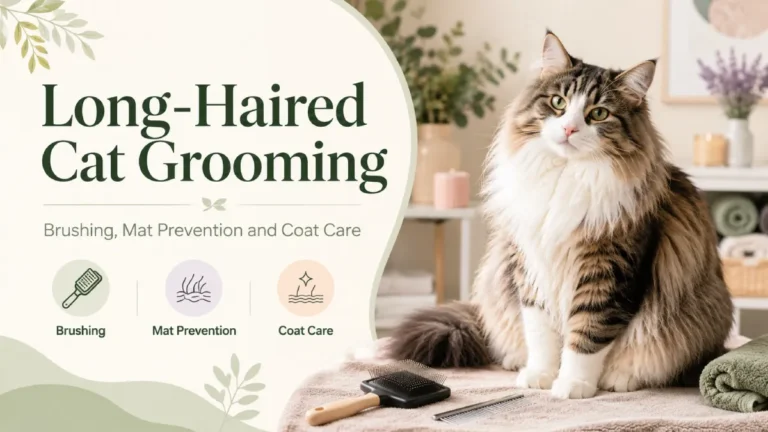
For the complete long-coat workflow, use Pawnium’s Long-Haired Cat Grooming guide. Its verified Pawnium URL is /long-haired-cat-grooming/.
Brushing and Combing
A brush can collect loose surface hair, while a suitable comb helps check whether deeper portions of the coat remain separated.
Pay particular attention to:
- armpits
- chest
- belly
- hindquarters
- behind the ears
- longer leg furnishings
The existing long-haired grooming page owns detailed brush-versus-comb technique, undercoat management and weekly scheduling rather than duplicating that entire workflow here.
Mat Prevention
Prevent small tangles from becoming skin-level mats by inspecting high-friction areas regularly.
If a comb repeatedly meets a firm, dense mat, do not simply increase force. The dedicated Pawnium matting workflow should handle removal safety rather than this breed page becoming a dematting guide.
Regular maintenance is particularly important for Maine Coons with dense, high-maintenance coat texture.
Maine Coon Shedding
Maine Coon shedding can change across the year, and indoor living may also affect the pattern.
More loose fur means more coat maintenance, particularly when the undercoat is releasing heavily. Increase brushing or combing according to the actual amount of loose coat rather than trying to strip attached fur.
This page should not create a separate universal “Maine Coon shedding calendar,” because individual environment and coat characteristics affect shedding.
Hairballs
Long-haired breeds including Maine Coons can have a greater hairball risk because they may swallow more or longer loose hairs while grooming. Cornell recommends regular brushing and combing as one way to reduce the amount of loose fur available for ingestion.
Do not treat repeated vomiting or unproductive retching as “just a Maine Coon thing.”
Pawnium’s Cat Hairballs article owns:
- hairball appearance
- recurrent episodes
- hairball versus vomiting
- hairball versus coughing
- obstruction warning signs
The URL /cat-hairballs/ is already verified in the Pawnium library.
Nail and Dental Care
Nail Care
Maine Coons need the same basic claw monitoring as other domestic cats.
Check nails regularly, provide appropriate scratching surfaces and trim when needed. Large paws or extra toe tufts do not change the basic rule that the quick must be avoided.
Some Maine Coons are polydactyl, meaning they have extra digits. If your individual cat is polydactyl, make sure every claw—including less obvious extra claws—is checked. TICA recognises Maine Coon Polydactyl cats separately within its breed programme.
Dental Care
Dental health should be part of lifelong Maine Coon care, not something delayed until bad breath develops.
AAHA/AAFP feline guidance recommends proactive oral care, including home tooth brushing when the mouth is healthy enough to tolerate it and regular veterinary dental assessment.
Use pet-specific dental products rather than human toothpaste.
Feeding and Weight
Feeding Considerations
Being a large breed does not mean a Maine Coon should simply receive an unusually large bowl of food.
Feed an appropriate complete and balanced diet for the cat’s life stage, and adjust the amount according to:
- age
- body condition
- activity
- neuter status
- actual calorie density of the food
- veterinary recommendations
- health conditions
Cornell emphasises that individual cats vary considerably in their food requirements and recommends adjusting intake to maintain appropriate body condition.
For full portion guidance, link to Pawnium’s Adult Cat Feeding Guide, which is the currently verified feeding destination in the Pawnium cluster.
Weight Management
Do not confuse “large breed” with “should be heavy.”
A Maine Coon can have a large skeletal frame and still become overweight. Extra body fat is not necessary for breed type and can make grooming and movement more difficult.
WSAVA recommends routine assessment of body condition rather than relying solely on scale weight.
A useful owner question is:
Does my cat have an appropriate body condition for its individual frame?
rather than:
Has my Maine Coon reached the weight I saw online?
Health Screening
Health testing is one of the most important considerations when buying a pedigree Maine Coon.
Hypertrophic Cardiomyopathy
A breed-associated variant in MYBPC3, often called the A31P Maine Coon HCM variant, is associated with increased risk of hypertrophic cardiomyopathy. UC Davis offers a breed-specific DNA test for this mutation.
However, a negative DNA result does not rule out every possible form of HCM.
TICA specifically recommends combining genetic information with appropriate cardiac evaluation and notes that not every HCM-associated mutation has been identified.
That distinction should remain very clear on Pawnium:
HCM DNA test ≠ complete guarantee of a disease-free heart.
Spinal Muscular Atrophy
Spinal muscular atrophy, or SMA, is an inherited neuromuscular condition recognised in Maine Coons. UC Davis offers genetic testing for the known recessive variant.
Responsible breeding programmes can use DNA results to avoid producing affected kittens.
Pyruvate Kinase Deficiency
Maine Coons are also among the breeds for which UC Davis lists genetic screening for erythrocyte pyruvate kinase deficiency. The disorder can cause inherited haemolytic anaemia.
Orthopedic Screening
Because Maine Coons are a substantial breed, orthopedic health is also relevant.
TICA notes that some responsible breeders assess breeding cats for hip dysplasia and patellar problems in addition to cardiac and DNA screening.
This does not mean every Maine Coon will develop joint disease. It means a prospective buyer should ask what breed-appropriate screening has actually been performed.
Questions to Ask a Responsible Maine Coon Breeder
Do not stop at:
“Are your kittens healthy?”
Ask for specifics.
Useful questions include:
- What cardiac screening has been performed on the sire and dam?
- Can I see the HCM DNA results?
- Have the breeding cats had cardiac imaging, and by whom?
- What SMA testing has been completed?
- What PK-deficiency testing has been completed?
- Has orthopedic screening been performed?
- Can I see the actual health records rather than a verbal assurance?
- Can I see the parents, either in person or by video?
- How are the kittens socialised and raised?
- What vaccinations and veterinary care have been completed?
- What is the return policy?
- Is there a written contract and health guarantee?
TICA’s buyer guidance specifically recommends requesting sire and dam health/genetic records, seeing the parents where possible, checking pedigree information and reviewing the breeder’s written contract and return policy.
Do not rely on statements such as:
“We have never had heart problems.”
Ask for the relevant documentation.
Rescue Considerations
You do not have to purchase a kitten to live with a Maine Coon or Maine Coon-type cat.
Breed-specific rescues, general rescues and shelters may occasionally have adult pedigreed cats or cats described as Maine Coon mixes. Unless ancestry is documented, however, appearance alone cannot confirm that a large long-haired cat is genetically a Maine Coon.
Adopting an adult can have one useful advantage: its current:
- adult size
- coat texture
- grooming tolerance
- activity
- sociability
may already be much easier to assess than those traits would be in a young kitten.
Example Daily Maine Coon Routine
A healthy adult routine might be organised around needs, rather than rigid clock times.
Morning
- measured meal according to the cat’s feeding plan
- fresh water check
- quick coat and body observation
- litter-box check
- short social interaction or play
During the Day
Provide opportunities for:
- climbing
- scratching
- resting in a secure location
- window observation
- puzzle or hunting-style feeding
- independent play
Evening
Use a more active interactive play session.
Rotate activities such as:
- wand chasing
- retrieving if the individual enjoys it
- food puzzles
- training
- exploration games
Coat Check
Run your hands through the coat and pay particular attention to high-friction areas. Comb or brush according to the individual coat’s needs.
Routine Health Maintenance
Periodically include:
- claw checks
- tooth brushing if tolerated
- ear and skin observation
- body-condition monitoring
The exact routine should change with age, health, coat density and the cat’s individual activity level.
Who May Suit a Maine Coon?
A Maine Coon cat may be worth considering if you want a larger companion and are comfortable providing:
- regular long-coat maintenance
- daily play
- stable climbing furniture
- large litter boxes and carriers
- ongoing enrichment
- measured feeding and weight monitoring
- preventive dental care
- breed-specific health-screening research
The breed may be less practical if you specifically want:
- almost no coat maintenance
- very small equipment
- a cat guaranteed to be quiet
- a cat guaranteed to enjoy children
- a cat guaranteed to accept another pet
- a predictable exact adult size
The strongest ownership decision should combine breed tendencies with the actual individual cat.
FAQs
How big does a Maine Coon cat get?
Maine Coons are a large domestic breed, with males generally larger than females. Exact adult weight varies substantially, and even TICA’s current profile provides different typical figures in different sections. Do not use viral giant-cat examples or one target weight as the definition of a healthy Maine Coon.
How long does a Maine Coon take to reach full size?
Maine Coons mature slowly. TICA describes full development as taking several years and refers to roughly three to five years in its detailed breed information.
What is the typical Maine Coon temperament?
The breed generally trends social, gentle, playful and people-oriented, but individual personality varies. A Maine Coon is not guaranteed to be a lap cat, tolerant of children or compatible with every other animal.
Do Maine Coons need a lot of grooming?
It depends heavily on coat texture. Some Maine Coons can remain manageable with regular weekly combing, while denser or cottonier coats may need much more frequent attention.
Do Maine Coons shed a lot?
Maine Coons have substantial semi-long coats and will shed loose hair, with the amount changing between individuals and seasons. Regular brushing or combing helps remove loose coat and may also reduce the amount of fur swallowed during self-grooming.
What is the Maine Coon lifespan?
TICA currently lists a life expectancy of 12.5+ years. This is only a general breed reference: longevity varies with genetics, health, preventive care, body condition, environment and individual disease risk.