
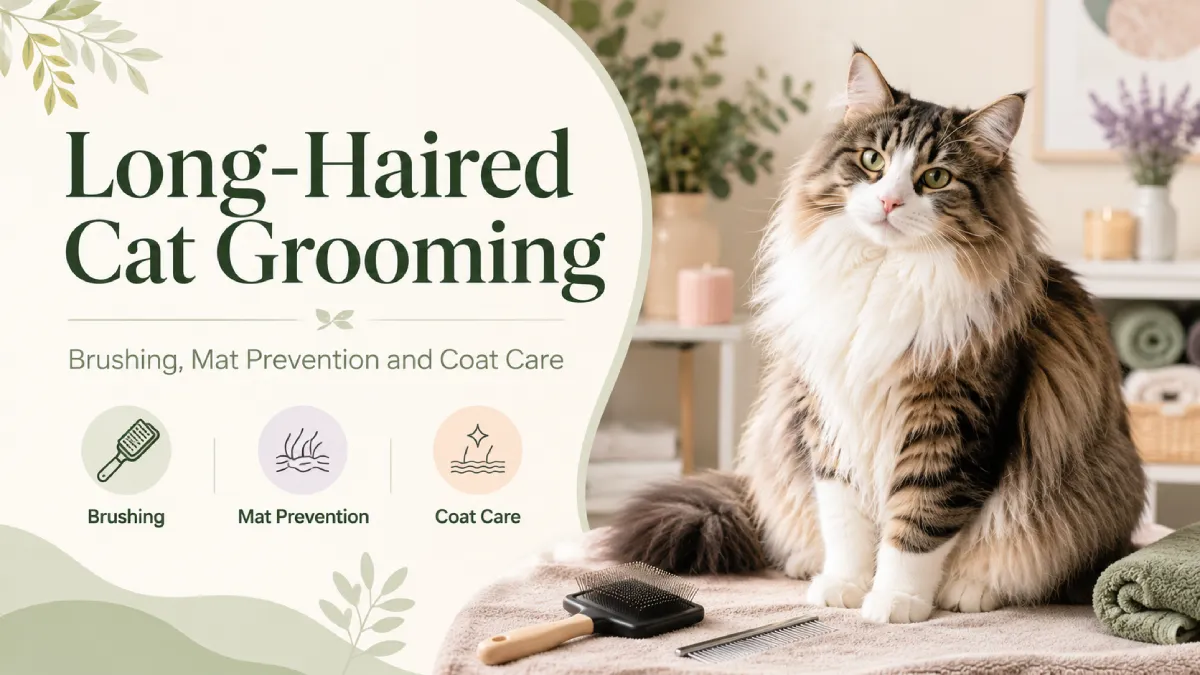
Long-Haired Cat Grooming: Brushing, Mat Prevention and Coat Care
Long-haired cat grooming works best as regular maintenance rather than occasional attempts to repair a tangled coat. Longer hair can trap shed fur, hide early knots and tangle around high-friction areas such as the armpits, behind the ears and along the hind legs. Some long coats also contain a substantial undercoat that becomes more noticeable during shedding periods. VCA recommends daily attention for long, silky or curly coats to reduce tangling and mat formation.
The goal is not to remove as much fur as possible. It is to keep the coat comfortably separated, find small problems early and notice when a change in coat condition may reflect reduced self-grooming or another health issue.
Quick Answer
Most long-haired cats benefit from brief daily brushing or combing, with extra attention to mat-prone areas such as behind the ears, armpits, belly and hindquarters. Use a cat-appropriate brush plus a long-toothed comb that can check beneath the surface coat. Stop when you meet a tight mat rather than pulling harder, and use professional or veterinary help when matting is painful or close to the skin.
Why Long Coats Need Additional Monitoring
Long hair creates more opportunities for loose and attached hairs to twist together. A coat can also look smooth on the surface while small tangles develop underneath.
VCA notes that long-haired coats frequently require daily grooming to prevent tangles and recommends regular inspection around the armpits, groin and behind the ears. Regular coat checks also make it easier to notice skin sensitivity, parasites, lumps or other changes.
This is why effective long-haired cat grooming involves both brushing and inspection.
Long-Haired Cats Do Not All Have the Same Coat
“Long-haired” describes hair length, not one universal coat structure.
Cats can differ in:
- outer-hair texture
- undercoat density
- coat thickness
- silkiness
- curl
- seasonal shedding
- tendency to tangle
VCA explains that most feline coats contain outer guard hairs and a finer insulating undercoat, while long-haired cats may have fine outer coats that tangle particularly easily.
One cat may develop knots quickly despite daily grooming; another may have a less dense coat that remains manageable with a simpler routine. Tool choice and frequency should therefore be adjusted to the actual coat rather than just the breed label.
Brushing Removes Surface Loose Fur
Brushing helps collect loose hair and debris and keeps the surface coat orderly.
When you brush a long-haired cat, use gentle strokes and work in manageable sections. Avoid repeatedly dragging a tool through resistance. The existing Pawnium How to Brush a Cat guide should remain the detailed resource for brush direction, pressure and cooperative brushing technique.
The Pawnium brushing architecture already reserves deeper long-coat maintenance for this dedicated article.
Combing Checks Beneath the Surface
For many long coats, a comb is especially useful because it can reveal tangles that a surface brush misses.
VCA recommends long-toothed metal combs or brushes for medium and long coats because they can remove loose hair and smooth minor tangles.
A useful sequence is:
- gently brush loose surface coat
- follow with a long-toothed comb
- work through a small section at a time
- note any repeated catching or resistance
- stop rather than pulling through a tight knot
If the brush glides over the back but a comb repeatedly catches underneath, the coat is not yet fully tangle-free.
Pay Attention to the Undercoat
Loose undercoat can remain trapped beneath longer outer hair, particularly during heavier shedding.
Some combs are designed to collect loose undercoat, but the tool needs to suit the individual cat and should never be dragged aggressively through the coat. VCA specifically recommends gentle handling and warns against excessive pulling on tangles.
The purpose of undercoat care is to remove hair that is already loose—not strip healthy attached coat.
Know the Mat-Prone Areas
The most useful places to check regularly are areas affected by movement, friction or difficult grooming access.
VCA highlights the under-leg areas, rear end, chest and collar region as common sites for long-haired cats to develop mats.
Armpits
The hair beneath the front legs rubs whenever the cat walks. It can also be difficult to see without gently lifting the leg.
Run your fingers through this area regularly and use the comb only while the coat separates comfortably.
Chest
Long chest hair can rub during movement or beneath a collar or harness.
Comb the area in small sections rather than pulling a large amount of coat at once.
Belly
The belly may have fine, soft hair that tangles easily and can be a sensitive handling area.
Do not force a cat onto its back for grooming. Work only in positions the cat comfortably accepts.
Hind Legs and Hindquarters
Loose coat can collect along the backs of the legs and around the rear end. VCA specifically identifies the back legs as an area where minor tangles and loose undercoat may accumulate.
These areas deserve even closer monitoring in overweight or older cats that cannot easily groom them.
Behind the Ears
Fine hair behind the ears can develop small knots quickly.
VCA identifies this as one of the important daily inspection areas for cats with long coats.
If a knot becomes tight or sits directly against the skin, move to Pawnium’s Matted Cat Fur guide rather than trying to comb harder. That page is specifically positioned around mat severity and safe professional escalation.
Tail
The tail can carry a surprisingly full coat in some cats.
Support the tail naturally rather than twisting or pulling it while brushing. Work through the fur in sections and stop if the cat becomes protective of the area.
Do not assume every long-haired cat needs extensive tail brushing; coat density varies.
Grooming Tools for a Long-Haired Cat
A practical long-haired cat grooming kit does not need a large collection of tools.
Useful options may include:
- long-toothed metal comb
- cat-appropriate brush
- grooming mitt for cats that prefer stroking-like contact
- suitable undercoat comb when the individual coat needs it
VCA recommends long-toothed combs for medium and long coats, while Cats Protection also lists combs as particularly suitable for long-haired cats.
Avoid choosing a tool purely because it is marketed as a powerful “deshedder.” Tool length, sharpness and resistance matter.
Short Daily Sessions Are Better Than Grooming Marathons
A long coat benefits from consistency, but the entire cat does not have to be thoroughly groomed in one prolonged session.
Cats Protection recommends beginning with small amounts of grooming and gradually building tolerance rather than attempting everything at once.
A practical routine might look like:
morning: quick finger check behind ears and under front legs
later: brush the back and sides
another short session: comb chest, belly or hindquarters
Rotating areas can be especially helpful for cats that dislike prolonged handling.
A successful session ends while the cat is still comfortable.
Seasonal Shedding
Long-haired cats may shed throughout the year, especially when living indoors, while some cats experience more noticeable seasonal undercoat release.
VCA notes that indoor cats may shed guard hairs and undercoat at low levels year-round, while some cats exposed to seasonal conditions undergo heavier periods of undercoat shedding.
During heavier long-haired cat shedding, increase attention to the loose undercoat as needed instead of trying to remove large amounts of attached hair.
For the full normal-versus-abnormal shedding discussion, Pawnium’s Cat Shedding Guide already owns that topic. Its role is specifically normal coat turnover, seasonal variation and abnormal shedding boundaries.
Hairballs and Long Coats
Cats swallow loose hair while self-grooming.
Cornell notes that long-haired cats may be at greater risk of hairballs and recommends regular brushing and combing to reduce the amount of loose fur available for ingestion.
That makes coat maintenance useful, but this page should not treat every episode of vomiting or retching as a grooming problem.
Pawnium’s Cat Hairballs guide owns:
- what a hairball looks like
- normal versus frequent episodes
- hairball versus vomiting
- hairball versus coughing
- obstruction warning signs
Its verified URL is /cat-hairballs/.
Do Long-Haired Cats Need Baths?
A long coat does not automatically create a fixed bathing schedule.
Most healthy adult cats rarely require full baths. Bathing becomes more useful when the coat is genuinely dirty, contaminated, difficult for the cat to maintain, or when a veterinarian has prescribed bathing for a medical reason.
Before a bath:
- check for tangles
- deal with loose minor tangles
- do not soak severe mats
- use shampoo specifically intended for cats
VCA warns that tangles can become much harder to remove after the coat is wet.
Drying a Long Coat
Long fur holds more water than a short coat and needs careful drying.
ASPCA recommends towel drying in a warm, draft-free location. If a cat tolerates a dryer, it should be used cautiously at low heat; long hair may also need careful combing as it dries.
Do not:
- use very hot airflow
- chase a frightened cat with a dryer
- vigorously rub a tangled coat
- leave the dense undercoat damp for an unnecessarily long period
After drying, gently check that the coat is separating rather than forming new tangles.
Sanitary-Area Hygiene
Long fur around the hindquarters can collect urine, litter or stool more easily than a short coat.
VCA notes that soiling around the rear can be especially noticeable in long-haired cats, while ASPCA advises routinely checking beneath the tail for material caught in the coat.
For minor ordinary soiling, local cleaning may be preferable to a full bath.
Repeated fecal or urine contamination deserves more attention. It may indicate:
- diarrhoea
- mobility problems
- obesity
- inability to self-groom
- another medical issue
If a sanitary trim is needed repeatedly, a qualified groomer or veterinary team can help determine the safest approach.
Nail Care Still Matters
Long-haired cats need the same claw monitoring as other cats.
Check the nails during routine grooming and make sure overgrowth is not being missed, particularly in older or less active cats. Cornell notes that ageing cats can develop thick, brittle or overgrown claws as self-maintenance changes.
Nail trimming is a separate skill from coat maintenance, so it should remain brief here rather than becoming another full tutorial.
Senior Long-Haired Cats
Senior cats often need more hands-on coat care.
Cornell notes that older cats may groom themselves less effectively, sometimes resulting in matting, odour and skin inflammation. It also specifically recommends gentle grooming assistance as self-grooming declines.
For an older long-haired cat, pay extra attention to:
- lower back
- hips
- hindquarters
- belly
- areas the cat can no longer comfortably reach
A sudden change in self-grooming should not be dismissed as “just ageing.”
Increasing matting, sensitivity or reluctance to twist may be associated with pain or another health problem.
The future Senior Cat Grooming page should own the full ageing-specific routine once its exact Pawnium URL is confirmed.
Overweight Cats May Need More Assistance
Body condition can affect coat maintenance.
An overweight cat may have difficulty reaching the rump, lower back or hindquarters. VCA specifically identifies obesity as a reason some long-haired cats develop mats in areas they cannot groom effectively.
That means repeated rear-end matting should not always be treated as a brushing failure.
Help maintain the coat, but also discuss body condition and reduced self-grooming with the veterinary team when appropriate.
When Professional Grooming Helps
Professional grooming may be useful when:
- coat maintenance repeatedly exceeds what the cat tolerates at home
- minor tangles keep developing despite an appropriate routine
- sanitary-area trimming is difficult
- bathing or complete drying is impractical
- the cat has a coat that needs more skilled maintenance
Cats Protection suggests professional help when home grooming cannot be performed comfortably, while VCA recommends groomer or veterinary assistance for extensive mats or difficult coat care.
Professional grooming should still respect the cat’s stress level.
When Clipping May Be Appropriate
Clipping can be useful in selected situations, particularly when the coat is badly matted or a cat cannot maintain a long coat despite regular assistance.
VCA notes that some long-haired cats with recurrent large mats or poor self-grooming may benefit from periodic clipping. Extensive mat removal may sometimes require veterinary sedation so it can be performed safely and humanely.
Clipping should solve a specific welfare or hygiene problem—not simply be the automatic default for every long coat.
Routine Full Shaving Is Not Always Necessary
Long hair alone is not a reason to routinely shave a cat.
VCA states that most cats, including long-haired cats, cope with warm weather without requiring a haircut. The coat also provides protection from environmental exposure.
A better question is:
Is the coat healthy and maintainable?
If yes, regular long-haired cat coat care is usually more appropriate than removing the entire coat.
If no—because of severe matting, pain, inadequate self-grooming or another problem—professional clipping may become reasonable.
Use Grooming Sessions for Skin Checks
Every grooming session is also an opportunity to notice changes beneath the coat.
VCA recommends regular inspection for:
- unusual lumps or bumps
- parasites
- sensitive areas
- tangles
- coat abnormalities
Watch for:
- redness
- sores
- scabs
- dandruff
- bald areas
- broken hair
- unusually greasy coat
- sudden sensitivity
Do not simply brush harder when the skin or coat suddenly changes.
If a cat develops bald patches or damaged skin, move to the appropriate health pathway rather than treating the problem as ordinary coat maintenance.
Example Long-Haired Cat Grooming Schedule
There is no reason every cat must follow an identical timetable, but the following long-haired cat grooming schedule provides a practical starting framework.
Daily
Brief coat check
- behind ears
- armpits
- chest
- belly
- hind legs
- rump
Brush or comb
- remove loose coat
- check whether the comb reaches through the coat
- stop at resistance
- reward calm participation
Monday — Full Comb Check
Work systematically from front to back.
Focus on whether the comb passes through the coat rather than how much hair you collect.
Tuesday — Friction Zones
Prioritise:
- armpits
- chest
- behind ears
- hind legs
These areas can develop tangles even when the back looks perfect.
Wednesday — Undercoat Check
Check whether loose undercoat is accumulating.
During heavier shedding periods, adjust the routine according to what the coat is actually releasing.
Thursday — Belly and Hindquarters
Check areas the cat may have difficulty reaching.
Also look for litter, stool or other contamination around the sanitary area.
Friday — Skin and Coat Inspection
Part the coat in several areas and look for:
- redness
- flakes
- parasites
- wounds
- lumps
- sensitivity
Saturday — Complete Brush and Comb
Do a more thorough coat review if your cat comfortably tolerates it.
If the coat repeatedly catches in one place, inspect rather than pulling.
Sunday — Maintenance Review
Ask:
- Did any tangle appear this week?
- Is shedding increasing?
- Is one area becoming difficult to maintain?
- Is the cat less tolerant of grooming?
- Has self-grooming changed?
- Does the current tool reach the full coat?
Then adjust the next week accordingly.
This planner is an example management routine, not a medical rule. VCA and Cats Protection support frequent, often daily care for long coats, but the individual coat and the cat’s tolerance should determine the exact workload.
FAQs
How often should I groom a long-haired cat?
Many long-haired cats benefit from daily brushing or combing because longer coats tangle more easily. VCA specifically recommends daily brushing for long, silky or curly coats. Keep sessions brief if that makes grooming easier for your cat to tolerate.
Is brushing enough for a long-haired cat?
Not always. A brush may maintain the surface while deeper tangles remain underneath. A long-toothed comb can help check through the coat and identify minor tangles before they become mats.
What is the best way to prevent mats in a cat with long fur?
Use frequent gentle brushing and combing, check high-friction areas every day and remove loose undercoat before it becomes trapped. Tight mats should not be forcefully brushed out; follow the dedicated Matted Cat Fur safety guide instead.
Should I shave my long-haired cat in summer?
Usually not solely because the weather is warm. VCA states that most long-haired cats cope with summer temperatures without needing their coat shaved. Clipping is more relevant when matting or inability to maintain the coat creates a welfare problem.
Why is my older long-haired cat suddenly getting mats?
Older cats may become less flexible or develop pain that makes self-grooming more difficult. Cornell notes that reduced grooming in senior cats can result in matting and skin inflammation. A new decline in coat maintenance deserves veterinary consideration.
Do long-haired cats get more hairballs?
They can be at greater risk because more or longer fur may be swallowed during grooming. Regular brushing reduces loose hair available for ingestion, but frequent hairballs should still be evaluated rather than accepted automatically as normal.