
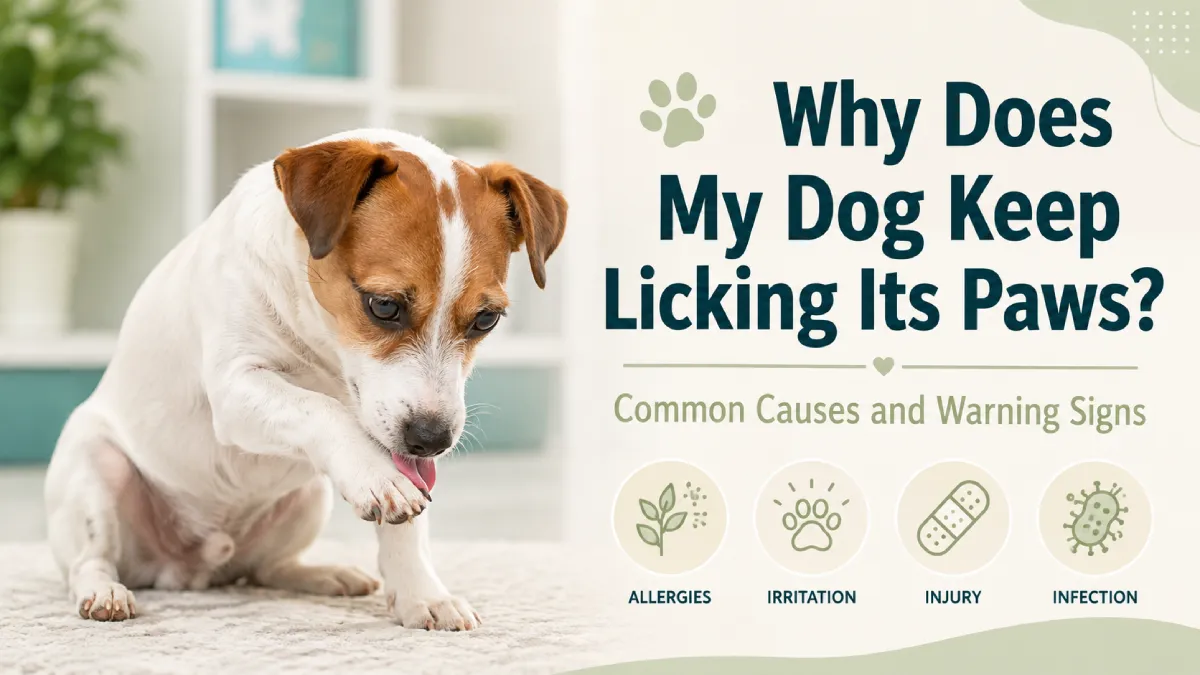
Why Does My Dog Lick Its Paws? Common Causes and Warning Signs
Occasional paw licking can be part of normal grooming, but repeated licking, chewing or biting deserves a closer look. A dog may focus on its paws because they itch, hurt or have been irritated by something in the environment.
If you are wondering why does my dog lick its paws, start with the pattern. One paw may draw attention to a local problem such as a cut, broken nail, foreign object or painful lesion, while several affected paws can occur with wider skin problems such as allergies. These patterns are clues rather than diagnoses, and persistent licking can itself damage the skin and make the original problem worse.
Direct Answer
Dogs may lick their paws because of normal grooming, foreign objects, cuts, damaged nails, burns, environmental irritation, allergies, skin infections, mites, interdigital disease, pain or repetitive behaviour. Check the paws visually without digging into painful tissue. Persistent licking, swelling, bleeding, severe pain, limping or lumps between the toes should prompt veterinary assessment.
Occasional Grooming Versus Excessive Licking
A few brief licks after coming indoors or during normal grooming are different from a dog repeatedly returning to the same paw.
Paw licking becomes more concerning when the dog:
- spends long periods licking
- wakes to lick repeatedly
- chews between the toes
- creates redness or hair loss
- makes the skin wet or raw
- begins limping
- focuses intensely on one site
Repetitive licking can create a cycle in which the skin becomes inflamed, which then encourages even more licking. In some dogs this can progress to significant self-trauma or acral lick dermatitis.
One Paw Versus Multiple Paws
The number of paws involved can help organise your observations.
Dog Licking One Paw
If a dog suddenly focuses on a single paw, visually check for local problems such as:
- a thorn or splinter
- damaged pad
- cut
- broken nail
- swelling
- a lump between the toes
- local pain
Foreign-body-associated interdigital lesions are often solitary, and deeply embedded material such as a grass awn can require veterinary exploration.
Licking Multiple Paws
Repeated licking of several paws can occur with wider skin problems such as allergic dermatitis, parasites or secondary infection. Allergic dogs commonly lick or chew their feet, but paw involvement alone does not establish an allergy diagnosis.
One paw versus multiple paws is a useful observation, not a diagnostic test.
Foreign Objects
Dogs can pick up:
- thorns
- splinters
- grass awns
- burrs
- small pieces of glass
- other debris
between the toes or in the paw pads.
If something is sitting superficially and can be seen easily, note its location. Small loose debris may sometimes be rinsed away with water. If an object is deeply embedded or removal would require digging into the pad, leave it alone and have a veterinarian remove it. Digging into the paw can increase pain, bleeding and tissue damage.
A dog that abruptly begins licking one foot after a walk deserves a careful visual paw check.
Cuts
Cuts and punctures can make a dog lick or protect the affected paw.
Check the pads and spaces between the toes for:
- bleeding
- splits
- punctures
- exposed tissue
- embedded debris
- tenderness
Foot-pad wounds can be slow to heal because the dog continues placing weight on the area during normal movement. Walking can repeatedly reopen injured tissue.
Deep cuts, punctures, persistent bleeding or signs of infection require veterinary care.
Broken Nails
A torn or broken nail can be extremely painful and may cause sudden:
- paw licking
- limping
- bleeding
- reluctance to put the foot down
The sensitive quick contains nerves and blood vessels, so injuries that expose it can hurt significantly.
Look for:
- a split nail
- a nail hanging at an unusual angle
- bleeding
- swelling around the nail
- a damaged dewclaw
Do not aggressively pull off a partially attached nail. Many damaged nails are better managed by a veterinarian.
Burns
Hot pavement, concrete, sand and metal surfaces can injure paw pads.
Possible signs of paw-pad burns include:
- licking or chewing
- limping
- redness
- blistering
- pad discolouration
- reluctance to walk
- visible pain
AAHA recommends moving the dog off the hot surface and rinsing affected paws with cool water; ice or extremely cold water should be avoided. Severe burns need veterinary treatment.
Do not apply random creams to a burned pad without veterinary guidance.
Salt and Chemical Irritation
Road salt and de-icing chemicals can irritate the skin between the toes and paw pads. Residue may also be swallowed when a dog licks its feet after returning indoors.
After exposure to salted or chemically treated surfaces:
- wipe or rinse the paws
- clean between the toes
- remove visible residue
- dry the paws gently
AAHA and VCA both recommend cleaning paws after winter walks to remove salt and other debris.
If a dog has stepped in a potentially corrosive chemical, more thorough rinsing is appropriate and veterinary advice should be sought. VCA recommends running water and additional cleaning for corrosive chemical exposure.
Allergies
Allergic skin disease is an important cause of chronic paw licking.
Dogs with environmental allergies may show:
- paw licking
- chewing the feet
- red or inflamed skin
- facial rubbing
- ear problems
- recurrent secondary infections
AAHA lists the paws among commonly affected regions in dogs with allergic skin disease.
However:
Paw licking does not prove that a dog has an allergy.
Veterinary allergy guidelines recommend checking for parasites, infection and other problems before concluding that allergic skin disease is responsible.
Link this section to Pawnium’s Why Is My Dog Itching but Has No Fleas? guide for broader skin troubleshooting.
Skin Infections
Bacterial skin infection can cause or worsen paw irritation.
Inflamed feet may develop:
- redness
- swelling
- bumps
- crusts
- discharge
- pain
- hair loss
- persistent licking
Deep bacterial infection is one recognised cause of painful interdigital lesions. Cytology and bacterial culture may be used during veterinary investigation, particularly for deeper or recurring disease.
Infection may also occur secondary to allergy, trauma or another problem, so treating the bacteria does not necessarily explain why the paws became inflamed.
Yeast-Related Irritation
Malassezia yeast can contribute to itchy or inflamed paws in some dogs, particularly when underlying allergic skin disease is present.
Paw licking can be accompanied by:
- redness
- odour
- greasy skin
- staining
- inflammation
However, smell or brown staining cannot diagnose yeast.
AAHA recommends skin cytology as part of the basic dermatologic evaluation of itchy dogs because it can help identify secondary microbial overgrowth.
Do not apply an antifungal cream simply because a paw smells unusual. VCA specifically cautions that smelly, discoloured paws do not all require the same treatment and advises veterinary assessment rather than using human antifungal products.
Parasites
Fleas, mites and other parasites can contribute to itching and self-trauma.
Paw licking is not specific enough to identify which parasite may be involved. AAHA’s allergy guidelines recommend flea combing and skin scrapings when investigating itchy dogs rather than assuming allergy from the symptom pattern.
If flea exposure is a concern, link to Pawnium’s Flea-Prevention Article.
Joint or Paw Pain
Not all paw licking begins with itchy skin.
Dogs may repeatedly lick an area because something hurts. Pain involving:
- a toe
- nail
- paw
- joint
- previous injury
can contribute to repetitive licking.
Veterinary behaviour references specifically warn that pain and orthopaedic problems can produce repetitive licking that may initially look behavioural.
A dog licking one limb and also limping, moving stiffly or avoiding normal activity should have pain considered as part of the veterinary assessment.
Interdigital Irritation
The skin between the toes can become red, sore and swollen.
Interdigital furunculosis is one example of a painful problem involving the webbing between the toes. Lesions may begin as redness or small bumps and progress into painful nodules. Dogs often lick or bite the affected foot and may become lame.
Potential contributors can include:
- bacterial infection
- allergies
- foreign material
- embedded hairs
- repeated trauma
- mites
- paw conformation
A lump between the toes should therefore not simply be called a “cyst” or treated at home without identifying what it actually is.
Anxiety or Compulsive Behaviour
Behaviour can contribute to repeated licking, but it should not automatically be blamed when a dog keeps licking a paw.
Veterinary behaviour guidance recommends investigating physical causes first because:
- skin disease
- allergy
- pain
- neurological problems
- infection
can produce similar repetitive behaviours.
Acral lick dermatitis can involve both physical and behavioural factors. Repeated licking itself can create inflammation and infection, which then encourages additional licking.
If medical causes are excluded and repetitive behaviour remains a concern, observations about the dog’s daily routine, triggers and body language can be useful.
Link naturally to Pawnium’s Dog Body-Language Guide here.
Licking After Walks
If paw licking starts soon after a walk, inspect the feet before assuming allergy.
Look for:
- grass seeds
- burrs
- splinters
- gravel
- cuts
- hot-surface irritation
- salt or de-icing residue
- chemical exposure
VCA recommends checking paws after walks for cuts, bruises and foreign material and cleaning between the toes and pads where needed.
Repeated episodes after specific outdoor routes or seasons are worth recording.
Licking at Night
A dog licking its paws at night does not necessarily have a different disease from a dog that licks during the day.
Night-time licking may simply be easier to notice when the dog is resting and the house is quiet.
Record whether the behaviour:
- delays sleep
- wakes the dog
- focuses on one paw
- affects several paws
- occurs after the evening walk
- causes redness or wet fur
- is increasing over time
Timing is useful history, but it does not identify whether the underlying problem is allergic, painful, infectious or behavioural.
Red Paws
Red paws indicate inflammation, but redness alone does not identify the cause.
Possible categories include:
- allergy
- infection
- contact irritation
- trauma
- excessive licking
- interdigital disease
VCA notes that pododermatitis commonly causes inflamed, swollen paws and persistent licking, while the underlying causes can vary considerably.
Persistent or painful redness should be evaluated rather than repeatedly treated with different home products.
Brown Saliva Staining
Dogs that lick pale-coloured paw fur repeatedly may develop reddish-brown staining.
VCA notes that saliva contains pigments that can contribute to reddish-brown staining, and paw dermatitis may also be associated with staining in chronically licked areas.
Brown staining tells you that an area may have been repeatedly wet or licked.
It does not prove:
- yeast infection
- food allergy
- environmental allergy
- bacterial infection
Look at the skin beneath the stained fur and record whether redness, swelling, odour or discomfort is also present.
Odour
A new or strong smell from the paws can occur with inflamed or infected skin.
But odour does not identify whether bacteria or yeast are responsible.
Skin cytology can help veterinarians investigate microbial involvement, while deeper or recurrent lesions may need culture or other testing.
Do not choose an antifungal or antibacterial treatment based only on smell.
Swelling
Swelling makes paw licking more concerning.
Check whether swelling affects:
- one toe
- the entire paw
- the space between two toes
- the nail bed
- a specific lump
Painful swollen interdigital lesions can be associated with deep inflammation or infection, and foreign material is another possible cause.
Paw licking plus noticeable swelling warrants veterinary assessment.
Sudden major swelling or rapidly worsening pain deserves more prompt attention.
Lumps Between the Toes
A bump between a dog’s toes should not automatically be called a cyst.
Merck notes that interdigital furuncles are painful inflammatory lesions and are frequently referred to incorrectly as interdigital cysts. Causes can include bacterial infection, foreign-body reactions, trauma, allergic disease and other factors.
Veterinary testing may involve:
- cytology
- culture
- examination for mites
- biopsy in unusual or recurrent cases
- investigation for foreign material
A solitary recurrent lesion may sometimes require exploration for a hidden grass awn or other foreign body.
Do not squeeze or puncture an interdigital lump at home.
What Owners Can Inspect Safely
You can gather useful information without aggressively manipulating a painful foot.
Check:
- All four paws
- Paw pads
- Between each toe
- Nail and nail-bed condition
- Dewclaws
- Redness
- Swelling
- Cuts
- Visible foreign material
- Blisters
- Discharge
- Lumps
- Hair loss
- Saliva staining
- Unusual odour
If the dog pulls away, growls, cries or becomes very uncomfortable, stop.
Even gentle dogs may resist handling when a paw hurts.
Do not dig into a pad, squeeze painful lumps or deeply manipulate an injured toe.
Paw Rinsing After Environmental Exposure
Simple rinsing can be useful after known environmental exposure.
After walking on salt, sand or treated surfaces, you can:
- Rinse or wipe the paws with clean lukewarm water.
- Clean gently between the toes.
- Remove obvious loose debris.
- Dry the paws carefully.
AAHA and VCA recommend cleaning paws after exposure to road salt and similar debris.
If the dog has stepped in a corrosive chemical rather than ordinary dirt or salt, use running water promptly and contact a veterinarian for further advice.
For routine paw maintenance, link to Pawnium’s Dog Paw-Care Guide.
What Owners Should Not Apply
Avoid experimenting with household or human products on unexplained paw inflammation.
Do not apply:
- human antifungal creams
- human muscle rubs
- concentrated essential oils
- harsh disinfectants
- leftover prescription skin medication from another pet
without veterinary guidance.
Dogs often lick anything placed on their paws, which means a topical product can also become an oral exposure. VCA cautions against human antifungal creams for smelly paws and notes that some human topical products can cause gastrointestinal or other problems if licked.
Concentrated essential oils can also irritate skin or cause toxicity depending on the product and exposure.
Do not use ice directly on burned paw pads.
Preventing Self-Trauma
Persistent licking can make a small problem much worse.
Repeated licking keeps the skin moist, adds mechanical trauma and can contribute to a cycle of inflammation and further licking.
While waiting for veterinary assessment:
- limit access to the injured area where practical
- avoid activities that worsen the paw
- keep obviously contaminated paws clean
- do not repeatedly manipulate painful tissue
A properly fitted veterinary recovery collar may sometimes be useful to prevent continued licking of an injury. VCA includes use of a recovery cone among measures that can help prevent licking-related complications in paw injuries.
The underlying reason for licking still needs to be addressed.
When Veterinary Care Is Needed
Arrange veterinary assessment when paw licking:
- persists or keeps returning
- causes hair loss
- creates raw or bleeding skin
- occurs with marked redness
- occurs with odour or discharge
- accompanies swelling
- accompanies limping
- focuses on a broken nail
- occurs with a lump between the toes
- appears associated with significant pain
- repeatedly involves several paws
- does not improve after obvious environmental residue has been removed
Veterinary evaluation may involve a paw examination, skin cytology, skin scrapings, culture, investigation for foreign material or additional testing depending on the pattern.
Seek More Prompt Veterinary Assessment If…
Seek prompt veterinary assessment if your dog has:
- uncontrolled bleeding
- a deep puncture or cut
- a deeply embedded foreign object
- a significant paw-pad burn
- severe pain
- inability or strong reluctance to bear weight
- substantial swelling
- pus or draining lesions
- rapidly worsening tissue damage
VCA specifically recommends veterinary attention for deep wounds, deeply embedded foreign objects, burns and signs of paw infection.
FAQs
Why does my dog keep licking one paw?
One-paw licking may draw attention to a local problem such as a cut, damaged nail, foreign object, painful interdigital lesion or another source of discomfort. Inspect the paw visually, but do not dig into painful tissue or assume the cause from licking alone.
Why is my dog licking all four paws?
Several affected paws can occur with wider skin problems such as allergic dermatitis, parasites or secondary infection. Allergies commonly involve paw licking, but multiple-paw licking by itself does not diagnose an allergy.
Why does my dog lick its paws after every walk?
Outdoor exposure can introduce grass awns, burrs, salt, de-icing chemicals, hot surfaces and other irritants. Check between the toes and paw pads after walks and rinse environmental residue away when appropriate.
Does brown fur on my dog’s paws mean yeast?
No. Repeated licking can produce reddish-brown saliva staining, and yeast-associated disease can also occur in inflamed paws. The colour alone cannot determine the cause.
Can anxiety make a dog lick its paws?
Behavioural factors can contribute to repetitive licking in some dogs, but pain, skin disease, infection, allergy and neurological problems should be considered before assuming anxiety is responsible.
When should I worry about paw licking?
Veterinary assessment is warranted when licking is persistent or accompanied by swelling, bleeding, significant pain, limping, discharge, strong odour, open wounds or lumps between the toes. Deep foreign objects and significant paw burns also require professional care.