
Cat Sitter Checklist: Feeding, Litter, Medication and Emergency Instructions
A useful cat sitter checklist should allow another person to care for your cat without guessing. Before you leave, write down exactly what your cat eats, when they are fed, where water and litter boxes are located, how medication is given, what behaviour is normal, who to contact in an emergency and where essential supplies are kept.
Keep the routine as familiar as practical. Cats often cope better when food, litter, resting places and normal human interactions remain predictable while their caregiver is away. The sitter should also know what changes would be unusual enough to contact you or your veterinarian.
Quick Answer
Before leaving your cat with a sitter, provide written instructions covering food portions and meal times, fresh water, litter-box care, medication, play and social preferences, indoor/outdoor rules, veterinary contacts, emergency authorization and your travel details. Show the sitter where food, litter, cleaning supplies, medication and the cat carrier are kept, and identify any behaviour or health changes that should trigger a call.
Why Written Cat-Sitter Instructions Matter
A verbal handover is easy to forget once you are away.
AAHA recommends giving pet sitters both a pet profile and clear instructions about the animal’s daily routine. Useful details include feeding amounts, medication administration, litter-box care and the location of supplies.
Written instructions are particularly important when:
- the sitter does not know your cat well
- more than one cat lives in the home
- medication is required
- the cat has a medical condition
- food portions differ between cats
- the cat is allowed outdoors under specific rules
- you may be difficult to contact while travelling
Choose and Meet the Sitter Before You Leave
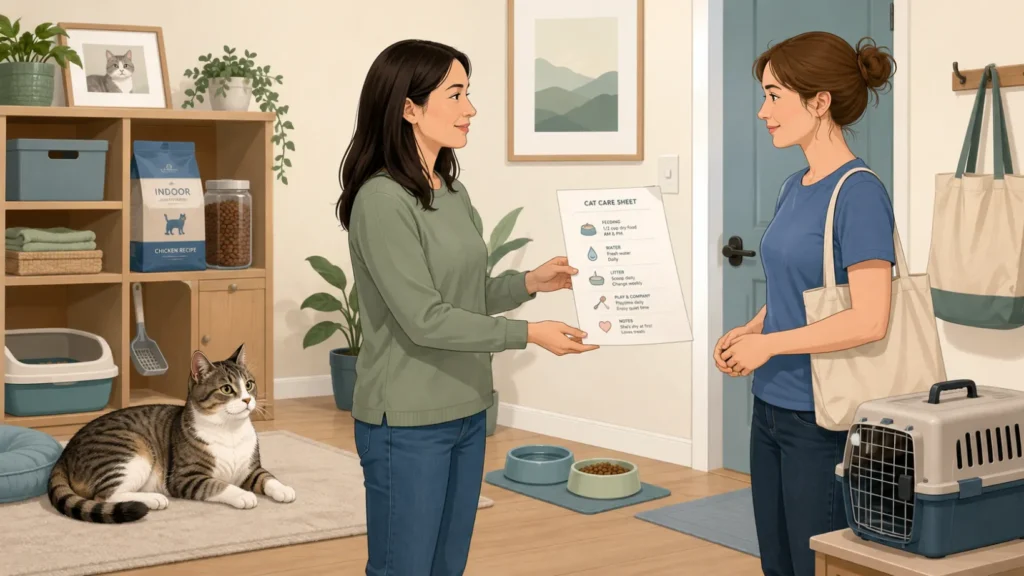
If the sitter is new to your household, arrange a visit before the trip.
Show them:
- where the cat normally eats
- water locations
- litter boxes
- favorite resting and hiding places
- food and litter storage
- medication
- cleaning supplies
- the cat carrier
- doors or rooms with special access rules
Cats Protection recommends meeting a prospective sitter in advance and making sure they understand the individual cat’s needs, particularly when medication or special care is involved.
Write Down the Feeding Routine
Do not simply write “feed twice a day.”
Record:
- food brand and exact product
- wet, dry or mixed feeding
- amount per meal
- meal times
- treat allowance
- where food is stored
- which bowl belongs to which cat
- whether cats need to eat separately
If your cat follows a veterinary diet, make that clear and tell the sitter not to substitute foods without veterinary direction.
Record What Normal Appetite Looks Like
A sitter needs context to recognize a meaningful change.
Write down whether your cat normally:
- finishes food immediately
- eats slowly over time
- prefers several smaller meals
- needs privacy to eat
- occasionally leaves some food
A sudden decline in appetite may be more important than whether the bowl is completely empty.
Explain the Water Routine
Show the sitter every normal water source.
Record whether your cat uses:
- a standard bowl
- several bowls
- a water fountain
- water added to food under an established feeding plan
Fresh water should remain available unless a veterinarian has given a specific medical instruction. Do not ask a sitter to restrict water to reduce litter-box use.
Give Clear Litter-Box Instructions

Cats Protection includes litter location and cleaning instructions as core information for cat sitters.
Show the sitter:
- where every litter box is located
- where clean litter is stored
- where the scoop is kept
- how waste should be disposed of
- how often each box is normally scooped
- whether a full litter change will be needed
If more than one cat shares the home, explain which toileting patterns are normal where possible.
A sitter should not have to search the house for a litter box after an accident occurs.
Tell the Sitter What Urine and Stool Changes Matter
Ask the sitter to tell you about significant changes such as:
- no obvious urine being produced
- repeated trips to the litter box
- straining
- blood in urine or stool
- new diarrhea
- repeated constipation signs
- urination or defecation outside the box when unusual for your cat
Repeated attempts to urinate with little or no urine require urgent veterinary attention.
Prepare Medication Instructions Carefully

For every prescription medication, write down:
- medication name
- the prescribed amount
- administration time
- frequency
- how your veterinarian instructed it to be given
- where it is stored
- whether refrigeration is required
- what to do if a dose cannot be given
Do not ask the sitter to change a dose, double a missed dose or improvise medication instructions.
If your cat is difficult to medicate, practice the handover before the trip and confirm that the sitter is comfortable performing the task.
List Every Relevant Medical Condition
The sitter should know about conditions that may affect daily care or emergency decisions.
Examples include:
- diabetes
- kidney disease
- hyperthyroidism
- heart disease
- arthritis
- seizure disorders
- urinary disease
- food allergies
- recent surgery or illness
Do not expect a sitter to diagnose disease. Their role is to notice when the cat differs from the baseline you described and follow the contact plan.
Describe Your Cat’s Normal Behaviour
A sitter may otherwise misinterpret normal hiding as illness or dismiss an unusual withdrawal as personality.
Tell them whether your cat normally:
- greets visitors
- hides from unfamiliar people
- enjoys petting
- dislikes being picked up
- plays actively
- sleeps in specific rooms
- hisses when frightened
- is likely to approach the door
For help explaining feline signals, you can link the sitter to Pawnium’s Cat Body Language Guide.
Do Not Force a Shy Cat Out of Hiding
A shy cat may remain under a bed, inside a box or in another familiar safe location when a sitter visits.
Cats Protection specifically notes that shy cats may prefer to remain hidden.
The sitter should confirm the cat’s wellbeing without chasing or forcibly pulling them from a safe hiding place unless there is a genuine emergency.
Instead, look for indirect evidence where appropriate:
- food eaten
- water use
- litter-box activity
- movement between known resting locations
Explain Play and Social Preferences
Maintaining familiar social interaction can make the sitter’s visits more predictable.
Write down:
- favorite toys
- usual play time
- whether the cat enjoys brushing
- where the cat likes to be petted
- behaviors that mean the cat wants interaction to stop
Do not leave string, yarn, ribbon or wand toys available for unsupervised play if they can create an entanglement or ingestion risk.
FelineVMA recommends positive, predictable human interaction suited to the individual cat’s preferences. :contentReference[oaicite:1]{index=1}
Keep the Home Routine Predictable
Try to preserve the normal arrangement of:
- food
- water
- litter boxes
- beds
- scratchers
- hiding places
FelineVMA notes that cats generally prefer familiar spaces and that unfamiliar smells, sights and sounds can be stressful. :contentReference[oaicite:2]{index=2}
A holiday is not an ideal time for the sitter to rearrange the cat’s environment unnecessarily.
Write Down Indoor and Outdoor Rules
Do not leave this decision to the sitter.
Clearly state whether the cat:
- must remain indoors
- normally uses a secure catio
- uses a cat flap
- has established supervised outdoor access
If you want the cat kept indoors while you are away, state that explicitly.
If normal outdoor access will continue, explain the exact routine and what to do if the cat does not return as expected.
Prepare for a Missing-Cat Emergency
Give the sitter:
- a recent clear photo
- microchip number
- microchip database information
- your current contact details
- backup contact details
- usual hiding places
- instructions not to delay contacting you
The 2025 Cats Protection sitter checklist specifically includes microchip number and database information. :contentReference[oaicite:3]{index=3}
If an escape occurs, the sitter can also use Pawnium’s What to Do If Your Cat Gets Lost guide.
Show the Sitter Where the Carrier Is
The cat carrier should be easy to locate in an emergency.
Do not leave it buried in a garage, attic or storage room where the sitter cannot find it quickly.
Show the sitter:
- where the carrier is stored
- how the door or latches work
- which carrier belongs to each cat
- how your cat normally enters it
If carrier entry is difficult, Pawnium’s Cat Carrier Training Guide can help improve this skill before future trips.
Provide Your Veterinarian’s Information
Write down:
- clinic name
- address
- telephone number
- normal opening hours
- after-hours emergency clinic
Tell your veterinary practice who will be caring for the cat if the cat has important ongoing medical needs.
Decide Who Can Authorize Veterinary Treatment
Do not assume your sitter can automatically consent to treatment on your behalf.
Before travelling, ask your veterinary clinic what authorization it requires.
Your written emergency plan can include:
- your primary phone number
- your destination or time zone if relevant
- a backup decision-maker
- who may authorize veterinary treatment
- how emergency costs will be handled
AAHA specifically recommends planning emergency decision-making and financial arrangements when a caregiver will be unavailable. :contentReference[oaicite:4]{index=4}
Leave a Backup Contact
You may be:
- on a flight
- in a different time zone
- without mobile reception
- temporarily unavailable
Give the sitter a trusted second contact who knows the cat and can respond promptly.
Confirm that the backup person knows they have been nominated.
Tell the Sitter What Counts as an Emergency
Your sitter does not need to diagnose the cat, but they should know which signs should not wait for your reply.
Seek urgent veterinary help for signs such as:
- obvious difficulty breathing
- open-mouth breathing or respiratory distress
- collapse or unresponsiveness
- seizure activity
- major trauma
- uncontrolled bleeding
- suspected poisoning
- repeated attempts to urinate with little or no urine
Other new changes such as persistent vomiting, diarrhea, refusal to eat, marked lethargy or pain should prompt veterinary advice rather than being dismissed because the owner is away.
Use Your Cat’s Normal Baseline
A written baseline is more useful than telling the sitter simply to “watch for illness.”
Record what is normal for:
- appetite
- water intake
- urination
- stool
- vomiting frequency if any
- activity
- mobility
- grooming
- social behavior
- sleeping locations
Pawnium’s Cat Health Check at Home can help you document the cat’s baseline before you leave.
Multi-Cat Household Instructions
Do not give one generic set of instructions if the cats have different needs.
For each cat, record:
- name and photo
- food
- portion
- medication
- normal behaviour
- preferred sleeping location
- handling preferences
AAHA specifically advises identifying individual pets clearly in multi-pet households so the sitter does not confuse them. :contentReference[oaicite:5]{index=5}
Also explain if cats must eat separately or if one cat is likely to steal another’s food.
Senior Cats and Cats With Medical Needs May Need More Support
A standard brief visit may not suit every cat.
Very young cats, senior cats and cats with medical conditions may require more frequent observation or specialized care.
Cats Protection notes that young, older or medically affected cats may need more frequent visits than the typical routine. :contentReference[oaicite:6]{index=6}
Before booking, confirm that the sitter can safely perform every required task.
Home Information the Sitter Also Needs
The sitter should know enough about the house to care for the cat safely.
Record:
- entry instructions
- alarm information where appropriate
- rooms the cat must not enter
- where cleaning supplies are stored
- trash and litter-waste disposal
- thermostat or heating instructions
- where spare keys are kept, if relevant
Do not leave dangerous household products accessible simply because someone will visit daily.
Ask for a Simple Daily Update
Agree on what type of update you want before leaving.
A short daily message can record:
- cat seen
- food eaten
- fresh water provided
- litter box checked
- medication given
- play or interaction
- anything unusual
This is more useful than receiving only a photo with no information about eating, toileting or medication.
Cat Sitter Handover Sheet
| Information | Details |
|---|---|
| Cat name | ____________________________ |
| Photo provided | Yes / No |
| Owner phone | ____________________________ |
| Travel location / time zone | ____________________________ |
| Backup contact | ____________________________ |
| Veterinarian | ____________________________ |
| Emergency clinic | ____________________________ |
| Microchip number | ____________________________ |
| Microchip database | ____________________________ |
| Food | ____________________________ |
| Amount per meal | ____________________________ |
| Meal times | ____________________________ |
| Water locations | ____________________________ |
| Litter-box locations | ____________________________ |
| Litter routine | ____________________________ |
| Medication | ____________________________ |
| Medication times | ____________________________ |
| Medical conditions | ____________________________ |
| Normal behaviour | ____________________________ |
| Favorite hiding places | ____________________________ |
| Indoor/outdoor rule | ____________________________ |
| Carrier location | ____________________________ |
| Emergency authorization | ____________________________ |
Printable Cat Sitter Checklist
Before You Leave
- ☐ Meet the sitter in the home
- ☐ Provide keys/access instructions
- ☐ Confirm visit schedule
- ☐ Leave your travel contact information
- ☐ Provide a backup contact
- ☐ Provide veterinarian and emergency-clinic details
- ☐ Confirm emergency treatment authorization
- ☐ Update microchip contact details
- ☐ Provide a recent photo of each cat
Food and Water
- ☐ Enough familiar food for the whole trip
- ☐ Exact meal portions
- ☐ Feeding times
- ☐ Treat rules
- ☐ Separate-feeding instructions if needed
- ☐ Water locations
- ☐ Food and bowl locations shown
Litter
- ☐ All litter boxes shown
- ☐ Enough litter supplied
- ☐ Scoop location shown
- ☐ Scooping routine explained
- ☐ Waste-disposal instructions supplied
Medication and Health
- ☐ Medication provided
- ☐ Written veterinarian-prescribed instructions
- ☐ Storage instructions
- ☐ Medical conditions documented
- ☐ Normal appetite documented
- ☐ Normal litter habits documented
- ☐ Emergency signs discussed
Behaviour and Routine
- ☐ Normal personality explained
- ☐ Hiding places shown
- ☐ Handling preferences explained
- ☐ Favorite toys identified
- ☐ Play routine explained
- ☐ Indoor/outdoor rules written down
- ☐ Escape risk explained
Emergency Preparation
- ☐ Carrier location shown
- ☐ Carrier checked and usable
- ☐ Veterinarian number saved
- ☐ Emergency clinic number saved
- ☐ Backup contact confirmed
- ☐ Missing-cat plan provided
Cat Sitter or Boarding Facility?
Home sitting can suit cats that prefer familiar surroundings and predictable territory, while a professionally run boarding facility may be more appropriate in other situations.
The choice depends on:
- the individual cat
- medical requirements
- how frequently the sitter can visit
- security of the home
- whether specialized care is needed
If you are comparing the options, use Pawnium’s Cat Boarding Checklist as well.
FAQs
What information should I leave for a cat sitter?
Provide feeding amounts and times, water locations, litter instructions, medication details, behavior and handling notes, indoor/outdoor rules, veterinarian and emergency-clinic contacts, your travel contact details, a backup contact and instructions for emergency authorization.
How often should a cat sitter visit?
The appropriate frequency depends on the individual cat. Cats Protection recommends at least twice-daily visits for typical home care and notes that very young, older or medically affected cats may need more frequent attention. Individual health and medication needs can require a different plan. :contentReference[oaicite:7]{index=7}
Should I leave my cat sitter the microchip number?
Yes. Current Cats Protection sitter guidance includes the cat’s microchip number and database information. Keeping these details available can save time if the cat escapes or is found away from home. :contentReference[oaicite:8]{index=8}
Should the sitter know where the carrier is?
Yes. The carrier should be easy to locate in case the cat needs veterinary care or emergency evacuation. Make sure the sitter knows how it opens and closes before you leave.
Can my cat sitter give medication?
Only if the sitter is comfortable and capable of following the veterinarian’s instructions. Provide the prescribed medication, exact directions and veterinary contact details. For complex treatment, consider a sitter with appropriate experience or another care arrangement.
What if my cat hides from the sitter?
Do not ask the sitter to drag a shy cat out of hiding. Explain your cat’s usual hiding places and how to verify eating, drinking and litter use. A major change from the cat’s normal behavior or inability to confirm their wellbeing should trigger contact with you.
Bottom Line
A strong cat sitter checklist removes uncertainty.
Leave exact feeding, water, litter, medication and routine instructions; describe what normal behavior looks like; show the sitter where supplies and the carrier are stored; and provide veterinary, emergency and backup contacts.
The most useful handover is not the longest one. It is the one that lets the sitter quickly answer three questions: What should I do today? What is normal for this cat? What should I do if something goes wrong?