Cat Body Language: How to Read Eyes, Ears, Tail and Posture
Cats have earned an unwarranted reputation for being secretive, unpredictable, and emotionally aloof. In reality, felines are constantly broadcasting their feelings, intentions, and physical health—they simply use a subtle visual dialect rather than loud, overt gestures. While dogs often communicate with energetic full-body displays like tail wags and panting smiles, feline communication is a delicate symphony of micro-expressions. A tiny shift in ear angle, a slight dilation of the pupils, or a subtle twitch of a tail tip can differentiate an affectionate companion from an overstimulated cat on the verge of scratching.
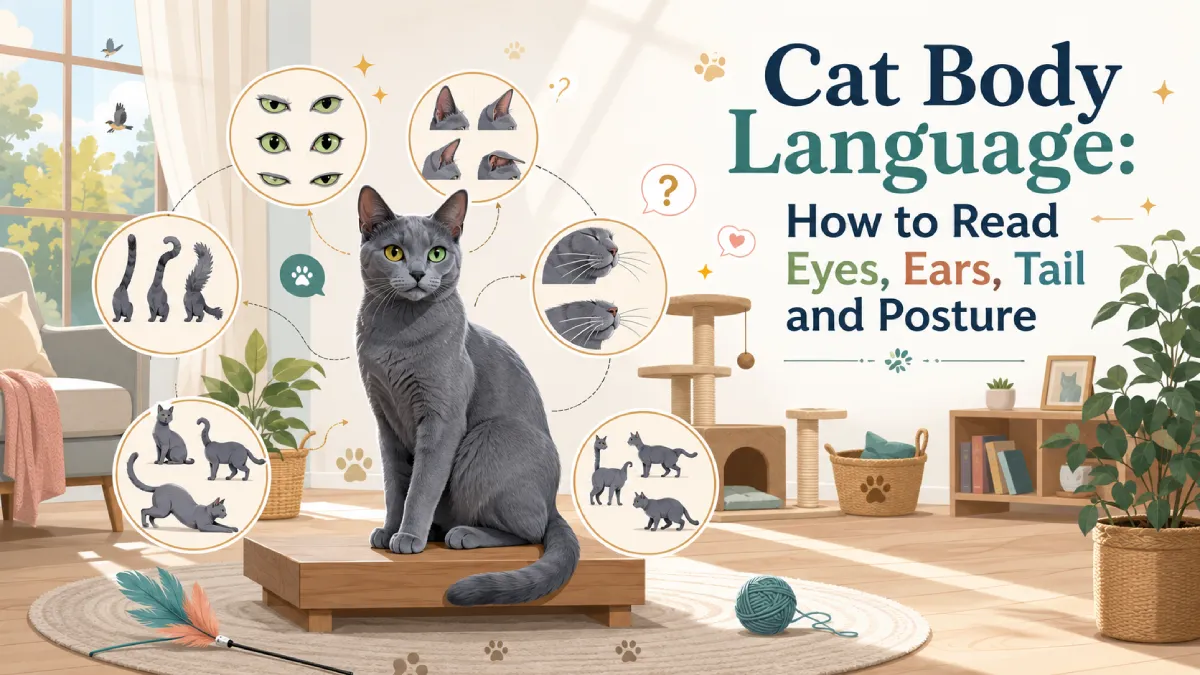
Mastering cat body language is the single most effective way to build mutual trust, prevent accidental bites or scratches, and identify early signs of physical pain or distress. Whether you are trying to understand a cat body language chart, figuring out how to read cat body language, decoding cat ear positions and cat tail meanings, or searching for subtle signs a cat is stressed, this comprehensive pillar guide serves as your complete visual decoder.
Quick Answer
Learning how to read cat body language requires looking at your cat’s entire body as a holistic system rather than focusing on a single feature. A cat’s emotional state is revealed through a combination of eye shape, pupil dilation, ear angle, whisker tension, tail movement, and overall body posture. A relaxed, happy cat exhibits soft eyes, forward-facing ears, relaxed whiskers, and a tail held gently upright with a curved tip. Conversely, a fearful or aggressive cat displays widened or narrowed pupils, ears flattened against the head (“airplane ears”), stiff body posture, and a thumping or low-tucked tail.
Why Cat Signals Must Be Read Together
One of the most common mistakes pet owners make is taking a single body signal out of context. For instance, many people associate a tail wag with happiness because of canine behavior. In cats, however, a fast-thumping tail usually signifies rising frustration or overstimulation.
Conversely, a cat purring does not always mean they are content; cats also purr to self-soothe when severely injured, stressed, or giving birth. To accurately assess what your cat is feeling, you must combine signals from multiple body regions:
-
The Eyes: Indicate emotional arousal, focus, and fear levels.
-
The Ears: Act as real-time directional radar dish indicators for mood shifts.
-
The Whiskers: Reveal spatial awareness, curiosity, or defensive retraction.
-
The Tail: Serves as a primary barometer for emotional intensity and speed of mood change.
-
Body Posture & Tension: Distinguishes between confident relaxation, active play, defensive posturing, and severe pain.
Unique Content Asset: Master Cat Body-Language Chart
Use this comprehensive diagnostic reference chart to evaluate your cat’s emotional and physical state across all major anatomical markers:
| Emotional State | Eye & Pupil Status | Ear Position | Whisker Placement | Mouth & Facial Cues | Tail Position & Motion | Body Posture & Weight |
| Relaxed & Content | Soft, almond-shaped; slow blinking; normal pupils | Forward, relaxed, upright | Fanned out softly to the sides | Closed, relaxed jaw; possible quiet purr | Loose, low, or held softly upright with a curved tip | Soft, fluid body; lying on side or loosely curled |
| Happy & Affectionate | Soft gaze; heavy lidded; frequent slow blinks | Erect, pointing forward | Drawn slightly forward toward you | Soft trilling or purring; gentle chin rubs | Held high vertically (“question mark” curve at tip) | Rubbing flanks against legs; kneading paws |
| Playful & Engaged | Widened pupils; focused, bright gaze | Pointed forward, alert | Extended forward toward target | Open mouth in pant or silent ambush stance | Twitching tip; low “S-curve” posture | Butt in air; wiggling hindquarters before pouncing |
| Curious & Inquiring | Wide, clear eyes; steady pupil focus | Swiveling forward and laterally | Pushed forward toward object | Sniffing air; slight mouth parting (Flehmen response) | Held horizontally or gently raised | Weight shifted forward; neck elongated |
| Alert / Vigilant | Wide open; pupils slightly dilated | Upright, rapidly swiveling toward sounds | Fan out laterally, tense | Tense jaw; quiet observation | Still, slightly elevated or hanging low | Standing tall, weight distributed on all four paws |
| Nervous / Uncertain | Slightly dilated pupils; vigilant scanning | Turned slightly sideways or backward | Pulled back toward cheeks | Fast lip-licking; swallowing; quiet | Tucked low near body or twitching slightly | Body lowered to ground; ready to dart away |
| Frightened / Terrified | Fully dilated “saucer” pupils; unblinking | Flattened back against skull (“airplane ears”) | Flattened tight against cheeks | Hissing, spitting, or silent open-mouth gape | Tucked tightly between hind legs | Crouched low, compact “loaf” or frozen rigid |
| Stressed / Anxious | Hyper-vigilant scanning; dilated pupils | Swiveling or held low and wide | Retracted backward | Frequent yawning, panting, or grooming | Low, twitching, or wrapping tightly around body | Stiff, hunched, or actively seeking dark hiding spots |
| Overstimulated | Rapidly dilating/constricting pupils | Turned back or swiveling rapidly | Tense, pulled flat | Fast head-turning toward handling hand | Thumping violently against floor or swinging side-to-side | Body stiffens; skin twitching along the spine |
| Defensive Aggression | Wide, wild gaze; dilated pupils | Flattened backward against head | Retracted completely | Hissing, growling, showing teeth | Puffed up (“bottle brush”) and arched low | Arched spine, body turned sideways, fur raised (piloerection) |
| Offensive Aggression | Narrowed, hard stare; constricted pupils | Rotated back with outer tips visible | Pushed forward aggressively | Deep, low growling, howling, or snarling | Stiff, twitching, held low or straight out | Weight shifted forward, standing tall, stalking |
| Pain & Illness | Squinting, glazed eyes; sunken appearance | Turned outward and downward (“flat ears”) | Flattened or pointing straight down | Tight muzzle, lip-licking, grimace | Tucked tightly or motionless | Hunched spine (“meatloaf” stance), head down |
Decoding Feline Emotional States
Understanding how your cat shifts between emotional states allows you to intervene before fear escalates into aggression or stress turns into illness.
Relaxed Cat
A relaxed cat exudes liquid comfort. Their muscles are loose, their breathing is slow and rhythmic, and their limbs are positioned without tension. They may stretch out on their side, expose their belly in a warm sunbeam, or rest in a loose “loaf” position with their paws tucked neatly under their chest.
Happy and Affectionate Cat
When a cat feels affectionate, they actively seek social interaction. They approach with their tail held straight up in the air—often with a delicate, hook-like curve at the tip, commonly called a “question-mark tail.” They may engage in “allorubbing,” rubbing their cheeks, flanks, and head against your ankles or furniture to deposit comforting facial pheromones.
Playful Cat
Play behavior mimics ancestral predatory hunting sequences: stalk, pounce, grab, and bite. A playful cat displays wide, bright eyes, forward-tilted ears, and whiskers extended outward. Before pouncing on a wand toy or feather, they often execute a hilarious “butt wiggle,” shifting their hind feet back and forth to test traction before launching forward.
Curious Cat
Curiosity drives felines to inspect every new box, bag, or visitor entering their territory. A curious cat lengthens their body, stretches their neck forward, swivels their ears to capture high-frequency sounds, and extends their whiskers toward the unknown object to gather tactile feedback.
Alert Cat
An alert cat is in monitoring mode. Whether they heard a strange noise in the hallway or spotted a bird through the window, their entire body becomes focused on sensory processing. Their ears stand tall, swiveling independently like satellite dishes to localize sound waves, while their body remains poised to react if necessary.
Nervous Cat
Nervousness is the entry stage of fear. A nervous cat feels uncertain about their environment. They shrink their body profile by lowering their head, tucking their tail close to their torso, and pulling their whiskers backward. They glance around rapidly, looking for safe escape routes or high perches.
Frightened Cat
When nervousness escalates into fear, a cat’s primary goal is self-preservation through escape or concealment. If trapped, a frightened cat flattens their body as low to the floor as possible, dilates their pupils to maximize light collection, and pins their ears flat against the sides of their skull—a defensive orientation known as “airplane ears” designed to protect delicate ear tissue from injury during potential fights.
Stressed Cat
Chronic or acute stress manifests as behavioral withdrawal or hyper-vigilance. A stressed cat may spend hours hiding under beds, develop excessive grooming habits (psychogenic alopecia), display rapid lip-licking, or yawn repeatedly when no tiredness is present.
Overstimulated Cat
Overstimulation frequently occurs during petting sessions (sometimes called “petting-induced aggression”). As a cat receives continuous physical touch, their nervous system reaches sensory overload. Warning signs include a twitching tail tip, rippling skin along the spine, subtle ear flattening, and sudden head-turning toward your hand. If ignored, the cat may swat or snap to enforce personal space.
Defensive Cat
A cat pushed into a defensive corner will attempt to make themselves look larger and more intimidating to ward off a perceived threat. They arch their back, raise the fur along their spine and tail (piloerection, giving the tail a “bottle-brush” appearance), turn their body sideways to maximize their visual silhouette, and emit loud warning hisses or growls.
Angry or Aggressive Cat
Offensive aggression is direct and assertive. Unlike a defensive cat that shrinks or arches sideways, an offensively aggressive cat moves toward their target. Their body is stiff, their weight is pitched forward onto their front legs, their pupils contract into narrow slits, their ears rotate backward, and they lock eyes in an unblinking hard stare.
Cat Eye and Pupil Meanings
Feline eyes are powerful visual indicators governed by the autonomic nervous system.
-
Dilated Pupils (“Saucer Eyes”): Occur naturally in low light, but in bright light, large pupils indicate high emotional arousal—either intense fear, acute panic, or high-velocity play stimulation.
-
Constricted Pupils (“Slit Eyes”): Occur in bright light, but when combined with a stiff posture, narrowed slits signal tension, offensive aggression, or acute pain.
-
Slow Blinks (The “Cat I Love You”): When a cat looks at you and slowly closes and opens their eyes, they are broadcasting deep trust and contentment. In feline language, closing one’s eyes in the presence of another animal is the ultimate declaration that they do not perceive you as a threat. Returning a slow blink to your cat reinforces your emotional bond.
-
Direct Staring: In the feline world, a hard, unblinking, direct stare is a territorial challenge or threat signal. Avoid staring directly into the eyes of an unfamiliar or tense cat, as they may interpret it as confrontation.
Cat Ear Positions
Equipped with 32 individual muscles per ear, a cat’s pinnae (outer ears) can rotate 180 degrees independently.
-
Neutral / Forward: Signals relaxation, contentment, or calm curiosity.
-
Swiveling / Twitching: Indicates active listening, alertness, or internal debate about an approaching noise.
-
Flattened Sideways (“Airplane Ears”): Indicates rising anxiety, fear, or frustration.
-
Pinned Back Tight Against the Head: Signals extreme panic or intense aggression; protects ears during physical conflict.
Whisker Positions
Whiskers (vibrissae) are highly sensitive tactile organs rooted deep within follicle beds rich in nerve endings.
-
Relaxed / Fanned Out: Whiskers stick out naturally to the sides, slightly downward. Signals comfort.
-
Pushed Forward: Whiskers fan forward past the muzzle. Signals curious exploration, hunting focus, or desire to interact.
-
Pulled Flat Against the Cheeks: Whiskers are drawn backward tightly against the face. Signals fear, defensiveness, or an attempt to appear smaller.
Mouth and Facial Signals
While cats do not possess the expressive smiling muscles of dogs, their muzzles provide rich behavioral context:
-
Lip Licking: Fast, repetitive flicks of the tongue across the nose in the absence of food signal nausea, internal stress, or psychological conflict.
-
Yawning: When performed outside of waking up from sleep, yawning acts as a displacement behavior designed to lower internal stress and self-soothe.
-
The Flehmen Response: If a cat sniffs a scent, lifts their upper lip, opens their mouth slightly, and squints their eyes, they are executing the Flehmen response. This traps scent molecules against the vomeronasal organ (Jacobson’s organ) in the roof of the mouth, allowing the cat to analyze complex pheromones from other animals.
Cat Tail Positions and Movement
A cat’s tail acts as an emotional rudder, reflecting mood shifts faster than almost any other anatomical feature.
-
Vertical Upright (The Flag): Confident, happy greeting signal.
-
Vertical with a Curved Tip (Question Mark): Friendly, welcoming invitation to interact.
-
Horizontal / Neutral: Calm, casual movement; general relaxation.
-
Low / Tucked Between Legs: Insecurity, fear, or submission.
-
Puffed Up (“Bottle Brush”): Intense fear or defensive terror; attempt to appear physically larger.
-
Swishing / Thumping Speed:
-
Slow, gentle sway: Mild focus or light relaxation.
-
Fast whipping or heavy thumping against the floor: High frustration, annoyance, overstimulation, or impending aggression.
-
Decoding Specific Physical Behaviours
Arched Back
Context is critical when evaluating an arched spine:
-
The Halloween Arch: Accompanied by puffed fur, sideways body alignment, and hissing, this signals defensive aggression and terror.
-
The Happy Stretch: Accompanied by a yawn, smooth fur, and purring as a cat wakes up or greets you, this is simply a pleasant muscular stretch.
Crouching
-
Predatory Crouch: Body low to the ground, weight balanced on paws, hindquarters twitching, eyes locked on a toy or prey.
-
Fearful Crouch: Body compacted tight, paws tucked underneath, head lowered below the shoulders, eyes wide and scanning.
Rolling Onto the Back
When a cat rolls onto their back and exposes their belly, humans often mistake it for a canine-style request for belly rubs. In cats, an exposed belly is a declaration of trust, not an invitation for a stomach rub. If you reach down to rub a cat’s soft belly, they may instinctively wrap four paws around your hand and bite. Rolling over shows they feel safe in your presence; respect that trust by scratching their chin or cheeks instead.
Kneading (“Making Biscuits”)
Rhythmically pushing their paws in and out against a soft blanket, pillow, or your lap is a comforting habit carried over from kittenhood. Nursing kittens knead their mother’s abdomen to stimulate milk flow. In adult cats, kneading releases endorphins and communicates complete emotional security.
Hiding
Hiding under beds, inside closets, or behind appliances is a primary feline coping mechanism for fear, environmental stress, or physical illness. While temporary hiding during a thunderstorm is normal, persistent hiding lasting days indicates severe distress or illness.
Freezing
When a cat suddenly locks their muscles and freezes mid-motion, they are experiencing extreme hyper-vigilance. They have detected a sensory trigger (a scent, sound, or visual threat) and are determining whether to fight, flee, or remain invisible.
Purring in Different Contexts
While most owners associate purring exclusively with happiness, felines utilize purring across multiple contexts:
-
Contentment Purr: Low-frequency, steady vibration accompanied by soft body language and slow blinking.
-
Solicitation Purr: A specialized, higher-frequency purr that embeds an auditory frequency similar to a human infant’s cry. Cats use this specific purr to demand food from their owners in the morning.
-
Healing & Stress Purr: Cats purr at frequencies between 20 Hz and 150 Hz—a range scientifically proven to promote bone density growth, tissue repair, and pain relief. Injured, dying, laboring, or severely stressed cats purr to self-soothe and accelerate internal healing.
Pain-Related Posture (The Feline Grimace Scale)
Cats are apex predators, but they are also small prey animals. Consequently, they possess a powerful evolutionary drive to mask physical pain to prevent appearing vulnerable. Recognizing pain requires observing subtle postural shifts:
-
The Hunched “Meatloaf” Stance: Sitting hunched up on all four paws with the head pulled down between the shoulders, eyes squinted shut, and weight shifted away from painful limbs or abdomen.
-
Facial Grimace Indicators:
-
Eyes tightly closed or half-squinted.
-
Muzzle pulled tight and flattened horizontally.
-
Whiskers straight, stiff, and pointing downward/forward rather than fanned out naturally.
-
Ears pulled outward and downward (“flat ears”).
-
Contextual Social Interactions
Body Language Around Unfamiliar Cats
When two unfamiliar cats meet, visual language prevents physical fights whenever possible:
-
Confident / Dominant Display: Walking tall on straight legs, tail held erect, direct approach, head elevated.
-
Submissive / Avoidant Display: Crouching low, avoiding eye contact, turning sideways, slowly backing away without turning their back on the other cat.
Body Language Around People
Cats treat trusted humans as large, safe social partners. They communicate affection through head-bunting (rubbing their forehead and scent glands against your face or hands), vertical tail raising, slow blinking, and sleeping near your head or chest.
Behaviour Around Children
Children often move quickly, speak in high-pitched voices, and struggle with physical restraint—all of which can overwhelm a cat. Watch for warning signs that a cat needs space from a child:
-
Tail twitching or thumping.
-
Ears turning backward.
-
Whisker retraction and body stiffness.
-
Seeking elevated perches (cat trees, high shelves) out of reach.
Common Owner Interpretation Mistakes
-
Mistaking an Exposed Belly for a Petting Request: Petting a cat’s exposed stomach often triggers a defensive bite/scratch reflex.
-
Assuming a Wagging Tail Means Happiness: A fast, swishing tail in cats indicates rising annoyance or overstimulation, not joy.
-
Believing Purring Always Means Contentment: Purring can indicate severe physical pain, nausea, or panic.
-
Ignoring Overstimulation Signals: Continuing to pet a cat when their tail starts thumping, leading to sudden “unprovoked” bites.
-
Punishing Hissing or Growling: Hissing is a polite, non-violent warning that a cat feels overwhelmed. Punishing a hiss removes the cat’s verbal warning system, teaching them to bite silently next time.
When to Contact a Veterinarian or Behaviourist
Visual signals often provide the first clue that a cat is suffering from underlying medical conditions (such as arthritis, FLUTD, dental disease, or hypertension). Schedule a professional assessment if you notice:
-
Sudden, drastic shifts in body language or personality (e.g., a sweet cat suddenly becoming aggressively reactive when touched).
-
Persistent hunched postures, squinting, or refusal to move.
-
Continuous hiding lasting more than 24 to 48 hours.
-
Aggression between household pets that escalates despite desensitization attempts.
Frequently Asked Questions
Why does my cat’s tail twitch at the tip when they look at me?
A gentle, light twitching at the very tip of an upright tail indicates happy anticipation, affection, and light excitement.
What does it mean when a cat’s skin ripples along their back?
Skin rippling (cutaneous trunci muscle reflex) indicates high nervous system arousal, physical irritation, overstimulation, or a condition called feline hyperesthesia syndrome.
Why does my cat stare at me without blinking?
A direct, unblinking stare can indicate high curiosity, waiting for food, or deep focus. If paired with a stiff posture, however, it serves as a dominant or tense warning signal.
What are “airplane ears” on a cat?
“Airplane ears” describe ear pinnae rotated backward and flattened horizontally against the head, signaling anxiety, fear, annoyance, or prep for fight-or-flight.
How can I tell if two cats are playing or fighting?
Play is quiet, features loose, tumbling bodies, role reversals (chaser becomes chased), and relaxed ears. Fighting features loud howling/hissing, stiff posture, pinned ears, puffed fur, and intent to cause injury.
Conclusion
Decoding cat body language is the ultimate key to unlocking a deep, harmonious relationship with your feline companion. By moving past human assumptions and evaluating the entire anatomical picture—combining eye softness, ear angles, whisker flare, tail speed, and posture—you transform from a confused spectator into a fluent speaker of feline communication. Take your next step by observing your cat’s posture right now, honoring their subtle boundaries, and returning a slow blink of trust today!
Veterinary & Behaviour Review Note
This article was reviewed and approved by a licensed doctor of veterinary medicine (DVM) and a certified applied animal behaviorist (CAAB) specializing in feline communication and clinical stress mitigation.