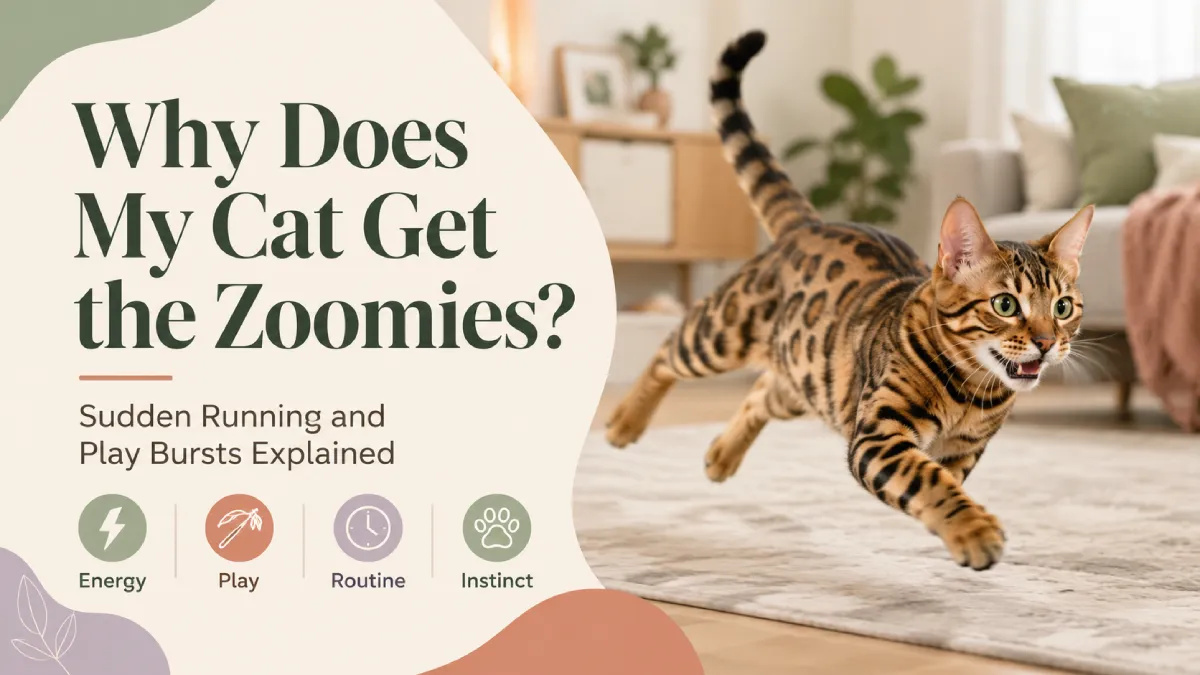
Why Does My Cat Get the Zoomies? Sudden Running and Play Bursts Explained
If you’re wondering why does my cat get the zoomies, short bursts of fast running can be part of normal feline activity and play. Cats may suddenly sprint after resting, during an active part of the day, while chasing another cat or after something in the environment triggers play.
Zoomies are especially noticeable in kittens and young cats, but adults can have them too. The important distinction is between a familiar, playful burst and new frantic behaviour accompanied by pain, skin rippling, self-injury, balance problems or other unusual signs. Running alone does not diagnose stress or feline hyperesthesia.
Direct Answer
Cat zoomies are brief periods of intense running, pouncing or rapid direction changes. They can occur during normal play, after inactivity or around periods when a cat is naturally active. Kittens commonly show energetic predatory-type play. However, a sudden major change—particularly with pain, abnormal skin sensitivity, self-trauma or neurological signs—should be assessed separately rather than labelled ordinary zoomies.
What Do Cat Zoomies Look Like?
A typical burst may involve:
- sprinting down a hallway
- sudden sharp turns
- jumping onto furniture
- racing up or down stairs
- pouncing at toys
- briefly chasing another cat
- stopping almost as suddenly as it began
Veterinary sources commonly use the term frenetic random activity periods, or FRAPs, for these short bouts of intense activity. They are particularly familiar in kittens and younger cats.
The exact appearance varies by cat. One may make three fast laps of the living room; another may combine running with pouncing and climbing.
Play and Energy Are Common Contexts
A familiar burst in an otherwise relaxed cat often fits normal activity better than distress.
Look at what happens immediately before and after.
A cat that:
- wakes from a nap
- races after a toy
- pounces several times
- then settles normally
presents a different picture from one that bolts suddenly while vocalising, biting at its back or appearing frightened.
FelineVMA guidance emphasises that cats need opportunities for play and predatory behaviour as part of a healthy environment.
Zoomies Can Overlap Hunting-Style Activity
Feline play often contains pieces of the predatory sequence, including watching, stalking, chasing, pouncing and catching. Kittens in particular have a high play drive and practise predatory-type behaviours throughout their first year.
A high-speed dash after a moving toy can therefore fit naturally into a broader play sequence.
That does not mean every unexplained sprint is a hunting attempt. It means rapid pursuit and sudden direction changes are compatible with normal feline play.
Pawnium’s Why Does My Cat Bring Me Toys? article can take over when the behaviour centres specifically on carrying, retrieving or delivering toys. That page already owns the deeper hunting-style object-play topic.
Kitten Zoomies Are Particularly Common
Kitten zoomies are not surprising given how much of kitten behaviour involves movement and play.
AAHA/AAFP describes kittens as having a high play drive, with swatting, chasing, pouncing and catching all helping develop predatory-type behaviour. Intercat social play is also especially prominent during early development.
Provide:
- safe chase toys
- climbing opportunities
- scratching surfaces
- short interactive play sessions
- enough rest between activity
Do not encourage kittens to chase hands and feet, because AAHA/AAFP specifically advises against teaching that human body parts are play targets.
Young Adult Cats Can Still Be Highly Active
The AAHA/AAFP life-stage framework defines young adult cats as roughly 1–6 years old and continues to recommend enrichment, play and exercise during this stage.
Some young adults remain extremely playful, while others become noticeably calmer than they were as kittens.
There is no correct number of zoomie episodes a healthy cat must have.
Individual activity level matters more than comparison with another cat.
Indoor Cats Need Suitable Activity Outlets
Indoor living can be safe, but it places more responsibility on the household to provide opportunities for natural behaviour.
FelineVMA states that indoor cats should have access to:
- play
- simulated hunting and foraging
- safe resting places
- scratching areas
- vertical space
- appropriate environmental resources
A cat racing through the house should not automatically be called under-stimulated, but it is reasonable to review whether the environment provides enough appropriate physical and mental activity.
Zoomies After Resting
Some cats burst into activity after a long period of resting.
Veterinary descriptions of zoomies note that they may occur after inactivity, but there is no need to invent a precise physiological explanation for every episode.
A useful interpretation is simply:
rest → waking → sudden activity
may be an ordinary pattern for that individual.
Track timing if it happens consistently.
Evening Activity Is Common
Owners often notice their cats becoming more active in the early morning or evening.
Cats Protection describes zoomies as commonly appearing during those periods, and veterinary-reviewed guidance similarly notes activity peaks around dawn and dusk.
That helps explain why a previously quiet cat can suddenly become the fastest animal in the house shortly after everyone settles down.
Household routines also matter, so not every cat follows exactly the same schedule.
Why Does My Cat Get Zoomies at Night?
Cat zoomies at night can reflect the cat’s activity rhythm, a long inactive day, play habits or a routine that has developed around the household schedule.
For a healthy cat, useful adjustments include:
- more appropriate daytime activity
- an interactive evening play opportunity
- food enrichment
- climbing and observation spaces
FelineVMA recommends regular opportunities for predatory-style play and enrichment rather than relying solely on passive toys left on the floor.
If nighttime activity is a new change in an older cat, however, treat it differently; senior behavioural changes can overlap medical disease.
What About Zoomies After the Litter Box?
The familiar cat crazy after litter box routine is widely reported: the cat urinates or defecates, jumps out and races away.
Veterinary sources recognise that some cats show a short burst of activity after litter-box use, but the exact reason is not firmly established. Relief or physiological stimulation has been proposed, but it should not be presented as a proven explanation for every cat.
More important is whether elimination itself appears normal.
Contact a veterinarian if running after the box appears with:
- repeated straining
- crying in the box
- blood
- constipation
- repeated unsuccessful attempts to urinate
- a sudden change in litter-box habits
Those signs make the elimination problem more important than the zoomies.
Multi-Cat Zoomies May Be Social Play—or Not
Two cats racing through the home can be playing together.
Look for a generally reciprocal interaction in which both cats voluntarily participate and can disengage.
Do not assume all chasing is play if one cat repeatedly:
- hides
- becomes cornered
- hisses or growls
- tries to escape
- is persistently stalked
- loses access to important resources
FelineVMA identifies cornering, one-sided chasing, fixated staring, flattened ears and other defensive behaviours as possible signs of intercat tension.
Environmental Stimulation Can Trigger a Running Burst
A sudden noise, moving toy, insect, another cat or a new object may initiate rapid activity.
That does not make environmental stimulation inherently stressful. Cats are curious, active animals, and their environment should provide opportunities to investigate, climb and play.
Pawnium’s Why Do Cats Like Boxes? guide is useful here because boxes can double as hiding, observation and ambush-style play spaces. That dedicated page now owns the deeper box-enrichment topic.
Interactive Play Gives Energy a Useful Outlet
Interactive toys allow a person to create movement that mimics parts of prey pursuit.
FelineVMA recommends opportunities for predatory play and advises allowing the cat to catch the toy periodically rather than making success impossible.
Different cats prefer different:
- speeds
- toy sizes
- movement patterns
- session lengths
You do not need to exhaust the cat.
The goal is regular appropriate engagement that matches its age, mobility and preference.
Add Safe Climbing Opportunities
Vertical space is another important component of an indoor environment.
FelineVMA recommends climbing and perching opportunities because they add usable territory and can increase the cat’s sense of control over its environment.
Options might include:
- stable cat trees
- secure shelves
- window perches
- sturdy climbing furniture
Check that structures cannot tip when a cat launches onto them at speed.
Puzzle Feeding Adds Mental Activity
Food enrichment can complement physical play.
FelineVMA feeding guidance recommends options such as puzzle feeders, food balls, forage feeding and multiple small feeding opportunities where appropriate. These can encourage behaviours associated with seeking and working for food.
Start easy.
A puzzle that prevents the cat from obtaining enough food is not good enrichment.
Create a Safe Running Route
If your cat runs around the house regularly, look at the route from the cat’s perspective.
Consider moving or securing:
- fragile objects
- unstable furniture
- loose cords
- objects that narrow a landing area
- lightweight items the cat repeatedly knocks over
Do not chase or deliberately frighten the cat to create zoomies.
The aim is to make normal voluntary movement safer while giving the cat appropriate play opportunities.
Watch Slippery Flooring
Some cats visibly lose traction during fast turns on smooth floors.
Where this happens repeatedly, non-slip runners or mats can provide more secure footing, particularly for an older cat or one with reduced mobility. AAHA specifically recommends non-slip surfaces as part of making the environment safer for senior pets with mobility concerns.
Do not cover every floor simply because your cat runs quickly. Focus on areas where you actually see slipping or difficulty.
Zoomies in Senior Cats Deserve More Context
Senior cats can still play and run, but a new increase in high-speed or restless activity deserves more attention than a lifelong familiar habit.
AAHA/AAFP states that new or unusual behaviour in senior cats should be medically evaluated. Pain, sensory changes and several age-associated diseases can alter activity patterns.
Hyperthyroidism is one example veterinarians may consider when an older cat becomes unusually active, particularly if increased activity occurs with weight loss, increased appetite, thirst or urination.
Running alone cannot diagnose it.
Sudden Unusual Frantic Behaviour Is Different From Familiar Zoomies
Pay attention to a cat suddenly running fast if the episodes look genuinely different from its normal play.
Record:
- when episodes occur
- duration
- what happened beforehand
- whether the cat responds normally
- whether it appears frightened
- skin or grooming changes
- balance
- vocalisation
- appetite and weight
- litter-box changes
A short video can be especially useful for veterinary assessment if it can be recorded safely.
Pawnium’s Cat Health Check at Home can support broader baseline tracking; that URL is already established in Pawnium’s health cluster.
Pain or Skin Sensitivity Changes the Interpretation
Do not diagnose feline hyperesthesia because a cat races around suddenly.
Cornell describes feline hyperesthesia as abnormal sensitivity, usually along the back, with possible signs such as:
- skin rippling
- intense scratching
- tail chasing
- sudden biting at the area
- vocalisation
- self-trauma
Cornell also stresses that veterinarians need to rule out other causes of pain or skin sensitivity, including spinal pain and dermatologic disease.
Therefore:
running alone ≠ hyperesthesia.
But:
frantic running + skin rippling + apparent pain/self-biting
deserves a different veterinary conversation.
When Veterinary Assessment May Be Needed
Usually Less Concerning
A familiar brief burst where the cat:
- appears playful
- moves normally
- settles afterward
- maintains normal appetite and routine
- shows no pain or self-injury
Arrange Veterinary Assessment
Contact your veterinarian if there is:
- a major new increase in frantic activity
- new hyperactivity in a senior cat
- weight loss with increased appetite
- repeated pain-associated running
- skin rippling or extreme touch sensitivity
- repeated biting or scratching at the back/tail
- self-inflicted wounds
- significant elimination changes
- progressive mobility changes
Seek Prompt Care for Neurological Changes
Running or pacing accompanied by loss of balance, circling, seizures, marked weakness, collapse or altered responsiveness should not be treated as ordinary zoomies. Cornell lists changes in gait, balance, responsiveness and seizures among signs that warrant veterinary attention.
The key distinction is:
familiar playful sprint → observe normally
versus
new frantic episode + physical or neurological change → investigate medically.
FAQs
Why does my cat suddenly sprint through the house?
Short bursts can occur during ordinary play, after inactivity or in response to something stimulating in the environment. Look at the cat’s posture and what happens afterward. A familiar playful sprint is different from new frantic running accompanied by pain, fear or neurological signs.
Are cat zoomies a sign of stress?
Not automatically. Zoomies can occur during normal playful activity. Distress is more plausible when the running occurs with tense posture, flattened ears, attempts to flee, persistent hiding or another clear stressor. Read the whole body rather than labelling the running itself.
Why does my kitten get more zoomies than my adult cat?
Kittens have a strong play drive and spend considerable time practising chasing, pouncing and other predatory-type movements. Play patterns commonly change as cats mature, although individual adults can remain very active.
Why does my cat run after using the litter box?
Some cats show a short burst of activity after toileting, but the exact mechanism has not been established. If litter-box use is comfortable and normal, the sprint itself may be harmless. Straining, crying, blood or other elimination changes deserve veterinary attention.
How can I reduce nighttime zoomies?
Review daytime enrichment and provide suitable interactive play and food-enrichment opportunities, particularly before the household settles. Avoid trying to completely suppress normal activity. If nighttime hyperactivity is new in an older cat, arrange veterinary assessment rather than assuming the cat simply needs more play.
Can feline hyperesthesia cause frantic running?
Cats with hyperesthesia can show sudden reactions associated with extreme skin sensitivity, but running alone cannot diagnose the condition. Skin rippling, intense scratching, tail chasing, self-trauma or apparent pain make veterinary evaluation more important.