
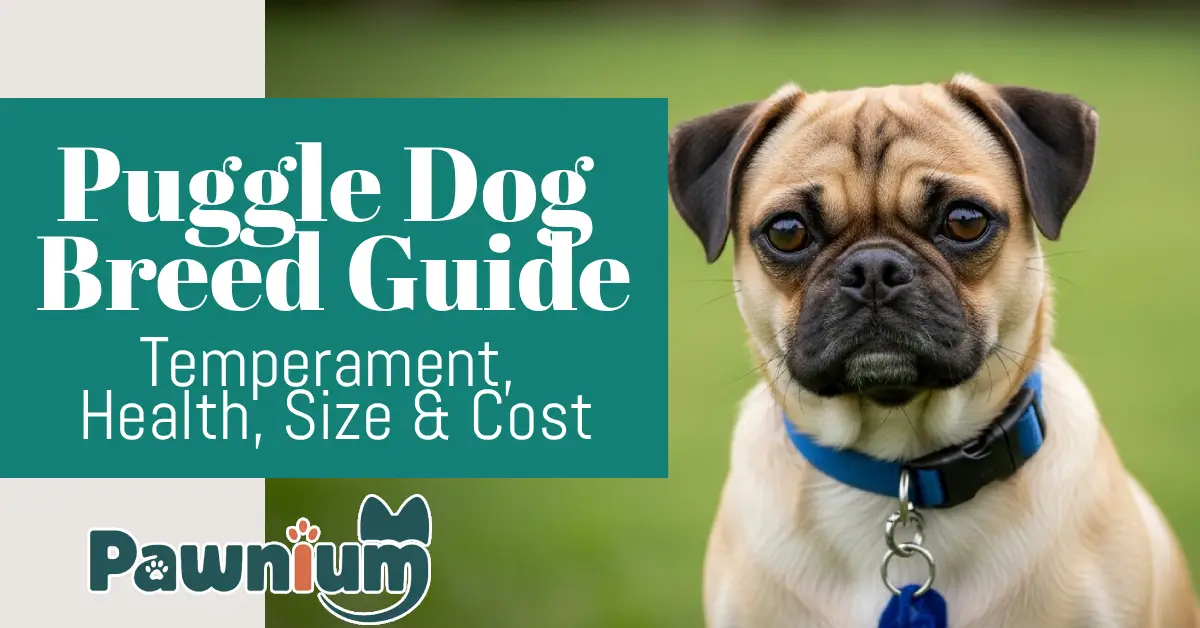
Puggle Dog: Size, Temperament, Exercise and Care Guide
A Puggle dog is a Pug–Beagle mix, so there is no single official size, muzzle length, energy level or personality that applies to every individual. One dog may have a compact, Pug-like build and relatively short muzzle; another may be taller, more athletic and more Beagle-like in the face. Behaviour can vary just as much.
The two parent breeds nevertheless provide useful context. Pugs were developed primarily as companion dogs, while Beagles are scent hounds bred to hunt and work in packs.
The goal is therefore not to predict the “perfect blend” of both parents, but to understand the range of traits a particular Puggle could express.
Quick Breed Profile
| Trait | Practical Puggle Guidance |
|---|---|
| Parentage | Pug × Beagle |
| Official breed standard | None |
| Size | Variable; parent size provides context rather than a guaranteed range |
| Muzzle | May be short and Pug-like, longer and Beagle-like, or intermediate |
| Coat | Usually expected to be short if directly produced from typical Pug and Beagle parents, but density and shedding can vary |
| Temperament | May combine sociability, affection, curiosity, independence and scent-driven behaviour |
| Energy | Variable; often capable of more activity than a purebred Pug |
| Training | Reward-based training recommended; scent distractions can make recall challenging |
| Vocalisation | Barking, howling or Beagle-style baying may occur |
| Apartment suitability | Possible, but vocalisation and exercise matter |
| Breathing | Depends partly on facial structure; do not assume every Puggle has a severely shortened airway |
| Health | Should not be assumed healthier than either parent merely because it is mixed |
The Pug Dog Club of America lists Pugs at about 10–13 inches and 14–18 pounds. Beagles occur in two height varieties—13 inches and under, or over 13 through 15 inches—and the National Beagle Club describes them as generally under 30 pounds.
Those are parent-breed references, not a Puggle standard.
Pug and Beagle Parentage
The two parent breeds were developed for very different purposes.
Pug Influence
The Pug is a compact companion breed. The Pug Dog Club of America describes the breed as even-tempered, playful, outgoing and loving, while AKC emphasizes adaptability and close attachment to people.
Physical traits that may influence a Puggle include:
- compact build
- relatively broad head
- facial wrinkling
- short muzzle
- curled tail
- short coat
Beagle Influence
The Beagle is a scent hound bred to follow quarry and work socially in packs. AKC describes the breed as energetic, easygoing and sociable, while the National Beagle Club emphasizes its long history of following scent.
Potential influences include:
- longer muzzle
- drop ears
- more athletic body
- strong interest in scent
- persistence
- social behaviour around dogs
- barking, howling or baying
A puppy does not inherit those lists evenly. Mixed-breed genetics can produce combinations that look and behave differently even within the same litter. AKC notes that mixed-breed dogs are less predictable in size, appearance and behavioural characteristics than established breeds selected consistently for type.
Why Mixed-Breed Traits Vary
There is no Puggle parent club defining an official:
- adult height
- adult weight
- muzzle length
- head shape
- coat standard
- temperament standard
- exercise requirement
This matters because phrases such as “a Puggle is exactly 15 inches tall” or “Puggles always have the Beagle personality with a Pug face” create certainty that does not exist.
Even genetic ancestry percentages do not tell an owner exactly which visible or behavioural traits will be expressed.
The safest rule is:
Use Pug and Beagle traits to understand possibilities, then assess the individual dog.
Size
There is no authoritative universal Puggle size range.
The parent references provide boundaries for what owners may encounter:
Pug: approximately 10–13 inches and 14–18 pounds.
Beagle: two varieties—13 inches and under, or over 13 through 15 inches. AKC breed data commonly places smaller Beagles under 20 pounds and larger 13–15-inch Beagles around 20–30 pounds.
A Puggle may fall somewhere around the size represented by its parents, but adult size should not be guaranteed from the mix name alone.
If buying a puppy, the actual size and build of both parents are more informative than a generic Puggle size chart.
Appearance
Puggles can differ noticeably in appearance.
Possible features include:
- Pug-like forehead wrinkles
- a smoother Beagle-like forehead
- drop ears
- compact or more athletic body proportions
- curled or less tightly curled tail
- broad or narrower chest
- fawn, tan, black or multicoloured coat patterns
Because there is no recognized conformation standard for the mix, none of these combinations makes one dog a “better” Puggle than another.
Facial Structure Can Vary
This is one of the most important physical differences within the mix.
Pugs are brachycephalic, meaning they have a shortened skull and muzzle. Cambridge veterinary researchers explain that skull shortening can leave relatively excessive soft tissue within the reduced airway space, contributing to brachycephalic obstructive airway syndrome, or BOAS.
Beagles, by contrast, have a medium-length muzzle according to their official breed standard.
A Puggle may therefore have:
- a noticeably shortened muzzle
- an intermediate muzzle
- a face much closer to Beagle proportions
Do not assume every Puggle is brachycephalic or has BOAS. Equally, do not assume that being a cross automatically removes breathing risk. If a dog has obvious facial shortening, narrowed nostrils, marked respiratory noise or poor exercise tolerance, its actual airway function matters more than the label “Puggle.” Cambridge research shows that BOAS severity varies considerably even among brachycephalic dogs.
Temperament
There is no guaranteed Puggle temperament.
A dog may inherit companion-oriented traits associated with the Pug, hunting and scent-driven tendencies associated with the Beagle, or a combination.
Pugs are generally described as outgoing, affectionate and adaptable. Beagles are described as energetic, happy and sociable, but their working history can also contribute independence and persistence.
A particular Puggle might be:
- affectionate
- playful
- socially confident
- scent-focused
- independent
- highly food motivated
- watchful
- persistent
Early experience and learning also shape behaviour, so parent breed alone cannot predict the adult personality.
Energy Level
Some Puggles may be more active than people expect from a small companion dog.
Pugs generally need moderate activity and require additional caution in heat because of their brachycephalic structure. Beagles are energetic hounds that need meaningful physical and mental activity.
A Puggle could fall anywhere between those tendencies.
Use the dog’s:
- breathing comfort
- age
- body condition
- recovery after activity
- enthusiasm
- health
- environmental temperature
to decide how demanding exercise should be.
Exercise
There is no evidence-based universal rule such as “every Puggle needs exactly 60 minutes.”
Healthy adults often benefit from a mixture of:
- walks
- sniffing
- play
- training
- scent games
- exploration
General exercise needs vary according to age, health and individual characteristics.
If your Puggle has a short Pug-like muzzle or shows respiratory limitation, heat and exertion require extra caution. If the dog is more Beagle-like and breathes comfortably, it may tolerate more sustained activity, but fitness should still be developed gradually.
Scent-Driven Behaviour
The Beagle side can matter greatly outdoors.
The National Beagle Club describes Beagles as scent hounds bred over many generations to follow a scent, while AKC training guidance warns that their noses can lead them far from their handlers if allowed unrestricted freedom.
A Puggle that strongly expresses this trait may:
- stop frequently to sniff
- follow wildlife scent
- pull toward interesting odours
- become difficult to interrupt outdoors
- investigate food or rubbish
- wander if given an opportunity
Rather than fighting that instinct constantly, owners can use sniffing as enrichment and practise attention around scent distractions.
Training
Use reward-based methods.
AVSAB’s current humane-training position recommends reward-based methods for all dog training and behaviour modification and advises against aversive tools and dog training and behaviour mogainst aversive tools and punishment-based approaches.
Useful Puggle skills include:
- name response
- recall
- loose-leash walking
- leave it
- drop it
- settle
- polite greetings
- waiting at doors
- handling
- food manners
Food can be useful in training, but rewards should remain part of the daily calorie plan, especially for dogs prone to excess weight.
Link naturally to the appropriate Pawnium training content where deeper technique is needed.
Recall Needs Special Attention
Recall deserves early work because of the Beagle parent’s scent-hound background.
AKC’s Beagle training guidance recommends containment rather than assuming a Beagle will reliably ignore a scent trail, and general recall guidance recommends using a leash or long line uncreasingly distracting environments.
For a scent-driven Puggle:
- Start recall indoors.
- Use high-value rewards.
- Practise in increasingly distracting locations.
- Use a long line outdoors during training.
- Avoid repeatedly calling when you know the dog is unlikely to respond.
- Keep off-leash freedom to securely enclosed areas unless recall is genuinely reliable.
Even well-trs, so no recall should be marketed as 100% guaranteed.
Link to Pawnium’s Dog Recall Training guide here.
Barking and Vocalisation
Puggles can be vocal, but the form and frequency vary.
Beagles are especially notable for vocalisation. AKC describocal sounds: barking, howling and a hunting-style bay.
A Puggle may therefore:
- bark at visitors
- howl
- bay when excited
- vocalise around scents
- bark from frustration
- remain relatively quiet
Do not guarantee that every Puggle will howl simply because one parent is a Beagle.
For persistent vocalisation, identify the trigger—excitement, isolation, frustration, attention-seeking, outside sounds or another cause—before deciding how to manage it.
Children
Both parent breeds can live successfully with children, but that does not guarantee that every Puggle will automatically be child-friendly.
AKC describes both Pugs and Beagles as gees positive relationships with children.
Still:
- supervise young children and dogs
- teach children not to climb on the dog
- avoid disturbing a sleeping or eating dog
- provide the dog with a quiet escape area
- watch body language for discomfort
Link to Pawnium’s Dog Body-Language Guide so families can recognise stress before an interaction escalates.
Other Dogs
A Puggle may be socially comfortable around other dogs.
Both parent breeds have a history of canine sociability: Pugs are commonly dehile Beagles were bred to hunt in packs.
That is useful context, not a guarantee.
Compatibility still depends on:
- individual temperament
- socialisation
- age
- previous experience
- introduction method
- resource guarding or other behaviour concerns
Introduce dogs gradually and observe behaviour rather than assuming breed ancestry guarantees friendship.
Cats
A Puggle can potentially live with cats, but the Beagle side deserves attention.
Beagles were bred to pursue scent ans may have stronger interest in chasing small animals.
A successful introduction should include:
- barriers initially
- safe elevated spaces for the cat
- controlled exposure
- reinforcement for calm behaviour
- prevention of repeated chasing
A Puggle raised around cats may coexist very well, while another individual may require more management.
Apartment Living
A Puggle’s physical size can fit apartment living, but square footage is only one part of suitability.
The bigger questions are:
- How vocal is the dog?
- Can you provide adequate exercise?
- Is scent-driven pulling manageable?
- Can the dog settle indoors?
- How does it cope when alone?
- Does a short muzzle limit safe outdoor exercise in warm weather?
AKC notes more generally that a dog’s living area does n its exercise and behavioural needs are properly met.
A quiet Puggle with good indoor settling skills may do very well in an apartment. A frequent baying dog in a building with thin walls may be much more challenging.
Link to Pawnium’s Apartment-Dog Guide.
First-Time Owners
A Puggle may suit a committed first-time owner, but the cross is not automatically effortless.
Potential advantages include:
- manageable physical size
- sociable parent-breed tendencies
- relatively straightforward short-coat grooming
- food motivation that can help training
Potential challenges include:
- scent-driven distraction
- recall
- vocalisation
- weight gain
- possible brachycephalic breathing limitations
- mixed-breed unpredictability
This suitability judgment is an infererather than a standardized Puggle trait.
Grooming
Most first-generation Puggles from typical Pug and Beagle parents would be expected to have a relatively short coat, but density can vary.
Both parent breeds have short coats and shed. Beagles have a smooth, dense double coat and benefit fhed noticeably despite their short coat.
Routine care may include:
- regular brushing
- occasional bathing when needed
- nail trimming
- ear checks
- skin checks
- dental care
Use Pawnium’s Dog Grooming Schedule for the broader routine.
Shedding
A short coat does not mean little shedding.
AKC specifically describes Beagles as moderate year-round shedders, while Pugs can also shed considerably.
A Puggle may therefore leave a noticeable amount of short hair around the home.
Regu loose fur, but it will not eliminate normal shedding.
Feeding
There is no special universal “Puggle diet.”
Food amount should be based on:
- life stage
- current weight
- body condition
- activity
- calorie density
- treats
- health status
AAHA recommends individualized nutritional assessment using body weight, body condit rather than assigning calories from breed name alone.
Because Pugs can be strongly food motivated and Beagles can also respond very well to food during training, other than treating them as calorie-free.
Link to Pawnium’s Dog Feeding Guide for complete portion guidance.
Weight Management
Maintaining appropriate body condition is particularly useful for this mix.
AAHA recommends adjusting calorie intake according to body weiather than relying solely on generic feeding formulas.
Watch for:
- ribs becoming difficult to feel
- loss of a visible waist
- steady unintended weight gain
- reduced activity without food adjustment
- large amounts of training treats
Excess weight is also relevant to respiratory health. Cambridge reOAS severity in brachycephalic dogs.
Do not crash-diet an overweight dog; use a veterinary weight-management plan where necessary.
Breathing Considerations
This section should be based on the individual Puggle’s face and respiratory function, not just its parentage.
Pugs are brachycephalic and can experience BOAS. Cambridge describes signs including:
- respiratory noise
- narrowed nostrilleep-related breathing problems
- cyanosis
- collapse
However, a Puggle may inherit a much longer muzzle from the Beagle side.
Therefore:
Do not write that all Puggles have breathing problems.
Also avoid:
“The Beagle genes fix Pug breathing problems.”
A longer muzzle may produce a different facial structure, but the health of one individual airway cannot be inferred solely from mixed parentage.
Arrange veterinary assessment if the dog has:
- marked snoring while awake
- obvious breathing effort
- narrow nostrils
- poor exercise tolerance
- repeated heat intolerance
- blue or grey mucous membranes
- collapse
Cambridge notes that even among brac significantly between individuals.
Link here to Pawnium’s existing brachycephalic-care pillar for the broader subject.
Health Screening
There is no official Puggle CHIC screening program, so responsible assessment should begin with the recognized parent-breed health recommendations.
Pug Parent
The Pug Dog Club of America’s current CHIC page lists the following as required:
- PDE DNA testing
- eye examination
- purrent page lists hip evaluation among optional tests.
AKC’s compiled parent-club testing page currently lists:
- hip evaluatixamination
- patellar luxation
- PDE DNA test
for Pugs.
Because those two official resources currently differ slightly in how hip testing is categorized, the breeder should be asked exactly which current PDCA/OFA protocol they are following.
Beagle Parent
The National Beagle Club’s current CHIC requirements include:
- hip evaluation
- ophthalmologist examinn
- autoimmune thyroiditis evaluation
These recommendations apply to the purebred parents, not as an official Puggle testing panel.
A breeder producing Puggles intentionally should be able to explain and document appropriate health screening on both parent dogs.
Does Mixing the Breeds Make the Puppies Healthier?
Do not make that promise.
A 2024 Royal Veterinary College study of several other popular designer crosses found that their overall health was broadly similar to their parent breeds rather than universally better. Importantly, **Puggles were not sh cannot tell us the exact disease risk of this cross.
The appropriate conclusion is simply that mixed ancestry is not evidence by itself of superior health.
Puppy Care
A Puggle puppy needs ordinary puppy priorities plus attention to whichever parent traits begin to emerge.
Focus on:
- complete growth-appropriate nutrition
- veterinary preventive care
- positive socialisation
- recall training
- leash skills
- comfortable handling
- rest
- gradual exercise
- body-condiupports early socialisation and reward-based training.
If the puppy is clearly short-muzzled, learn its breathing pattern and avoid forcing strenuous activity in hot conditions. If scent drive becomes strong, start recall and long-line skills early rather than waitappearing after interesting smells.
Senior Care
Older Puggles should be managed according to individual health rather than assuming the same age-related changes occur in every dog.
Monitor:
- body weight
- muscle condition
- exercise tolerance
- breathing
- mobility
- hearing and vision
- dental health
- appetite
- sleep
- behaviour changes
AAHA notes that senior dogs may experience changing energy needs and muscle loss a both body condition and muscle condition as dogs age.
A senior dog that previously tolerated walks comfortably but suddenly slows, coughs, becomes breathless or loses weight deserves veterinary assessment rather than simply being labelled “old.”
Example Daily Routine
This is a flexible example, not a required schedule.
Morning
- toilet break
- comfortable walk with time to sniff
- breakfast
- brief recall or leash-training practice
- rest
Midday
- toilet outing
- scent puzzle or food-search game
- short interaction or play
- rest
Evening
- second purposeful walk
- controlled sniffing
- training or enrichment
- dinner
- calm family time
Before Bed
- short toilet outing
- quiet settling routine
- sleep
A more Beagle-like dog may need more physical and scent-based activity. A shorter-muzzled dog with rtings and cooler exercise conditions.
Who This Mix May Suit
A Puggle may suit someone who:
- wants a relatively compact companion
- enjoys walking and sniffing activities
- is willing to train recall
- accepts some shedding
- can manage possible barking or baying
- will monitor body weight
- understands that facial structure can vary
- wants a social dog but accepts individual temperament differences
This assessment is lifestyle guidance rather than a promise about any particular Puggle.
Who May Struggle With This Mix
Think carefully if you need:
- a guaranteed quiet dog
- highly predictable adult appearance
- guaranteed off-leash reliability
- almost no shedding
- a dog for strenuous exercise regardless of weather
- guaranteed respiratory freedom because it is a cross
- a fixed personality profile
The most important ownership lesson is that “Puggle” describes parentage, not a complete specification for the adult dog.
FAQs
How big does a Puggle dog get?
There is no official Puggle size standard. Pugs are roughly 10–13 inches and 14–18 pounds, while Beagles occur in height classes up to 15 inches and are generally under about er context than a generic mix chart.
Are Puggles good family dogs?
They can be. Both parent breeds are commonly described as sociable family companions, including around children, but a mixed dog’s temperaics, socialisation and learning history.
Do Puggles bark or howl a lot?
Some do. Beagles can bark, howl and bay, so a P vocal tendencies. Others may be considerably quieter.
Are Puggles easy to train?
They can learn very well with rewards, but a dog that strongly inherits Beagle scent drive may become highly dist deliberate training and management.
Do all Puggles have breathing problems?
No. Facial structure varies because the Beagle parent has a substantially longer muzzle than the Pug. However, a Puggle with marked facial shortening, nl need veterinary airway assessment.
Are Puggles healthier than Pugs or Beagles?
That cannot be guaranteed. Research on other designer crosses does not support assuming that crossbreeding automatically creates hes were not included in the major RVC study cited here.