Goldendoodle vs Labradoodle: Temperament, Size, Coat and Care Compared
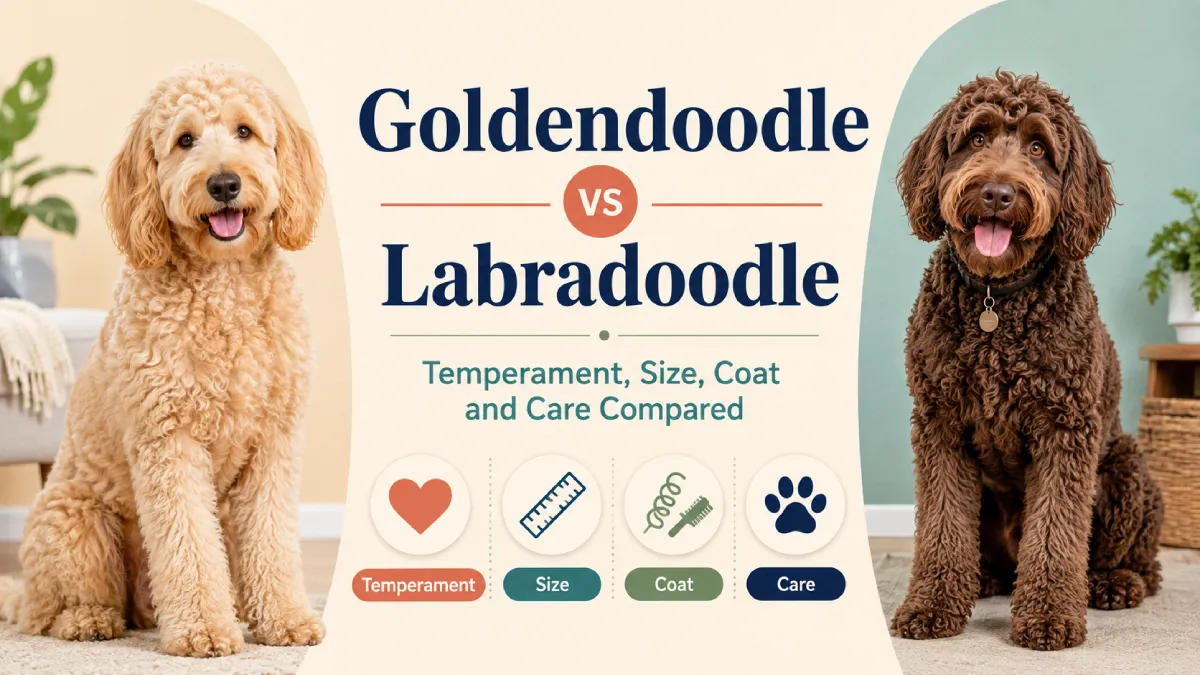
Comparing a Goldendoodle vs Labradoodle is not like comparing two standardized pure breeds. Goldendoodles combine Golden Retriever and Poodle ancestry, while Labradoodles combine Labrador Retriever and Poodle ancestry. Both can inherit a wide range of sizes, coat textures and behavioural traits, particularly when different Poodle sizes or later-generation crosses are involved.
The parent breeds overlap in important ways: Goldens, Labradors and Poodles are intelligent, active dogs with retrieving backgrounds, and all three can enjoy substantial physical and mental activity.
That overlap means the actual parents and individual dog often matter more than choosing one Doodle name over the other.
Quick Verdict
Neither cross is universally better. A Goldendoodle may appeal if you particularly like Golden Retriever traits, while a Labradoodle may suit someone drawn to the Labrador’s energetic, outgoing working style. Size, coat, shedding and temperament remain variable in both. If choosing between them, compare the actual parents, generation, health testing, adult relatives, grooming demands and individual puppy rather than relying on Doodle stereotypes.
Goldendoodle vs Labradoodle Comparison Table
| Trait | Goldendoodle | Labradoodle |
|---|---|---|
| Foundation parentage | Golden Retriever × Poodle | Labrador Retriever × Poodle |
| One standardized type? | No; breeding programs and generations vary | No; also distinguish Labradoodle from multigenerational Australian Labradoodle |
| Size | Highly variable | Highly variable |
| Coat | Straight, wavy, curly or intermediate | Straight, wavy, curly or intermediate |
| Shedding | Variable; cannot guarantee low shedding | Variable; cannot guarantee low shedding |
| Hypoallergenic? | No guarantee | No guarantee |
| Grooming | Often substantial | Often substantial |
| Energy | Moderate-high to high potential | Moderate-high to high potential |
| Trainability | Strong potential | Strong potential |
| Swimming | Many may enjoy it | Many may enjoy it |
| Family potential | Often good, but individual temperament matters | Often good, but individual temperament matters |
| Apartment potential | Possible with enough activity and management | Possible with enough activity and management |
| Garden required? | No, but regular outdoor activity is needed | No, but regular outdoor activity is needed |
| First-time owners | Possible with realistic expectations | Possible with realistic expectations |
| Health advantage from crossbreeding? | Not guaranteed | Not guaranteed |
Use this as a decision framework rather than a breed standard. These crosses do not produce one fixed adult package.
Breed Origins
Labradoodle Origins
The modern Labradoodle has a relatively well-documented development history. The Australian Labradoodle Association of America traces the deliberate Labrador Retriever–Poodle cross to Australia in the 1980s, when the combination was explored in connection with guide-dog work and allergy concerns.
It is important, however, to distinguish a Labradoodle from an Australian Labradoodle.
In ordinary usage, a Labradoodle refers to Labrador Retriever–Poodle ancestry. ALAA describes the Australian Labradoodle as a separately developed multigenerational population that also incorporates Cocker Spaniel ancestry.
This article compares the conventional Labrador Retriever–Poodle Labradoodle with the Golden Retriever–Poodle Goldendoodle.
Goldendoodle Origins
Goldendoodle history is less tied to one universally agreed first litter.
The Goldendoodle Association of North America says Golden Retriever–Poodle crosses occurred earlier, while organized breeding and promotion expanded during the late 1990s and early 2000s. GANA itself was established later as an organization for Goldendoodle breeding and pedigree records.
Because neither cross is an AKC-recognized breed with one universal studbook and standard, breeding practices vary between programs.
Parent Breeds
The biggest difference is straightforward:
Goldendoodle: Golden Retriever + Poodle
Labradoodle: Labrador Retriever + Poodle
The Golden Retriever typically weighs about 55–75 pounds and is known for an affectionate, friendly and trainable temperament. It is an active sporting dog rather than a low-energy companion.
Labrador Retrievers generally weigh about 55–80 pounds depending on sex and are friendly, outgoing, energetic sporting dogs. They are enthusiastic retrievers and commonly enjoy swimming and physically demanding activities.
Poodles add another major variable. Standard Poodles weigh approximately 40–70 pounds depending on sex, while Miniature and Toy Poodles are considerably smaller. Poodles are active, highly intelligent dogs with retrieving and water-dog ancestry.
That Poodle-size variable explains why two dogs carrying the same Doodle label can mature very differently.
Goldendoodle vs Labradoodle Size
There is no universal Goldendoodle vs Labradoodle size winner.
Their non-Poodle parents overlap considerably:
- Golden Retriever: approximately 55–75 pounds
- Labrador Retriever: approximately 55–80 pounds
- Standard Poodle: approximately 40–70 pounds
If both crosses are produced using Standard Poodles, substantial overlap in adult size is possible.
Smaller Goldendoodles and Labradoodles may instead involve Miniature or, in some breeding programs, Toy Poodle ancestry. Once that happens, the label alone tells you even less about eventual size.
If adult size matters strongly, ask:
- Which Poodle variety was used?
- What are both parents’ actual adult weights and heights?
- What generation is the puppy?
- How large were adult dogs from comparable previous litters?
- Is the breeder discussing a Labrador–Poodle Labradoodle or an Australian Labradoodle lineage?
Do not rely on marketing terms such as “mini,” “medium” or “standard” unless the breeder clearly defines what those terms mean within its program.
Generational Variation
Generation labels describe ancestry rather than guaranteeing a particular coat or personality.
An F1 Goldendoodle is a Golden Retriever crossed with a Poodle. An F1 Labradoodle similarly combines a Labrador Retriever with a Poodle.
A backcross—often written F1B—breeds a first-generation cross back to one of its foundation breeds. Multigenerational breeding uses dogs that already have Doodle ancestry.
These choices change the genetic mix.
They may influence:
- adult size
- coat curl
- visible shedding
- body structure
- retrieving behaviour
- temperament
But generation labels should not be treated as guarantees.
Even an F1 litter can show variation between siblings, and later-generation labels are not a substitute for asking what the actual parents look and behave like.
Coat Variation
This is one area where buyer expectations often become unrealistic.
Golden Retrievers have medium-length double coats that shed throughout the year and more heavily seasonally. Labrador Retrievers have dense, short, water-resistant double coats and also shed substantially.
Poodles have dense curly coats and shed much less visibly, but those coats require intensive maintenance.
A Goldendoodle or Labradoodle may therefore develop:
- relatively straight hair
- loose waves
- shaggy furnishings
- tight curls
- mixed textures
- a dense coat that readily tangles
- different hair texture on the body, face, ears and legs
A fluffy puppy coat does not reliably tell you exactly how the adult coat will behave.
Shedding
There is no evidence-based reason to declare one cross the universal winner for Goldendoodle vs Labradoodle shedding.
The Golden Retriever and Labrador both shed. Poodles shed minimally. Each cross can inherit different combinations of those coat characteristics.
Therefore:
- do not promise that all Labradoodles are low-shedding
- do not promise that all Goldendoodles are low-shedding
- do not assume a curlier puppy will produce no household hair
- do not equate “low shedding” with “low grooming”
Neither cross should be described as universally hypoallergenic.
The American Academy of Allergy, Asthma & Immunology states that there are no truly hypoallergenic dog breeds. Dog allergens arise from proteins in dander, saliva and urine, and the amount of visible hair a dog sheds does not by itself determine allergy risk.
Someone with significant dog allergies should discuss the issue with an allergist rather than relying on a breeder’s coat guarantee.
Grooming
For Goldendoodle vs Labradoodle grooming, the practical answer is that both can require considerable time and professional care.
Poodle coats need intensive brushing, especially when left long, because retained hair can tangle and mat.
Crossbred coat texture can make the schedule difficult to predict from the name alone.
A dense or curly individual may need:
- frequent brushing
- combing all the way to the skin
- attention behind the ears
- armpit and leg checks
- bathing
- thorough drying
- clipping
- nail trimming
- professional grooming
A straighter-coated individual may shed more visibly but still need regular brushing.
Do not assume that a low-shedding dog is a low-maintenance dog.
Pawnium’s Grooming Poodle Mixes article should own the detailed brushing and mat-prevention technique, while this page should focus on the ownership difference.
Temperament
A simple Goldendoodle vs Labradoodle temperament formula such as “Goldendoodles are calmer and Labradoodles are more energetic” goes beyond what the evidence supports.
Golden Retrievers are generally affectionate, friendly, trainable and active. Labradors are friendly, outgoing, affectionate and energetic. Poodles are highly intelligent, active and people-oriented.
A study of 5,141 dogs that included first-generation Labradoodles and Goldendoodles found that crossbred behavioural traits often fell between their constituent breeds, but there were exceptions. The Goldendoodle group differed from parent breeds on several measured behaviour traits, while F1 Labradoodles showed fewer significant differences.
That study used owner-reported C-BARQ data and should not be turned into a rule for predicting one puppy.
The useful takeaway is:
parent traits give context; they do not guarantee individual temperament.
Energy Level
Expect both crosses to have meaningful exercise needs.
All three foundation breeds are active dogs. Goldens enjoy running, retrieving, hiking and swimming; Labs are energetic athletes; Poodles need substantial daily activity and mental stimulation.
Individual Doodles can vary from moderate to very energetic.
Working or field-oriented Golden and Labrador lines can also produce a different activity profile from dogs bred primarily for companion homes.
A prospective owner who wants a low-exercise dog should not select either cross simply because the puppy looks like a soft teddy bear.
Exercise
There is no universal number of daily exercise minutes that fits every Goldendoodle or Labradoodle.
A healthy adult may enjoy:
- purposeful walks
- retrieving
- hiking
- swimming
- scent games
- training
- running where appropriate
- canine sports
The actual requirement should reflect:
- age
- adult size
- fitness
- health
- body condition
- parent-line working drive
- environmental conditions
Use Pawnium’s Dog Exercise content for the detailed activity framework rather than turning this comparison into a fixed exercise prescription.
Puppies need developmentally appropriate activity rather than adult endurance routines.
Trainability
Both crosses have strong potential.
Golden Retrievers and Labradors have long histories as working, assistance and sporting dogs, while Poodles are exceptionally trainable and regularly participate in obedience and other dog sports.
That makes either cross a reasonable candidate for owners who enjoy:
- obedience
- recall work
- retrieving
- tricks
- scent training
- dog sports
But intelligence does not reduce the need for training.
A highly intelligent adolescent dog with substantial energy and little structure can be more demanding, not less.
Mental Stimulation
Physical exercise alone is not always enough.
Poodles have substantial mental-stimulation needs, and both retriever parent breeds were developed to work cooperatively with people.
Useful enrichment may include:
- scent searches
- retrieving tasks
- puzzle feeding
- obedience practice
- trick training
- hide-and-seek
- controlled exploration
- dog sports
Mental stimulation should not mean keeping the dog constantly excited.
Learning to settle and rest is also an important household skill.
Swimming Tendencies
Both crosses have unusually strong water-dog ancestry on paper.
Labradors were developed as water-retrieving dogs and swimming remains one of the breed’s characteristic activities. Golden Retrievers also commonly enjoy swimming and retrieving. Poodles themselves originated as water retrievers and AKC specifically notes that many enjoy swimming.
That makes swimming a plausible activity for either Doodle.
It does not guarantee that an individual puppy will enjoy water or be a naturally safe swimmer.
Introduce water gradually, supervise the dog, and do not force a reluctant dog to swim.
Children
Both crosses can potentially work very well in family homes.
Golden Retrievers are generally known for positive relationships with children, while Labradors are affectionate family dogs, although their enthusiasm can be physically boisterous. Poodles also have strong family-companion potential.
For either Doodle, child compatibility still depends on:
- individual temperament
- socialisation
- adult size
- arousal level
- training
- child behaviour
- supervision
A large adolescent Doodle can unintentionally knock over a small child even without any aggressive behaviour.
Do not select either cross because a website labels it “perfect with children.”
Other Dogs
Both can potentially be sociable with other dogs.
Labradors are generally social with other dogs, and Golden Retrievers also tend to be socially oriented.
Individual compatibility still varies.
Good introductions should consider:
- play style
- body size
- age
- resource guarding
- previous social experience
- the other dog’s temperament
Breed ancestry can influence probability, but it does not guarantee household compatibility.
Cats
Either can potentially live successfully with cats.
All three foundation breeds have retrieving or hunting ancestry, so some individuals may show considerable interest in moving animals. Others can live calmly with cats.
For the best chance of success:
- introduce gradually
- provide escape routes for the cat
- initially use barriers
- reward calm behaviour
- prevent repeated chasing
- supervise early interactions
A puppy raised around cats may have an advantage in familiarity, but early exposure still does not guarantee lifelong compatibility.
Apartment Living
Neither cross is disqualified from apartment living simply because it can become a medium or large dog.
The larger challenge is their activity and management needs.
An apartment household needs to provide:
- regular outdoor exercise
- toileting opportunities
- training
- mental enrichment
- barking management
- calm indoor settling
A physically large dog that settles well indoors can be easier in an apartment than a smaller dog that is chronically under-exercised and highly aroused.
Still, prospective owners should be realistic: many Goldendoodles and Labradoodles are active dogs that need significant planned activity outside the apartment.
Do They Need a Garden?
A private garden is useful, but it is not a substitute for exercise and should not be treated as mandatory.
A secure yard can help with:
- toileting
- short play sessions
- training
- supervised outdoor time
But simply letting an energetic Doodle into a garden does not provide the same physical and mental value as walks, exploration and interactive activity.
A household without a garden can still succeed if it reliably provides sufficient outdoor access.
Conversely, a large garden does not make a poorly exercised dog well exercised.
First-Time Owners
Either cross can work for a first-time owner who understands the commitment.
Potential advantages include:
- high trainability
- strong people orientation
- family-companion potential
- enthusiasm for interactive activities
Commonly underestimated challenges include:
- large adult size in some lines
- adolescent energy
- coat maintenance
- professional grooming
- training commitment
- mental stimulation
- uncertain coat and shedding
- breeder-quality variation
The 2019 behavioural research on Goldendoodles and Labradoodles is another reason not to assume that crossbreeding automatically creates an easier behavioural package.
Use Pawnium’s First-Time-Owner Breed Guide for comparisons with dogs that may require less grooming or exercise.
Health Screening
Mixed breeding does not automatically eliminate inherited disease.
This point needs nuance because the research available for these two crosses is uneven.
A large 2024 RVC study included Labradoodles and found that, across the designer crosses studied, 86.6% of disorder comparisons showed no statistically significant difference from the relevant parent breeds. Labradoodles were therefore not shown to have a broad automatic health advantage simply because they were crossbred.
Goldendoodles were not included in that study, so those percentages should not be applied to them.
There is nevertheless no biological reason to assume a Goldendoodle cannot inherit disease-associated variants from Golden Retriever or Poodle ancestry. Published veterinary literature has documented inherited disease in individual Golden Retriever–Poodle crosses, illustrating why parent screening still matters.
Golden Retriever Parent Screening
The Golden Retriever Club of America recommends breeding dogs be screened for:
- hips
- elbows
- eyes
- heart
with results made publicly verifiable where possible.
Labrador Retriever Parent Screening
The Labrador Retriever Club’s current CHIC-related recommendations include:
- hip evaluation
- elbow evaluation
- ophthalmologist eye examination
- EIC DNA testing
- D-locus DNA testing
The club also lists additional testing that may be recommended depending on the breeding program.
Poodle Parent Screening
Testing depends on the Poodle variety.
For Standard Poodles, the Poodle Club of America currently lists:
- hip evaluation
- annual ophthalmologist eye examination
- at least one health elective such as thyroid, sebaceous adenitis or cardiac evaluation for CHIC
Miniature and Toy Poodles have different screening requirements.
That means someone buying a “mini Goldendoodle” or “mini Labradoodle” should verify testing appropriate to the actual Poodle variety rather than accepting a generic statement that the parents are “health tested.”
Feeding
Neither cross requires a special food simply because it is a Doodle.
Portions should reflect the individual dog’s:
- life stage
- adult size
- current weight
- body condition
- activity
- calorie density of the food
- treats and training rewards
- health
This is particularly important because adult size can vary considerably within either cross.
A 30-pound Doodle should not automatically receive the same portion as a 70-pound dog merely because both have the same designer-cross name.
Use Pawnium’s wider feeding content for calorie and portion calculations rather than relying on a generic Doodle cups-per-day chart.
Grooming Costs
Do not publish one universal price.
Professional grooming costs depend on:
- location
- dog size
- coat length
- matting
- behaviour during grooming
- requested haircut
- appointment frequency
A large, dense, curly Doodle that arrives heavily matted will usually involve a different level of work from a smaller dog maintained in a short trim.
The useful ownership conclusion is simply:
budget for professional grooming before bringing either cross home.
Buying clippers or a brush later does not replace the need to understand coat maintenance.
Exercise Commitment
Exercise can become one of the biggest lifestyle costs in time, even when no money is involved.
Both crosses may require:
- daily walks
- interactive play
- training
- mental enrichment
- opportunities to retrieve or explore
- structured activity during adolescence
A working-from-home owner should not assume physical presence automatically meets those needs.
Likewise, a large garden is not a substitute for purposeful interaction.
If you want a dog that is satisfied with minimal daily activity, neither cross should be selected solely for its appearance.
A Goldendoodle May Suit You If…
A Goldendoodle may be the more natural starting point if:
- you particularly like Golden Retriever traits
- an affectionate, active family companion appeals to you
- you enjoy walks, retrieving and outdoor activities
- you are comfortable with considerable grooming
- variable shedding is acceptable
- you can manage a medium-to-large dog if the puppy grows that way
- you understand that temperament is not guaranteed
The Golden parent itself should be evaluated for temperament and appropriate health clearances.
A Labradoodle May Suit You If…
A Labradoodle may be the more natural starting point if:
- Labrador temperament and working style appeal to you
- you enjoy an energetic dog
- retrieving and swimming fit your lifestyle
- you want a potentially versatile training companion
- you can meet substantial physical and mental needs
- you accept variable coat and shedding
- you are prepared for professional grooming
Be sure you know what the breeder means by “Labradoodle.” A Labrador–Poodle Labradoodle and a multigenerational Australian Labradoodle do not have identical ancestry.
FAQs
Which is better, a Goldendoodle or Labradoodle?
Neither is universally better. Both combine an active retriever with a Poodle and can overlap considerably in size, trainability, energy and grooming needs. Choose according to the actual parent dogs, generation, health screening and the individual puppy rather than expecting one cross to have a guaranteed personality.
Which is bigger, a Goldendoodle or Labradoodle?
There is no reliable universal winner. Golden Retrievers and Labradors already overlap substantially in adult weight, and the Poodle parent’s size can change the outcome further.
Which sheds less?
Neither can guarantee lower shedding. Goldens and Labradors shed, while Poodles shed much less visibly. Each puppy can inherit a different coat combination, so the actual adult coat matters more than whether the dog is called a Goldendoodle or Labradoodle.
Are Goldendoodles and Labradoodles hypoallergenic?
No dog is universally hypoallergenic. AAAAI states that allergens are associated with dander, saliva and urine and that there are no truly hypoallergenic dog breeds.
Which is better with children?
Both have parent breeds with strong family-companion reputations, but individual temperament, size, training and socialisation remain important. Neither cross should be guaranteed good with children purely from ancestry.
Which needs more exercise?
There is too much overlap to declare one consistently more demanding. Golden Retrievers, Labradors and Poodles are all active dogs, so either Doodle can require substantial exercise and mental engagement.