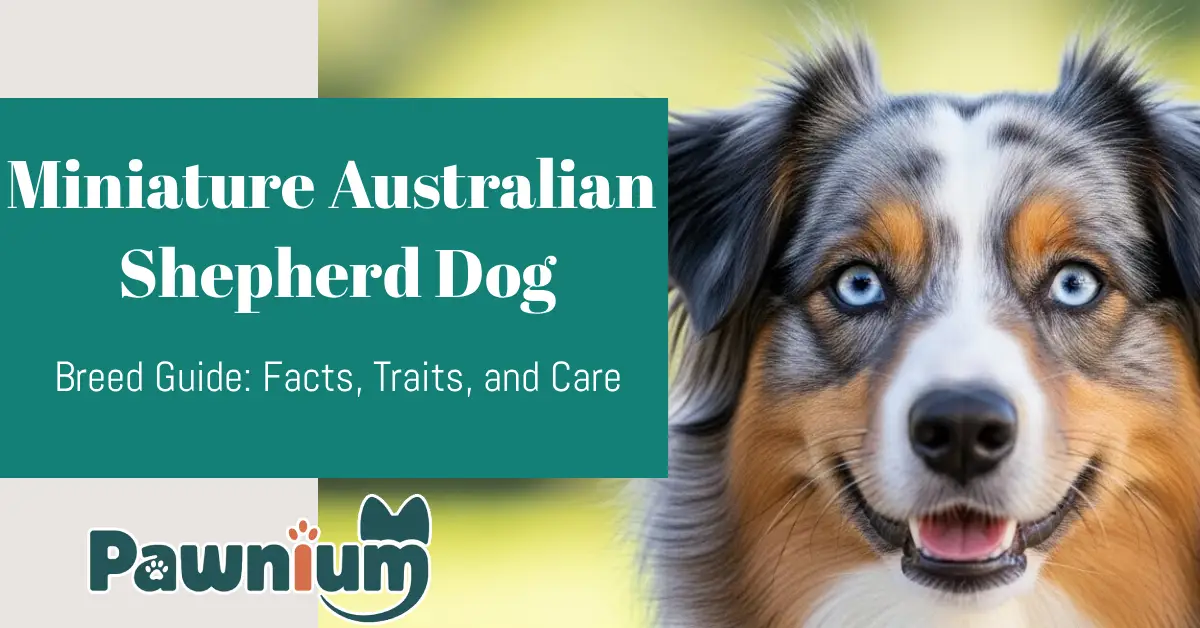
Miniature Australian Shepherd: Temperament, Size, Exercise and Care
The Miniature Australian Shepherd is best understood as a compact, energetic herding dog rather than a low-maintenance small pet. There is also an important naming distinction: the breed recognized by the American Kennel Club is officially the Miniature American Shepherd, a breed developed from smaller Australian Shepherd-type dogs in the United States.
These dogs combine relatively modest size with considerable intelligence, athletic ability and working instinct. They can adapt to many homes, including urban ones, but they still need meaningful physical activity, training and mental engagement. Their small footprint should not be mistaken for low energy.
Quick Breed Profile
| Trait | Breed Reference |
|---|---|
| Official breed name | Miniature American Shepherd |
| Common historical/search name | Miniature Australian Shepherd / Mini Aussie |
| Breed group | Herding |
| Male height | 14–18 inches |
| Female height | 13–17 inches |
| Typical AKC weight | 20–40 pounds |
| AKC life expectancy | 12–13 years |
| Coat | Medium-length double coat |
| Temperament | Intelligent, devoted, good-natured, working-oriented |
| Exercise needs | Active; regular physical and mental activity needed |
| Trainability | High |
| Shedding | Regular, heavier seasonally |
| Apartment potential | Possible with sufficient exercise and enrichment |
The height ranges come directly from the MASCUSA breed standard. AKC provides the 20–40-pound weight reference and 12–13-year life expectancy.
Terminology and Naming Accuracy
“Miniature Australian Shepherd” is not the current AKC breed name.
MASCUSA’s official breed history says the dogs were originally registered as Miniature Australian Shepherds. When the breed entered the AKC Foundation Stock Service in 2011, it entered as the Miniature American Shepherd, and AKC fully recognized the breed in 2015.
The distinction is important because the Australian Shepherd Club of America does not recognize Miniature Australian Shepherds, Miniature American Shepherds or Toy Australian Shepherds as size varieties of the Australian Shepherd. ASCA considers them separate from its Australian Shepherd registry.
For this article:
- Miniature American Shepherd = official AKC/MASCUSA breed name
- Miniature Australian Shepherd = historical and commonly searched name
- Mini Aussie = informal shorthand
A dog advertised as a “Mini Aussie” should not automatically be assumed to be a registered Miniature American Shepherd. Pedigree, registration and health-testing records matter more than marketing terminology.
Size
The MASCUSA breed standard specifies height at the withers as:
Males: 14–18 inches
Females: 13–17 inches
The standard describes a moderately boned dog that is slightly longer than tall, without exaggerated heaviness or fineness.
Their size makes them considerably more compact than an Australian Shepherd, but their working-dog structure and athleticism remain central to the breed.
Weight
AKC gives an average breed weight range of 20–40 pounds.
Unlike height, weight is not presented in the MASCUSA standard as a narrow show-ring requirement. A healthy individual should therefore be judged using body condition, build and veterinary assessment rather than being deliberately fed toward one particular number within the AKC range.
A lightly built 25-pound dog and a more substantial 35-pound dog could both potentially represent healthy adults.
Appearance
The Miniature American Shepherd should look athletic and balanced rather than tiny, fragile or exaggerated.
According to the official standard, the breed is:
- slightly longer than tall
- moderately boned
- agile
- strong enough for sustained work
- smooth and balanced in movement
Its expression is alert and attentive, which fits a breed developed for both companionship and practical herding work.
Accepted coat colours include:
- black
- blue merle
- red
- red merle
White and/or tan markings can occur within the limits of the standard. Eyes may vary in colour and can include brown, blue, hazel, amber or combinations.
Coat
This is a double-coated breed.
The official standard describes a medium-length double coat, while AKC describes a longer outer coat over a woolly undercoat.
The coat provides a practical weather-resistant covering suitable for a working herding dog.
It should not be confused with the coat of a continuously growing breed that requires routine clipping to control length.
Temperament
MASCUSA describes the Miniature American Shepherd as intelligent and primarily a working dog with strong herding and guardian instincts. With its family, the standard describes it as protective, good-natured, devoted and loyal. It may be reserved around strangers without being shy.
That combination can create an excellent companion for people who enjoy interacting with and training their dog.
It can also mean the dog notices:
- visitors
- unusual movement
- animals
- activity outside the home
- changes in routine
Owners should therefore expect to provide guidance rather than assuming a smaller shepherd will naturally behave like a quiet lapdog.
Intelligence
Intelligence is one of the breed’s defining characteristics.
Both MASCUSA and AKC describe the Miniature American Shepherd as highly intelligent, versatile and readily trainable.
Fast learning has two sides.
A dog can quickly learn:
- recall
- tricks
- obedience
- scent games
- agility skills
- household routines
but it can also quickly practise behaviours owners did not intend to reinforce.
Consistency and good management matter as much as teaching commands.
Energy Level
Small does not mean low-energy.
AKC describes Miniature American Shepherds as active and athletic. MASCUSA’s breed standard emphasizes stamina, agility and working ability.
Many enjoy a full day that combines movement, training and interaction rather than relying on one walk followed by hours without engagement.
The exact amount of activity should still match the individual dog’s age, fitness, health and lifestyle.
Exercise Requirements
There is no authoritative requirement that every Miniature American Shepherd receive an exact number of minutes of exercise each day.
AKC describes the breed as needing a moderate amount of exercise while also stressing that it is active, athletic and benefits from activities that engage both mind and body. The breed commonly participates in obedience, agility, tracking, hiking, rally and scent work.
Useful exercise can include:
- purposeful walks
- sniffing and exploration
- fetch or tug
- hiking
- controlled off-leash activity where safe
- canine sports
- herding-related activities
- interactive training
For puppies, link to Pawnium’s Puppy Exercise Chart rather than applying an adult exercise routine to a developing dog.
Mental Stimulation
A physically tired dog is not necessarily mentally satisfied.
This breed was developed to notice movement, respond to a handler, solve working problems and make decisions. AKC describes Miniature American Shepherds as self-motivated workers that thrive with regular mental as well as physical stimulation.
Useful mental work can include:
- obedience practice
- scent searches
- food puzzles
- trick training
- retrieving games
- shaping exercises
- problem-solving toys
- dog sports
Pawnium’s Managing a High-Drive Dog article is a natural supporting link here.
Training
High trainability does not mean training is optional.
Early foundations should include:
- recall
- loose-leash walking
- settling
- handling
- staying around distractions
- leaving and dropping objects
- polite greetings
- disengaging from movement
AKC recommends early puppy training and basic obedience for the breed.
Training should remain reward-based. The American Veterinary Society of Animal Behavior’s current humane-training position recommends reward-based methods and advises against aversive training methods.
Link naturally to Pawnium’s Dog Training Basics.
Socialisation
Early socialisation is especially relevant for a breed that can be reserved and watchful around unfamiliar people.
The aim is not to make every Miniature American Shepherd enthusiastically greet every stranger. It is to help the puppy become comfortable and functional around ordinary people, animals, surfaces, sounds and environments.
AKC recommends early socialisation for the breed, and AVSAB identifies puppy socialisation as an important developmental priority.
Experiences should remain positive and manageable rather than forcing a hesitant puppy into overwhelming interactions.
Understanding Pawnium’s Dog Body Language guide can help owners notice when a dog is uncomfortable.
Barking
This breed can be an alert barker.
AKC describes Miniature American Shepherd barking as generally moderate and notes that the breed may bark to alert owners to perceived threats or strangers.
That fits the strong guardian instinct described in the MASCUSA standard.
Barking can become more disruptive when a dog repeatedly rehearses reactions to:
- people in hallways
- delivery workers
- windows
- neighbouring dogs
- movement outside a fence
Training, enrichment and environmental management are more realistic solutions than expecting the dog never to vocalise.
Herding Tendencies
Herding is not merely part of the breed’s history.
MASCUSA describes strong herding instincts in the breed standard, and AKC notes that Miniature American Shepherds have been used to move livestock.
In a home, that instinct can sometimes appear as:
- following movement intensely
- circling
- controlling pathways
- chasing
- attempting to gather people or animals
- occasional heel-directed behaviour
These behaviours are not guaranteed in every individual, but owners should be prepared to redirect inappropriate herding into structured activities.
Children
Miniature American Shepherds can live successfully in families with children, particularly when the dog is well socialised and children understand respectful dog interaction. AKC specifically notes that the breed can be good with children but may attempt to herd them.
Supervision remains important.
Children should not be encouraged to:
- chase the dog
- climb on it
- disturb it while resting
- take food or toys
- deliberately trigger herding behaviour
A household with active children can be a good match when adults manage both dog and child behaviour.
Other Dogs
AKC describes Miniature American Shepherds as capable of being friendly with other pets and dogs, although individual temperament and experience still matter.
Good introductions should be calm and controlled rather than assuming two dogs will get along because of breed.
Socialisation should also teach a young dog that seeing another dog does not always mean it gets to rush over and play.
Cats
A Miniature American Shepherd can potentially live successfully with cats, but the breed’s herding instinct makes management important.
AKC describes the breed as generally social with other pets, while the parent-club standard confirms strong herding instinct. From those two traits, it is reasonable to infer that individual dogs may attempt to follow, chase or control a cat’s movement, particularly without early exposure and training.
Use:
- gradual introductions
- safe escape areas for the cat
- barriers when unsupervised initially
- reinforcement for calm behaviour
- prevention of repeated chasing
Do not expect the cat to “teach the puppy a lesson.”
Apartment Living
Apartment living is possible, but suitability is conditional.
AKC’s breed page says Miniature American Shepherds can do well as city dogs when sufficient exercise is provided. Another AKC care article notes that the breed may benefit from more space because of what it was bred to do.
Those points are not really contradictory.
An apartment can work when the owner can provide:
- regular outdoor exercise
- daily enrichment
- barking management
- training
- toileting access
- opportunities to decompress
A large house without engagement can be a worse home than a well-managed apartment.
Link this section to Pawnium’s Best Apartment Dogs guide for owners prioritising easier urban breeds.
First-Time Owners
The breed can work for a committed first-time dog owner, but it is not automatically an easy beginner choice.
Advantages include:
- strong trainability
- willingness to work with people
- manageable physical size
- adaptability
Challenges include:
- significant mental needs
- herding behaviour
- alert barking
- sensitivity to movement
- need for consistent socialisation and training
AKC presents the breed as highly trainable and adaptable, while MASCUSA emphasizes its working and guardian instincts.
A first-time owner willing to learn and train consistently may do very well. Someone looking primarily for a low-effort companion may struggle.
Link to Pawnium’s First-Time-Owner Breeds guide for comparison.
Grooming
The coat is not exceptionally complicated, but it does require routine maintenance.
AKC recommends approximately weekly brushing during much of the year and more frequent—often daily—brushing when seasonal shedding becomes heavy. Slicker brushes and metal combs can help work through tangles.
Routine care should also include:
- nail trimming
- ear checks
- dental care
- checking skin beneath the coat
- removing developing tangles
Link naturally to Pawnium’s Dog Grooming Schedule.
Shedding
Expect visible shedding.
The breed has a double coat and sheds throughout the year, with heavier seasonal shedding that AKC says may occur once or twice annually.
Regular brushing removes loose coat but will not stop the natural shedding cycle.
Anyone seeking a dog that leaves very little hair around the home should take this into account before choosing the breed.
Feeding Considerations
Breed name alone cannot determine the correct food or portion.
AKC recommends food appropriate to the dog’s life stage and warns owners to monitor calorie intake and body weight.
Practical feeding decisions should consider:
- puppy, adult or senior stage
- current body weight
- body condition
- activity
- training treats
- food calorie density
- veterinary advice
Highly active sport dogs may need a different calorie intake from lower-activity companions of the same weight.
Avoid choosing portions simply because another Miniature American Shepherd eats a particular amount.
Puppy Development
Miniature American Shepherd puppies are learning far more than obedience commands.
Early puppyhood involves physical, cognitive and social development. AKC identifies the first months as an important socialisation period, while adolescence can bring increasing independence and changing behaviour later in the first year.
Important puppy priorities include:
- positive socialisation
- handling
- household routines
- recall
- appropriate chewing
- rest
- age-appropriate exercise
- calm exposure to different environments
Because this is an athletic breed, owners can be tempted to begin strenuous sport training too early. Use Pawnium’s Puppy Exercise Chart for developmentally appropriate activity rather than applying an adult workload to a young puppy.
Health Screening
Responsible breeding involves more than simply saying the parents are “healthy.”
MASCUSA currently lists the following tests as required for its MAS OFA/CHIC health program:
- hip dysplasia radiographic evaluation
- annual ophthalmic examination
- PRA-prcd DNA test
- MDR1 DNA test
- HSF4 hereditary cataract DNA test
- Miniature American Shepherd neuroaxonal dystrophy (NAD) DNA test
The parent club also lists additional recommended or available tests, but the required list above is the clearest starting point when evaluating breeder health screening.
A health clearance reduces breeding risk; it does not guarantee that a puppy will never develop a medical condition.
When buying a puppy, ask to see verifiable results rather than accepting “DNA tested” or “vet checked” as substitutes for specific breed-recommended screening.
Lifespan
AKC currently lists the Miniature American Shepherd’s average life expectancy as 12–13 years.
Treat that as a population-level breed reference rather than a prediction for an individual dog.
Genetics, disease, accidents, body condition, veterinary care and many other factors can influence how long one particular dog lives.
Example Daily Routine
This is a sample lifestyle framework, not a required schedule.
Morning
- toilet break
- purposeful walk or sniffing outing
- breakfast
- short training session
- settle while the household starts its day
Midday
- toilet break
- brief play or enrichment
- food puzzle, scent activity or chew
- rest
Late Afternoon or Evening
- more substantial physical activity
- training, retrieval, scent work or another interactive task
- dinner
- calm family time
Before Bed
- short toilet outing
- quiet decompression
- predictable sleep routine
A more athletic dog may need substantially more activity than this framework suggests, while a senior or medically restricted dog may need less. The useful principle is physical activity + mental work + genuine rest, rather than constant stimulation.
Ownership Costs
There is no useful universal number for what a Miniature Australian Shepherd costs to own.
Costs vary by country, veterinary market, dog age, breeder or rescue, health and lifestyle.
Initial Costs May Include
- breeder or adoption fee
- veterinary examination
- vaccinations or preventive care
- crate
- bed
- harness and leash
- bowls
- grooming tools
- gates or household management equipment
- puppy training
Recurring Costs May Include
- complete dog food
- routine veterinary care
- parasite prevention where appropriate
- grooming supplies
- treats and enrichment
- training classes
- pet insurance if chosen
- boarding, daycare or pet sitting
Optional Lifestyle Costs
An owner interested in the breed’s working ability may also spend money on:
- agility
- rally
- scent work
- herding
- private training
- travel
- sport equipment
The important question is not whether the dog is physically small. It is whether the household has the time and budget for an active, trainable working companion.
Who This Breed Suits
A Miniature American Shepherd may be a particularly good fit for someone who:
- enjoys training
- wants an active companion
- likes hiking or dog sports
- can provide daily interaction
- enjoys intelligent, responsive dogs
- accepts regular shedding
- is willing to socialise carefully
- appreciates a dog that is closely involved with family life
Its compact size can make an athletic working dog more manageable for people who do not want a full-sized Australian Shepherd.
Who May Struggle With This Breed
This breed may be more difficult for someone wanting:
- very low exercise needs
- little mental stimulation
- minimal training
- almost no barking
- a dog that is naturally outgoing with every stranger
- very little shedding
- a dog content to spend most of the day without interaction
A small yard—or no yard—is not automatically a problem.
A lifestyle with very little time for the dog is.
FAQs
Is a Miniature Australian Shepherd the same as a Miniature American Shepherd?
Historically, the dogs were called Miniature Australian Shepherds. The breed recognized by the AKC today is the Miniature American Shepherd. MASCUSA is its official AKC parent club.
How big does a Miniature Australian Shepherd get?
The official Miniature American Shepherd standard sets males at 14–18 inches and females at 13–17 inches at the withers. AKC lists a typical weight range of 20–40 pounds.
Are Miniature American Shepherds high-energy?
They are active, athletic herding dogs with substantial mental-stimulation needs. AKC describes them as adaptable and requiring regular exercise, while the parent-club standard emphasizes stamina, intelligence and working ability.
Are Mini Aussies good with children?
They can be good family dogs, but their herding instinct may result in attempts to control children’s movement. Early training, socialisation and adult supervision are important.
Can a Miniature American Shepherd live in an apartment?
Yes, some can. AKC says they can adapt to city living when their exercise needs are met. Because they remain active herding dogs and may alert bark, apartment suitability depends heavily on the owner’s routine and management.
Are Miniature American Shepherds good first dogs?
They can be for a motivated first-time owner because they are highly trainable. However, their energy, herding instincts, alertness and need for mental engagement make them more demanding than many lower-drive companion breeds.