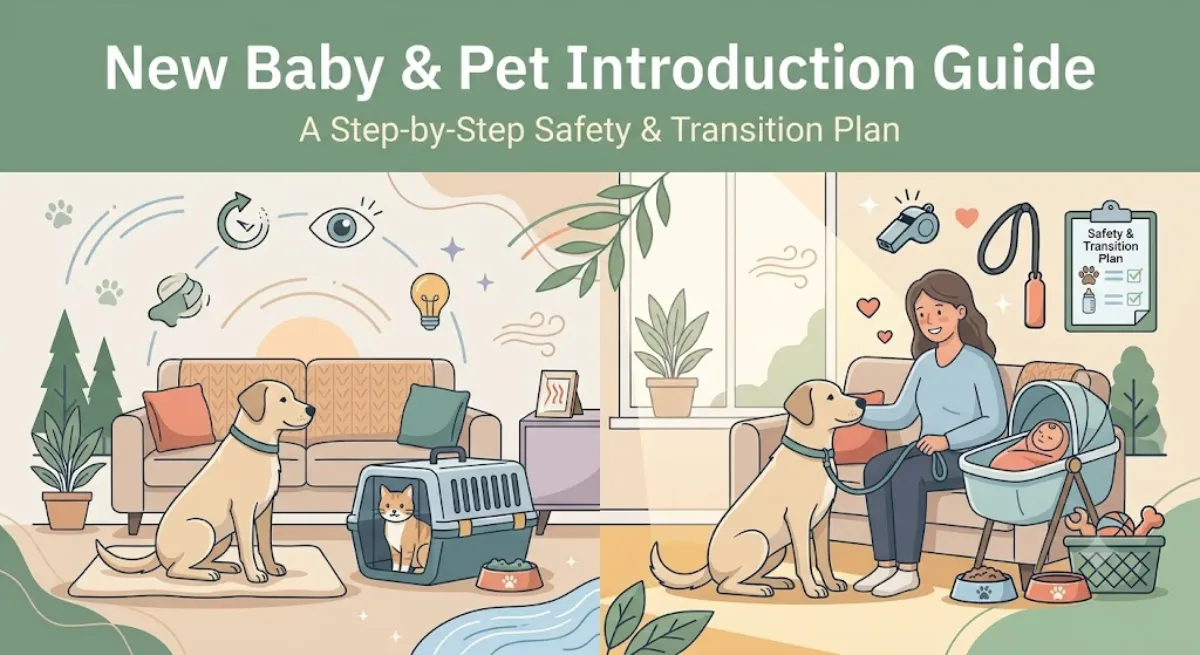
Introducing a Dog to a New Baby: Preparation and Safe First Meetings
Successfully introducing a dog to a new baby starts well before the first meeting. The biggest changes for the dog are not limited to the newborn’s presence: routines shift, new equipment appears, crying and other unfamiliar sounds begin, visitors may increase and access to parts of the home can change.
Preparation should therefore focus on useful training, gradual exposure to new household changes, reliable barriers and a quiet dog-only retreat. Once the baby arrives, keep interactions controlled and optional. Most importantly, a dog and baby should never be left together without active adult supervision, regardless of the dog’s breed, previous behaviour or history with children.
Quick Answer
Prepare your dog before the baby arrives by gradually changing routines, setting up gates and baby equipment, practising useful cues and creating a safe resting area. For the first meeting, keep the environment calm, allow plenty of distance and let the dog choose whether to approach. Reward relaxed behaviour, stop if the dog appears uncomfortable and never force close contact. Dogs and babies should never be left alone together.
Start Before the Baby Arrives
A newborn can appear to enter the dog’s life almost overnight, but many of the associated changes can be introduced much earlier.
Dogs Trust recommends preparing as early as practical so new routines, equipment, sounds and smells can be introduced gradually and at the dog’s pace.
Consider what will change after the birth:
- walk times
- feeding times
- time spent with the dog
- rooms the dog can enter
- where the dog rests
- who provides walks
- visitors to the home
- household noise
- times when the dog needs to settle away from activity
Make manageable changes before the baby arrives instead of changing everything during the first week home.
Check Veterinary Issues Beforehand
If your dog has an existing medical problem, appears painful or has developed a significant behaviour change, arrange veterinary assessment before relying on a training solution.
Pain and other medical conditions can contribute to changes in tolerance and aggressive behaviour. VCA recommends veterinary assessment when aggressive behaviour develops because medical causes may need to be ruled out.
A veterinary appointment is particularly worthwhile before the baby arrives if your dog:
- has become unusually irritable
- resists handling that was previously comfortable
- suddenly guards resting areas
- has mobility problems
- has developed unexplained fear or aggression
- takes medication requiring a changing household routine
Do not assume every behavioural difficulty is caused by “jealousy.”
Strengthen Useful Training Foundations
Good training cannot guarantee that a dog will be safe with a baby, but it can make everyday management easier.
ASPCA highlights several useful skills for homes preparing for a baby, including:
- sit
- down
- stay
- waiting at doors
- settling
- leave it
- drop it
- recall
- polite greetings
Pawnium’s dog training basics can be used to strengthen these everyday cues before the household becomes busier.
Use reward-based methods. The American Veterinary Society of Animal Behavior recommends reward-based training and advises against aversive or punishment-based approaches.
Teach a Place or Settle Cue
One particularly useful skill is teaching the dog to relax on a bed or mat.
RSPCA recommends preparing a resting place in the same room but away from where parents will be busy with the baby.
This can be useful while:
- feeding the baby
- changing the baby
- answering the door
- preparing bottles
- receiving visitors
- managing floor play later
The goal is not to command the dog to remain near something frightening. The mat should represent a comfortable place where relaxing is worthwhile.
Pawnium’s place and settle training guide gives the full training process.
Prepare for Handling Changes Without Practising Rough Treatment
Some older baby-preparation advice suggests deliberately tugging ears, pinching skin or poking a dog so the dog becomes accustomed to what a child might eventually do.
That should not be the goal.
RSPCA advises preventing children from pulling ears or tails, climbing on dogs, disturbing sleeping dogs or placing their faces close to a dog’s face.
Instead:
- continue normal positive cooperative handling
- teach the dog that moving away is allowed
- provide protected resting areas
- physically stop a crawling baby or toddler from grabbing
- separate dog and child whenever active supervision is impossible
Your management should protect the dog from rough handling rather than trying to make rough handling acceptable.
Make Routine Changes Gradually
Dogs can become unsettled when familiar routines change abruptly.
Dogs Trust notes that a baby may mean reduced attention, shorter walks, more time alone or restrictions on access to particular rooms. Introducing predictable changes beforehand can make the transition less sudden.
If another person will take over morning walks, let that person start walking the dog before the birth.
If the dog will no longer sleep in a bedroom, make that transition in advance.
If certain rooms will become dog-free, install the barrier before the baby comes home.
If your dog already struggles significantly with changes in access to family members, Pawnium’s separation-anxiety guide may provide useful background, although ordinary routine disruption should not automatically be labelled separation anxiety.
Set Up Baby Equipment Early
Prams, highchairs, swings, play mats and other equipment can change the layout of the dog’s home.
Dogs Trust recommends setting these items up ahead of time and allowing the dog to investigate at its own pace, paired with positive experiences where appropriate.
Practise everyday situations such as:
- walking beside an empty pram
- settling while someone sits in the feeding chair
- moving around a highchair
- staying out of the nursery when a gate is closed
Do not deliberately frighten the dog with moving equipment.
Introduce Baby Sounds Gradually
Crying can be particularly unfamiliar.
Dogs Trust recommends starting baby-noise recordings at very low volume while the dog is engaged in something enjoyable. Volume can be increased gradually only while the dog remains relaxed; if the dog becomes worried, reduce or stop the exposure.
The point is not to make the dog “put up with” distressing noise.
Look for comfort at each stage.
If the real baby’s crying later concerns your dog, give the dog more distance and pair the sound with calm positive experiences where appropriate.
Introduce New Smells Without Making Them a Requirement
Baby products, clothes and blankets bring unfamiliar scents into the home.
Dogs Trust suggests gradually introducing baby-related smells before the birth and allowing the dog to investigate without pressure.
You might introduce:
- clean baby equipment
- baby toiletries being used in the home
- clothing or blankets associated with a baby
A hospital blanket is not a mandatory introduction technique and should not be described as something that guarantees acceptance of the newborn.
Put Barriers and Gates in Place Early
Physical barriers are among the most useful safety tools in a home with a dog and baby.
They can create:
- dog-free nursery areas
- baby-free dog resting areas
- safer feeding spaces
- separation during visitors
- separation when adults are distracted
Dogs Trust recommends physical separation with baby gates, playpens or different rooms whenever adults cannot actively supervise dog-child interactions.
Install barriers before the baby arrives so the dog does not learn that every new restriction began at exactly the same time as the baby.
Create a Protected Dog-Only Space
Your dog should have somewhere to rest without being followed.
Dogs Trust recommends a comfortable den or quiet area where the dog can leave family activity and relax undisturbed. Giving the dog a choice to remain with the family or retreat can help reduce pressure.
That space might be:
- a bed behind a gate
- part of a quiet room
- a crate for a dog already comfortable using one
- a separated resting corner
As the child grows, the dog-only area remains off limits to the child.
Returning Home With the Baby
The parent’s return can itself create excitement, particularly after time away at the hospital.
Dogs Trust suggests having another person hold the baby while the returning parent initially greets the dog, where practical.
After the initial greeting settles:
- keep the room quiet
- reduce unnecessary visitors
- have another adult available to manage the dog
- prepare rewards
- make sure a barrier or exit route is available
There is no requirement for the first introduction to happen immediately.
Dogs Trust explicitly notes that families may introduce the dog straight away or choose to wait.
The First Dog-and-Baby Introduction
For a first dog meeting a newborn, aim for calm coexistence rather than physical contact.
Dogs Trust recommends beginning while an adult securely holds the baby, observing the dog for relaxed behaviour and allowing approach only if the dog wants to investigate.
A practical sequence is:
- Have one adult responsible for the baby.
- Have another adult responsible for the dog.
- Begin with comfortable distance.
- Observe the dog’s body language.
- Reward calm behaviour.
- Allow voluntary approach only if the dog remains relaxed.
- Keep any investigation brief.
- Allow and reward the dog for moving away.
- End the session while everyone remains calm.
A successful first meeting may simply be the dog calmly sharing the room.
There is no need to obtain a nose-to-baby photograph.
Use a Lead for Management, Not Forced Proximity
A lead can provide additional control, but it should not be used to pull the dog toward the newborn.
Dogs Trust says a helper may keep the dog on a loose lead depending on how that individual dog responds to being restrained.
Keep enough distance that the lead does not need to remain tight.
If the dog struggles, lunges, freezes or becomes increasingly aroused, move the dog away rather than holding it beside the baby.
Distance Is a Safety Tool
Closer is not automatically better.
A dog that can relax three metres away from the baby is in a better position than a dog forced to sit ten centimetres away while showing discomfort.
VCA’s guidance on dogs showing fear around children emphasises beginning at a distance where the dog can remain comfortable and increasing exposure gradually.
Use distance early rather than waiting until the dog feels forced to escalate communication.
Reward Calm Behaviour
Useful behaviours might include:
- relaxing on a bed
- looking at the baby and looking away
- responding to a familiar cue
- choosing to leave
- resting while the baby is held
- remaining loose and relaxed when the baby makes ordinary sounds
ASPCA recommends creating positive associations with the baby’s presence rather than scolding the dog around the infant.
Do not reward only very close interaction. Calm behaviour at a comfortable distance is valuable.
Allow the Dog to Choose Distance
The dog should always have a practical way to leave.
Dogs Trust recommends allowing dogs to approach if they wish and specifically advises against forcing interaction. It also recommends providing a retreat area where the dog can relax undisturbed.
Backing away is not a failed introduction.
It is information.
If your dog chooses its bed instead of sniffing the baby, let that be acceptable.
What Not to Force
Do not force:
- nose-to-face contact
- licking
- prolonged sniffing
- photographs beside the baby
- lying beside the baby
- the baby touching the dog
- the dog remaining in the room
- close interaction because relatives want to see it
RSPCA recommends avoiding close face-to-face contact and ensuring children do not disturb or physically grab dogs.
Previous enjoyment of children does not justify removing these precautions.
AVMA’s current bite-prevention guidance says young children should always be supervised around dogs regardless of how well behaved either appears.
Keep Feeding and High-Value Toys Separate
Food and valued items deserve particular care.
RSPCA advises that children should not approach dogs when they are:
- eating
- enjoying a treat
- playing with a valued toy
- sleeping
- unwell or tired
A newborn cannot approach the food bowl, but setting these household rules now matters because the child will eventually crawl.
Use gates or separate rooms during meals and high-value chew time.
Do not intentionally take food or toys away from the dog to “prove” that the dog will tolerate it.
When the Baby Cries
Some dogs quickly learn to ignore crying. Others become alert, worried or excited.
If a dog is stressed by a new baby crying, look at the whole body rather than deciding from barking alone.
ASPCA recommends associating baby sounds with positive experiences for dogs that seem concerned by them.
You can:
- increase distance
- allow the dog to retreat
- provide a familiar activity
- reward calm behaviour
- use the settle area
If the crying repeatedly causes intense barking, lunging, fixation, trembling or inability to settle, seek professional guidance rather than repeatedly exposing the dog until it “gets over it.”
Prepare Again Before the Crawling Stage
Dog-and-baby safety changes when the baby becomes mobile.
A newborn stays where an adult places them. A crawling baby can move toward:
- the dog
- the bed
- food
- toys
- tail
- ears
ASPCA and RSPCA both note that crawling and increasingly unpredictable movement can be challenging for dogs.
Before crawling begins:
- recheck gates
- make the dog-only retreat inaccessible to the child
- separate dog food and toys
- create protected resting periods
- practise calling the dog away
- supervise floor time actively
Do not wait for the first growl to change the setup.
Toddler Safety Requires More Management, Not Less
Toddlers can run, fall, shriek, grab and approach dogs suddenly.
RSPCA notes that children’s close contact and unpredictable behaviour can be difficult for dogs to understand.
Dogs Trust’s recommended approach is:
- Stay close and pay attention
- Step in early
- Separate whenever active supervision is not possible
Teach children as they develop to leave dogs alone when they are:
- eating
- sleeping
- resting
- chewing something
- attempting to move away
Learn Your Dog’s Body-Language Warning Signs
Body language should be monitored from the first meeting onward.
Possible signs of discomfort include:
- turning the head away
- leaning away
- repeated lip licking
- yawning when not tired
- lowering the body
- ears held back
- tail lowered or tucked
- trying to leave
- becoming very still
- freezing
- staring
- growling
- snapping
Dogs Trust advises intervening when subtle early signs appear rather than waiting for behaviour to escalate. VCA likewise describes freezing, growling and snapping as increasingly important warning signals in potentially aggressive situations.
Use Pawnium’s dog body-language guide for a deeper explanation of posture, facial signals and movement.
Take Growling Seriously
A growl around a baby or child should never be dismissed as harmless.
But it also should not be punished.
Growling can communicate that a dog is uncomfortable and wants a situation to change. VCA notes that punishing communication such as growling can suppress important warning signals rather than resolving the underlying problem.
If the dog growls:
- Calmly create distance.
- Separate dog and baby.
- Do not scold, hit or physically confront the dog.
- Record what happened immediately beforehand.
- Prevent the same setup while seeking appropriate professional advice.
A growl is a reason to improve safety, not a reason to force another interaction.
Do Not Punish Warning Behaviour
Punishment does not make the baby feel safer to the dog.
AVSAB recommends reward-based methods for behaviour modification and advises against physical or psychological punishment.
If a dog is:
- growling
- freezing
- snapping
- repeatedly attempting to escape
- barking intensely at the baby
increase distance and investigate why the situation is difficult.
Trying to punish the warning while leaving the dog in the same uncomfortable situation can remove useful communication without fixing the underlying emotion.
Supervision Means Active Attention
Never leave a dog and baby unsupervised.
This applies even if:
- the dog has always been gentle
- the dog loves children
- the baby is sleeping
- the dog is asleep
- you are “just in the next room”
- they have already had many calm interactions
Dogs Trust says supervision should involve active engagement and undivided attention, not simply an adult being somewhere nearby.
AVMA likewise recommends always supervising young children around dogs, regardless of how well behaved the dog or child appears.
No past history can guarantee future behaviour in every circumstance.
Use Physical Separation Whenever You Cannot Supervise
If your attention is going elsewhere, separate first.
Examples include:
- cooking
- showering
- answering the door
- sleeping
- making a phone call
- changing another child
- leaving the room
Useful separation tools include:
- baby gates
- doors
- playpens
- dog-safe rooms
- the dog’s established secure area
Dogs Trust specifically recommends physical separation whenever adults cannot stay close and actively pay attention.
Supervision and separation work together. One does not replace the other.
What About Multi-Dog Households?
Each dog may respond differently to the baby.
One dog may ignore the newborn while another becomes excited, worried or highly alert. Do not assume the household can be assessed as one unit.
As a practical extension of the controlled-introduction guidance, consider introducing dogs individually if managing several dogs at once makes it difficult to:
- observe body language
- maintain distance
- reward calm behaviour
- prevent crowding
- move the baby safely
Maintain separate resting options and prevent competition around food, chews or attention.
If one dog needs greater distance or stricter management, that does not mean every dog needs the same arrangement.
When to Contact a Qualified Behaviour Professional
Get professional help before attempting close introductions if your dog has a history of:
- biting
- snapping at children
- serious resource guarding
- intense fear of children
- aggressive responses to sudden movement
- predatory-looking stalking, chasing or fixation toward infants or small children
- inability to disengage from the baby
- repeated growling at the baby
- escalating lunging or barking
- severe distress despite adequate distance
RSPCA warns that some infant sounds and movements can trigger concerning responses in dogs and stresses that babies should never be left unattended with dogs.
VCA recommends veterinary evaluation when fear or aggression toward children appears, followed where appropriate by veterinary behavioural assessment or another appropriately qualified behaviour professional.
Do not use the baby as part of a DIY desensitisation exercise when serious aggression, fear or predatory behaviour is present.
Start with physical separation and professional assessment.
FAQs
Should my dog sniff the baby during the first introduction?
Only if the dog remains relaxed and chooses to approach. Dogs Trust says dogs may be allowed to investigate gently but should never be forced. Brief sniffing of the baby’s feet may feel more manageable than close face-to-face contact.
Is my dog jealous of the new baby?
Behaviours interpreted as jealousy can also occur because attention, exercise, access, routines, sleep and household activity have changed. Avoid diagnosing the emotion from behaviour alone. Review what has changed, maintain appropriate routines and watch for signs of stress or guarding.
Should I bring a baby’s blanket home for my dog to smell first?
You can introduce baby-associated smells gradually, but a hospital blanket is not essential and does not guarantee a successful first meeting. Dogs Trust recommends allowing dogs to investigate baby-related smells in their own time without overwhelming them.
What should I do if my dog growls at the baby?
Create distance and physically separate them. Do not punish the growl or force another interaction. Growling can be an important warning signal, and punishment can suppress communication without changing the dog’s discomfort. Seek qualified professional guidance, particularly when the growl is directed at a baby or child.
Can I leave my baby with a dog that has always loved children?
No. Previous friendly behaviour cannot guarantee safety in every future situation. Dogs Trust and AVMA recommend that babies and young children never be left alone with dogs and that shared time is actively supervised.
When does managing a dog around a baby become more difficult?
The crawling and toddler stages often require additional management because the child becomes mobile and can approach the dog’s resting areas, food, toys or body. Reassess barriers and supervision before mobility begins.