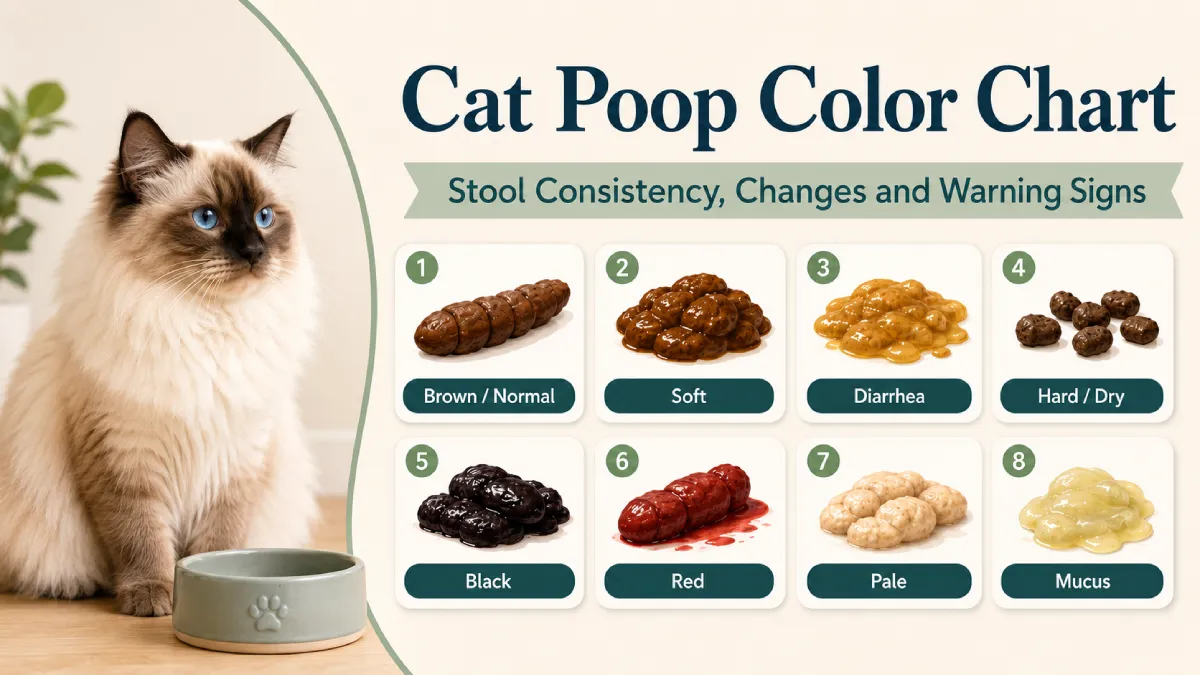
Cat Poop Color Chart: Stool Changes & Warning Signs
A cat poop color chart can help you describe what is changing in the litter box, but stool colour by itself cannot tell you what disease, if any, is present. Brown is generally expected, while yellow, grey, green, red or black stool may occur for different reasons. Consistency, frequency, appetite, vomiting, weight and behaviour often provide more useful context than colour alone.
Cornell notes that feline diarrhoea can range from short-lived digestive upset to a sign of more significant illness. Persistent diarrhoea becomes more concerning when it occurs with poor appetite, lethargy, vomiting or other systemic changes.
Quick Answer
Healthy cat stool is generally formed, moist rather than watery, and brown. One unusual bowel movement may be less concerning than a persistent pattern, but black tarry stool, substantial fresh blood, severe watery diarrhoea, repeated vomiting, appetite loss, weakness or major behaviour changes need veterinary attention. Colour and texture are useful observations—not diagnoses.
What Healthy Stool Generally Looks Like
There is natural variation between cats, diets and individual bowel movements.
A generally healthy stool is usually:
- brown
- formed
- moist but not watery
- easy to pass
- cohesive enough to hold its shape
Consistency matters because stool becomes abnormal at both extremes: very dry, hard stool can accompany constipation, while soft or watery stool reflects diarrhoea. Merck describes constipation as difficult or infrequent passage of typically dry, hard faeces, while Cornell defines diarrhoea by frequent passage of soft or watery stool.
Your cat’s normal baseline also matters. A consistent change from that baseline is often more useful than comparing one bowel movement with an internet photograph.
Why Consistency Matters With Colour
A stool colour means more when you also record the texture.
For example:
- brown and well formed may be routine
- brown but watery still represents diarrhoea
- yellow and watery needs a different interpretation from one small yellowish firm stool
- red blood mixed into frequent mucus-coated stool suggests a different pattern from black, sticky, tar-like stool
Merck distinguishes large-bowel diarrhoea by features such as increased frequency, urgency, mucus and fresh red blood, while black stool is associated more strongly with digested blood from farther up the digestive tract.
Think of the useful combination as:
colour + consistency + frequency + other symptoms
rather than colour alone.
Brown Stool
Brown is generally the expected stool colour.
Normal brown shades can vary depending on:
- food
- moisture
- digestion
- individual differences
The important issue is whether the stool is also reasonably formed and whether the cat feels well.
A brown stool that suddenly becomes watery, extremely hard, mucus-coated or unusually frequent is still a digestive change even though its colour looks normal.
Dark Brown Stool
Dark brown does not automatically mean bleeding.
Food ingredients and normal variation can make stool darker.
The distinction that matters is between ordinary dark brown and truly black, sticky or tarry stool. Merck identifies black tarry stool as possible melena—digested blood originating from the stomach or small intestine.
If you are unsure whether stool is dark brown or black, photograph it in good lighting rather than relying on memory.
Yellow Stool
Yellow cat poop may occur with diarrhoea or rapid intestinal transit, but yellow colour does not identify a specific disease.
Cornell notes that feline diarrhoea may sometimes appear yellow or grey and can result from many gastrointestinal and systemic conditions.
Record whether yellow stool is:
- formed or watery
- a one-time change or persistent
- unusually foul smelling
- associated with vomiting
- accompanied by appetite or weight changes
Persistent yellow diarrhoea deserves veterinary evaluation rather than being attributed automatically to one ingredient or organ.
Orange Stool
Orange stool is less specific.
Dietary pigments can influence stool appearance, while changes in bile pigments can also alter faecal colour under some circumstances. Merck notes that disrupted or altered bile handling can produce changes ranging from pale stool to orange or green faecal colour in animals.
That does not mean orange stool diagnoses liver or gallbladder disease.
A one-off change should be interpreted in context with diet, consistency and general health. Persistent orange stool—especially with jaundice, appetite loss, vomiting or illness—needs veterinary assessment.
Green Stool
Green cat poop can occur for several reasons and is not a diagnosis.
Possible influences include:
- food pigments
- ingested plant material
- altered gastrointestinal transit
- bile pigments
Merck documents that abnormal bile flow or bilirubin handling can alter faecal pigmentation, but a green bowel movement by itself cannot identify the mechanism.
If green stool is also watery, persistent or accompanied by vomiting, lethargy or reduced appetite, focus on the overall illness pattern rather than the colour.
Red Blood
Fresh red blood in cat poop is often called hematochezia.
Merck notes that large-bowel inflammation can produce frequent small-volume stool containing mucus and bright red blood.
Fresh blood can occur with several different problems, so do not assume:
- parasites
- colitis
- food allergy
- cancer
from red colour alone.
Record:
- how much blood is present
- whether it coats the surface or is mixed throughout
- stool consistency
- mucus
- frequency
- straining
Repeated or substantial blood deserves veterinary assessment.
Black or Tarry Stool
Black cat poop that is genuinely tarry, sticky or unusually dark should not be treated as a routine diet change.
Black tarry faeces can represent melena, meaning blood has been digested before passing in the stool. Merck associates melena with bleeding from the stomach or small intestine, and Cornell lists black or tarry stool as a concerning finding.
Parasites are only one possible cause. Severe hookworm infection, for example, can cause gastrointestinal blood loss and black tarry stool, but black stool does not prove a parasite infection.
Contact a veterinarian promptly when true black tarry stool is present.
Pale or Grey Stool
Cornell notes that feline diarrhoea can sometimes appear grey or yellow.
Pale stool can also occur when normal bile pigment reaching the intestine is markedly reduced. Merck describes pale or acholic stool with severe disruption of bile flow.
However, one pale stool does not diagnose liver, pancreatic or biliary disease.
Persistent pale or grey stool becomes more important when accompanied by:
- weight loss
- diarrhoea
- poor appetite
- vomiting
- jaundice
- poor body condition
White Material
White material inside or around stool can be:
- litter
- mucus
- undigested material
- parasite segments
- other debris
Do not diagnose worms from a photograph alone.
Tapeworm segments can sometimes be visible in faeces or around the rectum and may resemble rice grains when fresh or sesame seeds when dry. However, many intestinal parasites are microscopic and cannot be identified simply by looking at stool.
If you see suspicious material, photograph it and consider bringing a fresh stool sample to your veterinarian.
Mucus
Mucus can look:
- clear
- whitish
- gelatinous
- slimy
Small amounts may occasionally be noticed, but repeated mucus—particularly with frequent bowel movements, straining or red blood—can fit a large-bowel diarrhoea pattern. Merck lists mucus, fresh blood and increased urgency among characteristic features of colitis.
Mucus does not tell you why the colon is irritated.
Possible causes still require veterinary investigation when the problem persists.
Very Hard Stool
Very dry, firm pellets or hard stool can occur with constipation.
Constipated cats may:
- defecate less often
- strain
- pass very small dry stools
- repeatedly enter the litter box
- appear uncomfortable
Cornell and Merck both define feline constipation by difficult or infrequent passage of hard, dry faecal matter.
Chronic constipation can progress to obstipation or megacolon, so repeated straining or ongoing inability to pass stool should not be ignored.
Soft Stool
Soft stool holds some shape but is less formed than usual.
A brief episode may occur after:
- a diet change
- stress
- temporary gastrointestinal upset
Cornell specifically notes that abrupt food changes and stressful events can cause short-lived diarrhoea in some cats.
If soft stool keeps returning or progresses to watery diarrhoea, record the pattern rather than repeatedly changing food.
Watery Diarrhoea
Cat diarrhoea involves abnormally soft or watery faeces and often increased frequency.
When intestinal contents move too rapidly, less water and electrolytes are absorbed. Persistent diarrhoea can therefore contribute to dehydration and electrolyte imbalance.
Watery diarrhoea deserves more attention when it is:
- frequent
- persistent
- bloody
- accompanied by vomiting
- associated with poor appetite
- occurring with lethargy or weakness
Kittens and medically vulnerable cats need additional caution.
Greasy-Looking Stool
Greasy or fatty-looking stool may occur when fat digestion or absorption is abnormal, but appearance alone cannot identify the cause.
Merck notes that conditions involving malabsorption and exocrine pancreatic insufficiency can produce pale, loose, voluminous or malodorous stool, and fat can occasionally give the faeces or surrounding coat a greasy appearance.
Giardiasis can also be associated with soft, pale, foul-smelling and fatty-looking faeces.
Because several conditions can overlap in appearance, persistent greasy stool should be investigated rather than diagnosed visually.
Food-Transition Changes
Changing food abruptly can temporarily affect stool consistency.
Cornell specifically lists abrupt dietary change as one possible reason for short-lived diarrhoea.
If the timing matches a recent diet switch and the cat otherwise seems well, slow the transition and use Pawnium’s Cat Food Transition Guide.
Do not continue making multiple rapid food changes if stool remains abnormal. That can make it harder to identify what the cat actually tolerates.
Stress-Related Changes
Stress can also affect bowel habits.
Cornell notes that events such as travel or a stay at a veterinary clinic can cause temporary loose stool in some cats.
Possible household triggers include:
- moving
- boarding
- a new pet
- major routine changes
- feeding or litter-box competition
However, stress should not become the default explanation for persistent diarrhoea, blood, weight loss, appetite changes or vomiting.
Parasites
Gastrointestinal parasites can cause:
- diarrhoea
- mucus
- blood
- vomiting
- appetite changes
- weight loss
but the signs are nonspecific.
Some parasites are visible occasionally, but many require faecal testing.
For example, tapeworm segments may be visible, while infections such as Giardia, coccidia or other intestinal parasites usually require specific testing for confirmation.
Do not give dewormers based solely on the colour or texture of stool unless your veterinarian has recommended the product and plan.
Constipation
Constipation is more than simply “not pooping today.”
Look for the combination of:
- decreased stool output
- repeated straining
- hard dry faeces
- discomfort
- appetite loss
- occasional vomiting
Severe cases can progress to obstipation, where a mass of hard faeces cannot be evacuated normally.
Also remember that urinary straining can sometimes look like constipation from across the room. If you are unsure whether your cat is trying unsuccessfully to urinate or defecate, veterinary assessment is appropriate.
Kitten Stool
Kittens deserve closer monitoring because diarrhoea can occur with:
- dietary transitions
- parasites
- infectious disease
- gastrointestinal upset
Cornell notes that kittens may be particularly affected by intestinal parasites and may also develop diarrhoea as their digestive system adjusts to solid food.
Seek veterinary advice promptly when a kitten has:
- repeated watery diarrhoea
- vomiting
- poor appetite
- lethargy
- weight loss
- blood in stool
Keep normal kitten nutrition on Pawnium’s Kitten Feeding Schedule page.
Senior-Cat Stool
New stool changes in older cats should not automatically be dismissed as ageing.
AAHA specifically recommends asking about diarrhoea, vomiting, appetite, hydration and other elimination changes in mature and senior cats because these observations can guide diagnostic testing.
Cornell also lists:
- diarrhoea
- blood in stool
- black tarry stool
- decreased defecation
- painful defecation
- dry hard stool
among signs worth attention in senior cats.
Stool With Vomiting
Diarrhoea plus vomiting is more concerning than a single isolated stool change because both can contribute to fluid loss.
The combination may occur with many gastrointestinal and systemic problems and cannot be diagnosed from appearance alone.
Use Pawnium’s Cat Vomit Color Chart to document the vomit separately.
Seek veterinary advice when vomiting is repeated, the cat cannot keep fluids down, or diarrhoea is persistent, bloody or accompanied by weakness.
Stool With Appetite Loss
Persistent digestive change plus reduced appetite needs veterinary attention.
Cornell specifically advises veterinary care when diarrhoea persists and occurs with systemic signs such as poor appetite, lethargy or vomiting.
If food intake becomes the primary concern, use Pawnium’s Why Is My Cat Not Eating? guide.
Do not treat appetite loss simply by changing foods repeatedly while ignoring ongoing diarrhoea.
Stool Frequency
There is no useful universal bowel-movement number that fits every cat.
Frequency can vary with:
- diet
- food volume
- hydration
- individual digestive patterns
The key observation is change from normal.
Record if your cat suddenly:
- defecates much more frequently
- strains repeatedly
- produces only tiny amounts
- stops passing stool
- develops urgency or accidents
Large-bowel diarrhoea often increases frequency while decreasing the volume of each bowel movement.
Link the detailed frequency discussion to Pawnium’s Litter-Box Frequency Guide.
What Owners Should Record
Useful information includes:
- Date
- Colour
- Consistency
- Frequency
- Fresh blood
- Black/tarry appearance
- Mucus
- Visible foreign material
- Food being fed
- Recent food change
- Appetite
- Vomiting
- Water intake
- Medication or supplements
- Behaviour
- Weight change
Veterinary diarrhoea histories commonly consider colour, consistency, mucus, frequency, diet, medication, appetite, activity, water intake and vomiting.
Photographs and a fresh faecal sample may also be useful when your veterinarian requests them.
When Veterinary Care Is Needed
Contact your veterinarian when stool changes:
- persist
- keep recurring
- become increasingly watery
- contain repeated fresh blood
- become black and tarry
- occur with poor appetite
- occur with vomiting
- are associated with lethargy
- accompany weight loss
- occur with significant straining
- affect a young kitten or medically vulnerable cat
Cornell advises prompt veterinary attention for ongoing diarrhoea when appetite, energy or vomiting are also abnormal.
Do not use colour alone to decide that a persistent digestive problem is safe to manage at home.
Urgent Warning Signs
Seek urgent veterinary care when stool abnormalities occur with:
- severe bloody diarrhoea
- black tarry stool with weakness or illness
- repeated vomiting and inability to keep fluids down
- collapse
- profound weakness
- severe abdominal pain or distension
- suspected toxin exposure
- major dehydration
- a kitten rapidly becoming weak or unresponsive
Cornell’s emergency service includes severe diarrhoea with red or black/tarry blood among conditions needing emergency assessment.
Do not give human anti-diarrhoeal medication as a substitute for evaluation. Cornell warns that some over-the-counter medications can be harmful to cats.
FAQs
What colour is healthy cat poop?
Healthy stool is generally brown and formed. The exact shade can vary, so consistency and your cat’s usual pattern matter as much as colour. A sudden change in texture, frequency, blood or associated symptoms may be more important than a small difference in brown shade.
Is yellow cat poop always a sign of liver disease?
No. Yellow stool can occur with diarrhoea and rapid intestinal transit, and its appearance is not specific to one disease. Cornell notes that feline diarrhoea can sometimes appear yellow or grey. Persistent changes should be interpreted with appetite, vomiting, weight and other findings.
Is black cat poop always blood?
Ordinary dark brown stool is not necessarily blood. However, truly black, sticky or tarry faeces can represent digested blood and should be evaluated promptly rather than treated as a normal food-related colour change.
Does white material in stool mean my cat has worms?
Not necessarily. Tapeworm segments can resemble grains of rice, but litter, mucus and other material can also look pale or white. Many parasites cannot be seen with the naked eye and require faecal testing.
When is cat diarrhoea serious?
Diarrhoea becomes more concerning when it persists, recurs, contains blood, or occurs with vomiting, appetite loss, lethargy, weakness or weight loss. Kittens and medically vulnerable cats also deserve additional caution.
Can I give my cat human anti-diarrhoea medicine?
Do not give human anti-diarrhoeal medication unless your veterinarian specifically directs you to use a particular product. Some over-the-counter medications can be unsafe for cats, and suppressing diarrhoea does not address the underlying cause.