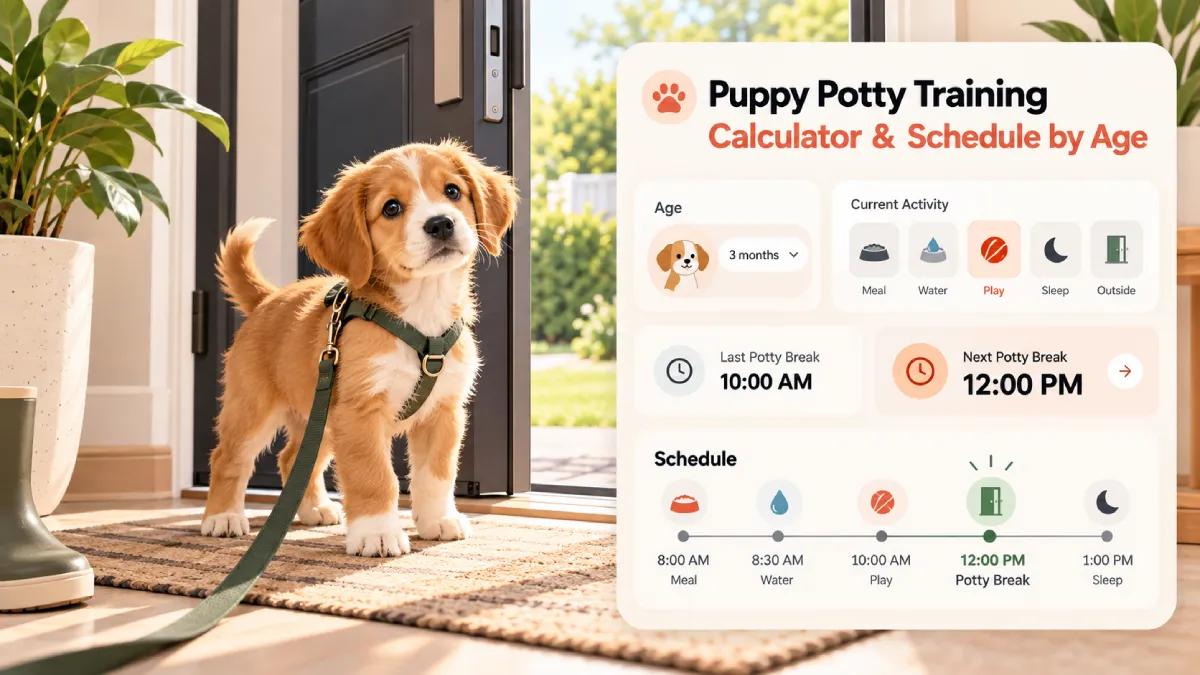
Puppy Potty Training Calculator & Schedule by Age
Use this puppy potty training calculator to answer two practical questions: when should your puppy go out next, and what should their potty schedule look like through the day?
Quick Next Break helps with the decision you need to make right now. Full-Day Schedule builds a routine around your puppy’s age, wake-up time, bedtime, meals and house-training progress. The calculator gives you a starting point; the guide below shows you how to adjust that starting point when your puppy succeeds, has an accident, wakes from a nap, plays hard, refuses to pee outside or suddenly starts having problems after previously doing well.
Puppy Potty Training Calculator
Plan your puppy’s next potty break or build a practical daily potty schedule. Age is only the starting point—waking, meals, drinks and active play can mean your puppy needs to go sooner.
Your Puppy’s Potty-Break Plan
Your Puppy’s Potty Schedule
What Should You Do With Your Puppy’s Calculator Result?
Treat the result as your next planning point, not as a timer you must wait for. A puppy showing a clear potty signal or reaching an important transition such as waking or finishing play should go sooner than the ordinary scheduled time.
| Calculator Result | What to Do Now | If It Keeps Happening |
|---|---|---|
| Take them out now | Pause the current activity and give a calm potty opportunity. | Notice whether the same trigger—waking, play, food, water or elapsed time—keeps creating the need. |
| Within about 30 minutes | Keep your puppy supervised and avoid starting a long play session, car ride or crate period. | If accidents consistently happen sooner, shorten that type of interval. |
| Within about 1–2 hours | Use the result as the normal calm-awake rhythm. | If the puppy remains dry across several ordinary days, consider extending the interval gradually. |
| Take them out before bed | Give one final toilet opportunity immediately before settling for the night. | If overnight accidents continue, review the final bedtime trip and when your puppy naturally wakes. |
| Sudden regression | Tighten supervision and look for a pattern rather than simply adding more scheduled trips. | If the change is unexplained or comes with urinary symptoms, contact your veterinarian. |
The real value appears over several days. If the suggested rhythm repeatedly works, keep it. If accidents keep happening before the planned break, adjust the part of the routine that is failing rather than forcing your puppy to match the original interval.
Puppy Potty Training Schedule by Age
A puppy potty training schedule by age gives you a sensible place to start, but age alone does not tell you when a puppy is ready for a longer gap. Use the puppy potty training chart below as a starting point, then adjust it from your puppy’s actual dry-time history.
| Age / Training Stage | Starter Daytime Rhythm | Move to a Longer Gap When… | Shorten It When… |
|---|---|---|---|
| 8–12 weeks | About every 1 hour while awake | Your puppy is repeatedly dry between normal calm-awake trips. | Accidents happen before the next planned break. |
| 3–4 months | About every 1–1.5 hours | The current interval works across several normal days. | Accidents cluster near the end of the interval. |
| 4–6 months | About every 2 hours | Your puppy remains reliable as household freedom increases. | More freedom or longer gaps bring accidents back. |
| 6–12 months, still learning | About every 2 hours | The puppy is consistently dry across different activities and days. | Longer gaps repeatedly fail. |
| 6–12 months, usually reliable | About every 3 hours as a training rhythm | The routine remains stable with less direct supervision. | A new routine, environment or activity level causes setbacks. |
These are starter training intervals rather than maximum bladder-hold times. Waking, meals, substantial drinking and energetic play can all create extra potty trips between the normal scheduled breaks.
8- to 12-Week-Old Puppy Potty Schedule
At eight to twelve weeks, the main job is accident prevention. The routine should follow the puppy’s day: waking should lead to a potty trip, breakfast should be followed by another opportunity, energetic play should end with a trip outside, and every nap should be followed by a potty break as soon as the puppy wakes.
A young puppy may therefore go outside several times within a relatively short period. That does not mean the schedule is too frequent. At this stage, successful repetitions in the correct location are more useful than trying to stretch the gap.
3- to 4-Month-Old Puppy Potty Schedule
The challenge at three to four months is extending the routine without moving faster than the puppy’s actual progress. If a 90-minute interval works reliably, keep it. If accidents repeatedly happen around 70 minutes, use that pattern and return to a shorter starting point.
The schedule should adapt to the puppy rather than forcing the puppy to fit the chart.
4- to 6-Month-Old Puppy Potty Schedule
Many puppies in this stage can work with a more normal household rhythm. The main challenge becomes increasing freedom without losing reliability.
A two-hour calm-awake baseline may work well, but a nap, dinner or vigorous play session can still create a separate potty trip before those two hours have passed.
6- to 12-Month-Old Puppy Potty Schedule
For older puppies, training history matters more. A reliable eight-month-old puppy does not need the same level of structure as an eight-month-old that is still having regular indoor accidents.
This is why the calculator uses both age and house-training status when it creates a full-day routine.
When Can You Increase the Time Between Puppy Potty Breaks?
Increase the interval when the current schedule is consistently successful—not just because your puppy has reached another month of age.
A puppy is a better candidate for a longer gap when the current interval stays dry across several normal days, wake-up and play-related accidents are under control, potty signals are becoming more predictable, and additional household freedom is not causing setbacks.
Make the change modestly. If your puppy has been successful at 90 minutes, do not jump directly to three hours. Extend the calm-awake period gradually and watch what happens.
For example, suppose your puppy reliably stays dry for 90 minutes across several ordinary days. You try a somewhat longer gap, but accidents begin appearing near the end of that new window. That is useful information: return to the previous successful rhythm and build from there.
How to Adjust a Puppy Potty Schedule After an Accident
An accident becomes much more useful when you look at when it happened. The timing can point directly to the part of the routine that needs to change.
| Accident Pattern | What It May Mean | What to Change |
|---|---|---|
| Just before the normal scheduled break | The ordinary interval may be too long. | Shorten the next comparable interval and rebuild from there. |
| Immediately after waking | The nap-to-potty transition was missed. | Take the puppy out as soon as they wake instead of waiting for the clock. |
| During or just after play | The regular schedule may be fine, but active periods need extra opportunities. | Add a potty break during energetic play and again when play ends. |
| Shortly after eating | The meal-related trip may be too late. | Move the post-meal potty opportunity earlier. |
| On the way through the hallway or elevator | The trip outside is starting too late. | Begin leaving several minutes before the target potty time. |
| Only after getting more freedom in the house | Freedom increased faster than reliability. | Reduce unsupervised space temporarily instead of changing the entire daily schedule. |
| Suddenly after weeks of reliable house-training | This may not be an ordinary training mistake. | Check for routine changes and watch for urinary or other health symptoms. |
If you discover an accident after it has already happened, quietly clean it rather than punishing the puppy. The useful response is to prevent the same pattern next time through better timing, supervision or access management.
What If Your Puppy Goes Outside but Does Not Pee?
If you take your puppy outside and nothing happens, avoid turning the trip immediately into playtime. Go to the usual toilet area, keep the outing calm and give the puppy a reasonable opportunity to eliminate.
If they still do not pee, return indoors under close supervision rather than giving unrestricted access to the house. Try again shortly, particularly if your puppy had a clear reason to need a bathroom break. When they finally eliminate in the correct place, reward the successful trip immediately.
This prevents a frustrating pattern in which the puppy learns that outside is for exploring while the quieter indoor environment becomes the place where they finally pee.
Why Does My Puppy Pee Inside Right After Being Outside?
A puppy that urinates shortly after coming back inside may have been too distracted outdoors, may not have finished emptying their bladder, or may have moved straight into drinking or energetic activity after returning.
For the next trip, make the bathroom portion boring and predictable. Use the same toilet area, allow enough time to finish, supervise closely after an unsuccessful outing, and save play or exploration for after the puppy has eliminated.
If the pattern changes from occasional accidents to unusually frequent urination, repeated tiny amounts, discomfort or straining, treat that differently from ordinary incomplete house-training and contact your veterinarian.
How Often Should You Take a Puppy Out to Pee?
Young puppies need frequent toilet opportunities, and the right interval changes quickly during the first few months. VCA notes that puppies may need breaks every one to two hours while awake, immediately after waking, after meals or substantial drinking, and as often as every 30 minutes during high-energy activity.
That means a puppy might go outside after waking at 7:00, again after breakfast, after active play and again after the next nap even though the normal scheduled interval has not elapsed.
This also explains why how often a puppy should pee is not best answered with one daily number. During house-training, owners may provide far more toilet opportunities than the puppy actually uses. What matters is whether the routine gives the puppy enough chances to remain successful.
How Long Can a Puppy Hold Its Pee?
As a rough maximum, one commonly used guideline is your puppy’s age in months plus one hour. Under that rule, a three-month-old puppy might be capable of roughly four hours under suitable circumstances. That does not mean four hours should become the puppy’s normal daytime potty-training interval.
Puppy bladder control by age is useful as developmental context, but individual puppies vary and ordinary training breaks should usually be more frequent than a theoretical maximum.
| Question | What You Are Really Asking |
|---|---|
| How long can my puppy hold it? | Approximate physical holding capacity. |
| When should I take my puppy out? | Training, comfort and accident prevention. |
This calculator focuses on the second question. If a puppy wakes from a nap, finishes energetic play or has just eaten, that event can create a useful potty opportunity long before an age-based maximum would be reached.
When Should a Puppy Go Potty After Eating or Drinking?
After a meal, plan a bathroom opportunity fairly soon rather than simply waiting for the next ordinary scheduled break. AKC guidance describes a broad post-meal window of roughly 5–30 minutes, with younger puppies generally needing the earlier end of that range.
The Full-Day Schedule therefore places a post-meal reminder into the routine. If your own puppy consistently needs to go sooner, follow that repeatable pattern instead of waiting for the calculator’s default marker.
Water is less predictable. There is no useful universal formula that converts a particular amount of water into an exact number of minutes before a puppy will need to pee. After a substantial drink, move the next opportunity earlier and supervise more closely.
If you also need to organize feeding frequency, use Pawnium’s puppy feeding chart by age and weight and build the potty routine around the meal times you actually follow.
Real-Life Puppy Potty Schedule Examples
A schedule becomes easier to understand when you see how regular intervals and event-based breaks fit together. These examples show the logic rather than a timetable every household must copy exactly.
Example: 10-Week-Old Puppy at Home
| Time / Event | Potty Plan |
|---|---|
| 7:00 AM | Wake up → potty immediately |
| 7:15 AM | Breakfast |
| 7:25–7:35 AM | Post-meal potty opportunity |
| 8:00 AM | Short play session |
| After play | Another potty opportunity |
| After nap | Potty immediately on waking |
| Calm awake periods | Continue the normal roughly hourly starter rhythm |
The important point is that an hourly baseline does not mean the puppy goes outside only once every hour. Meals, play and naps can create additional trips between those regular breaks.
Example: 5-Month-Old Puppy
A five-month-old puppy may use a two-hour baseline. If the puppy wakes from a nap only 60 minutes after the last trip, take them out then. If dinner follows 45 minutes later, add the meal-related opportunity instead of waiting for the next two-hour mark.
The routine follows the day rather than functioning as a row of fixed alarms.
Example: Puppy in an Apartment
Suppose it takes seven minutes to get from your apartment to the toilet area and your planned potty time is 9:00 AM. Start preparing to leave around 8:53 instead of reaching for the leash at 9:00.
Target potty time − normal exit delay = time to start leaving.
This does not change the puppy’s bladder capacity. It simply accounts for the real-world delay between deciding to go out and reaching an appropriate toilet location.
Puppy Potty Schedule at Night
A puppy potty schedule at night should start with a final bathroom opportunity immediately before bed. Very young puppies may still need an additional overnight outing, while older puppies often develop longer uninterrupted stretches of sleep.
Should You Wake a Puppy for a Potty Break at Night?
Very young puppies may need planned overnight trips while nighttime accidents are still common. Once a puppy is consistently sleeping for longer stretches and waking dry, the goal is not to keep waking them indefinitely.
| What Happens Overnight | What to Do |
|---|---|
| Puppy wakes, whines or becomes restless | Give a calm potty opportunity. |
| Puppy repeatedly wakes at a similar time and eliminates | Use that pattern to plan the temporary overnight routine. |
| Puppy sleeps through and remains dry | Do not create unnecessary wake-ups just because a daytime interval has passed. |
| Puppy repeatedly wets the sleeping area | Review the final bedtime trip, overnight interval and sleeping setup. |
How Long Can a Puppy Hold Its Pee Overnight?
There is no single overnight hold time that fits every puppy. The age-in-months-plus-one guideline can provide rough maximum context, and sleeping puppies may sometimes manage longer quiet stretches than they do while active during the day. Very young puppies can still require overnight outings.
Your puppy’s own overnight pattern is more useful than forcing a generic target. If they repeatedly wake at a similar time and eliminate, use that pattern temporarily. If they begin sleeping through consistently and waking dry, the overnight schedule can gradually become less intrusive.
Does a Crate Change a Puppy Potty Schedule?
A crate can make supervision and routine easier, but it does not increase bladder capacity. The useful sequence is simple: rest → wake → potty → next activity.
Take the puppy out promptly after crate rest. If they wake and become restless, respond to that change instead of using confinement to force a longer interval.
For crate setup and training beyond potty timing, see Pawnium’s crate training guide.
Keep a Puppy Potty Log When the Pattern Is Not Obvious
If accidents seem random, record what actually happens for a few days instead of repeatedly changing the schedule. A simple potty log can reveal that the normal routine is working and only one specific situation—such as afternoon play or breakfast—is causing the problem.
| Time | Event | Result |
|---|---|---|
| 7:00 AM | Woke up → outside | Pee |
| 7:20 AM | Breakfast | — |
| 7:32 AM | Outside | Pee + poop |
| 8:15 AM | Active play | — |
| 8:35 AM | Indoor accident | Pee |
After three to five days, look for repetition. If accidents repeatedly happen after active play but the rest of the schedule works, add a play-related potty trip rather than shortening every interval throughout the day.
Puppy Potty Training Regression: When the Schedule May Not Be the Problem
Puppy potty training regression deserves different attention from an occasional mistake in a puppy that is still learning.
If a previously reliable puppy suddenly starts urinating indoors, first check what changed. A new work schedule, visitors, increased water after exercise, a different environment, longer unsupervised periods or missed routine breaks can all change the pattern.
If the change is sudden, persistent or accompanied by urinary symptoms, a veterinary assessment becomes more important than continuing to adjust the timetable.
| Watch For | Why It Matters |
|---|---|
| Straining or repeated attempts with little or no urine | This is not a normal potty-training problem and can require prompt veterinary attention. |
| Pain or crying during urination | Discomfort should not be treated as a training failure. |
| Blood or unusual urine discoloration | Contact a veterinarian. |
| Marked increase in thirst or urination | A sudden change in normal pattern warrants investigation. |
| Lethargy, vomiting or other signs of illness | The accident may be part of a broader health problem. |
The calculator also stops treating an implausibly long “time since last pee” as an ordinary scheduling question for this reason.
Potty Breaks Are Not the Same as Puppy Alone Time
Do not use a bladder-hold estimate as an alone-time recommendation. A puppy may remain dry for a certain period and still need food, water, supervision, exercise, social contact or gradual separation training before being comfortable alone for that long.
For absences rather than bathroom timing, use Pawnium’s guide to how long a puppy or dog can be left alone.
How the Puppy Potty-Break Calculator Works
The planner uses two separate decision models so an immediate potty question does not get treated the same way as an all-day routine.
Quick Next Break is situation-based. It considers age, current activity, waking, meals, substantial drinking, play and the elapsed time since the last successful pee. The most useful current factor shapes the recommendation.
Full-Day Schedule is routine-based. It uses age and house-training reliability to create a starter daytime rhythm, then adds wake-up, bedtime and entered meal times. Apartment access, indoor toilet setups and crate use change the practical guidance without being turned into artificial bladder multipliers.
The puppy potty-break calculator intentionally does not generate breed-based hold percentages, exact water-to-urination formulas, a house-training “success probability” or a prediction that a puppy will be fully trained in a precise number of weeks. The available inputs cannot support that level of certainty.
Puppy Potty Training FAQs
How soon after drinking water should a puppy pee?
There is no dependable number of minutes that applies to every puppy. A substantial drink is a reason to offer an earlier potty opportunity and supervise more closely, particularly with a young puppy. If your puppy develops a repeatable post-drink pattern, use that history to refine the schedule.
Should I wake my puppy to pee before I go to bed?
If your puppy is already sleeping but you have not yet given the final bedtime potty trip, a young puppy may benefit from that last opportunity before the household settles for the night. Once the puppy has a reliable bedtime routine and consistently remains dry, avoid adding unnecessary wake-ups without a reason.
Why is my puppy suddenly peeing much more often than usual?
A one-off change can happen with increased drinking, activity or a disrupted routine. A persistent increase—especially with repeated small urinations, straining, pain, unusual thirst, blood or other signs of illness—should be discussed with a veterinarian rather than managed only by adding more potty breaks.
Why does my puppy keep having accidents at the same time every day?
A repeated accident time usually gives you something useful to investigate. Check what normally happens beforehand: a meal, nap, play session, substantial drink, long unsupervised period or a regular interval that is simply too long. Adjust that specific part of the routine first.
How long does puppy potty training take?
There is no dependable number of days or weeks for every puppy. A better measure of progress is whether accidents are becoming less frequent, successful potty trips are becoming predictable, and reliability remains intact as intervals and household freedom gradually increase.
Methodology & Sources
This calculator is built around a practical distinction: potty-training timing is a planning decision, not an exact measurement of bladder capacity. Age provides the starting context, while waking, meals, drinking, activity, recent potty history and demonstrated reliability determine how the routine should change.
The methodology was reviewed against current guidance from VCA Animal Hospitals on puppy housetraining and the American Kennel Club puppy potty-training timeline. These sources support frequent opportunities for young puppies, prompt post-wake trips, meal- and drink-related timing, extra breaks during active play, consistent routines and age-based bladder guidance used as context rather than a complete training schedule.
The regression and urinary-warning guidance reflects veterinary recommendations that sudden house-soiling, abnormal urinary frequency, pain, straining or difficulty passing urine should not automatically be treated as a training problem.
Methodology last reviewed: September 2026.