
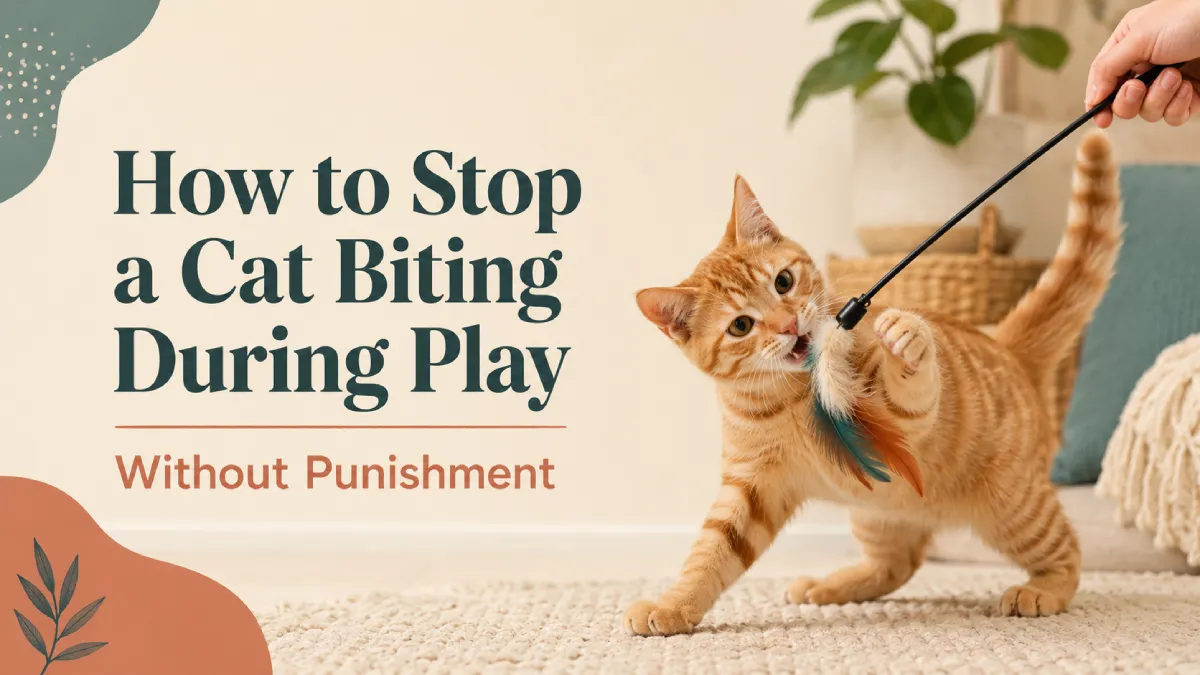
How to Stop Cat Biting During Play Without Punishment
Play biting can hurt, but punishment is not the solution. Cats naturally use stalking, chasing, pouncing, grabbing and biting during play, so the goal is to direct those behaviors toward appropriate toys rather than hands, feet or ankles.
To stop cat biting during play, remove hands and feet from the game, provide toys that create distance, schedule regular opportunities for hunting-style play and learn the body-language changes that appear before play becomes too intense. If biting begins suddenly, becomes severe or occurs outside normal play, a veterinary assessment may be needed to rule out pain or illness.
Direct Answer
Stop using hands and feet as toys, redirect hunting behavior toward wand, toss and kicker toys, and end interaction calmly when teeth contact skin. Provide predictable play opportunities and intervene before arousal becomes too intense. Never hit, yell at, spray, scruff or deliberately frighten a cat for biting, because punishment can increase fear without teaching an appropriate alternative.
Play Biting Is Different From Defensive Aggression
Before changing the behavior, identify whether the interaction actually looks like play.
Play-directed behavior commonly includes:
- stalking moving objects
- hiding and pouncing
- chasing
- grabbing with the front paws
- kicking with the hind legs
- biting a moving target
A cat may direct the same sequence toward a toy, another cat, a moving ankle or a hand under a blanket.
Defensive or fear-related aggression is different. A frightened cat may crouch, flatten or rotate the ears, hiss, growl, attempt to retreat or use biting to create distance from something they perceive as threatening.
Do not assume every bite is playful simply because it happens during interaction. Look at the entire context and body language.
Use Cat Body Language for a broader guide to feline signals.
Play Rehearses the Hunting Sequence
Normal feline object play resembles parts of hunting behavior. Cats stalk, chase, pounce, grab, bite and claw at things that move like prey.
This is one reason a hand darting beneath a blanket or fingers wiggling across the floor can become such a powerful target.
The behavior itself is not abnormal. The problem is the choice of target.
Good management therefore gives the cat appropriate objects on which those normal behaviors can be expressed.
Do Not Teach That Hands Are Toys
Hand wrestling may seem harmless with a small kitten, but it teaches the kitten that human skin is part of the game.
AAHA/AAFP kitten guidance specifically advises against using hands or feet as play toys because kittens can learn that biting and scratching people are appropriate forms of play.
Avoid:
- wrestling with bare hands
- wiggling fingers for the kitten to chase
- letting the cat grab your arm and kick it
- encouraging attacks on toes
Use a toy between the cat and your body instead.
Kitten Play Biting
Kittens have a strong play drive and spend considerable time rehearsing predatory-style movements.
If a kitten bites hands, the response should be consistent from the beginning:
- Do not turn fingers into moving prey.
- Provide appropriate chase and grab toys.
- Redirect before the kitten reaches your skin.
- End skin-directed play calmly if biting occurs.
- Repeat the same rule across household members.
A kitten should not learn that one person allows hand wrestling while another person punishes it.
Consistency makes the alternative clearer.
Adult Cats Still Need Appropriate Play
Play is not only a kitten activity.
FelineVMA recommends routine object play regardless of age because it provides an outlet for important hunting-related behavior. The intensity and style can differ between cats, and senior cats may play more quietly than younger animals.
An adult cat that attacks hands or ankles may benefit from more appropriate opportunities to chase, pounce and capture toys rather than simply being told to stop.
Use Toys That Keep Teeth Away From Skin
Wand Toys
Wand toys create physical distance between your hands and the moving “prey.”
Move the toy in ways that resemble something the cat can stalk and catch rather than waving it continuously in the cat’s face.
Depending on the cat, this may include:
- moving along the floor
- disappearing around furniture
- brief pauses
- short bursts of movement
- allowing successful catches
Inspect string, feathers and attachments regularly and store unsafe-to-chew interactive toys when they are not being supervised.
Distance Toys
Small toys that can be safely tossed away from your body are useful for cats that like to chase.
They allow the cat to direct running, grabbing and biting toward an object rather than your ankles.
Examples may include appropriate toy mice, balls or other cat-safe chase toys.
Kicker Toys
Some cats enjoy grabbing a larger soft toy with the front paws while kicking with the hind legs and biting it.
A kicker toy provides an appropriate target for that close-contact style of play without requiring your forearm to become the target.
Provide Appropriate Chase Opportunities
Do not make every play session consist of waving a toy directly beside the cat.
Allow room for:
- watching
- stalking
- chasing
- pouncing
- capturing
Interactive play should let the cat succeed sometimes. A toy that is permanently impossible to catch can be less satisfying than an interaction that includes successful capture.
Rotate Toys to Maintain Interest
A large pile of the same toys left on the floor every day may gradually become less interesting.
Rotate suitable toys so that some disappear for a period and return later.
You can vary:
- texture
- movement pattern
- size
- location
- ground-level versus airborne play
Rotation does not mean withholding enrichment. Keep safe independent-play options available while changing which interactive toys appear during sessions.
Use Predictable Interactive Play Sessions
Regular play can provide an appropriate outlet before the cat starts creating their own hunting opportunities with human feet.
FelineVMA’s current behavior toolkit recommends routine object-play sessions at least twice daily, using short hunting-like bursts. Individual cats differ, so the useful amount and intensity should still be adjusted to age, health and interest.
Look for patterns in when biting tends to occur and schedule play before predictable problem periods where practical.
Redirect Before Play Escalates
Redirection works best before the cat has already grabbed your hand or ankle.
If you notice the cat beginning to:
- stalk your feet
- hide in a regular ambush location
- focus intensely on moving fingers
- become increasingly fast or forceful with play
move the hunting opportunity onto an appropriate toy.
Keep the toy away from your hands so the cat does not need to pass through your skin to reach it.
What to Do When Teeth Touch Skin
When your cat makes tooth contact during play, stop turning your body into moving prey.
Pause the interaction and disengage calmly as soon as you can do so safely.
Do not respond by:
- hitting
- shouting
- spraying water
- flicking the cat’s nose
- scruffing
- throwing objects
- deliberately frightening the cat
The lesson should be simple:
Appropriate toy play continues. Teeth on human skin end the interaction.
End the Interaction Calmly
If rough play has escalated, stop the game instead of turning the interruption into another exciting event.
Walk away or create a brief pause once you can disengage safely.
You do not need to lecture the cat, chase them from the room or physically restrain them.
When the next play opportunity begins, start again with an appropriate toy.
Avoid Dramatic Reactions
Large, fast reactions can add movement and excitement to an already highly aroused interaction.
Try not to:
- flail your hands
- run away while encouraging a chase
- scream at the cat
- start wrestling to remove them
The priority is human safety, but once safe, keep the interaction as uneventful as possible.
Stop Making Feet Under Blankets Into Prey
Moving toes under a blanket strongly resembles small hidden prey to many cats.
If your cat repeatedly attacks feet in bed:
- stop deliberately wiggling feet to encourage chasing
- provide interactive play before settling down
- keep appropriate toys available elsewhere
- avoid rewarding attacks with an exciting wrestling game
The blanket does not make a foot an appropriate cat toy.
Manage Ambush Behavior
Some cats learn to wait behind furniture, around corners or beneath a bed and pounce at passing legs.
Look for a consistent location and pattern.
Where possible:
- offer play before the usual ambush period
- redirect to a distance toy before walking past
- temporarily change access to a particularly problematic hiding setup
- provide other appropriate stalking opportunities
FelineVMA specifically recommends redirecting foot-directed hunting toward an appropriate toy.
Plan for High-Activity Periods
Many cats show predictable periods when they are more interested in running, chasing or playing. For some households, this is especially noticeable around morning or evening routines.
Instead of waiting until the cat begins attacking ankles, use the pattern to your advantage.
A structured play opportunity before the usual high-energy period can give the cat an appropriate outlet.
Play in Multi-Cat Homes
Do not assume that two cats will meet all of each other’s play needs.
Differences in age, energy and social preference can create problems. A young energetic cat may repeatedly chase an older cat that does not want to participate.
Provide individual object-play opportunities as well as appropriate shared play where both cats genuinely appear comfortable.
Watch for:
- one cat always pursuing
- one cat repeatedly hiding
- blocking
- growling or hissing
- one cat being unable to disengage
Those signs suggest the interaction should not simply be treated as mutually enjoyable play.
Learn the Signs That Play Is Becoming Too Intense
Do not judge arousal from one body part alone.
Look at ears, eyes, tail, posture, movement and context together.
Ear Position
Relaxed or forward-facing ears may accompany comfortable engagement.
Ears beginning to rotate sideways or backward can occur as arousal or discomfort increases. Flattened ears combined with defensive posture, hissing or retreat deserve more caution.
Tail Movement
Increasingly forceful tail movement can indicate rising arousal.
A rapidly lashing or thrashing tail during an interaction is a useful reason to reduce intensity rather than continuing to provoke the cat.
Pupil Size
Dilated pupils can occur with excitement, fear and changes in lighting, so pupil size alone cannot tell you whether a cat is playing comfortably.
Large pupils together with intense stalking, tail thrashing and increasingly forceful attacks can indicate high arousal.
Body Tension
A relaxed playful cat generally moves fluidly.
Increasing stiffness, crouching, defensive posture, attempts to retreat, growling or hissing suggest that the interaction is no longer simple relaxed play.
Play Escalation Body-Language Chart
| Stage | Possible Body-Language Pattern | What to Do |
|---|---|---|
| Relaxed Play | Fluid movement, voluntary chasing, brief pauses, appropriate toy focus, ears generally neutral or forward, cat re-engages willingly | Continue appropriate toy-based play and allow successful captures. |
| Highly Aroused | Faster movement, intense stalking, stronger grabbing, rapidly moving tail, large pupils, increasing focus on hands or feet | Reduce intensity and redirect toward a suitable distance or kicker toy before skin contact occurs. |
| Stop Interaction | Repeated skin-directed biting, forceful grabbing, inability to disengage from the person, escalating body tension | End play calmly. Avoid punishment or dramatic reactions. Restart later with an appropriate toy and easier setup. |
| Possible Fear/Pain | Hissing, growling, defensive crouching, flattened ears, retreat attempts, sudden aggression with handling, new sensitivity or unexpected behavior change | Do not treat the episode as ordinary play. Give the cat space and consider veterinary assessment, especially if the behavior is new. |
This chart is a guide to observation, not a diagnostic tool. The same signal can have different meanings depending on the rest of the cat’s body language and the situation.
Biting During Petting Is a Different Problem
A cat that bites after a period of stroking may not be showing play-directed biting at all.
Some cats tolerate or enjoy petting for a period and then use biting to end the interaction when handling becomes too long, intense or uncomfortable.
Do not use the play-biting plan as the only explanation for biting that consistently occurs during physical contact.
For that pattern, see Why Does My Cat Lick Me Then Bite Me?.
This article intentionally does not duplicate the full petting-overstimulation explanation.
Sudden Aggression Needs More Caution
If an adult cat that previously played gently suddenly begins biting hard, do not assume the cat has simply developed a training problem.
Changes in behavior can occur with:
- pain
- illness
- fear
- environmental stress
- redirected arousal
Cornell notes that medical conditions including osteoarthritis, dental disease and other health problems can contribute to aggressive behavior.
Pain Can Change How a Cat Responds
A cat experiencing pain may bite to prevent touch, movement or handling that makes the discomfort worse.
Possible clues that biting may involve more than play include:
- sudden sensitivity to touch
- avoiding jumping
- limping or stiffness
- reduced activity
- hiding more than usual
- changes in appetite
- unexpected aggression during routine handling
- rapid change from previous behavior
Behavior alone cannot identify the medical cause, so do not attempt to diagnose pain from biting patterns at home.
When Veterinary Assessment Is Needed
Contact your veterinarian when biting:
- appears suddenly in a previously tolerant cat
- becomes substantially more severe
- occurs when a particular body area is touched
- is accompanied by limping, stiffness or reduced movement
- occurs with appetite, grooming, litter-box or sleep changes
- happens outside recognizable play situations
- creates a significant safety concern
A veterinary examination can help rule out medical contributors before the behavior is treated purely as a training issue.
When a Behavior Professional May Help
Professional help may be useful when:
- biting causes repeated injuries
- the triggers are difficult to identify
- fear or defensive aggression may be involved
- redirected aggression occurs
- multi-cat tension contributes to the problem
- the behavior continues despite appropriate environmental and play changes
Start with your veterinarian. For complex cases, they may recommend a board-certified veterinary behaviorist or another appropriately qualified feline behavior professional.
Use Positive Reinforcement Instead of Punishment
Teach and reinforce what you want the cat to do instead.
For example:
Instead of: attacking ankles → being sprayed with water.
Teach: stalk wand toy → chase toy → capture toy → appropriate play continues.
Positive reinforcement can also help teach cues, mat behaviors and redirection skills.
See How to Train a Cat for the broader training framework.
FAQs
Why does my cat bite my hands while playing?
Moving hands can trigger normal stalking, grabbing and biting behavior, especially if the cat has previously been encouraged to wrestle with fingers. Stop using hands as toys and provide wand, toss or kicker toys that allow the same play behaviors to be directed toward an appropriate target.
How do I stop a kitten biting my hands?
Be consistent from the beginning. Do not wiggle fingers or wrestle with the kitten. Redirect play toward appropriate toys and calmly stop the interaction when teeth contact skin. Provide regular opportunities for chasing, pouncing and grabbing toys.
Why does my cat attack my feet when I walk past?
Moving feet can become prey-like targets, especially when a cat has learned to ambush people from a predictable hiding place. Redirect the hunting sequence toward a distance toy before the usual ambush and provide regular interactive play.
Should I spray my cat with water for biting?
No. Punishment can increase fear and does not clearly teach which behavior you want instead. Remove hands and feet from play, provide appropriate targets and calmly end skin-directed interactions.
How can I tell play biting from real aggression?
Look at the entire context and body language. Play often involves voluntary stalking, chasing and pouncing with an ability to pause or disengage. Defensive aggression may include hissing, growling, retreat attempts, flattened ears and tense posture. Sudden or severe aggression also deserves veterinary attention.
Why has my adult cat suddenly started biting during play?
A sudden behavior change should not automatically be blamed on excess energy. Pain, illness, fear, environmental stress or another form of aggression may be involved. If the change is new, pronounced or accompanied by other symptoms, arrange veterinary assessment.
Bottom Line
The best way to stop cat biting during play is not to suppress normal feline hunting behavior but to give it an appropriate target.
Keep hands and feet out of the game, use wand, distance and kicker toys, provide predictable interactive play and redirect before arousal becomes excessive. When teeth touch skin, stop the interaction calmly rather than escalating it with punishment.
Body language matters. If biting begins suddenly, occurs with defensive behavior or appears connected to pain or illness, treat it as more than a training issue and involve your veterinarian.


