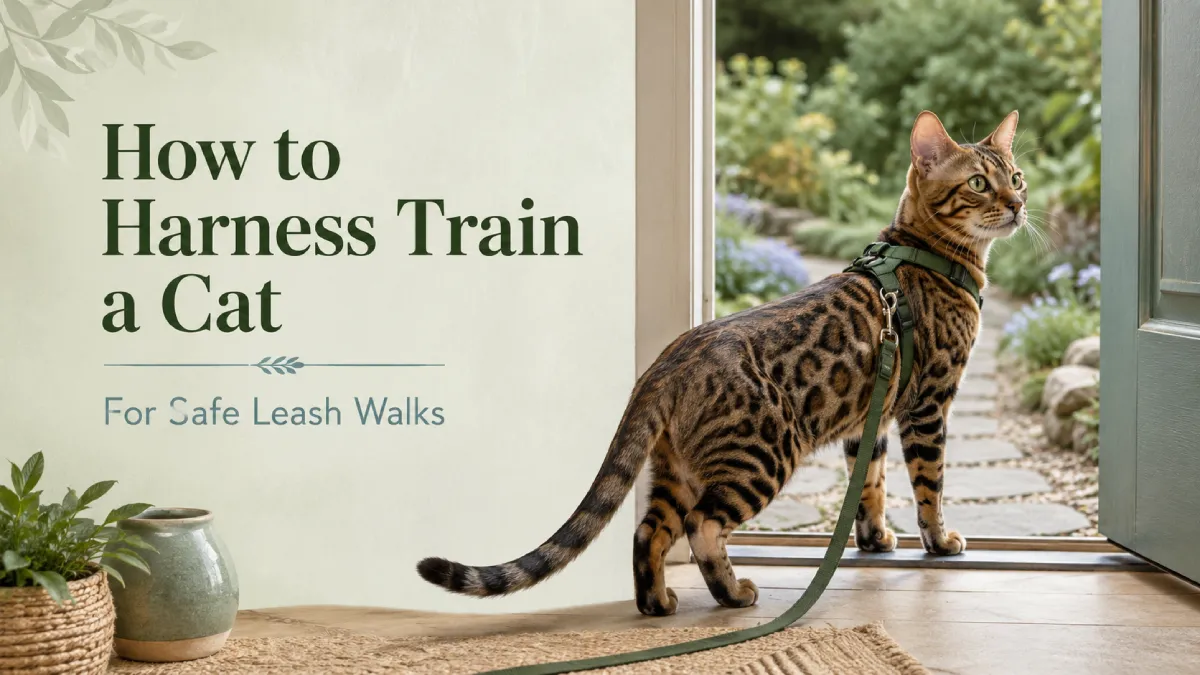
How to Harness Train a Cat for Safe Leash Walks
Learning how to harness train a cat starts indoors, long before the first outdoor walk. The goal is not to put on a harness and persuade the cat to move. Instead, introduce each part gradually so the harness, leash, doorway and outdoor environment remain predictable and rewarding.
Many cats can learn to explore outside on a harness and leash, but leash walking is not suitable for every cat. Some prefer indoor enrichment or an enclosed outdoor space. Progress according to your cat’s body language, never force them outside, and keep physical escape prevention in place even when training is going well.
Quick Answer
Introduce the harness gradually indoors, reward calm investigation, then build from brief contact to wearing it comfortably and moving normally. Attach a lightweight fixed-length leash only after the cat is relaxed in the harness. Follow the cat rather than dragging them, and introduce the outdoors in a quiet, controlled location. Stop if the cat shows persistent fear or repeatedly tries to escape.
Is Leash Walking Appropriate for Every Cat?
No. Some cats enjoy controlled outdoor exploration, while others find unfamiliar sounds, smells, people and animals overwhelming.
Harness walking may be worth exploring if your cat:
- shows relaxed curiosity about new environments
- recovers reasonably well from mild surprises
- enjoys interactive training
- can remain comfortable wearing the harness indoors
- shows interest in exploring rather than immediately retreating
It may be a poor fit for a cat that becomes intensely fearful around unfamiliar environments, repeatedly tries to escape the harness or remains distressed despite slow training.
The objective is enrichment, not making every cat into a walking companion.
For the broader principles behind positive reinforcement, shaping and voluntary participation, see How to Train a Cat.
Choose a Secure Cat Harness
A collar alone is not an appropriate substitute for a properly fitted walking harness. A harness distributes control around the body and reduces the chance of the cat slipping directly out of a collar while exploring.
Choose a harness that:
- is designed for cats or appropriately sized for your individual cat
- has secure closures
- does not restrict normal shoulder movement
- does not interfere with breathing
- cannot easily slide forward over the shoulders
- provides a secure attachment point for the leash
A style that works well for one cat may not fit another cat’s body shape securely.
Check the Fit Carefully
Fit should be snug enough to reduce escape risk without pinching, rubbing or restricting normal movement.
Before attaching a leash, check:
- every buckle or fastening
- the neck and chest areas
- the position around the shoulders
- whether the harness shifts excessively when the cat turns
- whether the cat can walk, sit and lie down normally
Follow the fitting instructions for the specific harness rather than relying on one universal measurement.
Recheck the fit regularly. This is especially important during kitten harness training because a growing kitten can quickly outgrow an earlier adjustment.
Take Escape Risk Seriously
Cats can become unexpectedly flexible and determined when frightened. A harness that seems secure while the cat walks forward may behave differently if the cat suddenly backs away, twists or crouches.
Do not deliberately frighten the cat to “test” whether the harness is escape-proof.
Instead, inspect the fit carefully indoors and maintain close leash control outdoors.
Keep microchip information current in case separation still occurs. If your cat ever gets away, follow the active search process in What to Do If Your Cat Gets Lost.
Introduce the Harness Before Putting It On
Let Your Cat Look at and Investigate It
Place the harness in a familiar room where your cat can approach it voluntarily.
Do not immediately pick up the cat and fasten it around them.
Reward calm interactions such as:
- looking toward the harness
- approaching it
- sniffing it
- sitting beside it
The harness should initially become an ordinary object rather than a signal that restraint is about to happen.
Pair the Harness With Rewards
Use something your cat genuinely values.
This might be:
- a small preferred food reward
- play
- gentle social interaction if your cat enjoys it
A simple early sequence is:
Cat approaches harness → reward.
As the cat becomes comfortable, you can begin interacting with the harness more directly.
Introduce Touch Before Wearing the Harness
Pick up the harness and briefly touch it against an area of the body where it will eventually rest.
Keep the first contact brief.
For example:
- touch the harness lightly to the shoulder area
- reward calm behavior
- remove the harness
Gradually build toward longer contact only when your cat remains relaxed.
If the cat moves away, crouches, hides or becomes tense, reduce the difficulty rather than holding them in place.
Put the Harness On Briefly
Once your cat comfortably accepts the harness touching their body, put it on for a very short period indoors.
Secure it calmly, reward the cat and remove it before the experience becomes difficult.
The first objective is not walking. It is simply:
Wear harness briefly and remain comfortable.
Increase Wearing Time Gradually
Across later sessions, allow the harness to remain on a little longer.
Continue pairing it with positive experiences such as:
- food rewards
- play
- exploring a familiar room
- resting voluntarily
Do not follow a rigid timetable. One cat may progress quickly while another needs many repetitions at the same stage.
Encourage Normal Indoor Movement
Before adding a leash, your cat should be able to move reasonably normally while wearing the harness.
Let them:
- walk around
- turn
- sit
- lie down
- play if interested
A cat that remains uncomfortable in the harness is not ready for outdoor exposure.
Attach the Leash Indoors
Once the cat is comfortable moving in the harness, introduce a lightweight leash.
Current FelineVMA caregiver guidance recommends a lightweight fixed-length leash and advises avoiding retractable leashes during this process.
At first, attach the leash indoors and supervise closely so it cannot become caught around furniture or the cat’s legs.
Do not leave a cat unattended with a leash attached.
Let the Cat Lead the Movement
When you begin holding the leash, follow your cat around the room without putting unnecessary pressure on it.
This differs from traditional heel-style dog walking.
The early goal is for the cat to learn:
I can move normally while this person holds the leash.
If you want the cat to move toward a particular place, use positive reinforcement, a target or a familiar cue rather than pulling them there.
Never Drag the Cat
Do not pull a frozen, crouching or reluctant cat along by the harness.
Dragging can:
- increase fear
- make the harness predict an unpleasant experience
- encourage struggling
- increase escape attempts
If the cat does not want to move, reduce the difficulty.
Practice Near the Door Before Going Outside
The doorway itself can become an important part of training.
Practice approaching the exit while the cat remains harnessed and controlled.
You can use a consistent cue that tells the cat when supervised outdoor access is available.
This helps distinguish a planned harness outing from simply darting through an open door.
Do not encourage the cat to rush through exterior doors whenever they open.
Plan the First Outdoor Experience Carefully
The first trip outdoors should be a controlled introduction, not a neighborhood walk.
Choose somewhere close to safety and allow the cat to decide whether to investigate.
If your cat wants to remain near the doorway or return inside, allow that.
Never carry a frightened cat into an unfamiliar outdoor area simply because you want the training session to progress.
Choose a Quiet Location
The best starting environment has as few sudden distractions as practical.
A suitable location might be a quiet private yard or another secure area away from:
- busy traffic
- off-leash dogs
- construction
- crowds
- loud machinery
Scan the environment before taking the cat outside.
Use Gradual Outdoor Exposure
Allow the cat to take in new smells, sounds and sights at their own pace.
An early session might involve nothing more than:
- standing near the doorway
- sniffing the ground
- watching the environment
- taking a few voluntary steps
- returning indoors
Distance is not the measure of success. Relaxed exploration is more important than completing a particular route.
What If Your Cat Freezes?
Some cats initially crouch or stop moving when a harness is introduced.
If this happens indoors, give the cat time to process the sensation without pulling them forward.
You can:
- reduce wearing time
- offer a preferred reward
- encourage a very small voluntary movement
- return to an earlier training stage
If freezing happens outdoors, it may also indicate that the environment is too challenging.
Move back to safety rather than forcing the cat to continue.
What If Your Cat Rolls Over?
A cat that falls or rolls while wearing a new harness may be reacting to an unfamiliar sensation rather than demonstrating that they understand leash walking.
Do not pull the leash to make the cat stand.
Shorten the session and return to rewarding comfortable indoor movement.
If the harness appears to interfere physically with normal movement, recheck its fit and design.
What If Your Cat Tries to Escape the Harness?
Take repeated escape attempts seriously.
If the cat backs up, twists, bites at the harness or struggles:
- do not add leash pressure
- move to a secure indoor area if possible
- end the difficult part of the session
- recheck the harness fit
- return to an easier stage later
If your cat consistently hates the harness despite gradual positive training, leash walking may simply not be an appropriate form of enrichment for that individual.
Prepare for Outdoor Distractions
Loud Noises
Cars, construction, doors slamming, machinery or other sudden sounds can trigger an immediate escape response.
If your cat startles:
- maintain control of the leash without jerking it
- give the cat access to retreat
- increase distance from the sound
- end the outing if the cat cannot recover
A cat that remains frightened is not benefiting from continued exposure.
Dogs Outdoors
Do not assume an approaching dog is safe because the dog’s owner says it is friendly.
Your cat may still perceive the dog as a threat.
Keep enough distance that you can retreat before the cat panics. Avoid locations where loose or uncontrolled dogs are likely to approach.
Cars and Roads
Traffic introduces noise, unpredictable movement and physical danger.
Choose walking locations away from busy roads whenever possible.
A harness and recall cue do not make road exposure safe.
If you are building a recall behavior alongside harness work, use How to Teach a Cat to Come When Called, while remembering that feline recall is not guaranteed outdoors.
Outdoor Health and Identification
Discuss Parasite Prevention With Your Veterinarian
Outdoor exposure can change a cat’s contact with parasites such as fleas, ticks, mosquitoes and intestinal parasites.
Preventive recommendations depend on factors including:
- geographic region
- local parasite prevalence
- how often the cat goes outside
- other animals in the household
- the cat’s health
Ask your veterinarian which parasite-prevention plan is appropriate rather than using a product chosen only because your cat has started leash walking.
Never use a parasite product labeled only for dogs on a cat unless a veterinarian specifically directs its use.
Keep Identification Current
FelineVMA recommends microchip identification for cats and visible identification where appropriate.
Before outdoor training, check that:
- the microchip registration is current
- your phone number is correct
- your address is current
- any visible identification is safe and readable
Identification provides an additional recovery layer if the harness, leash or handler fails.
Watch for Hot Weather
Do not make a cat walk in uncomfortable heat simply because an outing was planned.
Choose cooler conditions, provide access to water where appropriate and avoid hot surfaces or prolonged direct sun.
End the outing and move to a cooler environment if the cat shows concerning signs such as:
- panting
- marked weakness
- unusual lethargy
- obvious distress
Seek veterinary advice promptly if a cat appears unwell after heat exposure.
Watch for Cold Weather
Cold tolerance also varies with the individual cat, coat, age, health, wind and wet conditions.
Do not apply one temperature rule to every cat.
Keep outings brief in uncomfortable conditions and return indoors if your cat appears distressed, repeatedly seeks shelter, becomes wet or no longer wants to continue.
Know When to Stop a Training Session
Training should stop or become easier when your cat is no longer participating comfortably.
Possible signs include:
- repeated attempts to retreat
- persistent freezing
- crouched posture
- ears held back
- tail tucked closely to the body
- growling or hissing
- frantic harness biting
- repeated escape attempts
- refusing normally valued rewards
- difficulty recovering after a frightening event
Ending a session is not failure. It gives you information about which step was too difficult.
If behavior changes suddenly or the cat appears painful while wearing or moving in the harness, stop training and consider veterinary assessment.
Alternatives to Leash Walking
A cat does not need to walk around the neighborhood to have meaningful enrichment.
If leash walking creates more fear than enjoyment, consider other controlled options.
Catios
A secure catio can provide:
- fresh air
- sunlight and shade
- new smells
- visual stimulation
- opportunities to observe wildlife without unrestricted roaming
The enclosure should prevent escape and protect the cat from direct access by other animals.
Secure Enclosed Outdoor Areas
Other options can include a properly secured garden enclosure or cat-safe fencing designed to prevent roaming.
FelineVMA recognizes controlled outdoor access, including enclosures, cat-safe fencing and harness-and-leash walking, as ways to provide outdoor stimulation while reducing some of the risks associated with unrestricted outdoor access.
Indoor enrichment also remains a valid choice for cats that prefer staying inside.
Harness Training Readiness Ladder
Use this ladder as a progression rather than a fixed timetable. Move forward when the current stage looks comfortable and repeat an earlier stage whenever your cat begins struggling.
| Stage | Readiness Goal | What to Look For |
|---|---|---|
| 1 | Looks at harness calmly | Approaches, sniffs or remains relaxed near it |
| 2 | Accepts harness touch | Allows brief contact without retreating or becoming tense |
| 3 | Wears harness briefly | Remains comfortable with the harness secured for a short period |
| 4 | Walks indoors | Moves, turns, sits and explores normally while wearing it |
| 5 | Accepts leash | Moves comfortably while a supervised lightweight leash is attached and held |
| 6 | Approaches doorway calmly | Can remain controlled near the exit without rushing through |
| 7 | Explores a quiet outdoor location | Shows voluntary curiosity and can retreat indoors when desired |
There is no requirement that every cat reach Stage 7. A cat that remains comfortable only with indoor harness work has not “failed.” The final goal should match the individual cat’s welfare and preferences.
Using a Carrier With Harness Adventures
For some outings, the safest way to reach a quiet location is to transport the cat in a secure carrier rather than walking from home through a busy area.
Do not rely on holding a harnessed cat in your arms inside a vehicle.
Build carrier comfort separately with Cat Carrier Training.
For longer journeys, accommodation and packing considerations, see Traveling With a Cat.
FAQs
How long does it take to harness train a cat?
There is no reliable universal timeline. Some cats become comfortable quickly while others need much slower progression. Move forward according to the cat’s behavior rather than trying to complete training within a set number of days.
Can you harness train an adult cat?
Yes. Harness training does not have to begin during kittenhood. Adult cats can learn through the same gradual positive-reinforcement process, although established sensitivities or previous negative experiences may mean progress needs to be slower.
Why does my cat fall over when I put the harness on?
The unfamiliar sensation can temporarily change how some cats move. Do not drag or pull the cat upright. Keep the experience brief, use rewards and build comfortable indoor movement gradually. Also check that the harness is not restricting normal movement.
What should I do if my cat hates the harness?
Return to an easier stage, such as rewarding calm investigation or brief body contact. If the cat remains consistently fearful or distressed despite gradual training, stop trying to make leash walking the goal and use another form of enrichment such as a catio or secure enclosure.
Should I use a retractable leash for my cat?
A lightweight fixed-length leash provides more predictable control during training. Current FelineVMA caregiver guidance advises avoiding retractable leashes. Secure handling and calm leash skills should be established before increasing freedom or distance.
Can I let my cat off leash once harness training goes well?
No. Successful harness walking or indoor recall does not make a cat escape-proof outdoors. Fear, wildlife, dogs, traffic and unexpected noise can suddenly change behavior. Continue using secure containment rather than testing off-leash reliability.
Bottom Line
Successful cat harness training is built indoors before an outdoor walk ever happens.
Start by allowing your cat to investigate the harness, pair it with worthwhile rewards and gradually progress through touch, brief wearing, normal indoor movement and controlled leash handling. Follow rather than drag your cat, and make the first outdoor experience quiet, voluntary and close to safety.
Not every cat will enjoy leash walking. If your cat repeatedly freezes, struggles, tries to escape or remains frightened, respect that response and choose another form of enrichment. Controlled outdoor access should increase your cat’s quality of life, not create another source of stress.