

Cat Emergency Kit Checklist: Supplies & Evacuation Plan
A cat emergency kit should do more than provide food for a few days. It should help you identify, contain, transport and care for your cat if a fire, flood, storm, evacuation order, chemical incident or another emergency forces you to leave home quickly.
Good preparation combines three things: essential supplies, current records and identification, and a realistic evacuation plan. Keep the kit accessible, make sure every household member knows where the carrier is, and review supplies regularly so expired medication, old contact details or missing documents do not become a problem during an emergency.
Quick Answer
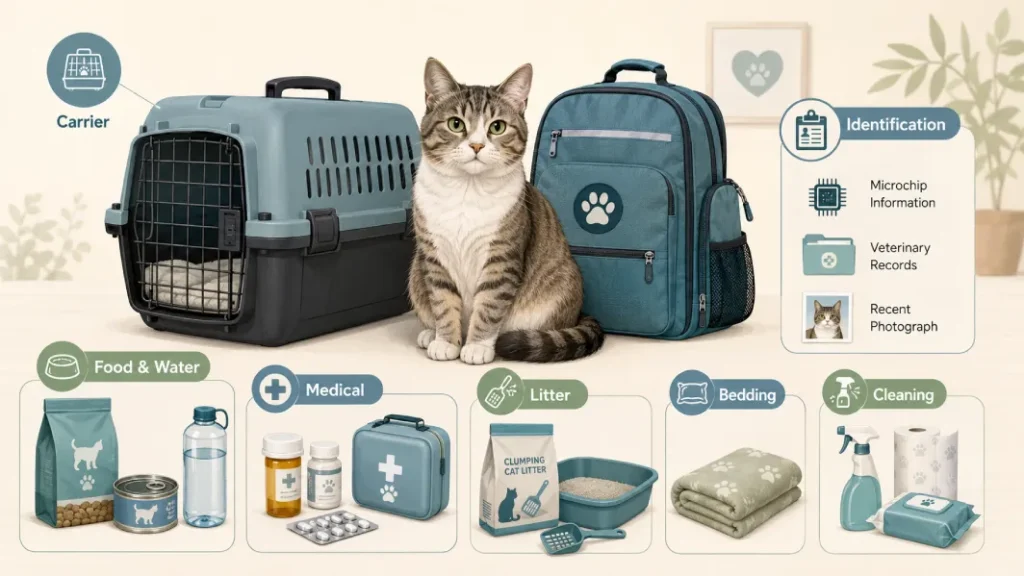
Prepare a portable kit containing your cat’s normal food, water, prescribed medication, veterinary records, identification details, litter supplies, bowls, bedding, cleaning items and a basic pet first-aid kit. Keep a secure carrier readily accessible, identify pet-friendly evacuation options and a backup caregiver, and maintain current microchip, veterinary and emergency-contact information.
Why Cat Disaster Preparation Matters
Emergencies often remove the time you would normally have to organize supplies. You may need to leave quickly, transport a frightened cat, stay somewhere unfamiliar or continue medication while your normal veterinary clinic is inaccessible.
Preparation can help with predictable problems such as:
- finding and containing a frightened cat
- transporting the cat securely
- proving ownership if you become separated
- showing veterinary or vaccination records
- continuing prescribed medication
- providing familiar food and litter
- finding temporary veterinary care
- locating accommodation that accepts cats
Do not wait for an evacuation notice before deciding where your cat can go.
Create the Evacuation Plan First
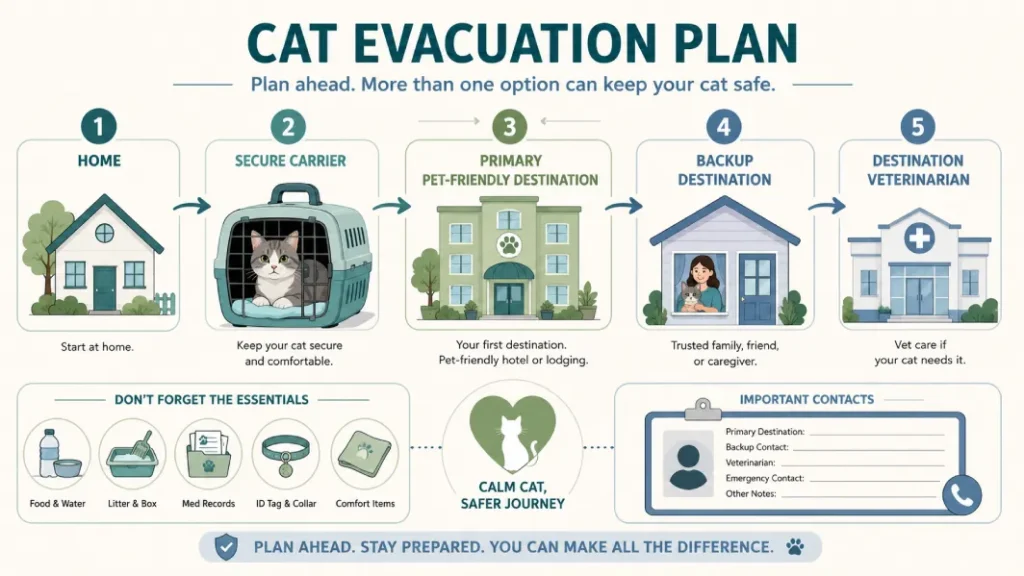
A well-packed bag is much more useful when you already know how you will evacuate.
Write down:
- your primary evacuation destination
- a backup destination
- pet-friendly accommodation options
- friends or relatives outside the likely emergency area
- boarding facilities where appropriate
- your regular veterinarian
- an emergency veterinarian near the evacuation destination
- a backup caregiver who can access your home
Many emergency evacuation centers do not accept household pets, so identify alternatives before an emergency begins.
Plan More Than One Destination
A flood, wildfire, storm or other regional event may affect the first hotel, friend or boarding facility on your list.
Keep at least one alternative outside the immediate area where practical.
Choose a Backup Caregiver
Select someone who could help if you are unable to return home.
They should know:
- where your cat normally hides
- where the carrier is stored
- where the emergency supplies are kept
- feeding instructions
- medication instructions
- where you plan to evacuate
Your Cat Sitter Checklist can also be adapted into written emergency caregiver instructions.
Carrier and Evacuation Equipment
Use a Secure Carrier
The carrier is one of the most important parts of a cat evacuation plan.
Choose one that:
- closes securely
- provides adequate ventilation
- is suitable for the individual cat
- can be transported without collapsing
- can be cleaned after an accident
Label the carrier with your cat’s name, your name and current contact information.
Keep the Carrier Accessible
A carrier stored behind boxes in an attic, basement or locked shed may be difficult to reach when you need to leave quickly.
Keep it somewhere practical and make sure everyone responsible for the cat knows its location and how the closures work.
For cats that avoid the carrier, use Cat Carrier Training before an emergency occurs.
Consider a Backup Carrier
A backup can be useful if the normal carrier becomes damaged or inaccessible.
Do not depend on an open box, laundry basket or another container that cannot securely contain a frightened cat.
Multi-Cat Households
Ideally, plan an appropriate secure carrier for each cat.
Separate carriers make it easier to:
- identify each cat
- monitor individual animals
- transport cats safely
- separate frightened cats if tension develops
- attach the correct medical and contact information
Do not assume cats that normally sleep together will necessarily remain relaxed together during an evacuation.
Identification and Proof of Ownership
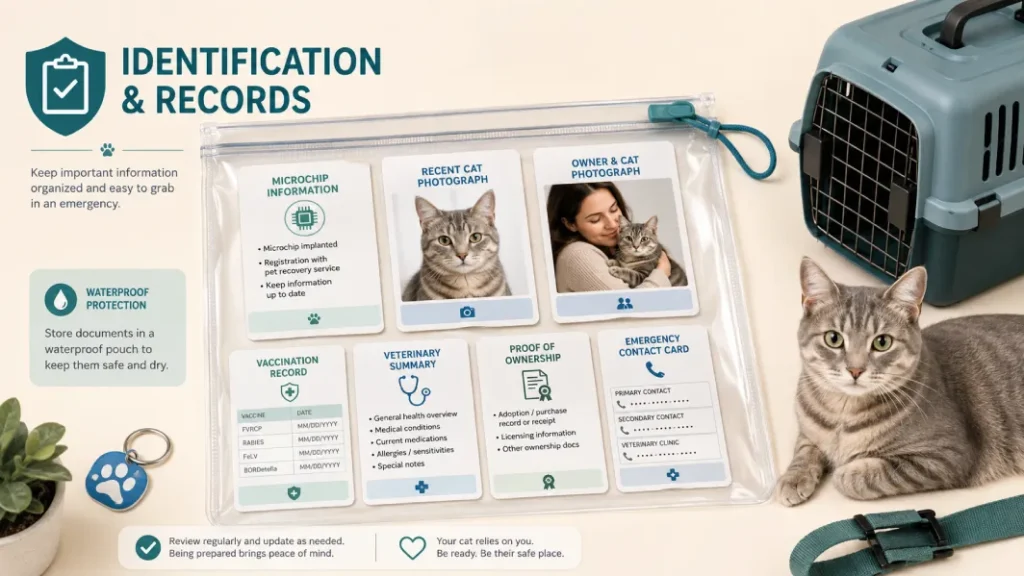
Emergencies increase the possibility of escape or separation, so use more than one form of identification where appropriate.
Microchip Information
Keep a record of:
- microchip number
- registry or microchip company
- registry contact details
- owner phone number
- backup contact where available
Also make sure the information held by the registry itself is current. Writing a new phone number inside your emergency kit does not update the microchip database.
Recent Photographs
Keep clear recent photographs:
- on your phone
- in secure digital storage where practical
- as printed copies in your records packet
Useful images show your cat’s face, full body and distinctive markings. A photograph of you with your cat can also help support proof of ownership if you become separated.
Proof of Ownership
Keep copies of relevant records such as:
- adoption paperwork
- registration information
- microchip registration
- veterinary records linking you to the cat
Use copies rather than placing irreplaceable originals in a bag that may be lost or damaged.
Veterinary and Medical Records
Keep important veterinary information together in a waterproof document pouch or container.
Useful records can include:
- medical summary
- vaccination documentation
- current medical conditions
- prescription information
- important test results where relevant
- allergies or known adverse reactions
- regular veterinary clinic details
Vaccination Records
Some boarding facilities, shelters or evacuation accommodations may request vaccination documentation.
Requirements differ by facility and location, so keep current records available rather than publishing one universal shelter requirement.
Medication List
Create a written medication list for every cat receiving treatment.
Include:
- medication name
- veterinarian-prescribed amount
- schedule
- how it is normally given
- storage instructions
- prescribing clinic
Keep the written instructions with the kit even when the medication label contains similar information. This makes the routine easier for a backup caregiver to understand.
Food, Water and Medication Supplies
Food
Pack your cat’s normal food rather than assuming your evacuation destination will stock the same product.
Current CDC pet disaster-kit guidance recommends keeping a two-week supply of food for each animal in appropriate containers.
Also consider:
- a manual can opener if needed
- feeding instructions
- prescription diets that may be difficult to replace
- food expiration dates
Local authorities may issue different recommendations for a particular emergency, so follow specific official instructions when they are provided.
Water
CDC’s current general pet disaster-kit guidance also recommends a two-week supply of water for each animal.
A complete water supply can be heavy, so your emergency setup may include both a portable evacuation bag and additional stored supplies rather than trying to fit everything into one backpack.
Bowls
Pack dedicated food and water dishes.
Lightweight, stable and easy-to-clean bowls are practical for evacuation. Do not assume a hotel, shelter or temporary caregiver will provide suitable dishes.
Medication Supply
CDC recommends keeping a two-week supply of necessary medication where applicable.
For prescription medicines, ask your veterinarian or pharmacy what reserve can legally and safely be maintained for your individual cat.
Never:
- change the prescribed dose to stretch a supply
- share one cat’s medication with another animal
- substitute human medication
- use an expired medication simply because it remains in the bag
Litter and Sanitation Supplies
Litter and Portable Tray
Pack familiar litter and a portable or disposable litter tray.
This may be needed in:
- a hotel room
- a relative’s home
- temporary accommodation
- an evacuation center that accepts cats
A disaster is not an ideal time to discover that your cat refuses an unfamiliar litter substrate.
Scoop and Waste Bags
Keep a scoop with the emergency supplies rather than expecting to remove your everyday scoop while leaving quickly.
Pack waste bags for:
- used litter
- soiled carrier liners
- food waste
- general cleanup
Cleaning Supplies
A simple sanitation kit may include:
- paper towels
- waste bags
- disposable gloves
- appropriate cleaning supplies
- spare absorbent carrier liners
Keep cleaning products securely closed and inaccessible to the cat.
Bedding, Towels and Familiar Items
Familiar Bedding
Include a small familiar blanket, carrier pad or washable bed.
Choose something compact enough to transport and easy to wash if it becomes soiled.
Towels
Several towels can be useful for:
- carrier bedding
- cleanup
- drying
- replacement liners
- partially covering a carrier while maintaining ventilation
Comfort Item
Pack one or two familiar safe items such as a small toy or blanket.
Familiar belongings can make an unfamiliar environment more predictable, but they should not take up space needed for essential food, water or medication.
Pet First-Aid Supplies
Include a basic pet first-aid kit and a reputable pet first-aid reference.
The purpose is to support immediate safety until veterinary care is available, not to turn the emergency bag into a home veterinary clinic.
Do not use the kit to:
- diagnose injuries or illness
- perform invasive treatment
- give human painkillers
- give unprescribed antibiotics
- induce vomiting
- create your own medication doses
For suspected toxic exposure, use Cat Poison Emergency and seek appropriate veterinary or poison-control guidance rather than improvising treatment.
Emergency Contacts
Regular Veterinarian
Keep your regular veterinary clinic’s:
- name
- phone number
- address
- after-hours instructions where available
Store this both digitally and on the printed emergency contact card.
Destination Emergency Veterinarian
Your usual veterinarian may be far away after evacuation.
Before an emergency, identify a veterinary clinic or emergency hospital near your planned evacuation destination and save its contact information.
Backup Caregiver
Record the name and contact details of the person who can evacuate or care for your cat if you cannot reach home.
Pet-Friendly Evacuation Locations
Do not assume every public evacuation center accepts cats.
Potential alternatives can include:
- pet-friendly accommodation
- friends or relatives
- boarding facilities
- veterinary facilities
- local animal-relief organizations
Keep both a primary and backup option where possible.
For broader transport and accommodation planning, use Traveling With a Cat.
Practice Before an Emergency
A written disaster plan is more useful when household members have practiced it.
Practice:
- finding the carrier quickly
- closing exterior doors
- locating the cat
- getting the cat securely into the carrier
- collecting the emergency kit
- moving toward the planned exit
Keep practice calm and brief rather than creating a frightening simulation.
Know Where Your Cat Hides
Frightened cats may use hiding places they rarely use during normal household life.
Know whether your cat commonly retreats:
- under beds
- behind furniture
- inside closets
- onto high shelves
- into covered beds or boxes
If the cat is missing during or after an emergency, use What to Do If Your Cat Gets Lost for a structured search and recovery plan.
Where to Store the Cat Emergency Kit
Store the main portable kit somewhere:
- easy to reach
- known to every responsible household member
- close enough to a practical exit
- protected from likely flooding
- protected from extreme heat
Large water and food reserves may need to be stored separately from the portable go-bag.
The goal is not to force every emergency supply into one small backpack. The goal is to know exactly what must leave with you and where the remaining reserves are stored.
Check Expiration Dates and Documents Regularly
A bag packed once and ignored for years can contain expired food, outdated medication and useless contact information.
Review:
- food expiration dates
- medication expiration dates
- stored water according to packaging or local guidance
- first-aid supplies
- microchip details
- veterinary records
- vaccination documents
- photographs
- backup caregiver details
- evacuation destinations
Instead of relying on one universal replacement interval, use the actual expiration date or manufacturer’s storage instructions for each item.
Printable Cat Emergency Kit Inventory
| Item | Quantity | Packed | Expiry | Last Checked | Replacement Date |
|---|---|---|---|---|---|
| Cat carrier | _____ | ☐ | N/A | ________ | ________ |
| Carrier identification | _____ | ☐ | N/A | ________ | ________ |
| Food | _____ | ☐ | ________ | ________ | ________ |
| Water | _____ | ☐ | ________ | ________ | ________ |
| Food and water bowls | _____ | ☐ | N/A | ________ | ________ |
| Prescribed medication | _____ | ☐ | ________ | ________ | ________ |
| Medication instructions | _____ | ☐ | Update | ________ | ________ |
| Litter | _____ | ☐ | As applicable | ________ | ________ |
| Portable litter tray | _____ | ☐ | N/A | ________ | ________ |
| Litter scoop | _____ | ☐ | N/A | ________ | ________ |
| Waste bags | _____ | ☐ | N/A | ________ | ________ |
| Bedding or blanket | _____ | ☐ | N/A | ________ | ________ |
| Towels | _____ | ☐ | N/A | ________ | ________ |
| Familiar comfort item | _____ | ☐ | Check condition | ________ | ________ |
| Cleaning supplies | _____ | ☐ | ________ | ________ | ________ |
| Pet first-aid kit | _____ | ☐ | Check contents | ________ | ________ |
| Veterinary records | _____ | ☐ | Update | ________ | ________ |
| Vaccination records | _____ | ☐ | Update | ________ | ________ |
| Proof of ownership | _____ | ☐ | Update | ________ | ________ |
| Microchip information | _____ | ☐ | Update | ________ | ________ |
| Recent photographs | _____ | ☐ | Update | ________ | ________ |
| Emergency contact card | _____ | ☐ | Update | ________ | ________ |
Cat Emergency Contact Card
Cat name: ______________________________
Description / markings: ______________________________
Microchip number: ______________________________
Microchip registry: ______________________________
Owner
Name: ______________________________
Phone: ______________________________
Alternative contact: ______________________________
Backup Caregiver
Name: ______________________________
Phone: ______________________________
Can access home: Yes / No
Regular Veterinarian
Clinic: ______________________________
Phone: ______________________________
Address: ______________________________
Destination Emergency Veterinarian
Clinic: ______________________________
Phone: ______________________________
Address: ______________________________
Evacuation Locations
Primary destination: ______________________________
Backup destination: ______________________________
Important Medical Information
Medical conditions: ______________________________
Medication: ______________________________
Allergies / adverse reactions: ______________________________
Carrier location: ______________________________
Emergency kit location: ______________________________
FAQs
What should be in a cat emergency kit?
Include food, water, bowls, necessary prescribed medication, veterinary and ownership records, microchip information, recent photographs, litter supplies, a secure carrier, bedding, cleaning supplies, a basic pet first-aid kit and emergency contacts. The kit should be adapted to your individual cat’s health and care needs.
How much food and water should I store for my cat?
Current CDC general pet-disaster guidance recommends keeping a two-week supply of food and water for each animal. Follow any more specific instructions issued by emergency authorities in your area during a particular event.
Should every cat have a separate emergency carrier?
Ideally, plan a suitable secure carrier for each cat. Separate carriers make individual identification, transport and monitoring easier and prevent frightened cats from being forced to share a confined space during an evacuation.
Where should I store the emergency kit?
Keep the portable kit somewhere easy to reach, known to the household and protected from likely local hazards such as flooding or extreme heat. Large water and food reserves can be stored separately if carrying the entire reserve in one bag would be impractical.
Should I put medicines for first aid in the kit?
Keep your cat’s prescribed medication and a basic pet first-aid kit, but do not stock human medicines or create your own treatment plan. Veterinary first aid is temporary support and should not replace professional veterinary care.
What if my cat hides during an evacuation?
Know your cat’s likely hiding places before an emergency and practice calm carrier handling. During an actual emergency, follow official evacuation instructions and prioritize safe containment rather than chasing or frightening the cat unnecessarily.
Bottom Line
A useful cat emergency kit combines supplies with preparation.
Keep identification and medical records current, maintain food, water, medication and litter supplies, keep the carrier accessible and know where you can evacuate with your cat. Also choose a backup caregiver and destination veterinarian before an emergency occurs.
Review the kit regularly so it remains usable when you actually need it.
Sources
- Centers for Disease Control and Prevention — Build a Pet Disaster Preparedness Kit
- Centers for Disease Control and Prevention — Be Prepared: Pet Safety in Emergencies
- Centers for Disease Control and Prevention — Pets in Evacuation Centers
- Centers for Disease Control and Prevention — Pets: Preparing for a Chemical Emergency
- ASPCA — Disaster Preparedness
- ASPCA — Keep Your Pet Safe and Calm During Natural Disasters


