
Is Xylitol Toxic to Cats? How Cat Risk Differs From Dogs
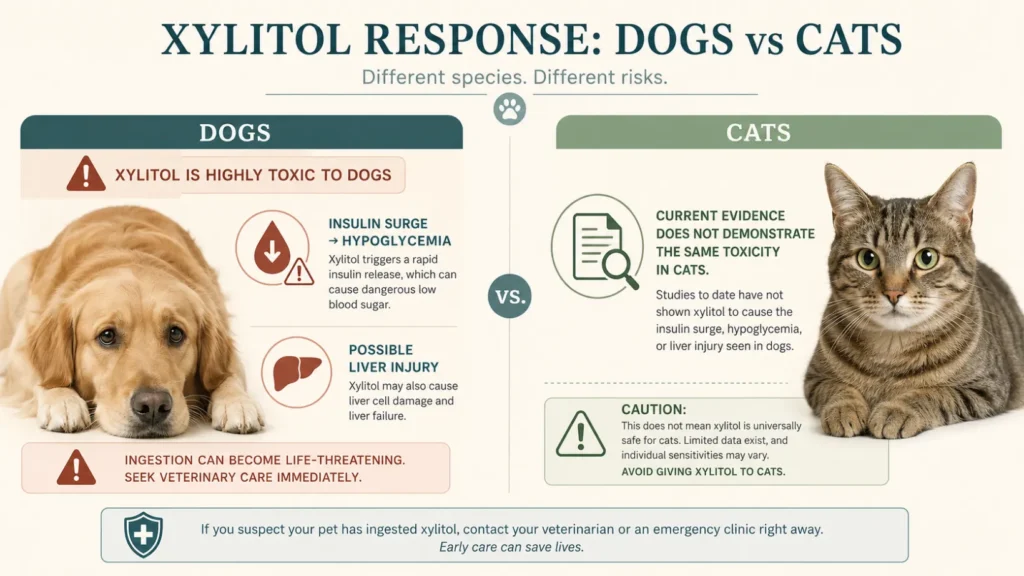
Xylitol is extremely dangerous to dogs, but current evidence does not show the same classic toxicity in cats. Merck Veterinary Manual states that cats are not considered at risk for the severe hypoglycemia or liver injury associated with xylitol poisoning in dogs.
A small controlled study also found no toxic effects in six healthy cats given relatively high oral doses of xylitol. That does not mean every sugar-free product is automatically safe for cats. Products containing xylitol may contain other harmful ingredients, medications or foreign-body hazards, so the complete ingredient list still matters after an accidental exposure.
Quick Answer
Current veterinary evidence indicates that xylitol does not cause the characteristic hypoglycemia and liver injury seen in dogs when ingested by cats. However, the available feline study was small, and xylitol-containing products can contain other dangerous ingredients. Do not intentionally feed xylitol products to cats, and check the full product label after an accidental ingestion.
Why Xylitol Is So Dangerous to Dogs
Xylitol is a sugar alcohol used as a sweetener in many sugar-free and reduced-sugar products.
In dogs, xylitol can cause a rapid, dose-dependent release of insulin. This may result in profound hypoglycemia, or dangerously low blood glucose. Higher exposures in dogs may also be associated with serious liver injury.
This canine response is the reason xylitol appears on many general pet-toxin lists.
However, toxicity cannot automatically be transferred from one species to another.
What Research Shows About Xylitol and Cats
A peer-reviewed 2018 study evaluated six healthy middle-aged cats given xylitol orally at three different doses:
- 100 mg/kg
- 500 mg/kg
- 1,000 mg/kg
The researchers monitored blood glucose, blood counts and multiple biochemical markers of liver and kidney function.
The study did not identify hypoglycemia, liver injury or other clinically significant toxic effects from xylitol at the doses tested.
Merck’s current veterinary toxicology guidance similarly states that cats are not considered at risk for xylitol-induced hypoglycemia or hepatic injury.
Why the Evidence Still Has Limitations
The feline study involved only six healthy cats.
That means it would be inappropriate to claim that:
- every amount is proven safe
- every cat will respond identically
- every xylitol-containing product is harmless
Current evidence supports a narrower conclusion: cats do not appear susceptible to the classic xylitol toxicosis seen in dogs.
Do Not Confuse Xylitol With the Whole Product
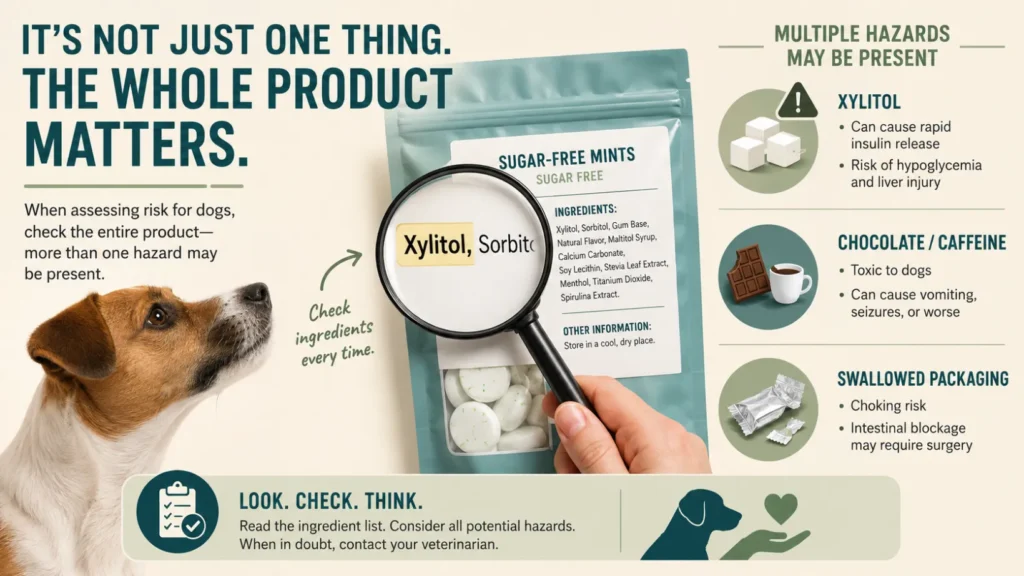
A cat rarely encounters pure laboratory-grade xylitol.
Exposure usually occurs through a commercial product such as:
- sugar-free gum
- mints or sweets
- baked goods
- toothpaste
- mouthwash
- some nut butters
- vitamins and supplements
- liquid medications
- personal-care products
The product may contain other ingredients with different risks.
For example, a baked product could also contain chocolate, caffeine, raisins or another ingredient that changes the toxicology assessment completely.
What If My Cat Ate Sugar-Free Gum?
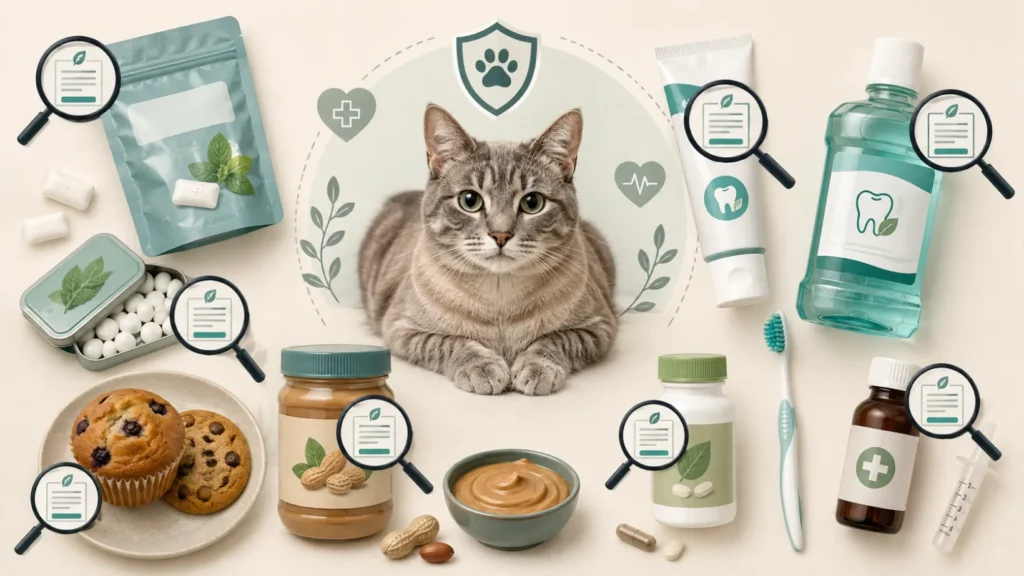
Check the complete ingredient list rather than assuming the only concern is xylitol.
Record:
- the product name
- all active or food ingredients
- approximately how much is missing
- whether wrappers or packaging were swallowed
- when the exposure occurred
- whether the cat has any symptoms
If another potentially toxic ingredient is present, the ingredient list is unknown, packaging was swallowed or your cat appears unwell, contact your veterinarian or veterinary poison service.
What If My Cat Ate Xylitol Toothpaste?
Again, the entire formulation matters.
Toothpaste can contain:
- xylitol
- fluoride compounds
- detergents
- flavorings
- other active ingredients
Do not evaluate toothpaste exposure based on xylitol alone.
Human toothpaste should not be intentionally used to brush a cat’s teeth.
What If the Product Contains Xylitol and Chocolate?
Then chocolate becomes an independent toxicology concern regardless of the lower cat-specific concern surrounding xylitol.
The same principle applies to any product containing another known or suspected feline toxin.
See Pawnium’s Foods Cats Cannot Eat guide for broader food-hazard information.
Does Xylitol Cause Low Blood Sugar in Cats?
The dangerous insulin-mediated hypoglycemia seen in dogs has not been demonstrated in cats.
In the controlled feline study, blood glucose did not fall significantly after xylitol administration.
At the highest tested dose, glucose increased slightly but remained within the physiological range.
Does Xylitol Cause Liver Failure in Cats?
Current evidence does not show the xylitol-associated liver injury documented in dogs.
The cats in the published study did not develop biochemical evidence of hepatotoxicity after the tested exposures.
Merck likewise states that feline hypoglycemia or liver injury from xylitol toxicosis has not been demonstrated.
Why Do Some Websites Still Call Xylitol Toxic to Cats?
Many pet-toxin lists were originally designed for multiple species or borrowed heavily from canine toxicology.
Older feline safety resources have also included xylitol among foods to avoid.
Keeping xylitol-containing products away from cats remains sensible, but there is an important difference between:
“Do not intentionally feed this product”
and
“Xylitol produces the same life-threatening poisoning in cats that it produces in dogs.”
The second statement is not supported by current evidence.
What Should You Do After an Exposure?
- Take the product away from your cat.
- Check the complete ingredient list.
- Keep the packaging.
- Estimate how much may have been consumed.
- Check whether packaging or wrappers are also missing.
- Observe for abnormal behaviour or gastrointestinal signs.
- Contact your veterinarian if another hazardous ingredient is present, the exposure cannot be identified or your cat becomes unwell.
Do Not Make Your Cat Vomit at Home
Do not use hydrogen peroxide, salt, mustard or another home remedy to induce vomiting.
Cats do not have a safe, reliable at-home vomiting method comparable with veterinary decontamination.
If vomiting or another intervention is appropriate for a particular exposure, a veterinary professional should make that decision.
Xylitol Product Exposure Record
| Information | Record |
|---|---|
| Product | ________________ |
| Xylitol listed | Yes / No / Unsure |
| Other ingredients | ________________ |
| Estimated amount eaten | ________________ |
| Packaging swallowed | Yes / No / Unsure |
| Time of exposure | ________________ |
| Symptoms | ________________ |
| Veterinarian contacted | ________________ |
When Veterinary Advice Is Appropriate
Contact your veterinarian promptly if:
- the product contains another potentially toxic ingredient
- the ingredient list cannot be determined
- a substantial amount of an unknown product was consumed
- packaging may have been swallowed
- your cat develops vomiting, weakness, abnormal coordination, tremors or another significant change
For a broader poisoning response plan, use Cat Poisoning Emergency.
FAQs
Is xylitol poisonous to cats like it is to dogs?
Current evidence says no. Cats do not appear to develop the profound hypoglycemia or liver injury that characterizes xylitol poisoning in dogs.
Can xylitol kill a cat?
Published evidence has not demonstrated the classic lethal xylitol syndrome seen in dogs. However, the feline evidence base is limited, and products containing xylitol may contain other dangerous ingredients.
Should I take my cat to the vet after eating xylitol gum?
Check the entire product first. Veterinary advice is appropriate if another hazardous ingredient is present, the amount or ingredients are uncertain, packaging was swallowed or the cat develops abnormal signs.
Should I make my cat vomit after eating xylitol?
No. Do not attempt to induce vomiting at home unless a veterinary professional specifically directs you to do so.
Can I intentionally give my cat xylitol?
No useful reason exists to add xylitol to a cat’s diet. The fact that current evidence does not show canine-style toxicity does not