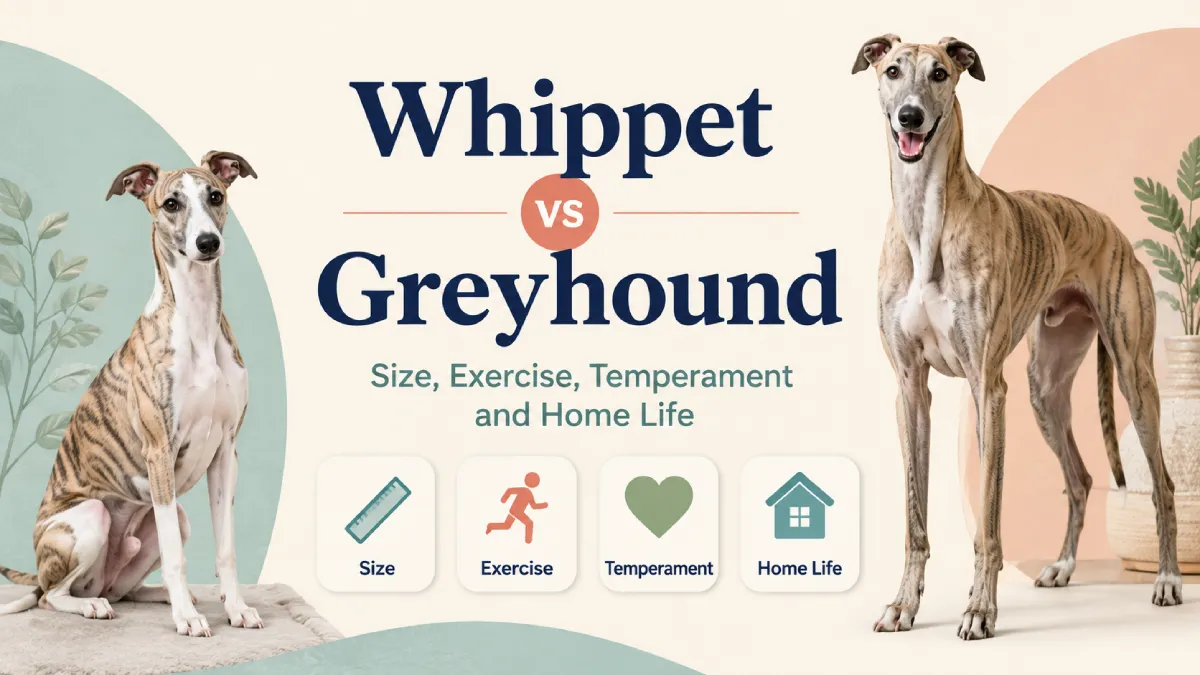
Whippet vs Greyhound: Size, Exercise, Temperament and Home Life
A Whippet vs Greyhound comparison can be misleading if you judge the breeds only by what they look like while running. Both are fast sighthounds built to pursue moving prey, yet both can be remarkably quiet and relaxed indoors. The clearest difference is size: Whippets are medium-sized, usually 25–40 pounds, while Greyhounds are substantially taller and typically around 60–70 pounds under AKC reference ranges. Their prey drive, recall reliability and compatibility with cats or small pets can vary by individual, so those issues deserve more attention than simple breed stereotypes.
Quick Verdict
A Whippet may suit you better if you want Greyhound-like sighthound traits in a considerably smaller package. A Greyhound may suit you if you have room for a much larger dog but still prefer a companion that can be quiet and relaxed indoors. Neither should be assumed safe off leash around wildlife, cats or small pets simply because it behaves calmly at home.
Side-by-Side Chart
| Trait | Whippet | Greyhound |
|---|---|---|
| Typical AKC weight | 25–40 lb | 60–70 lb depending on sex |
| Height | 18–22 in depending on sex | 27–30 in depending on sex |
| Build | Medium, lean, athletic | Large, long, powerful |
| Coat | Short, smooth | Short, smooth |
| Grooming | Low coat-maintenance | Low coat-maintenance |
| Indoor behaviour | Often quiet and relaxed | Often calm and prone to lounging |
| Exercise style | Regular activity plus opportunities to sprint | Regular exercise plus safe opportunities to run |
| Endurance athlete? | Not simply because it is fast | Not simply because it is fast |
| Recall concern | Significant around moving prey | Significant around moving prey |
| Secure off-leash area | Strongly recommended | Strongly recommended |
| Cats | Individual assessment required | Individual assessment required |
| Small pets | High caution | High caution |
| Apartment potential | Good with adequate exercise | Often possible despite size |
| Cold weather | Thin coat requires care | Individual jacket needs depend on conditions |
| Rescue population | Some breed rescue | Many retired racers may be available through specialist groups |
The biggest visual difference is scale, but the more important ownership similarities are their sighthound chase instincts, short coats and ability to shift from explosive outdoor movement to substantial indoor rest.
Size
The Whippet vs Greyhound size difference is substantial.
AKC lists Whippets at:
- 19–22 inches for males
- 18–21 inches for females
- approximately 25–40 pounds
Greyhounds are listed at:
- 28–30 inches for males
- 27–28 inches for females
- approximately 65–70 pounds for males
- approximately 60–65 pounds for females
A Whippet therefore gives many owners the appearance and movement of a classic sighthound without requiring the floor space, lifting capacity or vehicle space of a Greyhound.
Greyhounds are not simply taller Whippets, however. Their greater length and mass materially change practical tasks such as carrying an injured dog, fitting a bed into a small room or arranging transportation.
Build
Both have the classic sighthound outline: a deep chest, narrow waist, long legs and a structure designed for speed.
The American Whippet Club standard describes the Whippet as a medium-sized sighthound combining speed and muscular power without heaviness. Its body is designed for efficient movement and rapid acceleration.
The Greyhound Club of America standard describes a much larger animal with a deep chest, powerful hindquarters, long muscular limbs and a body designed for fast coursing. GCA emphasizes function rather than unnecessary mass.
Both should look lean and athletic, but lean structure should not be confused with being underweight.
Coat
Both breeds have short coats.
The Whippet standard requires a short, close, smooth, firm coat, while the Greyhound standard similarly calls for short, smooth, firm hair.
That makes coat care much simpler than it is for long-haired or continuously growing breeds.
Short hair does not provide much insulation, however, which becomes important when discussing cold weather and bedding.
Shedding
Neither requires coat clipping, but both do shed.
The American Whippet Club specifically notes that the Whippet’s short coat sheds, while Greyhound grooming guidance recommends regular coat maintenance despite the breed’s smooth hair.
The practical difference between these dogs is therefore less about elaborate grooming and more about the amount of total body surface you are brushing and bathing.
Owners expecting a completely non-shedding sighthound will be disappointed with either breed.
Grooming
Routine grooming is straightforward.
A typical home routine can include:
- brushing or a hound-glove rubdown
- occasional bathing
- nail trimming
- ear checks
- dental care
AKC describes Greyhound coat maintenance as minimal beyond regular bathing and weekly coat care, while the Whippet’s short coat similarly needs little specialist grooming.
The dedicated Pawnium Dog Grooming Schedule is not one of the requested links for this article, so detailed grooming frequency does not need to be duplicated here.
Temperament
The Whippet vs Greyhound temperament comparison contains more similarities than differences.
The Whippet standard describes the breed as amiable, friendly and gentle while still capable of intense focus during sporting pursuits. The American Whippet Club also describes Whippets as quiet and gentle indoors and strongly attached to their people.
Greyhounds are described by AKC as independent, gentle and sensitive. Greyhound Club of America material similarly characterizes adults as frequently composed, quiet and stable with people rather than constantly demonstrative.
That means neither should be reduced to “the hyper racing dog.”
A dog can be extremely fast outdoors and still spend a large portion of its home life resting.
Indoor Behaviour
This is one of the reasons both breeds surprise first-time sighthound owners.
Whippets often preserve their energy for short periods of fast activity and can remain quiet for long stretches indoors. AKC explicitly notes their tendency to relax between bursts of pursuit.
Greyhounds can be similarly restful. AKC describes them as capable of explosive speed while also being happy to lounge around the house.
That does not mean every Greyhound is low-energy or every Whippet automatically settles beautifully.
Age, individual temperament, previous lifestyle, exercise, training and environment all affect indoor behaviour.
Exercise
For Whippet vs Greyhound exercise, neither should be assigned a universal minute quota.
AKC describes Whippets as sprinters and recommends regular walks, retrieving or play, plus opportunities to run in safely fenced areas.
Greyhounds also need regular exercise and safe opportunities to run, but AKC specifically notes that they can spend substantial time resting indoors. They are not automatically high-energy simply because they are capable of exceptional speed.
Useful activity for either breed can include:
- walks
- sniffing and exploration
- controlled play
- fenced free running
- lure coursing where appropriately trained
- short training sessions
Exercise should reflect age, health, body condition and individual enthusiasm.
Sprinting Versus Endurance
Speed does not automatically equal endurance.
AKC explicitly describes the Whippet as a sprinter. Its exercise needs can include short bursts of vigorous movement mixed with ordinary walks and substantial rest.
Greyhounds are also built for high-speed galloping. Their historical coursing work demanded speed and athleticism, but modern pet Greyhounds should not be assumed to require prolonged endurance running simply because of their racing or hunting ancestry.
If you want a dog specifically for sustained-distance running, assess the individual dog’s health, conditioning and suitability rather than assuming either breed is automatically an endurance partner.
Training
Both breeds can learn well, but their independent sighthound history matters.
Greyhounds were developed to pursue game visually and make decisions while coursing rather than waiting for constant direction from a handler. AKC therefore recommends short, gentle training sessions that suit their sensitive temperament.
Whippets also benefit from early socialisation and puppy training. AKC notes that young Whippets can be agile, mischievous and capable of jumping or climbing, making management as important as formal obedience.
Reward-based training should focus on useful household behaviour rather than expecting robotic obedience from a dog bred for independent pursuit.
Recall Considerations
Recall training is valuable, but it should not be used to justify unnecessary off-leash risk.
AKC advises keeping Whippets on lead whenever they are not in a safely fenced area. The American Whippet Club goes further, warning that a Whippet may pursue a small moving animal or object regardless of nearby traffic.
AKC gives essentially the same safety guidance for Greyhounds: off-leash running should take place only within secure fencing because pursuit of perceived prey can override ordinary behaviour.
Pawnium’s Recall Training guide can help build a strong response, but recall should be treated as an additional safety layer rather than a replacement for secure containment with these breeds.
Prey-Drive Considerations
Sighthounds were selected to detect and pursue moving animals visually.
That history remains relevant, but prey drive varies significantly between individuals.
The American Whippet Club describes Whippets as having strong prey drive outdoors, particularly toward enticing movement.
Greyhounds were likewise developed to pursue game by sight, and AKC specifically advises early socialisation around small animals.
This does not mean every Whippet or Greyhound will chase every small animal.
It means owners should avoid using breed-level reassurance as proof that one particular dog is safe.
Children
Both breeds can live successfully with children when temperament and household behaviour fit.
Whippets are generally gentle family companions, but the American Whippet Club notes that very loud or physical handling can make some dogs withdraw rather than engage.
Greyhound Club of America emphasizes that Greyhounds have little coat or body fat to cushion rough contact, so toddlers and dogs should be carefully supervised.
For either breed:
- supervise young children
- prevent climbing or grabbing
- give the dog a quiet resting place
- teach children to leave sleeping dogs alone
Gentle temperament does not mean unlimited tolerance.
Cats
Neither breed can be guaranteed safe with cats.
Some Whippets live successfully with cats. AKC notes that coexistence is possible, but the American Whippet Club simultaneously emphasizes the breed’s strong chase response toward small moving animals. Those facts are compatible because individual dogs differ.
The same principle applies to Greyhounds.
Some retired racers and companion-bred Greyhounds can live with cats, while others should not. Specialist rehoming organisations assess individual dogs and provide cat/small-animal guidance precisely because breed name alone cannot settle the question.
Do not test safety by simply releasing a newly adopted sighthound and cat together.
Small Pets
Rabbits, guinea pigs and other small mammals require even greater caution.
Whippets were historically used in rabbit hunting and retain strong attraction to rapidly moving quarry in many individuals.
Greyhounds were likewise developed to course game visually.
A dog that peacefully ignores a familiar indoor cat should not automatically be considered safe with rabbits, rodents or unfamiliar cats outdoors.
Physical separation and secure enclosures may be appropriate depending on the individual dog.
Other Dogs
Both breeds can live successfully with other dogs.
AKC rates both as breeds with meaningful dog-social potential, while breed-club guidance describes Whippets in particular as generally non-aggressive around other animals.
Individual compatibility still depends on:
- size difference
- play style
- social history
- arousal
- resource guarding
- age
A very physical large dog can unintentionally overwhelm a Whippet even without aggression.
Use Pawnium’s Dog Body-Language Guide when assessing whether play remains relaxed or is becoming uncomfortable.
Apartment Living
For a Whippet vs Greyhound apartment decision, size is not the whole story.
AKC specifically notes that Whippets can do well in apartments when properly exercised. Their relatively quiet behaviour and medium size are obvious practical advantages.
Greyhounds are much larger, but their ability to spend substantial periods lounging can make apartment living realistic for appropriate individuals.
The Greyhound still requires more physical floor space for:
- sleeping
- turning comfortably
- moving through narrow rooms
- a suitably large bed
For either breed, apartment success also depends on toileting access, exercise, noise, stairs and the individual dog’s ability to settle.
Use Pawnium’s Apartment-Dog Guide for comparison with other breeds.
Cold-Weather Care
Both breeds have very short coats and relatively little insulation.
The American Whippet Club states that Whippets are not suited to prolonged exposure in unheated outdoor conditions and specifically notes that their coats do not provide enough insulation for extended cold exposure.
Greyhound Club of America does not prescribe one universal coat rule. Its guidance says jacket needs depend on temperature, exposure time, age, condition, activity and the individual dog’s preference.
That is a useful approach for both breeds.
Watch the dog rather than following one fixed temperature threshold.
Pawnium’s Winter Walking Gear content can cover practical coat and weather-protection choices in more detail.
Bedding
Soft bedding is more important than their durable athletic appearance might suggest.
The American Whippet Club explicitly says Whippets need soft bedding.
Greyhound Club of America notes that Greyhounds have very little body fat or coat to cushion them and that their long bodies occupy substantial resting space.
A practical bed should therefore provide:
- enough length for stretching
- cushioning from hard flooring
- a warm resting surface in cooler homes
- an easy location for uninterrupted sleep
Use Pawnium’s Dog Beds content for bed types and sizing rather than turning this breed comparison into a product guide.
Feeding
Neither breed needs a universal “sighthound diet.”
AAHA recommends individualized feeding based on life stage, current weight, body condition, muscle condition, activity and the calorie density of the food.
That is particularly relevant when comparing a 30-pound Whippet with a Greyhound twice that weight.
A former racing Greyhound may also arrive with a feeding routine shaped by its previous environment, but any long-term diet should be adjusted to the individual dog’s present health, activity and body condition rather than continued solely because it was used during racing.
Do not deliberately keep a pet excessively thin to mimic a racing appearance.
Health
Neither breed should simply be labelled “healthier.”
Current AKC parent-club recommendations differ.
Whippet Health Screening
The national breed-club recommendations currently include:
- cardiac examination
- ophthalmologist evaluation
- BAER hearing testing
The American Whippet Club also discusses cardiac disease, congenital deafness and eye disorders as areas considered in breed health programs.
Greyhound Health Screening
Current national breed-club recommendations include:
- cardiac examination
- ophthalmologist evaluation
- Greyhound polyneuropathy DNA testing
AKC also notes that Greyhounds, as deep-chested dogs, can be susceptible to gastric dilatation-volvulus, commonly called bloat, which is a veterinary emergency.
Health screening helps reduce uncertainty when selecting breeding dogs, but it cannot guarantee that one puppy or adult will remain disease-free.
Rescue Greyhound Considerations
A Greyhound comparison is unusual because many prospective owners are not choosing a puppy at all—they are considering a retired racer or other adult from a specialist rehoming organisation.
The Greyhound Trust explains that some retired racing Greyhounds may initially have little experience of ordinary household features such as carpets, doorbells, vacuum cleaners or washing machines. Their transition from kennel or racing life to a family home can therefore involve learning everyday routines rather than simply learning obedience commands.
This does not apply identically to every rescue Greyhound. Backgrounds differ by dog and country.
A good rehoming organisation can help assess:
- reactions to cats and small animals
- behaviour around other dogs
- confidence in home environments
- ability to cope with being alone
- suitability for children
- walking behaviour
Greyhound Trust’s homing process specifically focuses on matching the individual dog to the household rather than selecting purely by appearance.
If adopting a retired racer, ask what the organisation has actually observed about that dog rather than assuming all ex-racers behave alike.
A Whippet May Suit You If…
A Whippet may be the stronger fit if:
- you want a medium rather than large sighthound
- apartment space is limited
- you like a quiet indoor companion
- you can provide safe opportunities to run
- you accept that off-leash freedom should usually be limited to secure areas
- you can manage prey-drive risk around small animals
- a 25–40-pound dog is easier for your home and transport
- you can provide warm, soft indoor sleeping arrangements
Whippets are not simply miniature Greyhounds, but they offer many of the same sighthound ownership themes in a smaller body.
A Greyhound May Suit You If…
A Greyhound may be the stronger fit if:
- a 60–70-pound dog is practical for your home
- you want a large but often quiet indoor companion
- you can provide a full-size bed and enough indoor room
- regular walks and safe running opportunities fit your routine
- you understand secure-leash and fencing requirements
- you are willing to assess cat and small-animal compatibility individually
- you are interested in adopting an adult through a specialist Greyhound organisation
Their racing reputation should not be mistaken for a requirement for nonstop exercise. Many Greyhounds combine impressive sprinting ability with substantial indoor rest.
FAQs
Which is bigger, a Whippet or Greyhound?
The Greyhound is considerably larger. Whippets generally weigh about 25–40 pounds, while AKC lists adult Greyhounds around 60–70 pounds depending on sex. Greyhounds are also several inches taller at the shoulder.
Which breed needs more exercise?
There is too much individual variation for a simple universal ranking. Whippets are sprinters that need regular walks and safe running opportunities, while Greyhounds also require regular exercise but can be surprisingly restful indoors. Neither should automatically be treated as a high-endurance dog.
Are Greyhounds calmer than Whippets?
Adult Greyhounds are often described as gentle and composed, while Whippets are also known for quiet indoor behaviour. Age and personality matter greatly; a young Whippet may be much busier than a settled adult Greyhound, but breed alone cannot guarantee calmness.
Can Whippets or Greyhounds live with cats?
Some can, but neither breed can be guaranteed cat-safe. Sighthound prey drive varies between individuals, so the actual dog’s behaviour and careful introductions matter more than breed-level reassurance. Specialist Greyhound adoption groups often assess individual compatibility before placement.
Can a Whippet or Greyhound ever be safely off leash?
Both can exercise off leash in securely fenced areas. AKC and breed-club guidance advise against relying on recall in open, unfenced spaces because sudden pursuit of wildlife or other moving stimuli can override training.
Which is better for an apartment?
Whippets have the obvious space advantage, but Greyhounds can also adapt to apartment life when their exercise and toileting needs are met. A Greyhound simply requires much more physical room for resting and moving around indoors.