
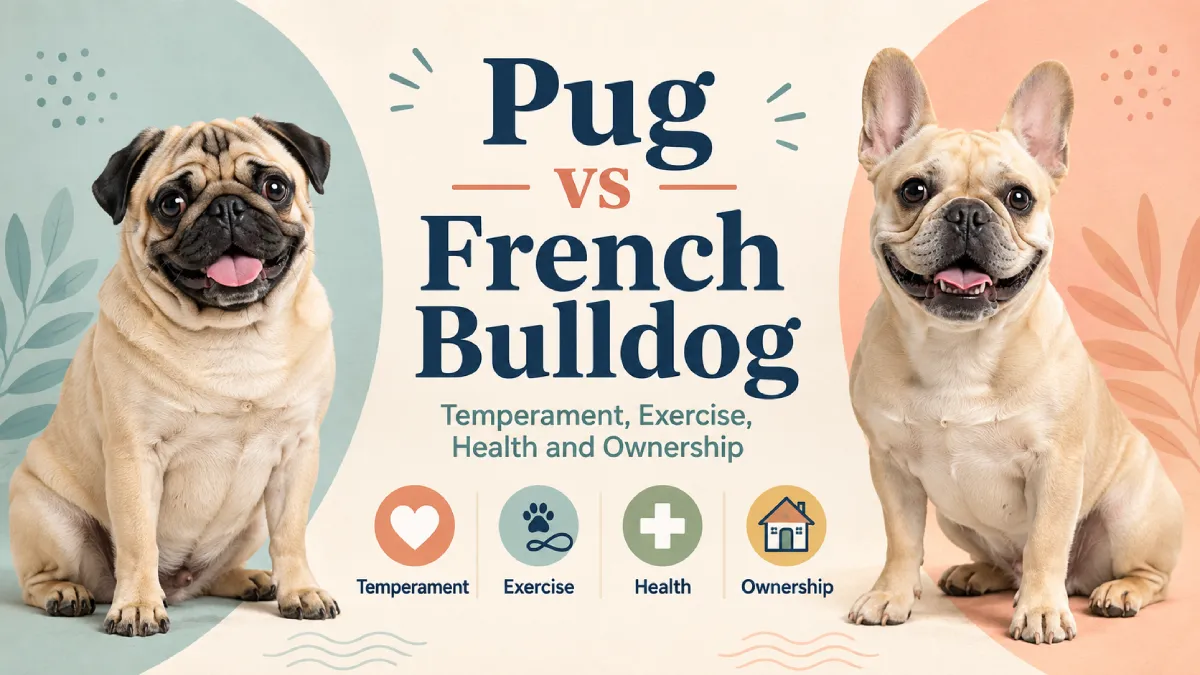
Pug vs French Bulldog: Temperament, Exercise, Health and Ownership
Choosing between a Pug vs French Bulldog means comparing two compact companion breeds that share flat-faced anatomy but differ in body build, coat shedding and some health-screening priorities. Pugs are smaller and more lightly built, with a curled tail and prominent round eyes. French Bulldogs are generally heavier and more muscular, with distinctive upright bat ears. Both are affectionate household companions and can adapt well to smaller homes.
The most important similarity, however, is medical rather than cosmetic: both are brachycephalic. Difficult or noisy breathing should never be dismissed as harmless simply because it is common in short-faced dogs.
Quick Verdict
A Pug may suit you if you want the smaller, highly companion-oriented option and can accept relatively noticeable shedding. A French Bulldog may suit you if you prefer a heavier, muscular small dog with a somewhat lower-maintenance coat. Both require careful heat management, weight control and attention to breathing and eye health. Neither should be chosen on the assumption that respiratory noise is “normal for the breed.”
Breed Comparison Table
| Trait | Pug | French Bulldog |
|---|---|---|
| Breed group | Toy | Non-Sporting |
| Official weight reference | 14–18 lb desirable | Under 28 lb |
| Build | Compact, square, sturdy | Compact, muscular, heavy-boned |
| Ears | Small button or rose ears | Large upright bat ears |
| Tail | Tightly curled | Naturally short |
| Coat | Short and smooth | Short and smooth |
| Shedding | Noticeable; AKC says Pugs shed a good amount | Sheds, but coat care is generally straightforward |
| Grooming | Weekly brushing plus fold/eye checks | Weekly brushing plus fold checks |
| Temperament | Affectionate, outgoing, adaptable | Affectionate, playful, adaptable |
| Exercise | Moderate | Moderate, generally short walks/play |
| Heat tolerance | Poor in hot/humid conditions | Poor in hot/humid conditions |
| BOAS risk | Yes | Yes |
| Eye concerns | Particularly relevant | Particularly relevant |
| Apartment potential | Strong | Strong |
| First-time owner | Possible with realistic health-care expectations | Possible with realistic health-care expectations |
The Pug Dog Club of America standard gives a desirable weight of 14–18 pounds. AKC lists French Bulldogs at 11–13 inches and under 28 pounds.
Appearance
The two breeds are easy to distinguish once you know what to look for.
A Pug has:
- a round, large head
- prominent dark eyes
- small folded ears
- deep facial wrinkles
- a compact square body
- a tightly curled tail
The PDCA standard describes the ideal Pug as square and compact, with a large round head and prominent eyes.
The French Bulldog has:
- large upright bat ears
- a broad square head
- heavy wrinkles over the nose
- an extremely short muzzle
- a muscular compact body
- a naturally short tail
AKC describes the Frenchie as compact and muscular, with its bat ears and large square head among its defining features.
Pug vs French Bulldog Size
The Pug is generally the smaller of the two.
The Pug standard gives a desirable adult weight of 14–18 pounds, while French Bulldogs may weigh up to—but not including more than—28 pounds under the AKC standard.
Body structure also changes how the size difference feels in everyday life.
French Bulldogs carry more muscle and bone, producing a heavier, broader dog. A 25-pound Frenchie can therefore feel substantially more solid to lift or handle than a 16-pound Pug.
For owners considering stairs, lifting into a car or physical handling, actual adult weight matters more than simply calling both breeds “small dogs.”
Coat
Both breeds have short coats, so neither needs routine clipping.
Pugs have short, smooth coats in the standard colours of fawn or black. French Bulldogs also have short, smooth coats, with a broader variety of recognized colours and markings.
Short coat does not mean zero maintenance.
Routine care still includes:
- brushing
- bathing when needed
- nail trimming
- ear checks
- skin inspection
- facial-fold care where required
Shedding
If household hair matters strongly, this is a useful difference.
AKC specifically notes that Pugs shed a good amount despite their short coats and recommends weekly brushing.
French Bulldogs also shed, but their basic coat care is generally straightforward and weekly brushing is typically sufficient for routine maintenance.
This makes the Pug the more obvious shedding consideration of the two, although individual variation still exists.
Neither is a non-shedding breed.
Grooming
Basic coat grooming is relatively easy for both.
Pug Grooming
Expect:
- weekly brushing
- occasional baths
- nail trimming
- eye monitoring
- facial-wrinkle checks
AKC recommends weekly brushing and routine nail care for Pugs.
French Bulldog Grooming
Expect:
- weekly brushing
- nail care
- ear checks
- facial-fold monitoring
- keeping deep folds clean and dry where necessary
AKC specifically advises keeping French Bulldog wrinkles and folds dry and cleaning them regularly.
For a complete schedule covering brushing, bathing, nails and ears, link naturally to Pawnium’s Dog Grooming Schedule.
Facial Wrinkles
Both breeds have facial wrinkles, but fold depth differs between individuals.
The Pug standard describes large, deep wrinkles on the head, while the French Bulldog has heavy wrinkles above its very short nose.
Deep facial folds can trap moisture and create conditions that favour irritation or infection. RVC notes that brachycephalic facial folds can contribute to chronic skin problems and may require ongoing home care.
Check folds for:
- redness
- moisture
- odour
- discharge
- soreness
Do not aggressively clean normal skin or apply medicated products without veterinary direction.
Temperament and Personality
Both breeds were developed primarily for companionship, so there is considerable overlap.
Pugs are described by AKC as affectionate, outgoing, playful and highly adaptable. They generally want substantial interaction with their people.
French Bulldogs are playful, affectionate, social and adaptable. AKC also describes them as people-oriented dogs that can fit singles, couples or family homes.
A useful practical distinction is that the Pug has an especially long history as a dedicated lap and companion breed, while the Frenchie combines close companionship with a slightly more substantial, muscular physical presence.
Individual temperament still matters. Breed tendencies cannot tell you exactly how sociable, confident or independent one puppy will become.
Energy Level
Neither breed should be selected for endurance sports.
Pugs typically fit a moderate-activity lifestyle. AKC describes moderate exercise as suitable and emphasizes their adaptability as household companions.
French Bulldogs likewise do not require large amounts of sustained outdoor exercise. AKC states that short walks or outdoor play can meet the needs of many healthy Frenchies.
That does not mean either dog should spend its life inactive.
Regular movement helps support:
- body condition
- muscle
- mobility
- enrichment
The intensity simply needs to remain appropriate for the individual dog’s breathing and heat tolerance.
Exercise
There is no universal number of minutes that every Pug or French Bulldog should exercise.
For a healthy individual, suitable activities may include:
- comfortable walks
- indoor play
- short training sessions
- sniffing
- gentle retrieving
- controlled exploration
The important limitation is respiratory comfort.
AKC cautions that Pugs do poorly in hot, humid weather and that strenuous activity should be avoided under those conditions. French Bulldog guidance likewise warns against exertion in hot or humid weather because flat-faced anatomy can compromise breathing.
If a dog becomes markedly noisy, distressed or slow to recover after mild activity, that is not a reason to “improve fitness” by pushing harder.
Link the detailed safety framework to Pawnium’s Brachycephalic Dog Care pillar.
Training
Both breeds can learn well using reward-based methods.
Pugs were bred closely around human companionship and AKC describes them as eager to please, although they can be sensitive. Positive training works well for this reason.
French Bulldogs are intelligent and can sometimes appear independent, but they are also people-oriented and often respond well when training is made rewarding.
Useful early skills for both include:
- recall
- toilet training
- leash walking
- handling
- calm greetings
- settling
- leave it
- drop it
- comfortable short periods alone
Food rewards can be useful, but they should be counted within the dog’s total daily calorie intake because weight management is especially important in brachycephalic dogs.
Barking
Neither breed is usually selected as a highly vocal watchdog.
AKC describes French Bulldogs as dogs that generally do not bark excessively, although they remain alert to activity around the home.
Pug vocalisation varies more by individual and situation, but their companion-oriented temperament makes constant guarding behaviour less central to the breed’s purpose.
For apartment living, actual behaviour matters more than a breed average.
Repeated barking can arise from:
- hallway noises
- visitors
- excitement
- frustration
- boredom
- distress when left
Address the trigger rather than assuming barking is unavoidable.
Heat
Heat is a major ownership issue for both breeds.
Brachycephalic dogs rely on an upper airway that can already be narrowed by their anatomy. Cambridge explains that when BOAS obstructs airflow, dogs cannot dissipate heat as effectively during exercise and can be more vulnerable to heat-related illness.
Pug-specific AKC guidance says they do poorly in hot, humid weather. French Bulldog guidance gives similar warnings and advises against exertion in warm, humid conditions.
Do not publish one universal safe temperature.
Risk changes with:
- humidity
- direct sun
- activity intensity
- body condition
- airway function
- age
- fitness
A walk that is comfortable on a cool morning may be inappropriate under hotter afternoon conditions.
Breathing
This is the most important shared health consideration.
Both Pugs and French Bulldogs are brachycephalic and can develop brachycephalic obstructive airway syndrome (BOAS).
Cambridge states that dogs with a normal upper airway breathe quietly. Snoring, snorting and other respiratory noises can indicate obstruction.
Therefore, do not dismiss the following as simply “normal for a Pug” or “normal for a Frenchie”:
- loud breathing while awake
- marked snorting after mild activity
- obvious abdominal effort while breathing
- poor exercise tolerance
- prolonged recovery
- sleep-related breathing difficulty
- repeated gagging
- heat intolerance
More severe signs can include cyanosis—blue or grey discolouration of the tongue or gums—and collapse. Those signs require urgent veterinary attention.
The Pug Dog Club of America explicitly notes that not every Pug is affected by BOAS, while Cambridge’s functional grading likewise recognizes clinically unaffected and affected individuals.
So the correct comparison is not:
“Which breed has breathing problems?”
Both can.
The more useful question is:
“How well does this particular dog—and its parents—actually breathe?”
Use Pawnium’s Brachycephalic Dog Care for general management and French Bulldog Breathing Care for Frenchie-specific exercise and breathing decisions.
Eyes
Eye health deserves serious attention in both breeds.
Pugs have particularly large, prominent eyes, and AKC specifically notes susceptibility to problems including corneal ulcers and dry eye.
Brachycephalic skull anatomy can also leave the eye relatively exposed. RVC explains that short-faced breeds including Pugs and French Bulldogs are particularly susceptible to corneal injury and ulceration because of shallow eye sockets and greater exposure of the ocular surface.
Prompt veterinary assessment is appropriate for:
- squinting
- holding the eye closed
- sudden redness
- cloudiness
- excessive tearing
- rubbing
- obvious injury
Do not casually watch a painful-looking eye for several days.
Weight Management
Weight control is important for both breeds, but the Pug deserves particular attention because of its strong food motivation.
AKC warns that Pugs can overeat and gain excess weight.
French Bulldog guidance likewise stresses monitoring calorie intake because excess body weight can worsen health problems and strain the dog’s physical structure.
Use:
- measured meals
- counted training treats
- regular body-condition checks
- adjustments when activity changes
Do not decide that a Pug should look round simply because the breed is compact.
Likewise, do not confuse a Frenchie’s naturally muscular build with excess body fat.
For detailed calorie and portion planning, link to Pawnium’s Dog Feeding Guide.
Children
Both breeds can fit family homes.
AKC describes Pugs as good companions for children and generally sociable family dogs when appropriately socialized.
French Bulldogs are also described as affectionate family companions that can do well with children.
Still, supervision matters.
Teach children not to:
- climb on the dog
- squeeze it
- disturb sleep
- take food
- repeatedly pick it up
- interfere when it seeks space
A tolerant breed reputation is not permission for rough handling.
Other Dogs
Both breeds can potentially be sociable with other dogs.
AKC notes that Pugs often enjoy the company of other dogs when appropriately socialized. French Bulldogs also commonly live successfully with other dogs.
That remains a probability rather than a guarantee.
Good introductions should consider:
- age
- play style
- body size
- previous social experience
- resource guarding
- the temperament of the other dog
Cats
Neither breed has an authoritative “always good with cats” guarantee.
Both are primarily companion breeds rather than high-drive hunting dogs, which may make peaceful coexistence realistic in many homes. However, individual temperament and experience still matter. That is an inference from their breed roles and social profiles, not a guarantee for one dog.
For introductions:
- initially use barriers
- give the cat escape areas
- reward calm dog behaviour
- prevent repeated chasing
- supervise until behaviour is predictable
Apartment Suitability
Both breeds are strong candidates for apartment living.
Pugs are highly adaptable companion dogs that can live successfully in a range of home environments.
French Bulldogs are particularly well known for city and apartment living because of their compact size, adaptability and relatively moderate exercise requirements.
Apartment suitability still depends on:
- indoor temperature control
- barking
- toileting access
- training
- ability to settle
- breathing comfort
- suitable daily exercise
In a hot climate, reliable cooling can be more important to a brachycephalic dog than having extra floor space.
Use Pawnium’s Apartment-Dog Article for broader breed comparisons.
First-Time Owners
Either breed can work for a first-time owner who understands the medical responsibilities.
Potential advantages include:
- small physical size
- affectionate temperament
- manageable exercise requirements
- relatively simple coat grooming
- adaptability
The main challenge is that “easy companion dog” should not be confused with “low veterinary-care risk.”
A first-time owner should understand:
- BOAS
- heat safety
- eye monitoring
- weight control
- fold care
- breeder health screening
French Bulldog owners should also be prepared for a heavier dog and a breed with several important orthopedic and conformational health considerations reflected in its screening recommendations.
Health Screening
Responsible selection should go beyond a breeder saying that the parents are “vet checked.”
Pug Parent-Club Screening
The Pug Dog Club of America’s current CHIC requirements list:
- PDE/NME genetic-marker testing
- eye examination
- patella evaluation
PDCA also lists several optional assessments, including hips, elbows, pyruvate kinase deficiency, spine/tracheal assessment and cardiac evaluation.
The club also specifically discusses BOAS as an important Pug health issue and emphasizes that individual respiratory compromise varies.
French Bulldog Parent-Club Screening
The French Bull Dog Club of America’s current CHIC requirements include:
- hip evaluation
- CAER eye examination
- patella evaluation
- cardiac evaluation
Its additional recommended tests include:
- tracheal hypoplasia
- elbow evaluation
- juvenile hereditary cataract testing
- respiratory function grading
- cystinuria Type 3 testing
Health screening does not guarantee a disease-free puppy, but it provides far more useful information than appearance alone.
Which Breed Is Healthier?
There is no responsible one-word answer.
Both breeds are brachycephalic and share clinically important risks involving airway function and eye exposure. Their other health priorities differ, as shown by their parent clubs’ screening programs.
A better comparison looks at:
- actual breathing of parents and puppy
- nostril openness
- body condition
- eye health
- mobility
- skin health
- health-test results
- family health history
Do not choose a Pug assuming it avoids French Bulldog health issues, or a French Bulldog assuming respiratory disease is simply an unavoidable breed quirk.
Cost Considerations
Avoid universal ownership-cost numbers.
Actual expenses vary by:
- country and city
- insurance
- food
- veterinary pricing
- preventive care
- individual health
- breeder or adoption source
Routine coat grooming is relatively simple for both, so professional coat clipping is not usually a major recurring requirement.
The larger financial uncertainty is veterinary care.
Potential costs may involve evaluation or treatment of:
- airway problems
- eyes
- skin folds
- orthopedic problems
- weight-related disease
- breed-specific conditions
French Bulldog screening encompasses hips, heart, eyes and patellas, while Pug screening emphasizes PDE/NME, eyes and patellas, illustrating that the two breeds do not have identical medical priorities.
Insurance availability, exclusions and pricing also vary too much to publish one universal number.
A Pug May Suit You If…
A Pug may be the more natural choice if:
- you prefer the smaller dog
- you want an intensely companion-oriented personality
- moderate activity fits your lifestyle
- you are comfortable with noticeable shedding
- you can maintain healthy body weight
- you are prepared to monitor prominent eyes
- you understand brachycephalic heat and breathing risks
- you will verify parent health testing
Do not choose one because you have been told snoring is harmless or inevitable.
A French Bulldog May Suit You If…
A French Bulldog may be the more natural choice if:
- you prefer a heavier, muscular small companion
- apartment living is important
- lower-intensity activity suits your routine
- you want a relatively straightforward short coat
- you can manage facial folds
- you understand breathing and heat limitations
- you are prepared for potentially significant veterinary needs
- you will verify hip, eye, patella and cardiac screening
The Frenchie’s adaptability should not be mistaken for freedom from medical limitations.
FAQs
Which is smaller, a Pug or French Bulldog?
The Pug is generally smaller. The Pug standard gives a desirable weight of 14–18 pounds, while French Bulldogs can weigh up to 28 pounds.
Which sheds more?
Pugs are the more obvious shedding concern. AKC specifically notes that Pugs shed a good amount despite having a short coat. Frenchies also shed, but routine coat maintenance is generally straightforward.
Which needs more exercise?
Both generally fit moderate exercise routines, and neither should be pushed through strenuous heat exposure. Individual airway function matters more than a small difference in breed-level activity expectations.
Do both Pugs and French Bulldogs have breathing problems?
Both breeds are at risk of BOAS, but not every individual is equally affected. Noisy breathing can indicate airway obstruction and should not automatically be considered normal.
Which is better for an apartment?
Both can work very well in apartments when temperature, exercise, toileting and behaviour are managed. French Bulldogs are particularly associated with city living, while Pugs are highly adaptable household companions.
Is a Pug healthier than a French Bulldog?
That cannot be stated reliably as a universal rule. Both are brachycephalic and have important airway and eye risks, while their parent-club health-testing priorities differ. Assess the actual dog’s conformation, breathing and family health information rather than relying on a simple breed ranking.