American Staffordshire Terrier vs Pit Bull: Differences Explained
Comparing an American Staffordshire Terrier vs Pit Bull is unusually complicated because “Pit Bull” does not have one universally accepted meaning. The American Staffordshire Terrier, or AmStaff, is a specific AKC-recognised breed. The American Pit Bull Terrier, or APBT, is a specific breed recognised by the United Kennel Club. In everyday speech, shelters, legislation and insurance policies, however, “pit bull” may be used more broadly for several bull-type dogs or dogs with a particular appearance. Understanding that terminology is essential before comparing size, temperament or care.
Quick Answer
If by Pit Bull you mean the American Pit Bull Terrier, the AmStaff and APBT share historical ancestry but are now defined differently by major registries and should not simply be treated as interchangeable names. If you mean “pit bull” as a general label, the comparison becomes less precise because that label can include several breeds and mixes. Individual temperament, breeding, training and socialisation matter far more than assumptions based on a broad visual label.
Important Terminology Clarification
There are three terms that should not be collapsed into one:
American Staffordshire Terrier is a defined breed recognised by the American Kennel Club. The AKC accepted the breed in 1936 under the name Staffordshire Terrier and changed the name to American Staffordshire Terrier in 1972.
American Pit Bull Terrier is a defined breed recognised by the United Kennel Club. The UKC traces its APBT registry to 1898, when the organisation’s first registered dog was an American Pit Bull Terrier.
Pit bull can also be a general descriptive or legal term rather than the name of one defined breed. The National Association of Insurance Commissioners notes that “pit bull” is not itself a recognised breed and can function as a general label based partly on physical characteristics. Definitions in laws and policies can vary.
This distinction is the foundation for the rest of the comparison.
What “Pit Bull” Can Mean
Someone using the phrase “pit bull” may be talking about an American Pit Bull Terrier specifically. Another person may mean an American Staffordshire Terrier, Staffordshire Bull Terrier, a mixed-breed dog or simply a dog judged visually to have bull-type features.
That inconsistency matters. Breed-specific legislation may define “pit bull” differently from a kennel club, and shelters or members of the public may apply the term based largely on appearance. NAIC also highlights the difficulty of visual breed identification and the resulting risk of misclassification.
The ASPCA similarly treats “pit bull” as a broad category in much of its policy material and stresses substantial behavioural variation among dogs placed under the label.
So when someone asks:
“What is the difference between an AmStaff and a Pit Bull?”
the first useful response is:
“Do you mean an American Pit Bull Terrier specifically, or the broader pit-bull-type label?”
Terminology Comparison
| Name | Organisation Recognition | General Usage | Common Confusion | Important Caveat |
|---|---|---|---|---|
| American Staffordshire Terrier | AKC-recognised breed | Usually shortened to AmStaff | Often called a pit bull | A defined AKC pedigree breed |
| American Pit Bull Terrier | UKC-recognised breed | Often shortened to APBT or Pit Bull | Sometimes treated as identical to AmStaff | A defined UKC breed with its own standard |
| Pit bull | Not one universally defined breed | Umbrella, visual, shelter or legal label | Assumed to mean APBT every time | Meaning depends on context |
| Staffordshire Terrier | Historical AKC name for the AmStaff | Mostly historical today | Can be confused with Staffordshire Bull Terrier | AKC changed the American breed’s name in 1972 |
| Pit-bull-type dog | Descriptive rather than one registry breed | Laws, shelters and general discussion | May imply a confirmed pedigree | Appearance alone cannot establish registry identity |
The important takeaway is that registry identity and visual identification are not the same thing.
American Staffordshire Terrier
The American Staffordshire Terrier is a muscular, medium-sized bull-type terrier recognised by the AKC. Its standard calls for notable strength for its size while remaining agile rather than cumbersome. The head is broad with well-developed cheek muscles, and the coat is short, close and glossy.
AKC currently lists males at about 18–19 inches and 55–70 pounds, with females around 17–18 inches and 40–55 pounds. The published lifespan range is 12–16 years.
Modern breed guidance describes responsible AmStaffs as intelligent, confident and people-oriented, while also emphasising socialisation, training and responsible management around other dogs.
American Pit Bull Terrier
The American Pit Bull Terrier is recognised by the UKC rather than the AKC.
The UKC standard describes a medium-sized, solidly built, short-coated dog with clearly defined musculature. Athletic ability and overall balance are important; the standard specifically avoids rewarding an excessively bulky or muscle-bound appearance.
UKC’s guideline ranges are:
- males: about 18–21 inches and 35–60 pounds
- females: about 17–20 inches and 30–50 pounds
The UKC makes clear that proportion and functional balance matter more than treating those figures as rigid limits.
Its temperament standard describes confidence, enthusiasm and willingness to engage with people. Human-directed aggression is considered uncharacteristic and highly undesirable. The standard also acknowledges that dog-directed aggression can occur in some APBTs, which makes responsible socialisation and management important without implying that every individual behaves the same way.
Breed-Recognition Differences
This is where the history becomes complicated.
The AKC recognises the American Staffordshire Terrier, not the American Pit Bull Terrier. The UKC recognises the American Pit Bull Terrier.
Historically, however, the populations overlapped. AKC’s own breed-history material explains that dogs from the existing American pit-bull population formed the foundation of its Staffordshire Terrier registry when the breed entered AKC recognition in 1936. The studbook later closed and the AmStaff developed as an AKC pedigree population.
There is still some registry overlap. UKC allows applications for APBT single registration from dogs registered with certain other organisations, including AKC, but registration is subject to pedigree, photographs and UKC approval rather than being automatic.
Registry policies also differ from one organisation to another. The American Dog Breeders Association, for example, has stated that it considers the AmStaff a separate breed and no longer accepts new AmStaff × APBT matings into its APBT stud book.
That is why saying “they are exactly the same breed” is too simplistic.
Breed-History Overview
Both breeds trace their ancestry to nineteenth-century bull-and-terrier dogs produced from bulldog and terrier types. Some of those dogs were historically used in blood sports, but their American history also included farm work, hunting, catching livestock and companionship.
In the United States, several names were historically used for related dogs, including Pit Bull Terrier, Pit Dog and American Bull Terrier. The UKC registered the APBT from its founding era, while the AKC eventually recognised part of the population as Staffordshire Terriers in 1936. The American breed received the name American Staffordshire Terrier in 1972.
Historical use should be explained accurately without treating it as a prediction of how a modern individual dog will behave.
Side-by-Side Comparison
| Trait | American Staffordshire Terrier | American Pit Bull Terrier |
|---|---|---|
| Recognition | AKC | UKC |
| Male height | 18–19 in preferred | 18–21 in guideline |
| Female height | 17–18 in preferred | 17–20 in guideline |
| Male weight | 55–70 lb AKC reference | 35–60 lb desired |
| Female weight | 40–55 lb AKC reference | 30–50 lb desired |
| Lifespan | 12–16 years | 10–14 years veterinary reference |
| Coat | Short, close, stiff/glossy | Short, smooth, close |
| Shedding | Moderate/light routine shedding | Short-coated routine shedding |
| Grooming | Low coat-maintenance | Low coat-maintenance |
| Exercise | Athletic; regular purposeful activity | Athletic; regular purposeful activity |
| Training | Early reward-based training important | Early reward-based training important |
| Barking | No useful breed-level winner | No useful breed-level winner |
| Apartment suitability | Conditional | Conditional |
| Children | Individual assessment and supervision | Individual assessment and supervision |
| Other dogs | Careful management may be needed | Careful management may be needed |
| First-time owner | Can be demanding because of strength and management | Can be demanding because of strength and management |
The APBT lifespan figure above comes from a veterinary-industry breed reference because lifespan is not specified in the UKC breed standard. Zoetis currently gives an approximate 10–14-year reference range; it should be understood as a general estimate rather than a registry requirement.
Size
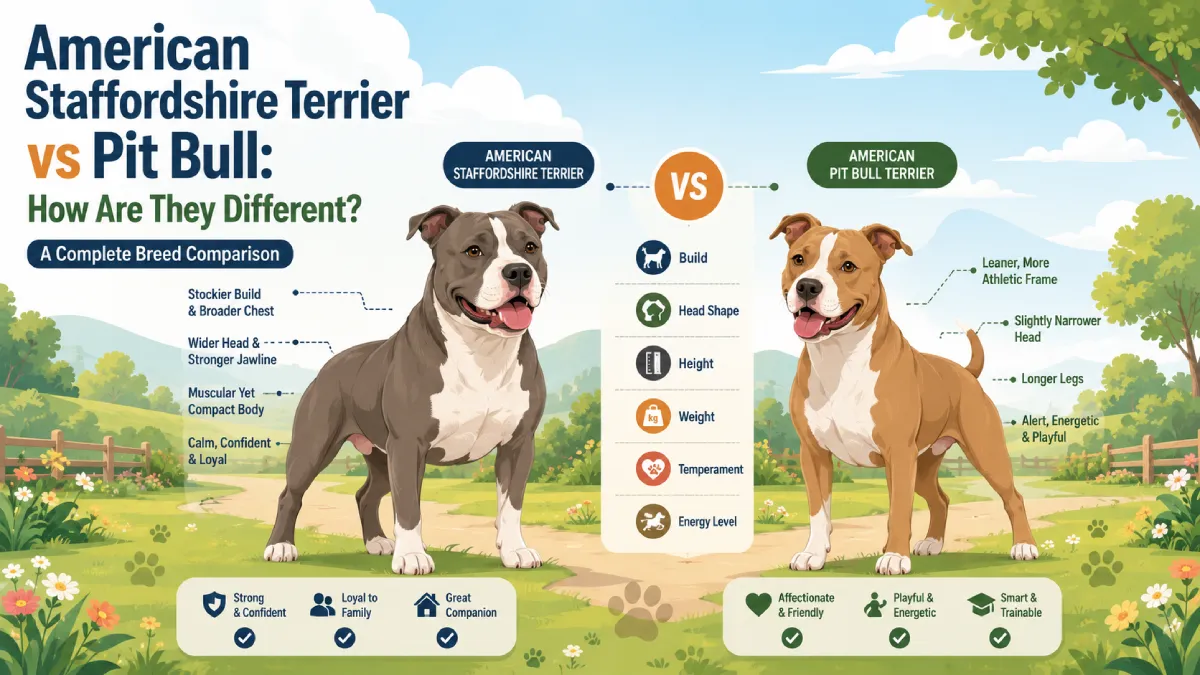
The AmStaff standard is somewhat more concentrated around a stockier, heavier presentation, while the UKC APBT standard allows a somewhat broader height range and emphasises athletic proportion.
That does not mean every AmStaff is heavier than every APBT. The ranges overlap, and individual dogs can differ.
A useful practical difference is that both are strong medium-sized dogs. Leash skills, doorway manners, cooperative veterinary handling and recall matter more to daily ownership than arguing over a few pounds.
Build
The AmStaff standard calls for significant strength relative to body size, a well-developed muscular build and a stockier outline while retaining agility and grace.
The UKC APBT standard also calls for a muscular dog, but places particularly strong emphasis on athletic function, balance and avoiding excessive bulk.
Photographs can exaggerate differences depending on conditioning, breeding lines and camera angle. Build alone should not be used to assign a dog to a registry breed.
Appearance
Both commonly have:
- short coats
- muscular bodies
- broad heads
- defined cheek musculature
- relatively deep chests
- athletic movement
This overlap is one reason visual identification can be unreliable. Public policy sources specifically warn that dogs labelled as pit bulls may be identified based on appearance rather than confirmed pedigree.
Colour is not a reliable way to separate the breeds either.
Head and Body Structure
The AmStaff standard describes a broad skull, pronounced cheek muscles, a medium-length muzzle and strong jaws, combined with a stocky but agile body.
The APBT standard describes a broad, flat skull and broad, deep muzzle while stressing that the head should remain proportionate to the body. Extreme, oversized heads or excessively massive construction are inconsistent with the UKC’s functional standard.
Neither standard supports the exaggerated anatomy sometimes associated with social-media “bully” imagery.
Coat
Both breeds have short, close coats and relatively simple coat maintenance.
The AmStaff standard specifies a short, close, stiff and glossy coat. The APBT standard describes a glossy, smooth, close coat of moderately stiff texture.
Neither requires clipping, deshedding appointments comparable to a heavy double-coated breed, or mat prevention.
Temperament
Breed labels can provide context, but they cannot predict the complete behaviour of one dog.
AKC describes the AmStaff as smart, confident and good-natured when responsibly bred and socialised. UKC describes the APBT as confident, enthusiastic and eager to please.
Neither source defines indiscriminate human aggression as desirable.
The ASPCA also stresses substantial behavioural variation among dogs commonly described as pit bulls. Genetics can influence behaviour, but development, socialisation, learning history and environment also matter.
This makes statements such as “pit bulls are automatically aggressive” or “all AmStaffs are safe with everyone” equally inappropriate.
Exercise
Both are athletic dogs that benefit from regular physical activity and interaction with their owners.
For an AmStaff, AKC recommends meaningful exercise rather than simply leaving the dog alone in a yard. Dog sports and active play can provide useful outlets.
The APBT’s UKC standard likewise describes an athletic, energetic working terrier rather than a sedentary dog.
Suitable activities can include:
- walks
- hiking
- retrieving
- structured tug
- scent searches
- obedience
- age-appropriate dog sports
There is no need to invent one universal daily minute target. Age, health, weather, conditioning and individual energy should determine the routine.
Training
Both dogs are physically strong enough that basic manners should be established early.
Useful priorities include:
- attention to the handler
- loose-leash walking
- recall
- leave it
- drop it
- settling
- polite greetings
- waiting at doors
- cooperative handling
- calm disengagement from distractions
The American Veterinary Society of Animal Behavior recommends reward-based methods for dog training and behaviour modification rather than aversive methods.
Good training is not about making a muscular dog more intimidating. It is about making everyday behaviour safer and more predictable.
Socialisation
Socialisation should help a puppy develop confidence and appropriate responses to ordinary life.
That can involve carefully planned positive exposure to:
- different people
- friendly dogs
- veterinary handling
- traffic
- surfaces
- visitors
- children
- household noises
- unfamiliar environments
AVSAB’s socialisation guidance emphasises appropriate early experiences rather than simply exposing a puppy to as many stimuli as possible.
For either breed, socialisation also does not guarantee that an adult will want to socialise closely with every unfamiliar dog.
Children
Neither breed should receive an automatic child-safe guarantee.
A well-adjusted individual may live very successfully with children, but both are muscular dogs capable of knocking over a small child during excited play. Individual temperament, previous experience and the behaviour of the children matter.
The safest household rules remain simple:
- supervise young children
- prevent climbing or grabbing
- give the dog a quiet resting area
- separate during high-excitement situations
- teach children to leave eating and sleeping dogs alone
The broader ASPCA position on pit-bull-type dogs supports evaluating individual behaviour rather than treating breed label alone as a behavioural prediction.
Other Dogs
This section deserves more nuance than either “they hate dogs” or “socialisation fixes everything.”
AKC notes that dog-directed aggression can develop in some AmStaffs even with socialisation. The UKC APBT standard similarly acknowledges that some degree of dog aggression may occur in the breed and stresses socialisation and obedience.
Neither statement means every dog of either breed will be aggressive toward other dogs.
It means owners should:
- assess the actual dog
- supervise interactions
- avoid forcing greetings
- learn body language
- interrupt escalating play early
- use secure management when compatibility is uncertain
Dog-directed behaviour also should not be automatically equated with behaviour toward people.
Other Animals
Compatibility with cats and smaller animals should also be assessed individually.
Shared terrier ancestry is relevant historical context, but it is not enough to predict whether one particular dog will chase a cat or live peacefully with one. The dog’s previous experience, arousal, training and actual observed behaviour matter more than relying on the broad pit-bull label.
Use gradual introductions and physical separation when supervision is not possible until compatibility is well understood.
Grooming
Coat care is one of the easier parts of owning either breed.
The short coat generally needs routine brushing, occasional bathing, nail trimming, ear checks and dental care. AKC describes AmStaff coat maintenance as straightforward, with weekly brushing typically sufficient for loose hair.
The APBT’s similarly short, smooth coat does not require professional clipping.
Detailed nail, bathing and dental schedules should remain on Pawnium’s dedicated grooming content rather than being duplicated here.
Feeding
There is no evidence-based reason to use a special “pit bull diet” purely because of the label.
AAHA recommends evaluating nutrition according to life stage, body weight, body condition, muscle condition, activity and health status.
For either breed:
- choose a complete and balanced diet appropriate to life stage
- measure meals
- account for training treats
- monitor body condition
- adjust intake as activity changes
Do not deliberately overfeed a dog to create a heavier or more muscular appearance.
Health
The health-testing picture differs because the breeds are represented by different kennel-club systems.
American Staffordshire Terrier
AKC’s current parent-club summary lists:
- hip evaluation
- cardiac examination
- thyroid evaluation
- NCL4A DNA testing
The Staffordshire Terrier Club of America’s own health material additionally recommends testing for ALPP and identifies eye and elbow evaluations as useful optional screening.
These should be verified through actual records rather than accepting “health tested” as sufficient.
American Pit Bull Terrier
I could not verify a UKC health-testing protocol equivalent to the AKC parent-club list above, so one should not be invented.
OFA does offer breed-relevant genetic testing resources, including NCL-4A and polyneuropathy/laryngeal-paralysis testing associated with American Pit Bull Terrier populations, but availability of a test is not the same as a universal breeder recommendation.
For an APBT breeder, ask what orthopedic, cardiac, eye and DNA testing has been performed, why those tests were selected for the pedigree, and where the results can be independently verified.
Health screening reduces uncertainty; it does not guarantee a disease-free dog.
Breed-Specific Legislation Considerations
This is one of the most important practical reasons to clarify terminology.
Breed-specific legislation can regulate dogs using breed names, physical descriptions or broad pit-bull-type classifications. That means an AmStaff, APBT or even an unregistered mixed dog could potentially fall within a particular jurisdiction’s definition depending on the wording of the law.
Rules may involve:
- ownership restrictions
- registration
- leash or muzzle requirements
- housing conditions
- insurance
- import or relocation rules
The definitions and legal status vary geographically and can change. Do not rely on an old online list.
Check the actual current law for your city, state/province and country before acquiring or relocating with the dog.
Insurance and Housing Considerations
Insurance restrictions are similarly inconsistent.
NAIC reports that some homeowners and renters insurers use breed-related underwriting rules, while some states restrict insurers from making decisions solely on dog breed. The regulatory picture therefore varies by jurisdiction and insurer.
Before committing to either dog:
- check your lease
- confirm building or HOA rules
- ask the insurer directly
- obtain written confirmation where possible
- check local ordinances
- think about future relocation
Do this before paying a breeder, adoption organisation or housing deposit.
Apartment and First-Time-Owner Considerations
Either breed can potentially live in a smaller home if exercise, training and management are excellent. Physical space alone is not the deciding factor.
More important questions are:
- Can the dog settle indoors?
- Is daily exercise available?
- Can barking or excitement around shared hallways be managed?
- Are breed restrictions present?
- Can the owner physically control the dog?
- Can dog-to-dog interactions be managed in lifts and entrances?
For first-time owners, the main challenge is not grooming. It is combining physical strength, consistent training, socialisation and potentially careful dog-to-dog management.
A committed beginner with skilled support may succeed with a suitable individual, but neither should be chosen on the assumption that affection for people makes training optional.
Cost and Practical Commitment
Neither breed has unusually expensive professional coat grooming, but ownership costs can still be substantial.
Major cost drivers include:
- medium-sized-dog food quantities
- veterinary care
- health screening
- training classes
- durable leads and harnesses
- secure fencing
- pet deposits
- insurance
- local licensing or regulatory requirements
Exact annual figures would depend heavily on country, insurer and veterinary market, so one universal number would be misleading.
Responsible Ownership
Responsible ownership starts by treating the dog as an individual animal rather than a stereotype.
That means:
- selecting for stable temperament
- using reward-based training
- maintaining secure containment
- providing exercise and enrichment
- supervising interactions where needed
- understanding dog body language
- preventing uncontrolled roaming
- keeping identification current
- obtaining appropriate veterinary care
- checking legal and housing rules
- seeking qualified behavioural help early when concerns emerge
ASPCA policy emphasises responsible ownership and individual assessment rather than predicting behaviour from a broad pit-bull label alone.
Similarities
The AmStaff and APBT genuinely have a great deal in common.
Both share:
- intertwined bull-and-terrier ancestry
- short coats
- muscular medium-sized bodies
- athletic ability
- strong human working/companion histories
- substantial physical strength
- need for training and socialisation
- overlapping appearance
Their histories are sufficiently connected that registry overlap has existed, which explains why even experienced dog owners sometimes use the names interchangeably.
Major Differences
The most defensible differences are not sensational temperament claims. They are registry definition, breeding population and breed-standard emphasis.
The AmStaff:
- is recognised by AKC
- has an AKC pedigree population established from the historical shared ancestry
- has a relatively concentrated standard size
- is described as muscular and stocky while remaining agile
- has a defined AKC/STCA health-testing framework
The APBT:
- is recognised by UKC
- has its own UKC pedigree and breed standard
- has a somewhat broader height guideline
- places very strong emphasis on athletic functionality and avoiding excessive bulk
- does not have an AKC parent-club health protocol because AKC does not recognise the breed
Those differences are much more reliable than claiming one breed is universally friendlier, tougher, calmer or more aggressive.
Which Should You Choose?
Choose an American Staffordshire Terrier If…
An AmStaff may make more sense if:
- you specifically want an AKC-recognised American Staffordshire Terrier
- you want breeder health screening tied to the current AKC/STCA framework
- its somewhat stockier breed standard appeals to you
- you are comfortable with a strong, athletic dog needing training and exercise
- you understand that dog-to-dog compatibility must still be assessed individually
- your housing and local regulations allow the breed
Choose an American Pit Bull Terrier If…
An APBT may make more sense if:
- you specifically want a UKC-recognised American Pit Bull Terrier, rather than a generic “pit bull”
- you value the UKC standard’s emphasis on athletic, functional structure
- you can verify the breeder’s pedigree and health-testing decisions
- regular training and exercise fit your lifestyle
- you are prepared to manage dog-to-dog relationships according to the individual
- you have confirmed local housing, insurance and legal rules
Neither is automatically the “better” dog.
The breeder, pedigree, individual temperament, socialisation, health, household and owner’s ability to manage the dog responsibly can matter more than relatively small differences between the written breed standards.
FAQs
Is an American Staffordshire Terrier the same as a Pit Bull?
It depends on what “pit bull” means in the conversation. An AmStaff is a specific AKC-recognised breed, while “pit bull” can be a broad informal or legal label. If you specifically mean American Pit Bull Terrier, the AmStaff and APBT share ancestry but are currently defined as separate registry populations.
Is the American Pit Bull Terrier a real recognised breed?
Yes. The United Kennel Club recognises the American Pit Bull Terrier as a specific breed. The AKC does not recognise APBT under that name; it recognises the American Staffordshire Terrier instead.
Can an AmStaff also be registered as an APBT?
Registry overlap can occur, but it is not automatic. UKC allows certain dogs registered with approved organisations, including AKC, to apply for APBT single registration, subject to documentation and UKC approval. Other registries may apply different rules.
Which is bigger, an AmStaff or APBT?
There is substantial overlap. AKC gives AmStaff males a reference range of 55–70 pounds and females 40–55 pounds. UKC’s desired APBT ranges are 35–60 pounds for males and 30–50 pounds for females, although APBTs can stand slightly taller within their standard. Individual dogs can fall outside the expected comparison.
Are pit bulls naturally aggressive?
A broad breed label cannot reliably predict one dog’s behaviour. UKC explicitly considers human aggression uncharacteristic of the APBT, while ASPCA stresses substantial behavioural variation within dogs labelled as pit bulls. Genetics, socialisation, learning and environment all contribute.
Can AmStaffs and APBTs live with other dogs?
Some can, but compatibility should never be guaranteed. Both AKC AmStaff guidance and the UKC APBT standard acknowledge that dog-directed aggression can occur in some individuals. Careful introductions, supervision and management should follow the behaviour of the actual dogs involved.