
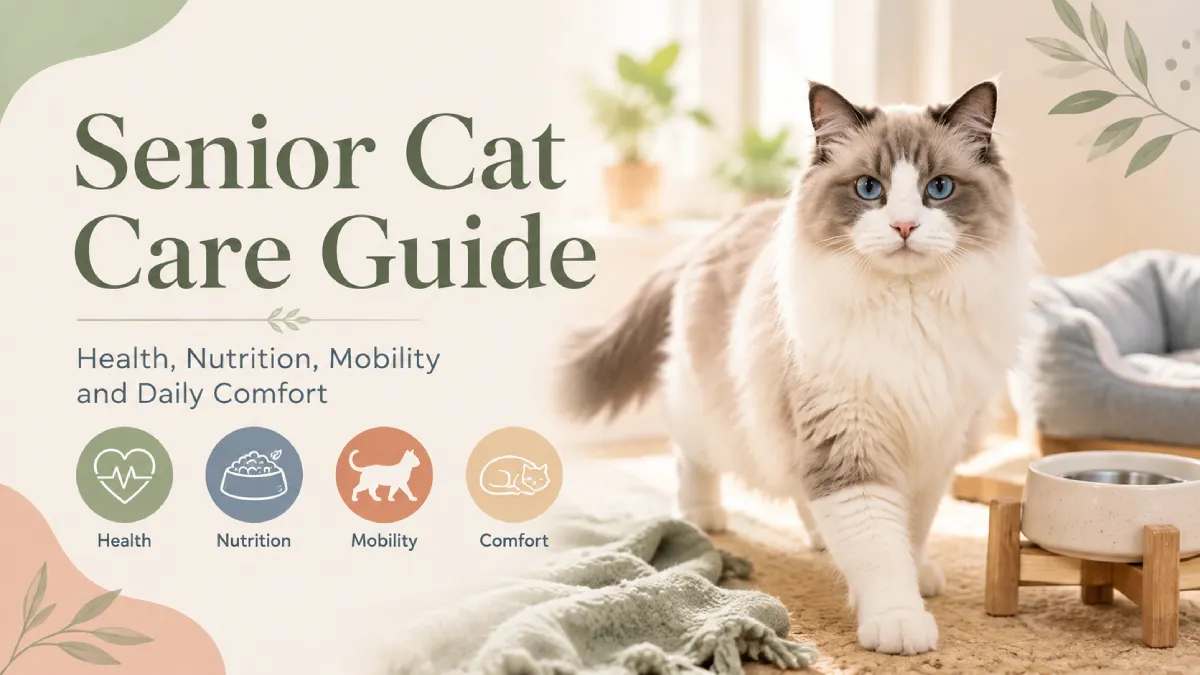
Senior Cat Care Guide: Health, Mobility & Comfort
Older cats often benefit from closer monitoring because small changes in weight, muscle, movement, grooming, appetite or daily routines can provide useful clues about emerging health problems. Senior cat care is therefore less about treating age itself and more about preserving comfort, independence and quality of life while investigating changes that may reflect pain or disease.
The 2021 AAHA/AAFP feline life-stage framework classifies cats over 10 years as senior, while also stressing that age categories are practical healthcare guides rather than biological switches. A healthy 11-year-old may remain active and robust, while another cat of the same age may already need substantial medical or environmental support.
Quick Answer
Caring for a senior cat means monitoring trends in weight, body and muscle condition, appetite, drinking, urination, stool, mobility, grooming, sleep and behaviour; keeping resources easy to reach; supporting comfortable movement and rest; and arranging veterinary assessment when something changes. Ageing itself is not a disease, so new or progressive changes should not automatically be dismissed as “old age.”
What Counts as a Senior Cat?
The current AAHA/AAFP feline life-stage system places cats over 10 years in the senior stage. This classification helps veterinarians and caregivers focus more closely on early disease detection, pain, mobility, nutrition, cognition and environmental accessibility.
It should not be interpreted as a sharp biological threshold. The same guidelines note substantial variation among individuals, which is why an older cat’s current health, function and behaviour matter more than the birthday alone.
For a fuller explanation of the life stages, see When Is a Cat Considered Senior?.
Why Ageing Varies Between Cats
Genetics, previous illness, body condition, dental health, activity, indoor or outdoor lifestyle, nutrition and chronic disease all influence how an individual cat ages. Two cats of the same chronological age can therefore have very different care needs.
Use your cat’s own baseline as the comparison. A gradual change still deserves attention if it affects comfort or function, while a sudden change is particularly important to investigate.
Ageing Is Not Itself a Disease
Cornell’s senior-cat guidance specifically warns owners not to assume that physical or behavioural changes are simply unavoidable consequences of old age. Reduced jumping, hiding, poor grooming, weight loss, house-soiling or nighttime behaviour can occur with treatable or manageable medical conditions.
A useful rule is: notice the change, record it, and ask what might explain it. Do not diagnose from one observation, but do not ignore it because the cat is older.
See Signs Your Cat Is Ageing: Normal Changes vs Signs of Illness for a structured comparison.
Veterinary Monitoring Becomes More Important
Senior appointments focus heavily on early disease detection. AAHA/AAFP recommends attention to weight, body condition, muscle condition, oral health, thyroid and kidney findings, mobility, pain, vision, behaviour and other changes in the medical history.
Your veterinarian may recommend examinations or screening more frequently than for a younger healthy adult, but the exact schedule and test panel should be individualized. Age, previous findings, medication, lifestyle and existing disease all affect the plan.
Prepare for appointments with the Senior Cat Vet Visit Checklist.
Track Body Weight, Not Just Appearance
Weight trend is one of the most useful things an owner can follow. An older cat can lose weight gradually enough that the change is difficult to notice visually, especially under a long coat.
Use the same reliable scale when possible and record the trend rather than reacting to one isolated measurement. Unexplained weight loss deserves veterinary assessment rather than an automatic increase in food.
Body Condition and Muscle Condition Are Different
Body Condition
Body condition scoring assesses fat stores. A cat may be under ideal, ideal or over ideal even when body weight has changed only slightly.
Muscle Condition
Muscle condition is assessed separately because a cat can lose muscle while still carrying excess body fat. WSAVA recommends evaluating muscle over areas such as the spine, shoulders, skull and pelvis. Senior monitoring is stronger when weight, body condition and muscle condition are considered together.
Appetite Changes Need Context
Record whether your cat is eating the usual amount, eating more, eating less, taking longer to eat or avoiding certain textures. Dental pain, gastrointestinal disease, kidney disease, hyperthyroidism and many other conditions can affect appetite in different ways.
A sudden reduction in intake or a persistent change deserves veterinary advice. Do not assume a senior cat is simply becoming “picky.”
Watch Water Intake
A noticeable increase in drinking can occur with several medical conditions common in older cats, including kidney disease, diabetes and hyperthyroidism. Conversely, some cats may not take in enough water when access is difficult or bowls are poorly located.
Provide clean, easy-to-reach water in more than one location where useful. Do not restrict water to reduce urination.
Monitor Urination
Changes in urine volume, frequency, litter-box use or straining can be medically important. Increased urine production may be associated with systemic disease, while difficulty reaching a box can reflect arthritis or weakness.
Repeated straining with little or no urine is an emergency, particularly in male cats. Use Cat Health Check at Home to organise observations, but do not delay veterinary care for urgent urinary signs.
Do Not Ignore Stool Changes
Record persistent diarrhea, constipation, straining, unusually hard stool or a change in frequency. Mobility and pain can also affect how comfortably a cat positions in the litter box.
Older cats can have multiple conditions at once, so stool changes should be interpreted with appetite, hydration, weight, medication and activity rather than in isolation.
Mobility Is a Major Senior-Care Priority
Reduced mobility is easy to underestimate because cats often adapt quietly. Instead of obvious limping, an owner may notice a cat choosing lower surfaces, hesitating before a jump, taking stairs differently or sleeping somewhere easier to reach.
Any unexplained decline should be assessed before you design an exercise plan. The cause could involve arthritis, pain, weakness, neurological disease, vision changes or muscle loss.
Use Senior Cat Mobility for practical home support.
Notice Changes in Jumping
Ask whether the cat jumps as often, as high and as smoothly as before. A cat that stops using a favourite windowsill or begins pulling up with the front legs instead of jumping cleanly may be showing a functional change.
Short videos recorded at home can be useful for your veterinarian because many cats move differently in a clinic.
Stairs Can Reveal Subtle Problems
Some cats begin pausing on stairs, taking them one at a time, avoiding a particular direction or remaining on one floor. Do not force repeated stair climbing as a test.
Instead, make essential resources available without unnecessary stairs and discuss the change with your veterinarian.
Arthritis and Pain Are Commonly Missed
Feline osteoarthritis often appears as altered function rather than obvious lameness. Difficulty jumping, reduced play, litter-box problems, grooming changes, irritability and different resting locations can all be relevant.
See Arthritis in Cats: Signs of Joint Pain Owners Often Miss. Never give ibuprofen, acetaminophen/paracetamol, aspirin or another human pain medicine unless a veterinarian specifically directs its use.
Grooming Changes Can Be Functional Clues
An older cat may groom less effectively when bending or twisting becomes painful. The result can be a greasy coat, dandruff, matting or neglected areas over the back and hindquarters.
Overgrooming can also be associated with discomfort. Grooming changes should therefore prompt consideration of skin disease, pain, mobility and other medical causes rather than being dismissed as cosmetic ageing.
Check Nails More Often
Senior cats may use scratching surfaces less or have less effective claw wear. Nails can become thick, curved or overgrown and may catch on fabric or, in severe cases, grow toward the paw pad.
Check paws regularly and ask your veterinary team or groomer for help if trimming is difficult or your cat appears painful.
Dental Health Still Matters
Dental disease can cause significant pain and may affect appetite, grooming, handling tolerance and social behaviour. Bad breath, drooling, chewing on one side, dropping food or avoiding dry textures can be useful clues.
Do not assume dental problems are normal because the cat is old. Discuss oral examination and treatment options with your veterinarian.
Vision Changes Need Investigation
Aging can bring subtle ocular changes, but sudden or meaningful vision loss is not something to accept as normal. Hypertension and other diseases can threaten vision in older cats.
Watch for bumping into objects, hesitation in dim light, difficulty locating resources or new startle responses. Sudden blindness requires prompt veterinary attention.
Hearing May Decline
Some older cats become less responsive to familiar sounds. Before assuming deafness, remember that sleep depth, attention, ear disease and cognitive change can also alter responsiveness.
Use visual cues and approach a hearing-impaired cat in a way that avoids startling them.
Sleep Patterns Can Change
Senior cats may spend more time resting, but comparison with the individual baseline matters. New night waking, pacing, vocalisation or an abrupt increase in sleep can occur with pain, disease, sensory loss or cognitive dysfunction.
Track patterns using Senior Cat Sleep Changes.
Vocalisation Should Be Interpreted in Context
New or increased vocalisation can be associated with many causes, including pain, hearing loss, hyperthyroidism, hypertension, anxiety or cognitive change. It is not specific enough to diagnose from sound or timing alone.
Cognitive Changes Require a Rule-Out Process
Disorientation, altered interaction, sleep-wake changes, house-soiling, staring, wandering or new nighttime vocalisation can occur with feline cognitive dysfunction, but other medical and neurological conditions must be considered first.
Use Cognitive Dysfunction in Cats for a careful, non-diagnostic overview.
Make Litter Boxes Easier to Use
Senior cats may need lower entry, a larger floor area, stable footing and shorter travel distance to the box. Keep a toilet on every regularly used floor when stairs have become difficult.
Use Senior Cat Litter Box Setup for age-specific accessibility. General cleaning, box-number and house-soiling questions should remain on their dedicated Pawnium pages.
Feeding Should Be Individualized
There is no single senior diet that suits every older cat. AAHA notes that calorie and nutrient needs vary widely and that healthy senior cats should not automatically be protein restricted.
Monitor body weight, body condition, muscle condition, appetite, disease status and calorie density. See Senior Cat Feeding Guide for detailed nutrition planning.
Support Hydration Without Forcing It
Offer clean water in accessible locations and consider food moisture when appropriate for the individual cat. Some cats prefer wide bowls, moving water or water placed away from food and litter resources.
Disease-related thirst should be investigated rather than treated as a preference problem.
Keep the Home Comfortably Warm
Older cats with reduced mobility or low body condition may seek warmth more often. Provide warm, draft-free resting areas while making sure the cat can move away from heat whenever desired.
Avoid improvised heating equipment that can cause burns or overheating. Use products designed for pets according to their instructions.
Provide Supportive Bedding
Choose beds that are easy to enter and sufficiently padded without being so deep or unstable that the cat struggles to stand. Place beds in the social and observation areas the cat already values rather than isolating them simply because they are older.
Improve Traction With Non-Slip Flooring
Slick tile, laminate or hardwood can make weak or painful movement more difficult. Secure rugs, runners or non-slip mats can create stable routes between core resources.
Edges should lie flat so the modification does not create a new trip hazard.
Use Stable Ramps and Steps Where Helpful
Ramps or small intermediate steps can preserve access to a favourite sofa, bed or window. They should be stable, non-slip and appropriately angled for the cat.
Do not force a cat to use a ramp. Observe whether the modification actually improves access and adjust if the cat avoids it.
See Senior Cat Home Setup for a room-by-room accessibility plan.
Enrichment Still Matters
Older cats still need opportunities to explore, investigate, play and interact. Enrichment does not have to involve high jumps or intense exercise.
Low-impact options include slow wand play, easy food puzzles, scent exploration, accessible scratching surfaces, cardboard boxes, window observation and simple positive-reinforcement training.
Adapt Play to Ability
Keep play on the floor or at low height when mobility is limited. Short bursts may be more comfortable than prolonged activity.
Stop if the cat appears painful, becomes reluctant to move or suddenly loses interest in an activity they previously enjoyed. New play refusal can be clinically useful information.
Maintain Positive Social Interaction
Continue the interactions your cat enjoys, whether that is sitting nearby, grooming, lap time or short play sessions. Do not force contact because you believe an older cat “needs company.”
In multi-cat homes, make sure younger or more active cats are not blocking the senior cat’s access to people or resources.
Reduce Unnecessary Stress
Older cats may cope less easily with major environmental change. Preserve predictable routes, familiar resting areas and reliable access to resources whenever possible.
If a move or other major change is unavoidable, use a gradual settling plan and familiar scents rather than completely rearranging everything at once.
Medication Management Needs a System
Keep an up-to-date list of every prescription medication, supplement and topical product. Record dose instructions exactly as prescribed, administration times, refill needs and any changes in appetite, stool, behaviour or mobility after a new treatment.
Do not stop, double or add medication based on internet advice. Contact the prescribing veterinary team if administration becomes difficult or side effects are suspected.
Changes Owners Should Record
A short monthly record can reveal trends that are hard to remember accurately. Useful observations include:
- weight, body condition and muscle condition
- appetite and food amount
- water intake
- urination and stool
- vomiting
- jumping, stairs and general movement
- grooming and nails
- sleep and vocalisation
- social interaction
- medication changes
Signs That Deserve Veterinary Investigation
Arrange veterinary advice for a new or progressive change in weight, appetite, drinking, urination, stool, vomiting, mobility, grooming, behaviour, sleep, vision, hearing or litter-box use.
Seek urgent care for collapse, seizures, severe breathing difficulty, inability to urinate, major trauma, sudden blindness, severe weakness or another acute emergency.
Monitor Quality of Life as a Trend
Quality of life includes comfort, appetite, hydration, toileting, mobility, grooming, sleep, interaction and access to activities the cat values. One difficult day does not automatically define the overall picture.
Track good and difficult days and discuss changing goals with the veterinary team. Use Senior Cat Quality of Life Checklist for a structured journal. No online score should make an end-of-life decision automatically.
If you are planning to bring an older cat home, Adopting a Senior Cat covers medical-history questions, accessible home setup and first-week monitoring.
Monthly Senior Cat Care Dashboard
Use this dashboard once a month, or more often if your veterinary team recommends closer monitoring. It is an observation tool, not a diagnostic score.
| Area | This Month | Change From Baseline? | Notes / Follow-Up |
|---|---|---|---|
| Weight | ________ | No / Yes / Unsure | ________ |
| Body condition | ________ | No / Yes / Unsure | ________ |
| Muscle condition | ________ | No / Yes / Unsure | ________ |
| Appetite | ________ | No / Yes / Unsure | ________ |
| Water | ________ | No / Yes / Unsure | ________ |
| Urination | ________ | No / Yes / Unsure | ________ |
| Stool | ________ | No / Yes / Unsure | ________ |
| Vomiting | ________ | No / Yes / Unsure | ________ |
| Mobility | ________ | No / Yes / Unsure | ________ |
| Jumping | ________ | No / Yes / Unsure | ________ |
| Grooming | ________ | No / Yes / Unsure | ________ |
| Nails | ________ | No / Yes / Unsure | ________ |
| Sleep | ________ | No / Yes / Unsure | ________ |
| Vocalisation | ________ | No / Yes / Unsure | ________ |
| Social interaction | ________ | No / Yes / Unsure | ________ |
| Medication | ________ | Changed / Same | ________ |
| Veterinary follow-up | ________ | Due / Completed | ________ |
Printable Senior-Care Checklist
- ☐ Weight trend recorded
- ☐ Body and muscle condition considered
- ☐ Appetite and water changes checked
- ☐ Urine and stool pattern reviewed
- ☐ Jumping and stairs compared with baseline
- ☐ Coat, grooming and nails checked
- ☐ Teeth and mouth concerns noted
- ☐ Sleeping and nighttime behaviour reviewed
- ☐ Litter boxes remain easy to reach and enter
- ☐ Food and water are accessible
- ☐ Flooring provides secure traction
- ☐ Warm, easy-entry beds are available
- ☐ Enrichment matches current mobility
- ☐ Medication list is current
- ☐ Veterinary follow-up is scheduled when needed
FAQs
What age should I start senior cat care?
The 2021 AAHA/AAFP framework classifies cats over 10 years as senior, but monitoring should become more detailed as a cat matures. The age label is a healthcare planning tool, not a switch that means every cat suddenly needs the same changes.
Do senior cats need different food?
Not automatically. Diet should be based on weight, body condition, muscle condition, appetite, activity and diagnosed disease. Healthy older cats should not automatically be placed on low-protein or kidney diets simply because of age.
Is sleeping more normal in an older cat?
Some cats rest more as they age, but compare the change with your cat’s usual pattern. Sudden lethargy, withdrawal, nighttime restlessness or a major sleep change deserves investigation.
Why has my older cat stopped jumping?
Reduced jumping can occur with arthritis, pain, weakness, muscle loss, vision changes or other conditions. It should not automatically be labeled normal ageing. Record a video if possible and discuss the change with your veterinarian.
How often should a senior cat see the veterinarian?
Senior cats often benefit from more frequent monitoring than younger healthy adults, but the exact schedule should be individualized. Your veterinarian will consider age, previous findings, medications, disease risk and current health rather than applying one universal timetable.
What is the most important thing to monitor at home?
There is no single best measure. Trends in weight, appetite, drinking, urination, stool, mobility, grooming and behaviour together give a much more useful picture than one symptom alone.
Bottom Line
Good senior feline care is built around observation, accessibility and early investigation. Preserve the routines and activities your cat still enjoys, make food, water, litter, beds and favourite social areas easy to reach, and adapt play and the home environment to current ability.
Most importantly, avoid assuming a new change is simply the price of getting older. Pain, arthritis, kidney disease, dental disease, endocrine disorders, sensory loss and cognitive problems can all alter daily behaviour, and many are more manageable when identified early.


