
Persian vs Ragdoll: Grooming, Size & Care Compared
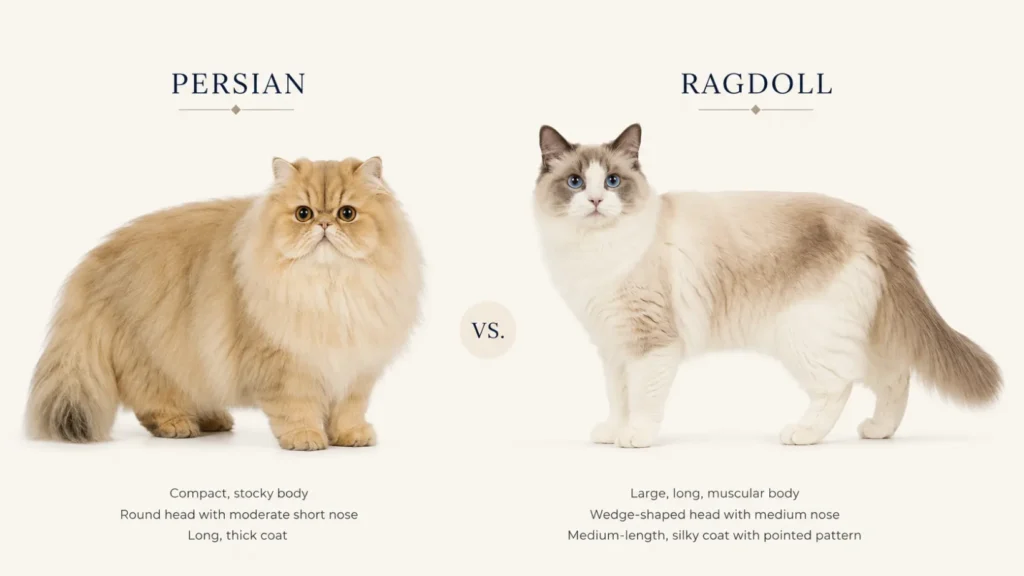
Persians and Ragdolls are both affectionate longhaired pedigree cats, but they differ considerably in body shape, facial structure, grooming demands and some important health considerations.
Persians are generally compact, stocky and extremely coat-intensive, with round heads and short noses. Ragdolls are usually larger and longer-bodied, with blue eyes, a semi-long coat and pointed coloration. Breed descriptions can help you compare them, but individual temperament and responsible breeding should guide the final choice.
Persian vs Ragdoll at a Glance
| Feature | Persian | Ragdoll |
|---|---|---|
| Body | Compact, stocky and heavily boned | Large, long and muscular |
| Coat | Long, thick and full | Semi-long, silky and dense |
| Grooming | Usually daily | Usually regular weekly grooming, more during shedding |
| Eyes | Several colors depending on variety | Blue |
| Face | Round with short nose | Broad modified wedge with medium-length nose |
| Typical temperament | Sweet, quiet and placid | Gentle, playful and people-oriented |
| Key health consideration | Facial conformation and PKD history | HCM-associated genetic variant |
Appearance
Persian
The Persian is a compact, heavily boned cat with a broad chest, short sturdy legs, a round head and a very long, full coat.
Persians occur in many colors and patterns, so coat color alone does not define the breed.
Ragdoll
Ragdolls are larger and longer in outline. They have substantial bone, a broad chest, a long muscular body and a medium-length silky coat.
They are pointed cats and should have blue eyes.
Size
Ragdolls are generally the larger breed.
GCCF lists Ragdolls broadly around 10–20 pounds, while Persians are generally listed around 6–12 pounds.
These are breed-level ranges, not promises about an individual adult cat.
Facial Structure
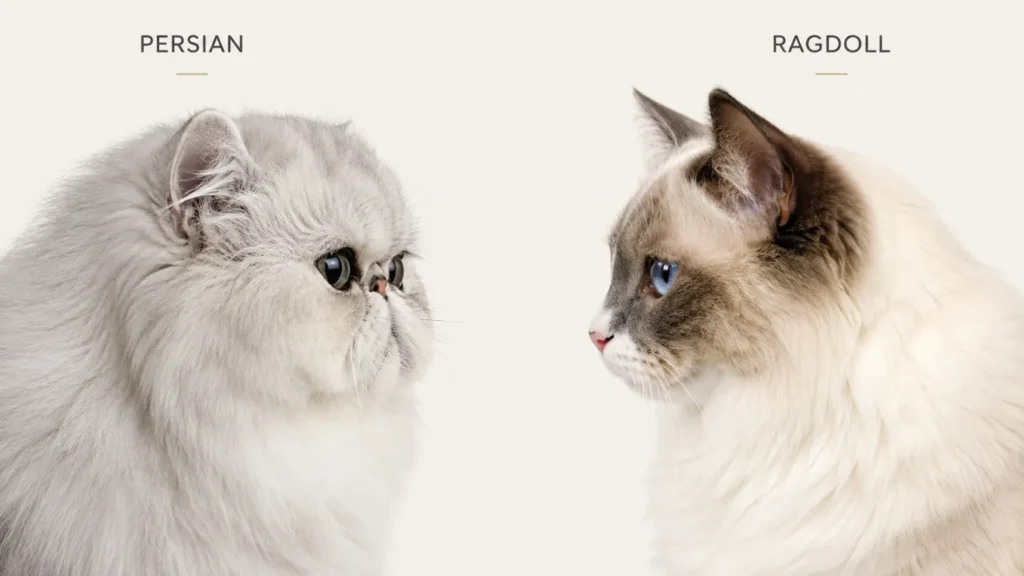
The breeds are particularly easy to distinguish by the face.
Persians have a round skull, round eyes and a short nose.
Ragdolls have a broader modified wedge-shaped head with a medium-length nose and much less facial shortening.
Persian Facial Conformation and Health
Extremely shortened facial anatomy can affect breathing, tear drainage, dental alignment and eye health.
Do not choose a Persian solely for an extremely flat facial appearance.
When speaking with a breeder, pay attention to:
- open nostrils
- comfortable quiet breathing
- absence of persistent respiratory noise
- eye health
- dental and jaw structure
Breathing difficulty should never be dismissed as normal simply because a cat is Persian.
Coat and Grooming
Persian Grooming
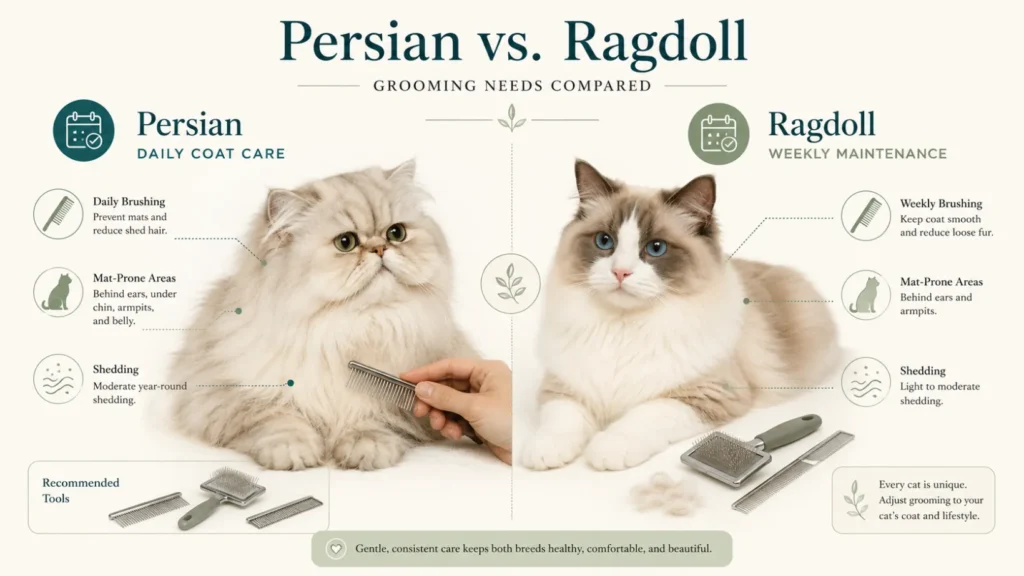
The Persian is one of the higher-maintenance pedigree cats.
Its long, dense coat can tangle and mat without frequent care. GCCF categorizes Persians as high maintenance and recommends daily grooming.
Regular grooming should include:
- gentle combing
- checking behind the ears
- checking the armpits and belly
- monitoring the hindquarters
- eye-area hygiene where needed
Ragdoll Grooming
Ragdolls also require coat care, but their semi-long coat is generally less intensive than the Persian coat.
GCCF describes weekly maintenance as typical, with extra grooming during periods of increased shedding.
Personality
CFA describes Persians as sweet, affectionate and quiet.
GCCF describes Ragdolls as gentle and playful and notes that they generally enjoy interaction with people.
Neither description guarantees personality.
Socialization, handling, household experience and individual genetics create substantial variation.
Are Ragdolls Really “Floppy”?
The breed’s name came from historical reports that some individuals relaxed dramatically when picked up.
However, GCCF specifically warns against treating this as a defining physiological feature.
A Ragdoll does not have an abnormally low pain threshold and should not be handled carelessly.
Activity and Play
Both breeds need play and enrichment.
Ragdolls are commonly described as somewhat more playful and interactive, while Persians are typically described as placid.
That does not mean Persians should live sedentary lives.
Provide both breeds with:
- interactive play
- scratching areas
- comfortable perches
- safe hiding areas
- appropriate climbing opportunities
Living With Children
Either breed may live successfully with respectful children.
Children should be taught not to:
- carry cats against their wishes
- pull fur or tails
- interrupt eating or sleeping
- remove a cat from its hiding place
Other Cats and Dogs
Breed reputation is less important than careful introductions.
Either breed can potentially share a home with compatible cats or dogs when introductions are gradual and each animal has adequate resources.
Persian Health Considerations
Health issues to discuss with a responsible Persian breeder include:
- polycystic kidney disease screening history
- respiratory health and facial conformation
- eye health
- dental alignment
- general family health history
CFA notes that genetic testing has substantially helped control PKD in responsibly bred Persians.
Ragdoll Health Considerations
Hypertrophic cardiomyopathy is particularly important in Ragdolls.
A known Ragdoll-associated HCM genetic variant can be tested for, and GCCF requires testing in certain breeding-registration circumstances.
However, one negative DNA test cannot guarantee that a cat will never develop every possible form of HCM.
Ask breeders about both genetic testing and broader family cardiac history.
Which Breed Costs More to Maintain?
Purchase price varies too widely to generalize reliably.
For ongoing care, the Persian’s intensive coat maintenance can create additional time and professional-grooming costs.
Veterinary and insurance costs depend on the individual cat, health status and location rather than breed name alone.
Persian vs Ragdoll: Which Should You Choose?
A Persian may suit you if you value a quiet, compact companion and are prepared for intensive coat care.
A Ragdoll may suit you if you prefer a larger, semi-longhaired cat that is generally described as gentle and playful and you can provide regular grooming and health screening.
Whichever breed you choose, prioritize health, temperament and responsible breeding over appearance.
FAQs
Which is bigger, a Persian or Ragdoll?
Ragdolls are generally larger and longer-bodied. Persians are more compact and stocky.
Which needs more grooming?
Persians generally require substantially more grooming and often need daily coat maintenance.
Do all Ragdolls have blue eyes?
Blue eyes are part of the recognized Ragdoll breed standard.
Are Persians less playful than Ragdolls?
Persians are generally described as more placid, while Ragdolls are often described as gentle and playful. Individual cats vary considerably.
Do Ragdolls have a low pain threshold?
No. GCCF specifically warns that Ragdolls should not be considered physiologically less sensitive to pain than other cats.
Bottom Line
Persians and Ragdolls are affectionate longhaired cats with very different physical types. Persians are compact, round-faced and grooming-intensive; Ragdolls are generally larger, longer-bodied and somewhat easier to maintain.
Health screening and individual temperament should matter more than choosing whichever appearance you prefer most.