How to Switch Cat Food Safely: A Gradual Transition Schedule
How to switch cat food safely depends partly on the individual cat, but for many healthy cats the new food is introduced gradually rather than replacing the old diet in one meal. AAHA/AAFP feline nutrition guidance supports allowing approximately 7–10 days for a gradual transition, while cats that are cautious about unfamiliar food or prone to digestive upset may need longer.
The goal is not to force a cat through a fixed timetable. Appetite, stool, vomiting, body weight and general wellbeing should guide the pace. Most importantly, do not intentionally leave a cat without food for a prolonged period simply to make it accept the new diet. Sustained food refusal can become medically significant in cats.
Direct Answer
For many healthy cats, gradually replace the old food with the new food over about 7–10 days. Start with a small proportion of new food, increase it only while the cat continues eating comfortably, and slow the transition if appetite or digestion changes. If your cat stops eating, develops repeated vomiting, significant diarrhoea or becomes unwell, contact your veterinarian rather than continuing the schedule.
Why Gradual Transitions May Help
An abrupt food change alters several things at once:
- ingredients
- nutrient composition
- fat and fibre content
- smell
- flavour
- texture
- moisture
Cats can also be particular about unfamiliar food textures and flavours.
AAHA recommends gradual diet changes because they may reduce negative gastrointestinal responses. Its feline life-stage guidance suggests allowing approximately 7–10 days when clinical circumstances permit.
A slower introduction also gives you time to notice whether the cat:
- accepts the new food
- develops loose stool
- vomits
- begins eating less
- loses weight
- otherwise acts differently
The transition is therefore both an introduction period and a monitoring period.
When Veterinary Instructions Differ
A generic cat food transition schedule should never override a veterinarian’s instructions.
This is especially important when the new diet has been recommended for:
- diabetes
- kidney disease
- gastrointestinal disease
- suspected food allergy
- obesity
- urinary disease
- pancreatitis
- another diagnosed condition
Therapeutic diets are chosen for specific medical goals, and reliable food intake may be more important than following a generic mixing schedule in some patients. Current AAHA diabetes guidance, for example, emphasises individualisation and prioritising reliable intake of an appropriate complete diet.
If your veterinarian gives you a different transition method, follow that plan.
Do not abruptly change or abandon a prescribed diet without discussing the problem with the veterinary team.
Example Cat Food Transition Schedule
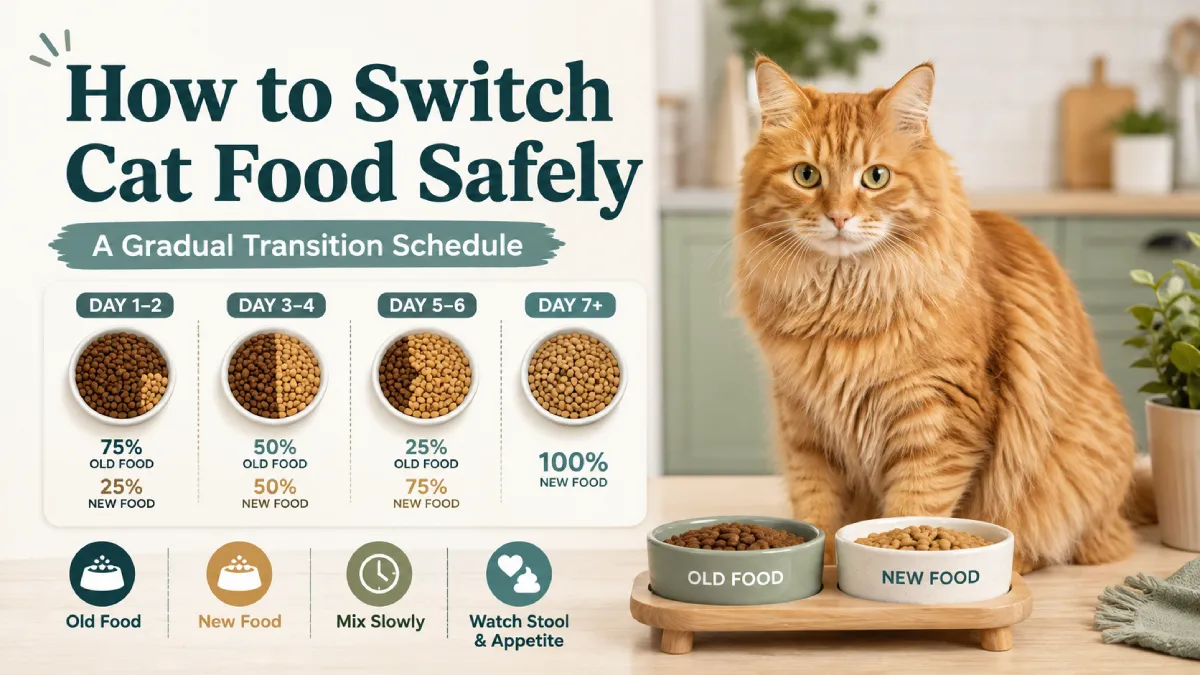
For a healthy adult cat that is eating normally, this can be used as a practical starting framework:
| Days | Old Food | New Food | What to Monitor |
|---|---|---|---|
| 1–2 | About 75% | About 25% | Appetite, stool, vomiting |
| 3–4 | About 50% | About 50% | Acceptance and digestion |
| 5–7 | About 25% | About 75% | Stool, appetite and energy |
| 8–10 | 0% | 100% | Continued tolerance |
This is an example, not a deadline.
AAHA/AAFP guidance allows clinical discretion around a 7–10-day gradual transition, while veterinary guidance for cats with previous gastrointestinal sensitivity or strong food preferences may extend the change over a longer period.
A cat doing well may move through the stages comfortably. A cautious cat may need several additional days at each stage.
Starting With a Small Amount
The first goal is simple:
Will the cat willingly eat the new food?
Introduce a small quantity while keeping the familiar food available.
For particularly selective mature or senior cats, AAHA/AAFP guidance suggests that offering the new food in a separate adjacent dish can allow the cat to investigate it without immediately losing access to the familiar diet.
This may work better than immediately mixing an unfamiliar food throughout the entire meal for a cat that refuses food once its usual smell or texture changes.
Increasing the New Food Gradually
Once the cat is eating the initial amount comfortably, increase the proportion of new food.
Do not increase it simply because the calendar says it is the next day.
Look at:
- appetite
- stool
- vomiting
- behaviour
- energy
If everything remains normal, continue.
If mild digestive changes appear, slowing the transition may be more appropriate than continuing to increase the new food immediately. Veterinary transition guidance specifically recommends slowing down when loose stool, vomiting or decreased appetite develops.
Cats That May Need a Slower Transition
Some cats are more challenging to transition than others.
A slower introduction may be useful for cats that:
- have previously developed gastrointestinal upset with diet changes
- strongly resist unfamiliar textures
- have eaten one food for a long time
- are senior
- are being moved between very different food formats
- have medical conditions affecting appetite or digestion
VCA notes that some selective cats may require several weeks to become comfortable with a new food or food format.
The important distinction is between taking longer to accept a food while still eating adequately and not eating enough.
The second situation needs more caution.
Kittens
Kittens need complete and balanced nutrition appropriate for growth.
If you are switching between two kitten foods, a gradual introduction can help reduce digestive disruption while allowing the kitten to adjust to the new smell, flavour and texture.
If the goal is to switch kitten food to adult food, do not move a growing kitten onto adult-maintenance nutrition prematurely just to simplify feeding. AAHA/AAFP defines the kitten life stage as birth to approximately one year and recommends growth-appropriate nutrition during this period.
Keep detailed age-specific feeding information on Pawnium’s Kitten Feeding Schedule rather than expanding it here.
Young kittens also deserve faster veterinary attention if food intake falls significantly.
Senior Cats
Older cats may have stronger established food preferences and may also have health conditions that affect:
- appetite
- smell
- digestion
- chewing
- body weight
AAHA/AAFP specifically recommends allowing mature and senior cats to express food preference by offering a new diet alongside the familiar one when appropriate. Dietary changes are often better introduced in the home environment, where stress is lower.
A senior cat that suddenly refuses food should not automatically be described as “picky.”
Appetite loss can accompany medical disease and should be evaluated when it is significant or persistent.
Sensitive-Stomach Cats
If a cat has a history of vomiting or diarrhoea after diet changes, a slower transition may be more appropriate.
Rather than moving through each stage every two days, the veterinarian may recommend remaining at each ratio longer.
Do not assume every episode of digestive upset is simply caused by changing cat food.
Vomiting and diarrhoea have many possible causes. Persistent or significant symptoms deserve veterinary assessment rather than repeated diet experiments.
Switching From Dry to Wet Food
Learning how to transition a cat to wet food sometimes involves more than changing ingredients because the cat must also accept a different:
- texture
- smell
- moisture level
- mouthfeel
Some cats accept wet food immediately; others need time.
You can initially offer a small amount of the wet food beside the familiar meal and gradually increase its role in the daily ration.
When replacing dry calories with wet food, also adjust the overall portion rather than adding a complete wet-food ration on top of the existing dry ration.
For the nutritional differences between the formats, use Pawnium’s Wet Food vs Dry Cat Food guide.
Switching From Wet to Dry Food
The reverse transition may also require adjustment to texture.
Some wet-fed cats do not immediately recognise kibble as desirable food.
Introduce the dry food gradually while keeping track of total calories and actual intake.
Fresh drinking water should remain freely available. Do not reduce access to water because the cat is moving to dry food.
If the cat repeatedly rejects the new format, reconsider whether the change is necessary rather than allowing intake to fall dangerously low.
Switching to a New Protein Source
A new food may use a different primary protein simply because you have changed products.
In that situation, a normal gradual transition is generally reasonable for an otherwise healthy cat.
The situation is different if a veterinarian is investigating a possible food allergy or dietary sensitivity.
Elimination trials may require a carefully selected novel or hydrolysed protein diet and strict avoidance of other foods, treats and flavoured products. Merck specifically warns that cats should not be starved or forced into accepting an elimination diet because prolonged poor intake can cause serious complications.
Do not design a diagnostic novel-protein trial yourself.
Follow the veterinarian’s exact diet instructions.
Veterinary Diet Transition
Prescription and therapeutic diets deserve special care because the reason for the food change matters.
Do not assume:
“Every prescription food must be switched over in exactly 7 days.”
The veterinarian may need to balance:
- urgency of the medical problem
- previous diet
- current appetite
- medication timing
- gastrointestinal tolerance
- how reliably the cat will eat the therapeutic food
For some older cats, offering the prescribed diet separately at first may help determine acceptance.
If the cat refuses a prescribed diet, contact the veterinary team rather than simply withholding the old food until hunger wins.
Cat Refusing New Food
A cat refusing new food is not necessarily being stubborn.
Cats can reject a diet because of:
- unfamiliar flavour
- unfamiliar texture
- stress
- nausea
- dental discomfort
- illness
- learned food preferences
Cornell notes that a disliked new food can contribute to food avoidance, but anorexia can also be caused by many medical problems.
If your cat refuses the new food but willingly eats the familiar diet, slow down.
Options may include:
- offering a smaller amount of the new food
- presenting it beside rather than throughout the old food
- extending the transition
- discussing another suitable diet with your veterinarian
Do not turn the feeding bowl into a prolonged contest.
Avoiding Prolonged Food Refusal
Do not “wait the cat out” indefinitely.
Cats are vulnerable to serious complications when they stop eating. Cornell identifies anorexia as a major feature associated with feline hepatic lipidosis, a potentially life-threatening liver disorder.
This risk is one reason to avoid advice such as:
“If the cat gets hungry enough, it will eventually eat.”
If your cat stops eating or its intake drops markedly, especially if it is overweight, ill, a kitten or a senior, contact your veterinarian promptly.
Do not force-feed unless a veterinarian has specifically instructed and demonstrated an appropriate medical feeding plan.
Monitoring Stool
Check stool throughout the transition.
Record:
- normal versus loose stool
- diarrhoea
- frequency
- mucus
- visible blood
- change from the cat’s usual pattern
Mild digestive upset can occur during dietary change, which is one reason gradual transitions are commonly recommended.
However, cat diarrhoea after changing food does not prove that the new diet is the only possible cause.
Use Pawnium’s Cat Poop Colour Chart when stool appearance needs separate assessment.
Monitoring Vomiting
Record:
- number of episodes
- timing relative to meals
- whether food or fluid stays down
- appearance of the vomit
- appetite afterward
- energy level
One episode and repeated vomiting are not equivalent.
If vomiting begins during the transition, do not automatically continue increasing the amount of new food.
Slow or pause the change and assess how the cat is behaving overall.
Repeated vomiting, inability to retain food or water, weakness or other illness warrants veterinary advice.
Use Pawnium’s Cat Vomiting Colour Chart for appearance-specific information without assuming colour alone identifies the cause.
Monitoring Appetite
Appetite is one of the most important transition measurements.
Each day, ask:
- Did the cat approach the meal?
- How much was actually eaten?
- Was intake lower than normal?
- Did the cat eat the old food but avoid the new?
- Did appetite decline regardless of which food was offered?
The last distinction matters.
A cat rejecting only the unfamiliar food may need a slower introduction. A cat refusing both familiar and new food may be ill rather than merely resistant to the transition. Cornell recommends veterinary evaluation for sustained feline appetite loss.
Use Pawnium’s Why Is My Cat Not Eating? guide when appetite loss becomes the primary problem.
Monitoring Weight
A short transition should not cause a deliberate major change in body weight.
If the new food has a different calorie density, the physical amount needed may differ even when the daily calorie target stays similar.
Track weight more closely when:
- changing between wet and dry food
- switching to a calorie-dense diet
- switching to a lower-calorie diet
- the cat is already underweight
- the cat is overweight
- the transition lasts several weeks
For daily portion calculations, use Pawnium’s How Much Should I Feed My Cat? pillar.
What to Do if Symptoms Appear
If a mild change appears during the transition:
- Do not automatically increase the proportion of new food.
- Record the symptom.
- Consider slowing the transition.
- Make sure the cat is still eating an adequate amount.
- Contact your veterinarian if the problem persists, worsens or is significant.
Veterinary guidance recommends slowing a diet transition when loose stools, vomiting or decreased appetite develops rather than pushing ahead on schedule.
Do not keep feeding increasing quantities of a suspected problem food through severe symptoms.
When to Pause the Transition
Pause the planned increase and seek veterinary guidance when the cat develops:
- repeated vomiting
- significant diarrhoea
- declining appetite
- marked lethargy
- progressive weight loss
- obvious abdominal discomfort
- blood in vomit or stool
- signs of dehydration
- refusal of both old and new food
A pause does not mean diagnosing the new food as the cause.
It means stopping an elective dietary progression until the cat’s condition is understood.
When Veterinary Advice Is Needed
Contact your veterinarian when:
- your cat stops eating
- intake becomes substantially lower than usual
- vomiting repeats
- diarrhoea persists or becomes severe
- weight is dropping
- the cat appears weak or unwell
- the diet was prescribed for a medical condition
- the cat repeatedly fails to tolerate food transitions
- you suspect food allergy
- the cat has a chronic gastrointestinal disorder
Cats with sustained loss of appetite need particular attention because prolonged inadequate intake can contribute to hepatic lipidosis.
Common Transition Mistakes
Switching Everything Overnight
An abrupt change may increase the chance of digestive upset or rejection. Gradual introduction is generally preferred when there is no medical reason to do otherwise.
Following the Calendar Instead of the Cat
The schedule is a framework.
If appetite or stool deteriorates, do not increase the new food simply because it is “Day 5.”
Waiting Out Food Refusal
Do not intentionally starve a cat into accepting a food.
Force-Feeding an Unwilling Cat
Force-feeding can create additional stress and is not a routine home solution for food rejection.
Changing Several Things at Once
Switching brand, protein, texture, feeding schedule and treats simultaneously makes it harder to understand what the cat tolerates.
Ignoring Calories
A new food can contain a different number of calories per gram, cup, can or pouch.
Do not assume the old physical portion remains correct.
Ignoring Veterinary Diet Instructions
A therapeutic diet transition may require different priorities from a routine food change.
Follow the veterinary plan.
FAQs
How many days should it take to switch cat food?
For many healthy cats, approximately 7–10 days is a reasonable starting framework. Some cats tolerate a change faster, while selective cats or those with previous digestive upset may need considerably longer. The cat’s appetite and gastrointestinal response should determine the pace rather than a rigid deadline.
What should I do if my cat refuses the new food?
Slow the transition and make sure the cat continues eating. You may initially offer a small amount of the new food separately from the familiar food. Do not simply remove all familiar food and wait indefinitely. Persistent or substantial appetite loss requires veterinary advice.
Is diarrhoea normal after switching cat food?
A diet change can be associated with temporary gastrointestinal upset, but diarrhoea should not automatically be considered normal or harmless. Slow the transition and monitor your cat. Persistent, severe or bloody diarrhoea, or diarrhoea accompanied by vomiting, poor appetite or lethargy, warrants veterinary assessment.
Can I switch my cat from dry food to wet food?
Yes. Introduce the wet food gradually and adjust the dry portion as wet-food calories increase so that you are not accidentally feeding two full rations. Cats that strongly prefer kibble texture may need extra time to accept wet food.
Should I mix the old and new cat foods together?
Mixing works well for many cats, but some selective cats reject the entire meal once an unfamiliar food is mixed into it. In those cases, initially offering a small amount of the new diet in a separate nearby bowl may be more successful.
Should prescription cat food be transitioned gradually?
Often, but not always according to a generic schedule. The reason for the therapeutic diet, the cat’s health and whether the cat is eating reliably can change the plan. Follow the prescribing veterinarian’s instructions and contact them if your cat refuses the diet or develops symptoms.