

Flying With a Cat: Airline Rules & Travel Checklist
Flying with a cat requires more preparation than booking a ticket and buying a travel carrier. Your destination country, any countries you transit, the operating airline and the country you return to may all have separate requirements. Those rules can also change between trips, so a process that worked previously should not be treated as permanent guidance.
For international travel, begin with current government entry rules and then check the airline separately. Depending on the journey, your cat may need a microchip, vaccinations, testing, treatments, permits or a veterinary health certificate. The airline can add its own conditions covering whether cats are accepted, how they may travel and which carrier is permitted.
Quick Answer
Start planning as early as possible. Check destination, transit and return-entry requirements; confirm that the operating airline accepts cats on every flight segment; verify its current carrier rules; and speak with your veterinarian about medical fitness and required documentation. Never assume that one carrier size, vaccination schedule or health certificate works for every airline or country.
Plan the Trip Before Booking
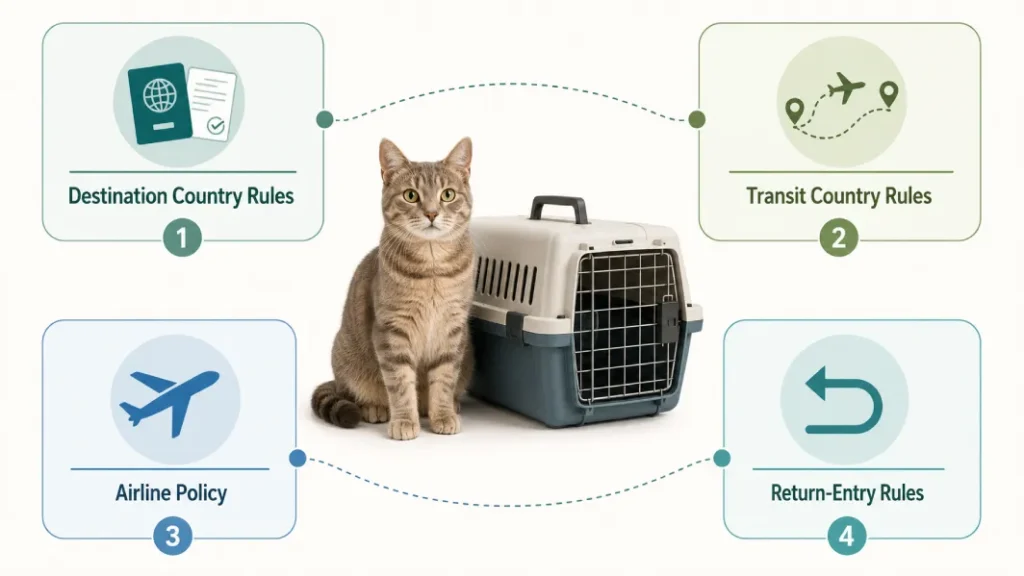
Pet air travel is controlled by more than one organization. Treat the destination country, transit countries, airline and return destination as separate checks rather than relying on one generic travel checklist.
Check Destination-Country Rules
The destination government determines what your cat must satisfy before entry.
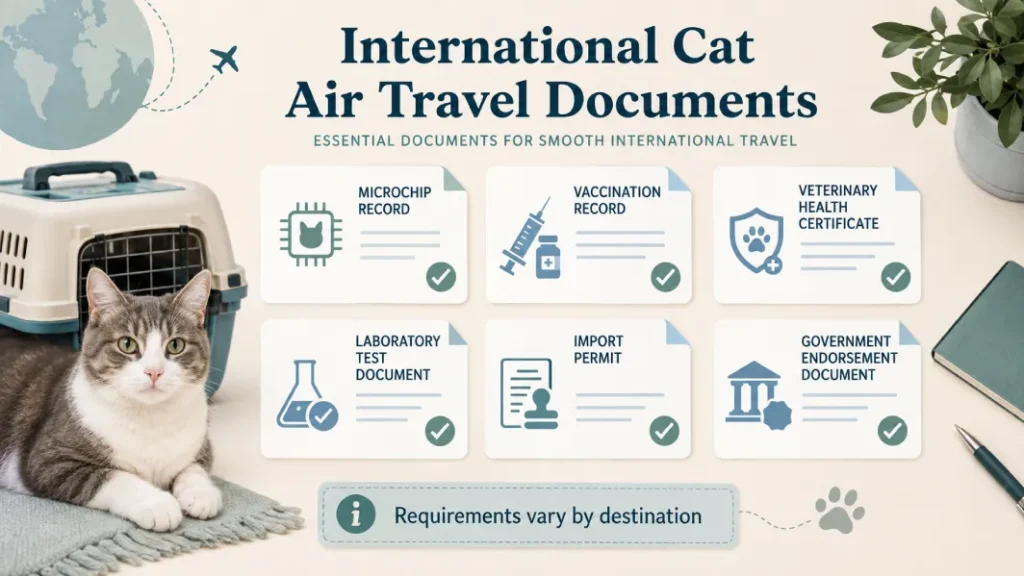
Depending on the country, possible requirements may include:
- microchip identification
- specific vaccinations
- laboratory testing
- parasite treatments
- veterinary health certificates
- import permits
- government endorsement
- arrival through designated ports or inspection locations
These are possible requirements, not a universal checklist. Verify the current official animal-entry rules every time you plan an international trip.
Check Transit-Country Rules
A layover can add another regulatory layer. Do not assume that remaining inside an airport automatically means the transit country’s animal rules do not matter.
The answer may depend on whether you:
- remain airside
- clear immigration or customs
- change airports
- collect and recheck the cat
- change airlines
- remain in the transit country for a particular period
Check both the relevant government authority and the operating airline for your exact itinerary.
Check Return-Entry Rules
Plan the return journey before leaving home.
A cat that normally lives in a country may still have to satisfy that country’s current import rules after traveling abroad.
For example, cats entering the United States are subject to inspection and may require veterinary examination if they appear ill. Individual states and territories can also impose additional requirements.
If you are returning to another country, use that country’s current rules rather than applying U.S. requirements internationally.
Check the Airline Policy for Every Flight
Government permission to enter a destination does not automatically mean an airline will transport your cat.
Before paying for a difficult-to-change ticket, confirm with the operating airline:
- whether cats are accepted on the route
- whether your cat can travel in the passenger cabin
- what other live-animal transport arrangements are available
- current carrier dimensions
- carrier construction requirements
- pet reservation procedure
- pet fees
- number of pets permitted on the flight
- age or health restrictions
- aircraft, seasonal or route restrictions
- any airline-specific documents
Codeshare flights deserve extra attention because the airline shown most prominently on your ticket may not operate every segment.
Cabin Travel
For U.S.-regulated flights, the Federal Aviation Administration allows individual airlines to decide whether pet cats are accepted in the passenger cabin.
When an airline allows cabin travel, the carrier is treated as carry-on baggage. It must fit under the seat without blocking access to the aisle and remain properly stowed when required during aircraft movement, takeoff and landing.
The airline can impose additional conditions beyond these FAA requirements.
Other Airline Transport Arrangements
If cabin travel is unavailable, ask what live-animal transport arrangements the airline actually provides on your route.
Do not assume every airline transports cats outside the cabin. Availability can depend on:
- aircraft
- route
- destination
- season
- weather conditions
- animal health
- carrier construction
- airline operating policy
Choose the Right Cat Airline Carrier

Carrier Dimensions
There is no universal cat airline carrier size.
Get the current measurements directly from the operating airline and check whether they vary according to:
- aircraft type
- cabin configuration
- hard-sided versus soft-sided carrier
- under-seat space
A carrier that was accepted on a previous flight is not automatically acceptable for another airline or aircraft.
Carrier Construction
The carrier should be secure, appropriately ventilated and large enough for the individual cat to maintain normal postures.
Look for:
- secure closures
- adequate ventilation
- stable construction
- a leak-resistant base
- an absorbent liner
- enough usable internal space for your cat
The operating airline’s current carrier requirements take priority over generic recommendations.
Reserve the Cat’s Place
Do not assume that buying your own ticket automatically reserves a place for your cat.
Airlines can restrict the number of pets accepted in a cabin or on a particular flight. Complete the airline’s pet-reservation process and retain confirmation.
For connecting itineraries, confirm acceptance on every operating segment.
Prepare the Required Health and Travel Documents
Microchip
Microchip requirements vary internationally.
Some destinations require a specific microchip standard or require identification to happen before a vaccination or test will count toward entry.
Before travel, verify:
- microchip number
- registry details
- your current phone number
- destination-specific microchip requirements
- whether the chip needs to be scanned during required veterinary procedures
Vaccination Requirements
There is no single vaccination rule for cats traveling internationally.
Requirements can depend on:
- destination country
- transit country
- return destination
- cat’s age
- vaccination history
- local animal-health regulations
Follow the official requirements for the actual itinerary instead of copying a timetable from another destination.
Health Certificate
There is no single international health certificate that works worldwide.
A destination-specific certificate may document:
- veterinary examination
- microchip information
- vaccination history
- laboratory testing
- required treatments
- other declarations requested by the destination
The format and validity period can also be destination specific.
Veterinary Examination
Schedule the veterinary examination according to the requirements that apply to your trip.
Give your veterinarian:
- destination country
- transit countries
- operating airline
- departure date
- return plan
- intended transport arrangement
- relevant medical history
For animals exported from the United States, a USDA-accredited veterinarian is needed when the destination requires USDA endorsement of the health certificate.
Testing and Treatments Where Required
Some destinations require laboratory testing or specific treatments before entry.
The type of test, laboratory, relationship to vaccination and permitted travel timing can all differ by country.
Do not use one generic international testing timeline.
Import Permits
Some destinations require an import permit before the cat travels.
If yours does, read it carefully because the permit may contain additional instructions involving:
- validity periods
- arrival airports
- inspection procedures
- supporting documents
- health requirements
Government Endorsement
Some veterinary health certificates require official government endorsement.
For pets leaving the United States, when USDA endorsement is required, the certificate must be issued by a USDA-accredited veterinarian and submitted through the appropriate APHIS process.
Travelers departing another country should follow that country’s veterinary export-certification process instead.
Prepare Your Cat Before the Flight
Carrier Training
A flight should not be your cat’s first extended experience inside the carrier.
Build familiarity gradually:
- Leave the carrier open in a familiar room.
- Encourage voluntary entry.
- Practice brief door closure.
- Practice lifting the carrier.
- Walk short distances with it.
- Add short transport experiences where appropriate.
Progress according to your cat’s behavior rather than forcing carrier training into a fixed number of days.
For a complete progression, use Cat Carrier Training.
Medical Fitness to Fly
Air travel is not equally appropriate for every cat.
Discuss the journey with your veterinarian if your cat has:
- heart disease
- respiratory disease
- significant chronic illness
- recent surgery
- severe previous travel-related illness
- major mobility limitations
- pronounced travel anxiety
The decision should be based on the individual cat rather than assuming that an animal is medically fit because another cat of the same age or breed has flown successfully.
Kittens
Do not use one universal minimum age for flying.
Eligibility may depend on airline policy, destination rules, vaccination timing, health status and import requirements.
Confirm both airline acceptance and veterinary suitability before booking.
Senior Cats
Age alone does not automatically prevent flying, but older cats may have medical conditions that change the risk.
Discuss factors such as heart and respiratory health, kidney disease, hydration, medication timing, mobility and tolerance of prolonged confinement with your veterinarian.
Short-Nosed Cats
Short-nosed cats, including Persian-type cats, can require additional consideration because they may be more vulnerable to respiratory stress during travel.
Airlines may also impose their own restrictions on certain animals or transport arrangements.
Check the current airline policy and discuss medical suitability with your veterinarian.
Airport Security With a Cat
U.S. TSA Checkpoints
The following procedure is specific to airport security in the United States.
TSA requires small pets to be removed from their carrying cases while the empty carrier is screened.
Maintain physical control of your cat and never send the cat through the X-ray machine inside the carrier.
Before reaching the checkpoint:
- check every carrier zipper and latch
- make sure identification details are current
- use a properly fitted harness only if your cat is already comfortable wearing one
- tell the security officer that you are traveling with a cat
- do not open the carrier until instructed
If using a leash at a U.S. checkpoint, follow TSA instructions about removing it while carrying the cat through the metal detector.
For airports outside the United States, check the local airport or security authority’s procedure.
Reduce the Risk of Escape
A calm cat at home may react very differently in a busy airport.
If you expect your cat to panic, tell security personnel before opening the carrier.
Do not assume the cat will respond normally to their name or remain calmly in your arms.
Ask About a More Controlled Screening Setting
If removing your cat in an open screening lane creates a serious escape risk, tell the security officer before opening the carrier and ask whether a more controlled or private screening arrangement is available.
Do not assume the exact procedure or room availability will be identical at every airport.
Food, Water, Litter and Medication
Food
Do not introduce a major diet change immediately before flying.
Pack enough familiar food for the journey and initial destination period, especially if the same diet may be difficult to buy after arrival.
Do not publish one universal fasting rule. Meal timing may need to be individualized for kittens and cats with diabetes, gastrointestinal disease or other medical conditions.
Water
Plan water access according to the length of the journey, transport method and airline procedure.
For cabin travel, offer water only in a way that does not create an escape risk. For other live-animal transport arrangements, ask the airline how water is provided.
Litter
Pack:
- familiar litter
- a portable litter tray where useful
- a scoop
- waste bags
- absorbent carrier liners
- spare liners
- paper towels
Do not open the carrier in an unsecured airport area merely to provide a litter box.
Medication
Keep essential prescribed medication accessible and in appropriately labeled packaging.
Carry enough for the planned trip and a reasonable delay contingency where your veterinarian can arrange one.
Check airline, airport-security and destination requirements for medicines and related medical equipment.
Sedation and Tranquilizers
Do not routinely sedate a cat simply to make air travel easier.
International air-transport guidance discourages routine sedatives and tranquilizers because they can cause adverse effects and reduce an animal’s ability to respond normally during transportation.
If medication is medically appropriate for your cat, use it only under veterinary direction and tell the airline when its rules require disclosure.
Never use:
- human sedatives without veterinary direction
- medication prescribed for another animal
- leftover medication from another trip
- an owner-calculated dose
Arrival and Customs
Check Your Cat After Arrival
Keep your cat securely contained until you reach an appropriate place to open the carrier.
After landing, look for:
- normal responsiveness
- comfortable breathing
- obvious injury
- repeated vomiting
- severe weakness
- unusual distress
Seek veterinary care if your cat appears medically unwell instead of assuming that every change is ordinary travel stress.
Customs and Animal-Entry Inspection
Follow the destination country’s arrival procedure exactly.
Depending on the destination, this may involve:
- customs declaration
- animal-health inspection
- microchip scanning
- document review
- import-permit verification
- arrival through a designated point of entry
Keep the required documents accessible until all animal-entry formalities are complete.
Set Up a Secure Destination Room
Do not immediately open the carrier into an unfamiliar hotel, rental or large home.
First check:
- exterior doors
- windows and screens
- balcony access
- unsafe furniture gaps
- cleaning chemicals
- potentially toxic plants
Then provide:
- fresh water
- familiar food
- litter box
- familiar bedding
- a safe hiding place
- the carrier
Allow your cat to emerge voluntarily rather than pulling them from the carrier.
For broader trip planning, packing, hotels and deciding whether your cat should travel at all, use Traveling With a Cat: Planning, Packing and Stress-Reduction Guide.
Cat Flight Preparation Timeline
Important: These are planning stages, not fixed medical deadlines. Testing, vaccination, certificate and permit timing depends on the destination and itinerary.
Early Planning
- ☐ Check destination-country rules
- ☐ Check transit-country rules
- ☐ Check return-entry rules
- ☐ Choose the airline and itinerary
- ☐ Confirm the airline accepts cats
- ☐ Contact your veterinarian
- ☐ Check microchip and registry information
- ☐ Review medical fitness to fly
Documentation Phase
- ☐ Complete required testing
- ☐ Complete required vaccinations
- ☐ Complete required treatments
- ☐ Obtain the required health certificate
- ☐ Obtain an import permit where required
- ☐ Complete government endorsement where required
- ☐ Verify transit documents
- ☐ Verify return-entry documents
Final Week
- ☐ Reconfirm the airline pet reservation
- ☐ Recheck the airline’s current pet policy
- ☐ Reconfirm carrier requirements
- ☐ Organize original documents
- ☐ Save backup copies
- ☐ Prepare prescribed medication
- ☐ Prepare food and litter supplies
- ☐ Identify a veterinarian at the destination
- ☐ Prepare the destination safe room
Travel Day
- ☐ Check identification
- ☐ Keep required documents accessible
- ☐ Inspect carrier closures
- ☐ Pack prescribed medication
- ☐ Keep emergency contacts accessible
- ☐ Tell airport security staff that you have a cat
- ☐ Maintain control whenever the carrier is opened
For emergency-oriented supplies, use the Cat Emergency Kit Checklist.
FAQs
What documents do I need to fly internationally with a cat?
There is no universal document list. Depending on the route, you may need a veterinary health certificate, vaccination records, microchip documentation, laboratory results, treatment records, an import permit or government endorsement. Check destination, transit, return and airline requirements separately.
Can my cat travel in the airplane cabin?
Possibly. The airline decides whether pet cats are accepted in the passenger cabin and may impose route, aircraft, carrier, capacity, age or health restrictions. Confirm the current rule for your exact flight before booking.
What size airline carrier does my cat need?
There is no universal size. Obtain the current carrier dimensions directly from the operating airline and reconfirm them for your aircraft and cabin before departure.
Does my cat need a health certificate?
It depends on the destination, route and airline. There is no single international health certificate that works for every destination.
Should I sedate my cat before flying?
Routine sedation solely to make air travel easier is discouraged. If your cat has severe anxiety, nausea or another medical issue, discuss an individualized medication plan with your veterinarian rather than using sedatives on your own.
How can I prevent my cat from escaping at airport security?
Use a secure carrier and current identification, tell security personnel before opening it and maintain physical control whenever removal is required. At U.S. TSA checkpoints, the cat is removed and the empty carrier is screened separately. If an open checkpoint creates a serious escape risk, ask staff about a more controlled screening arrangement before opening the carrier.
Bottom Line
Safe flying with a cat depends on current rules, preparation and the individual animal.
Treat destination requirements, transit rules, airline policy and return-entry requirements as separate checks. Verify carrier measurements directly with the operating airline, work with your veterinarian on medical fitness and destination-specific health requirements, and prepare your cat for the carrier well before travel day.
Last Travel Rules Checked: August 21, 2026
Sources
- USDA APHIS — Pet Travel Process Overview
- USDA APHIS — Frequently Asked Questions About Traveling With Your Pet
- Federal Aviation Administration — Flying With Pets
- Transportation Security Administration — TSA Travel Tips
- CDC Yellow Book 2026 — Traveling With Pets and Service Animals
- IATA — Traveler’s Pet Corner