
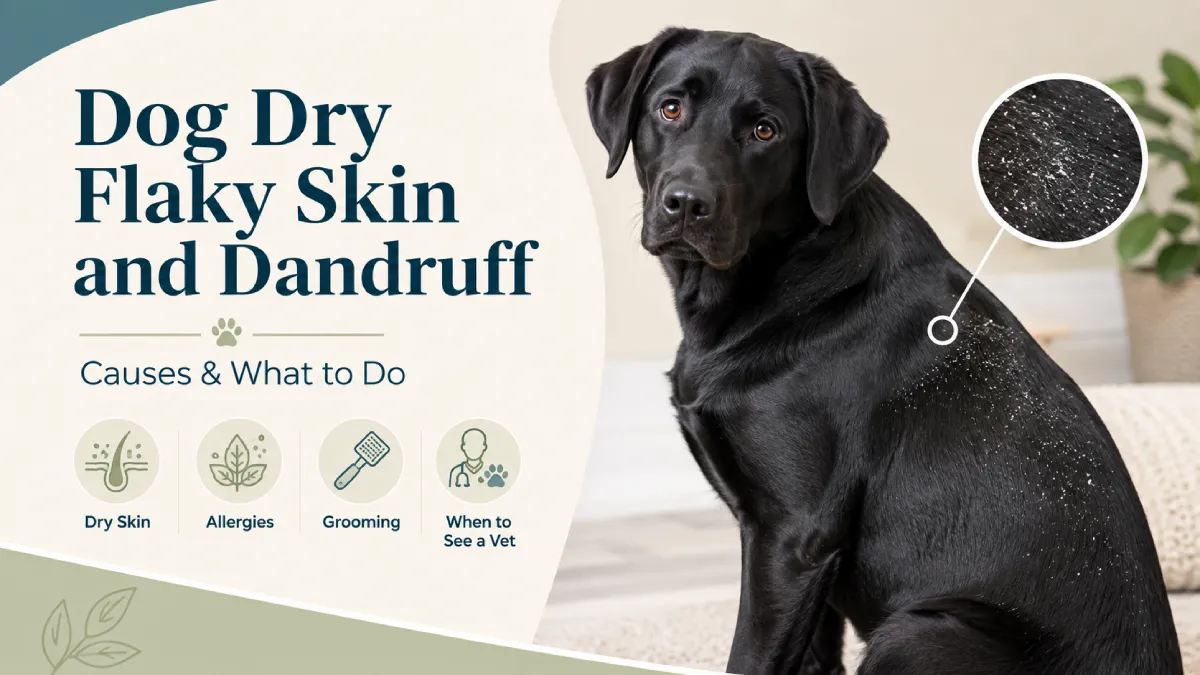
Dog Dry, Flaky Skin and Dandruff: Common Causes and What to Do Next
Dog dry flaky skin can look like white flakes scattered through the coat, but dandruff does not automatically mean the skin simply needs more moisture. Dogs can develop dry scaling, oily scaling or a mixture of both, and excessive flaking may occur with allergies, parasites, bacterial or yeast-associated skin disease, grooming problems, nutritional issues or hormonal disorders. Secondary seborrhoea caused by an underlying condition is much more common than primary seborrhoea.
The pattern matters. Note whether your dog is itchy, greasy, red, smelly, losing hair or developing flakes in a particular area. These observations can help a veterinarian decide whether skin testing or investigation for an underlying disease is appropriate.
Direct Answer
Dry, flaky skin or dandruff in dogs may occur with low humidity, excessive bathing, irritating grooming products, allergies, fleas or mites, bacterial or yeast-associated skin disease, nutritional problems or hormonal conditions. Flakes alone cannot identify the cause. Persistent scaling, itching, redness, odour, hair loss or recurring problems should be assessed by a veterinarian.
What Dog Dandruff Looks Like
Dandruff is visible scaling from the surface of the skin.
Owners may notice:
- small white flakes between hairs
- flakes falling onto bedding
- scale concentrated along the back
- larger pieces of flaky skin
- crusting
- greasy or waxy material mixed with scales
Seborrhoea is a veterinary term used for abnormal scaling that may occur with excessive oiliness, dryness or both. The back, face and flanks are commonly affected in dogs with seborrhoeic skin changes.
Dandruff describes what you see, not why it is happening.
Dry Versus Oily Flakes
Not all flaky skin is dry.
Dry Scaling
Dry scaling may look:
- white
- powdery
- loose
- easy to see against dark fur
The coat may also appear dull or brittle.
Oily Scaling
Oily seborrhoea can produce:
- greasy skin
- waxy scale
- clumped flakes
- oily hair
- stronger odour
Many dogs have a combination of dry and oily changes rather than fitting neatly into one category.
This distinction is useful to record because treatment for one type of skin problem may be inappropriate for another.
Seasonal Dryness
Some dogs develop increased skin irritation or flaking during dry weather.
Cold-season conditions can contribute when:
- outdoor humidity is low
- indoor air becomes dry
- heating systems are used regularly
VCA notes that dry winter conditions and low indoor humidity can contribute to seasonal skin irritation in some dogs.
However, a seasonal pattern does not automatically mean simple dryness. Environmental allergies can also flare during particular seasons, depending on the allergens involved.
Record whether the problem appears during the same months each year.
Indoor Heating
Indoor heating can lower humidity, which may contribute to a drier skin and coat environment in susceptible dogs.
If flaking begins during colder months, also consider whether anything else changed at the same time:
- bathing frequency
- shampoo
- diet
- flea prevention
- grooming routine
- indoor temperature
- time spent outside
If flakes persist after the season changes or are accompanied by itching, redness, odour or hair loss, another cause should be considered.
Over-Bathing
Bathing helps remove dirt and debris, but excessive routine bathing can strip protective oils from the skin and worsen irritation in some dogs.
That does not mean frequent bathing is always harmful.
Dogs receiving treatment for allergies, seborrhoea or skin infections may be prescribed frequent medicated baths. The correct frequency depends on the skin condition and product being used.
For routine bathing schedules, link to Pawnium’s Dog Bathing-Frequency Guide rather than duplicating that article here.
Grooming Products
Shampoo can contribute to flaky or irritated skin when the product is unsuitable for dogs or not rinsed away thoroughly.
Dogs should generally be bathed with products formulated for canine skin. Human shampoos have a different pH profile and can disrupt the normal skin barrier.
Also record whether:
- dandruff started after changing shampoo
- itching becomes worse after bathing
- redness appears after a bath
- the coat feels unusually dry
- shampoo residue remains in thick fur
Medicated products should be matched to the condition being treated. Antibacterial, antifungal and anti-seborrhoeic shampoos do different jobs and are not interchangeable.
For shampoo-specific discussion, use Pawnium’s existing Itchy-Skin Shampoo Article.
Allergies
Allergic skin disease can cause scaling, but dandruff alone does not diagnose an allergy.
Dogs with allergies are more likely to show other signs such as:
- scratching
- licking
- chewing
- red skin
- recurrent ear problems
- paw irritation
- secondary bacterial or yeast infections
AAHA identifies itching and recurrent secondary skin infections among common signs of allergic skin disease.
Merck also notes that scratching associated with atopic dermatitis can lead to scabbing, hair loss, skin infections and scaling.
If itching is the main concern, link to Pawnium’s Dog Itching Without Fleas guide rather than expanding this page into a complete allergy article.
Parasites
Parasites can also produce flaky skin.
Possible examples include:
- fleas
- sarcoptic mites
- Demodex mites
- Cheyletiella mites
Cheyletiella infestation is commonly known as walking dandruff because affected dogs can develop obvious scaling, particularly along the back. Itching ranges from minimal to severe.
Do not diagnose walking dandruff simply because flakes occur along the spine.
Veterinarians may use:
- skin scrapings
- tape preparations
- coat examination
- flea combing
to look for parasites.
Flea exposure also remains relevant when scaling is concentrated toward the back and tail base, especially if the area is itchy or losing hair.
Skin Infections
Bacterial skin infection can produce a surprising amount of scaling.
Merck describes excessive scaling as one of the most common signs of canine superficial pyoderma. Other changes can include:
- small bald patches
- crusts
- bumps or pustules
- redness
- scabs
Deeper infections may also produce pain, odour, swelling and discharge.
Infections can develop on their own or occur secondarily when another problem, such as allergy or parasites, has damaged the skin barrier.
Yeast-Associated Skin Problems
Malassezia yeast overgrowth may occur alongside seborrhoeic or allergic skin disease.
Possible changes include:
- increased scale
- greasy skin
- redness
- itching
- stronger odour
Secondary bacterial and yeast infections commonly complicate seborrhoeic skin disease and can account for much of the itching or inflammation.
Odour alone does not diagnose yeast.
Veterinarians may use skin cytology to look for bacteria and yeast under a microscope.
Nutrition Considerations
Skin and coat health depend partly on adequate nutrition.
Dogs need a complete and balanced supply of:
- protein
- fat
- essential fatty acids
- vitamins
- minerals
- energy
to maintain normal skin and hair growth. Nutritional deficiencies can contribute to dry, dull hair, scaling or hair loss. However, true nutritional dermatoses are uncommon in dogs eating appropriate modern balanced diets.
A diet-related problem is more worth investigating when a dog receives:
- an unbalanced homemade diet
- a highly restricted diet
- unusual supplements
- a diet inappropriate for life stage
- food that does not provide complete and balanced nutrition
For broader nutrition questions, link to Pawnium’s Dog Food and Nutrition Pillar.
Hormonal Conditions
Some hormonal disorders can change skin and coat quality.
Hypothyroidism
Hypothyroidism can be associated with:
- dry or dull coat
- scaling
- excessive shedding
- slow hair regrowth
- symmetrical hair loss
- recurrent skin infection
Itching may be minimal unless secondary infection develops.
Hyperadrenocorticism
Hyperadrenocorticism, also called Cushing syndrome, can also be associated with:
- hair loss
- seborrhoea
- darkened skin
- secondary skin infections
and broader signs such as increased drinking and urination may also occur.
Flaky skin does not justify hormone testing by itself. A veterinarian uses the entire history, examination and additional clinical signs to decide whether endocrine testing is appropriate.
Dry Skin With Itching
Dog dandruff and itching together shift attention toward problems that actively inflame or irritate the skin.
Veterinary differentials can include:
- allergies
- fleas
- mites
- bacterial infection
- yeast-associated disease
Merck notes that when seborrhoeic dogs are significantly itchy, allergies, scabies and flea-related disease become more important considerations.
Secondary infection can also make an otherwise less itchy condition much more uncomfortable.
Use Pawnium’s Dog Itching Without Fleas article for broader pruritus troubleshooting.
Dry Skin Without Itching
Flaking without obvious scratching creates a different diagnostic picture.
It may be seen with:
- some seborrhoeic disorders
- hormonal disease
- nutritional problems
- certain other skin diseases
Primary seborrhoea itself is generally described as non-pruritic, while endocrine disorders are among the underlying conditions considered when scaling occurs with little itching.
However, the absence of scratching does not prove the skin problem is harmless.
Persistent non-itchy scaling, especially with coat thinning, weight change, lethargy or other systemic signs, still deserves veterinary assessment.
Flakes Along the Back
The back is a common location for seborrhoeic scaling.
But flakes along the back can have other explanations.
For example, Cheyletiella infestation often produces scaling with a dorsal distribution.
This means:
flakes along the back ≠ walking dandruff
and
flakes along the back ≠ simple dry skin
Record whether the dog is itchy and whether the problem is localised or extends elsewhere.
Flakes Near the Tail
Scaling or crusting near the tail base deserves a close look for additional changes.
Flea-allergy dermatitis commonly affects the:
- tail base
- rear portion of the back
- hips
- thighs
and may produce itching, hair loss and crusting.
But location alone does not diagnose flea allergy.
Record:
- flea-prevention history
- scratching
- chewing
- hair loss
- redness
- crusting
and discuss persistent problems with your veterinarian.
Flakes With Odour
Flaky skin plus a noticeable odour raises suspicion for more than simple dryness.
Seborrhoea may itself be associated with odour, and the smell may become more obvious when bacterial or yeast infection is also present.
Deep bacterial infections can also cause:
- odour
- pain
- crusting
- blood or pus
in addition to scaling.
Smell cannot distinguish bacteria from yeast.
If odour persists, veterinary cytology may help identify what is present on the skin.
Flakes With Redness
Redness means inflammation is present, but it does not identify why.
Scaling and redness can occur with:
- infection
- allergies
- parasites
- contact irritation
- seborrhoeic disease
- self-trauma
Dermatitis may produce combinations of itching, scaling, redness, odour, excess oil and hair loss.
Persistent red, flaky skin is more concerning than a few isolated flakes in an otherwise normal coat.
Flakes With Hair Loss
Dog dry skin and hair loss should not automatically be blamed on seasonal shedding.
Hair loss together with scaling can occur with:
- bacterial infection
- fungal or parasitic disease
- severe skin inflammation
- nutritional problems
- hormonal disorders
Merck notes that infections, parasites, inflammation, nutritional deficiencies and hormonal imbalances can all interfere with hair or hair-follicle health.
If distinct bald patches or progressive thinning are present, use Pawnium’s Dog Hair-Loss Article for the deeper alopecia discussion.
If the issue appears to be normal coat turnover rather than true baldness, link instead to the Dog Shedding Article.
What Owners Can Safely Change
For mild flaking in an otherwise comfortable dog, owners can review basic skin-care factors without trying to diagnose the condition.
Useful steps include:
- Check whether bathing has become unusually frequent.
- Stop using human shampoo.
- Use a dog-formulated routine grooming product.
- Rinse shampoo thoroughly.
- Brush appropriately for the coat type.
- Maintain consistent flea prevention.
- Feed a complete and balanced diet.
- Record when and where flakes appear.
- Photograph any redness or hair loss.
- Arrange veterinary care if the problem persists or worsens.
Regular grooming can remove loose hair and dead skin cells while distributing natural skin oils through the coat.
Do not start several shampoos, supplements and diet changes simultaneously. If the skin improves or worsens, you may have no idea which change mattered.
Bathing Frequency
There is no single bathing interval appropriate for every dog.
Frequency depends on:
- coat type
- lifestyle
- dirt exposure
- skin condition
- product being used
- veterinary treatment plan
Routine healthy dogs usually need bathing based on cleanliness and coat needs, while some dermatology patients are intentionally bathed much more frequently with prescribed products.
Therefore, avoid statements such as:
“Never bathe a dog more than once a month.”
or:
“Dandruff means the dog needs weekly baths.”
Detailed timing should remain in Pawnium’s Bathing-Frequency Guide.
Grooming Routine
Brushing can help remove:
- loose hair
- surface flakes
- debris
while distributing skin oils through the hair shafts.
The appropriate routine varies according to coat.
Long, curly or dense coats generally need more frequent brushing than short coats. During grooming, inspect:
- back
- tail base
- armpits
- belly
- groin
- ears
- paws
for redness, parasites, thinning hair, crusts or odour.
Do not brush aggressively over inflamed or painful skin simply to remove dandruff.
Why Random Supplements May Not Help
It can be tempting to add:
- fish oil
- zinc
- biotin
- vitamin supplements
- skin-and-coat powders
whenever flakes appear.
Nutrition is important for healthy skin, but more nutrients are not automatically better.
VCA notes that inappropriate supplementation can unbalance an otherwise complete diet, and owners should discuss additional nutrients with their veterinary team rather than adding them arbitrarily.
Many commercial complete diets already contain essential fatty acids and other nutrients needed for skin health.
More importantly, supplements will not remove mites, diagnose hypothyroidism or treat a bacterial or yeast infection.
Address the underlying cause first.
When Veterinary Testing Is Needed
Veterinary assessment becomes more important when flaky skin:
- persists
- keeps returning
- becomes increasingly oily
- develops a strong odour
- becomes red or painful
- occurs with significant itching
- occurs with bald patches
- develops crusts or pustules
- accompanies changes in thirst, urination, weight or energy
- does not improve after an obvious grooming issue has been corrected
A veterinary dermatology work-up may include:
- skin cytology
- skin scrapings
- flea combing
- hair examination
- fungal testing
- blood testing
- endocrine testing
- occasionally skin biopsy
depending on the clinical pattern.
The purpose of testing is to determine why the skin is scaling rather than treating every dog with the same shampoo or supplement.
FAQs
Why does my dog suddenly have dandruff?
A sudden increase in flakes may follow environmental changes, bathing or grooming-product changes, but parasites, infection, allergy and other skin conditions can also cause scaling. If the dandruff persists or occurs with itching, redness, odour or hair loss, veterinary assessment is appropriate.
Can over-bathing cause dry skin in dogs?
Yes. Excessive routine bathing can remove natural oils and contribute to dryness and irritation in some dogs. However, frequent bathing may also be prescribed for certain skin diseases, so the appropriate frequency depends on the dog and the product being used.
Does dandruff mean my dog needs fish oil?
Not necessarily. Essential fatty acids are important for skin health, but a dog eating a complete and balanced diet may already receive appropriate amounts. Flaking can also be caused by parasites, allergies, infection or hormonal disease, which fish oil would not diagnose or correct.
Why does my dog have dandruff along its back?
Seborrhoeic skin disease commonly affects the back, but Cheyletiella mites can also cause dorsal scaling. The location alone cannot determine which condition is present.
Why does my dog have dandruff and hair loss?
Scaling with hair loss may occur with infection, parasites, inflammatory skin disease, nutritional problems or hormonal conditions. The pattern and associated symptoms help guide testing, but neither dandruff nor alopecia identifies the cause by itself.
When should I take my dog to the vet for flaky skin?
Arrange an examination if scaling is persistent, recurrent or accompanied by strong itching, redness, odour, greasy skin, crusts, pustules, pain or hair loss. Broader changes such as lethargy, weight gain, excessive thirst or altered urination also deserve attention because some internal diseases affect the skin.