
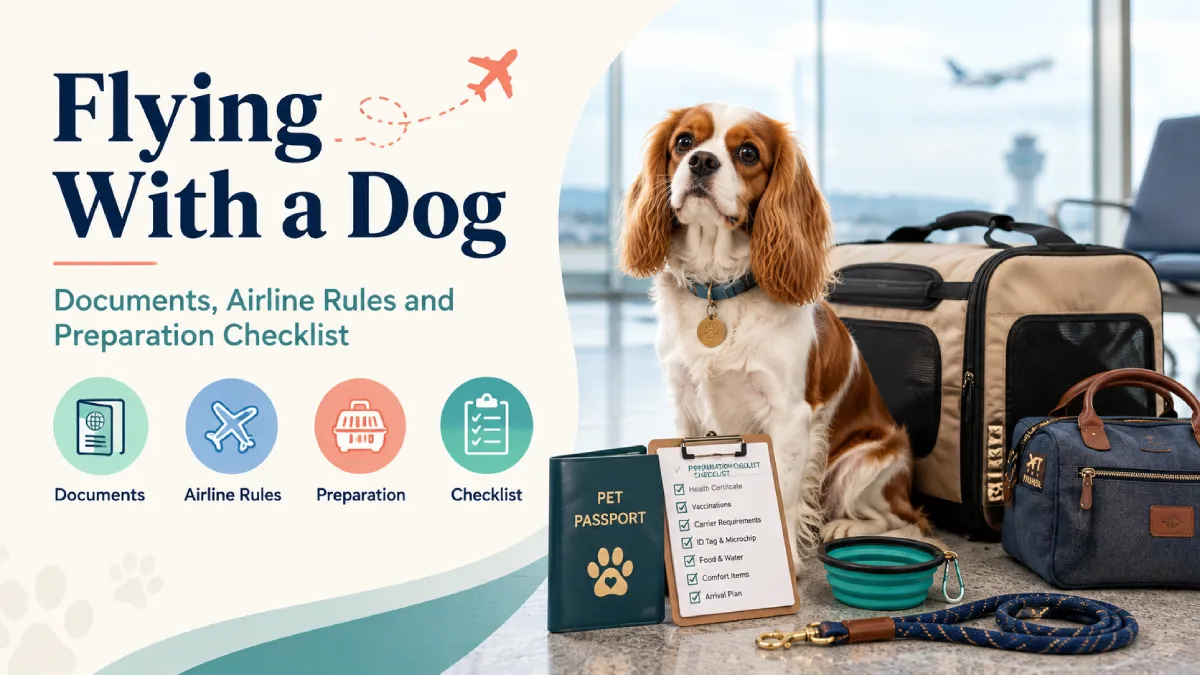
Flying With a Dog: Documents, Airline Rules and Preparation Checklist
Flying with a dog requires more preparation than reserving a ticket and buying a carrier. You may need to satisfy three separate sets of rules: the airline’s pet policy, requirements at your destination, and any rules that apply when returning home. International journeys can also involve transit-country requirements, veterinary certificates, microchips, vaccinations or other documentation.
Those rules can change. USDA APHIS specifically advises travellers to verify destination-country requirements for every trip, while the U.S. Department of Transportation notes that pet policies differ among airlines. CDC likewise advises researching both destination and return requirements before international travel.
This checklist explains what to investigate and prepare without assuming that one airline, carrier size or country-entry rule applies to every journey.
Quick Answer
Before flying, confirm that your dog is suitable for the proposed journey with your veterinarian, then check the airline, destination, transit and return-home rules for your exact itinerary. Confirm how the dog will travel, obtain any required veterinary documents, use an accepted carrier, keep identification current and verify every requirement again before departure. Airline and government requirements should be checked directly rather than copied from an older travel guide.
Start Planning Early
Air travel with a dog is one situation where leaving preparation until the final week can cause real problems.
USDA APHIS tells international travellers to contact an accredited veterinarian as soon as they decide to travel because destination requirements can include vaccinations, tests, treatments, certificates or official endorsements that take time to complete.
Begin by writing down:
- origin
- destination
- departure date
- return date
- airline
- flight numbers
- transit airports
- countries where customs may be cleared
- whether the dog travels in the cabin or another approved arrangement
Do not book the rest of the trip around an assumption that the dog will be accepted. Confirm pet availability on the exact flight first.
For broader planning beyond aviation, use Pawnium’s complete guide to traveling with a dog.
Check Destination Requirements
The destination government—not the airline—determines whether your dog meets that country’s animal-entry rules.
Requirements may concern matters such as identification, vaccination, testing, treatments, certification or other import documentation. USDA APHIS emphasises that destination-country rules can change and should be verified every time a pet travels internationally.
For each trip, find the official government animal-import page for the destination.
Record:
- what documents are required
- whether a microchip is required
- which vaccinations apply
- whether laboratory testing is required
- whether veterinary treatments are required
- whether official certificate endorsement is required
- where the dog may enter
- whether advance notification or permits are required
- what happens at arrival
Do not rely on an old blog post, forum answer or screenshot of someone else’s paperwork.
Last checked: August 14, 2026. Country-specific requirements should be rechecked directly with the relevant government before every trip.
Airline Requirements Are a Separate Set of Rules
Meeting government entry requirements does not automatically mean the airline will transport your dog.
The U.S. Department of Transportation states that airline pet policies vary. Carriers can impose their own restrictions concerning size, weight, age, behaviour, kennel type, seating, weather and how pets are transported.
Before paying for a ticket, ask the airline:
- Does this flight accept pet dogs?
- Is pet space still available?
- How may my dog travel?
- What dog-size restrictions apply?
- What carrier requirements apply to this flight?
- Are there breed restrictions?
- Are there age restrictions?
- Are there weather restrictions?
- What veterinary records are required?
- What is the pet check-in procedure?
- Are there connection restrictions?
- Does the aircraft type affect pet acceptance?
- What happens if the flight is changed or cancelled?
Check the airline’s current official pet policy immediately before publication or travel. Do not treat a rule copied from another airline as transferable.
Cabin Versus Other Transport Arrangements
Depending on the airline, route, aircraft and dog, a pet may be accepted in the passenger cabin or transported through another airline-approved arrangement.
DOT notes that some airlines provide cabin travel while others transport pets in the aircraft’s cargo hold. Policies differ by carrier.
Do not describe “cargo,” “checked pet,” “hold transport” and similar terms as though every airline uses them identically. Ask the airline what arrangement applies to your exact reservation and what handling process that arrangement involves.
Dog Size
A dog’s size can determine whether cabin travel is possible.
Many airlines impose size or weight restrictions for cabin pets, and a dog travelling in the cabin may need to fit inside an accepted carrier under the seat. DOT specifically notes that airline size and weight restrictions vary.
There is therefore no useful universal statement such as “dogs under X kilograms can always fly in cabin.”
Measure your dog and check the chosen airline.
Carrier Requirements
Do not purchase an expensive carrier solely because a retailer labels it “airline approved.”
The airline has the final say on what it accepts for your trip.
IATA’s current pet-transport guidance says containers should provide enough space for an animal to stand, sit, turn around and lie naturally. It also advises owners to become familiar with the carrier well before travel. Airlines can still impose additional specifications.
Check:
- permitted carrier type
- external dimensions
- ventilation requirements
- construction requirements
- closure system
- floor and leak-resistance requirements
- bedding rules
- labelling requirements
- water-container requirements
- whether wheels are allowed
- whether the dog must remain inside throughout the journey
For cabin travel, confirm measurements for the actual airline and aircraft rather than assuming one carrier-size rule applies universally.
Prepare the Required Dog Travel Documents
International dog travel documents can involve several separate records.
Your exact list depends on where the dog starts, where it is going, where it transits and where it will return.
Health Documentation
A veterinary health document may be required by the destination, airline or both.
DOT notes that some airlines require certified health records, while USDA APHIS explains that international certificates may need to follow destination-specific procedures and, in some cases, official endorsement.
Do not assume that an ordinary wellness-exam summary is equivalent to an official export health certificate.
Vaccination Requirements
There is no single vaccination list that applies to every flight.
Vaccination requirements may come from:
- destination government
- transit country
- return-home authority
- airline
- other applicable regulations
USDA tells travellers to have an accredited veterinarian determine the destination’s current requirements, including any vaccinations, testing or treatments.
Check requirements early enough to meet any officially specified sequence or waiting period.
Microchip
Microchip requirements also depend on the journey.
Some international systems connect the dog’s microchip number to vaccination or veterinary documentation. CDC’s current U.S. dog-import rules, for example, use microchip information as part of relevant import documentation for affected dogs.
That does not mean every destination follows the same microchip process.
Before travel:
- confirm the chip can be scanned
- confirm the number
- update your contact information
- make sure the number on documents is accurate
- check destination-specific microchip standards
Import, Export and Return Requirements Are Different
One of the easiest mistakes in flying internationally with a dog is researching only the destination.
A round trip can involve several regulatory stages.
Import Requirements
These are the rules for bringing your dog into the destination.
Use the official veterinary, agriculture, customs or animal-health authority for that country.
Export Requirements
Your country of departure may have procedures for issuing or endorsing veterinary documentation required by the destination.
For dogs leaving the United States, USDA APHIS advises working with a USDA-accredited veterinarian where international export documentation requires it.
Other countries have their own authorities and procedures.
Return-Home Requirements
Research the return before leaving.
CDC specifically advises travellers returning to the United States with dogs to ensure that the dog satisfies current U.S. entry requirements. Those requirements can depend on the dog’s travel history and other factors.
The same principle applies elsewhere: check the official authority responsible for bringing your dog back into your home country.
A document sufficient for entry into your holiday destination may not automatically be sufficient for the return journey.
Veterinary Preparation
Veterinary Appointment
A veterinary appointment should be part of planning when health documentation is needed or when you need individual advice about whether air travel is appropriate.
Give the veterinarian the actual itinerary, including:
- countries
- flight dates
- transit locations
- travel arrangement
- expected journey length
- known medical conditions
- regular medication
USDA notes that accredited veterinarians need details such as destination, travel date, transit countries and whether the animal travels with a person or through another transport arrangement when helping with international pet documentation.
Health Certificate
A dog health certificate for travel is not one universal form.
Different destinations and airlines can require different certificates, and some certificates may require official endorsement.
Do not create one generic deadline such as “get the certificate ten days before every flight.” Although some U.S. guidance and individual carriers use specific windows in particular situations, international certificate timing is determined by the rules that apply to the actual journey.
A veterinary certificate also should not be interpreted as a guarantee that nothing can go wrong during air transport.
Timing Requirements
Timing can apply to more than the date on a certificate.
Depending on the destination, there may be rules concerning:
- vaccination dates
- laboratory tests
- parasite treatments
- certificate issuance
- government endorsement
- permits
- arrival notifications
Because those intervals vary, the safest approach is to build your timetable from official destination instructions rather than from a generic internet countdown. USDA explicitly warns that the requirements can change.
Booking the Flight
Do not assume that purchasing a passenger ticket reserves space for your dog.
IATA advises contacting the airline to confirm that it will accept the pet on the intended day and flight, noting that airlines may limit how many animals they accept.
Get confirmation of the pet booking and keep the reservation information accessible.
Route Selection
Where practical, a simpler route can reduce handling, transfers and opportunities for disruption.
CDC recommends a direct flight where possible when a pet is travelling by air, particularly to reduce risks related to separation, layovers and extreme weather.
Route choice still needs to account for:
- legal entry points
- available pet services
- airline restrictions
- aircraft changes
- overall journey time
- climate
Connections
Connections require additional investigation.
Ask:
- Does the pet remain checked through?
- Must you collect and recheck the dog?
- Will customs clearance occur?
- Does changing airline change the rules?
- Does the transit country impose requirements?
- Is there an appropriate area for a toilet break?
- What happens during a missed connection?
CDC warns that, in some circumstances, clearing customs during a layover can affect how a country is treated in the dog’s travel history and therefore affect later entry requirements.
For international travel, give transit points the same attention as the final destination.
Weather Restrictions
Weather can affect whether an airline transports a pet.
DOT notes that some airlines restrict pet transport in aircraft cargo areas because of hot or cold temperatures and may impose seasonal restrictions.
Do not assume a confirmed pet reservation guarantees transport under every weather condition.
Before departure, ask what happens if:
- temperature limits are exceeded
- the flight is delayed
- the route changes
- the pet cannot be loaded
- an aircraft substitution changes eligibility
Have a backup plan.
Dogs That Need Extra Assessment
Brachycephalic Dogs
Short-nosed dogs deserve particular caution with air travel.
AVMA states that brachycephalic animals have increased risk of breathing problems and overheating during travel, especially air travel. DOT also notes that some airlines will not transport brachycephalic breeds because of respiratory risk.
A short muzzle does not tell you by itself whether a particular dog is fit to fly. Speak with your veterinarian about the individual dog and confirm the airline’s current restrictions before booking.
Pawnium’s brachycephalic dog care guide explains the broader breathing, heat and exercise considerations for short-nosed dogs.
French Bulldog owners should also use the dedicated French Bulldog breathing-care guide when that page is published rather than treating general breed information as a medical travel clearance.
Puppies
Puppies can face additional restrictions because age, vaccination status and import requirements may interact.
DOT notes that airlines can impose minimum-age policies, while government entry requirements may independently set age-related conditions.
Do not use one airline’s minimum age as a universal rule.
Check:
- airline age requirement
- destination animal-entry requirement
- vaccination eligibility and timing
- return-home rules
- individual veterinary fitness
Senior Dogs
Age alone cannot determine whether an older dog is medically fit to fly.
A senior dog may have cardiovascular, respiratory, mobility, endocrine or other health issues that make the individual assessment more important. AVMA recommends considering whether travel is appropriate for a pet when illness, injury or other concerns are present.
Ask your veterinarian whether the planned route and transport arrangement are reasonable for your dog’s current condition.
Medical Conditions
Dogs with existing medical problems need individual planning.
Questions for the veterinarian can include:
- Is air travel appropriate at all?
- Can normal medication timing be maintained?
- Does medication need refrigeration?
- What should happen if a dose is delayed?
- Could altitude, heat, handling or prolonged confinement create additional concerns?
- What emergency information should travel with the dog?
No online checklist can certify an individual dog as medically fit to fly.
A dog health check at home can help you recognise changes from your dog’s normal baseline before departure, but it does not replace veterinary examination.
Food, Water and Medication
Feeding Before Travel
Do not make a sudden diet change simply because you are flying.
Keep the dog’s usual food available and discuss meal timing with your veterinarian if the dog has motion sickness, diabetes, gastrointestinal disease or another condition affected by feeding schedules.
AVMA advises using smaller portions during long journeys rather than unexpectedly changing the pet’s normal diet, while IATA provides travel-specific feeding guidance for animals being transported by air.
Follow any applicable airline instructions for food containers or feeding during longer transport.
Water
Plan hydration rather than withholding water to prevent accidents.
CDC recommends providing water for animals travelling by air and includes water-container preparation in its cargo-travel guidance.
Check what your airline permits inside the carrier and how water is provided if your dog is not travelling in the cabin.
Medication and Sedation Questions
Routine sedation should not be treated as a simple way to make a dog quiet on a flight.
IATA discourages sedating or tranquilising animals specifically for transport because these drugs can have adverse effects and reduce an animal’s ability to respond normally during travel. When medication is considered medically necessary for a journey, IATA advises that it be used under veterinary direction.
Do not give:
- human sedatives
- leftover prescription medication
- an unfamiliar calming drug
- a different dose of an existing medication
without veterinary instruction.
If your dog is highly distressed by carriers or travel, discuss the problem well before departure rather than experimenting on flight day.
Airport Routine
Before leaving for the airport:
- confirm the flight is operating
- reconfirm that the pet reservation is active
- check current weather restrictions
- check your documents
- ensure identification is attached as required
- give your dog an appropriate toilet opportunity
- bring food, water and medication according to the plan
- allow enough time for the airline’s pet check-in procedure
CDC recommends allowing dogs an opportunity to relieve themselves before being secured for air transport.
Follow the airline’s requested arrival time rather than relying on a generic recommendation.
Security Screening
Airport security procedures differ by country.
For U.S. TSA checkpoints, current TSA guidance says a small pet should be removed from its carrying case, the empty carrier goes through X-ray screening, and the traveller should maintain control of the animal during the process. The dog itself should not be sent through the X-ray machine.
If you are worried your dog may escape when removed, tell security staff before opening the carrier and ask what screening options are available.
Outside the United States, check the relevant airport or security authority.
Arrival
Do not treat touchdown as the end of the travel plan.
After arrival:
- follow the airline’s collection procedure
- check the dog before leaving the airport
- offer an appropriate toilet opportunity
- provide water
- inspect the carrier
- check for obvious injury or distress
- confirm medication timing
- keep documents accessible until all entry procedures are complete
If your dog appears seriously unwell, prioritise veterinary care over continuing the holiday itinerary.
International Arrival Procedures
International arrivals may involve animal-health inspection, customs, document checks or other procedures determined by the destination.
USDA advises following the official destination country’s requirements because those rules can change at any time.
Keep original or required versions of documents accessible rather than placing them in luggage you cannot reach.
Do not assume a digital photograph of a certificate is acceptable when an authority requires the original.
Emergency Planning
Before flying, save:
- your regular veterinarian
- destination veterinarian
- 24-hour veterinary hospital if available
- airline pet desk or cargo contact
- airport animal-handling contact where relevant
- backup accommodation
- emergency contact at home
AVMA recommends keeping veterinary emergency numbers available when travelling with a pet and carrying an appropriate travel first-aid kit.
Pawnium’s Dog Emergency Kit should remain the dedicated resource for first-aid supplies rather than duplicating a large medical packing list here.
Pre-Flight Checklist
Rules and Booking
- Destination requirements checked on official government site
- Transit-country requirements checked
- Return-home requirements checked
- Airline currently accepts the dog
- Pet space confirmed on exact flight
- Travel arrangement confirmed
- Airline breed restrictions checked
- Airline age restrictions checked
- Weather restrictions checked
- Connection procedures checked
Veterinary Preparation
- Veterinary appointment arranged if needed
- Dog’s individual fitness to travel discussed
- Vaccination records reviewed
- Microchip requirements checked
- Required tests completed
- Required treatments completed
- Correct health certificate obtained
- Government endorsement completed if required
- Medication supply prepared
Carrier
- Exact airline carrier rules checked
- Dog measured
- Carrier size confirmed
- Dog can stand and rest appropriately
- Carrier closures checked
- Identification attached where required
- Dog accustomed to carrier before travel
Travel Day
- Pet reservation reconfirmed
- Required documents accessible
- Dog wearing current identification
- Food packed
- Water arrangements ready
- Medication accessible
- Toilet break provided
- Emergency contacts saved
- Arrival procedure reviewed
FAQs
How far in advance should I start preparing to fly internationally with my dog?
Start researching as soon as the trip becomes likely. USDA APHIS advises travellers to contact an accredited veterinarian as soon as they decide to travel internationally because destination requirements may involve several steps and can change.
Does every dog need a health certificate to fly?
No universal rule applies to every journey. A health certificate may be required by an airline, destination government or other authority, and the type and timing can differ. Check both the airline and official government requirements for the specific trip.
Can my dog fly in the cabin with me?
Possibly, but it depends on the airline, dog’s size, carrier, route and other restrictions. DOT confirms that airline policies differ and that many carriers impose cabin size and weight limits.
Can I sedate my dog before a flight?
Sedation should not be used routinely simply to keep a dog quiet. IATA discourages sedation or tranquilisation specifically for transport because of possible adverse effects. Discuss any medication with your veterinarian well before travel.
Are short-nosed dogs safe to fly?
Brachycephalic dogs can have greater difficulty with breathing and temperature regulation during travel, and some airlines restrict their transport. Whether an individual dog should fly requires veterinary assessment plus confirmation of the airline’s current rules.
Do I need to check the rules for the return flight too?
Yes. Entry requirements for returning home can differ from the requirements for your destination. CDC specifically tells travellers returning to the United States to check current U.S. dog-entry requirements, and the same principle applies to other countries’ official authorities.