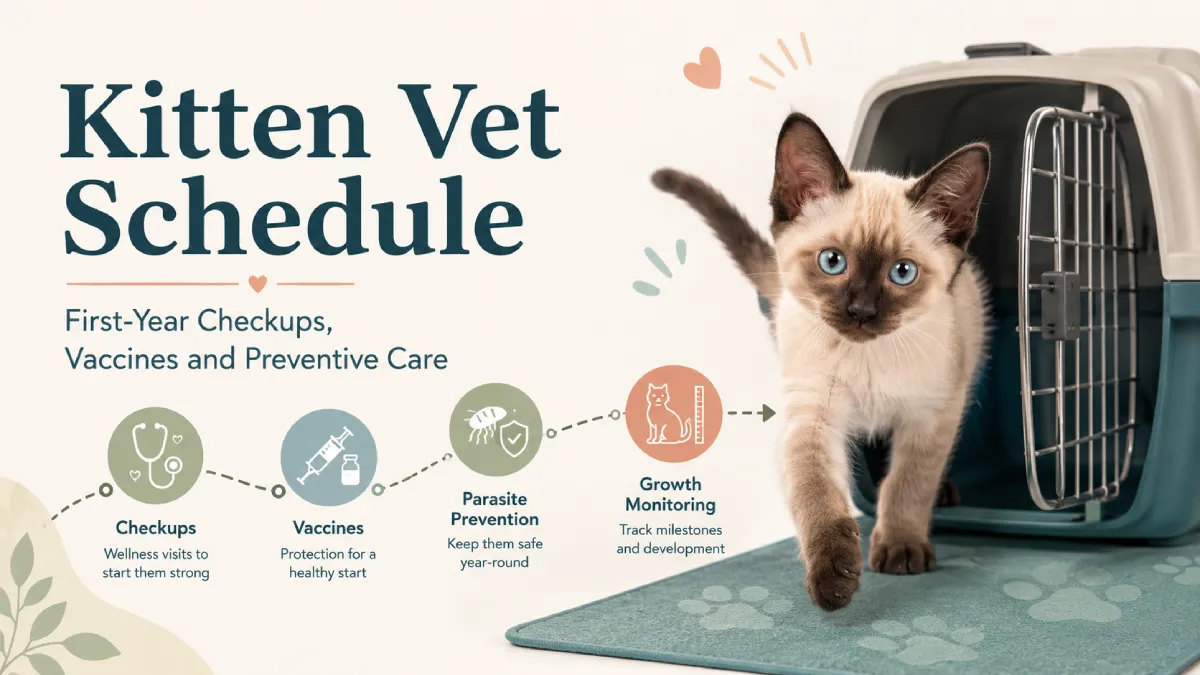
Kitten Vet Schedule: First-Year Checkups & Vaccines
A kitten’s first year involves much more than vaccines. Veterinary care tracks growth, body condition, heart and lungs, eyes, ears, mouth, skin, parasites, retrovirus risk, nutrition, behaviour, microchip status and spay/neuter planning. Several visits are usually needed because vaccination and parasite protocols unfold over time and maternal antibodies can affect early vaccine response.
Quick answer
Arrange a first veterinary appointment soon after bringing home a new kitten, then follow the clinic’s schedule for the primary vaccine series, parasite management, testing and growth checks. The exact dates depend on age, previous shelter or breeder care, health, vaccine history, product labels and lifestyle risk.
First appointment and medical history
Bring all records from the shelter, rescue, breeder or previous caregiver. The veterinarian needs dates and products for vaccines, deworming, flea treatment, tests, microchip placement and any illness so unnecessary repetition can be avoided.
Physical examination
The first examination usually assesses overall appearance, hydration, temperature as appropriate, heart and lungs, abdomen, eyes, ears, mouth, skin, coat, limbs and external anatomy. Findings create a baseline for future visits.
Weight, growth and body condition
Record weight at each visit and compare the trend with the kitten’s age and development. Growth should not be judged by body weight alone; body condition and muscle development also matter.
Heart and lungs
The veterinarian listens for heart murmurs, abnormal rhythms and respiratory sounds. Some juvenile findings resolve with age while others require follow-up, so the meaning depends on the examination and the individual kitten.
Eyes, ears, mouth, skin and coat
Kittens may arrive with conjunctivitis, ear mites, skin disease, parasites or dental-development concerns. The veterinary team can distinguish normal juvenile findings from problems requiring treatment.
Parasites and stool testing
Kittens are particularly vulnerable to intestinal parasites. CAPC supports age-appropriate anthelmintic management and repeated faecal testing based on risk. A normal-looking stool does not rule out infection.
Deworming
Do not use one universal dewormer or dose. Different products cover different parasites, and age and weight restrictions matter. Bring previous treatment records so the veterinarian can continue rather than guess the plan.
Fleas, ticks and heartworm risk
Parasite prevention should be kitten-safe, weight appropriate and selected for local risk. Never apply a dog flea or tick product to a kitten. Mosquito exposure also makes heartworm prevention a discussion even for indoor kittens in risk areas.
Vaccination series
The core kitten series protects against FPV, FHV-1 and FCV through repeated doses because maternal antibodies can interfere with early vaccination. Rabies timing follows product and local law. FeLV vaccination is considered core for cats under one year in the 2020 AAHA/AAFP guidance.
FeLV and FIV testing
Retrovirus testing is recommended after acquisition and when exposure risk warrants it. FIV antibody results in young kittens can be complicated by maternal antibodies, while FeLV status should be established before FeLV vaccination.
Microchip
Microchipping provides permanent identification and is recommended regardless of lifestyle. Confirm that the chip is registered with current contact information rather than assuming implantation alone completes the process.
Nutrition and kitten feeding
Discuss the exact food, quantity and meal pattern. Growing kittens need complete and balanced food formulated for growth. Overfeeding can still produce excessive body condition, so growth should be monitored rather than encouraged without limit.
Litter-box habits
Ask about litter preference, stool consistency, urination and any house-soiling. Repeated straining, diarrhoea or failure to use the box can have medical or environmental causes and should not be dismissed as “bad training.”
Behaviour and socialisation
The first year is important for learning and social development. Discuss handling, play, scratching, bite inhibition, carrier training and gradual exposure to normal household experiences. Use positive reinforcement rather than punishment.
Grooming and dental handling
Introduce gentle paw, coat, ear and mouth handling when the kitten is relaxed so future grooming and veterinary care are easier. Do not force prolonged restraint. Tooth-brushing training can begin gradually with cat-safe products.
Spay/neuter planning
For cats not intended for breeding, current feline guidance supports sterilisation by about five months for many kittens. Schedule the procedure based on individual health and the clinic’s protocol rather than waiting automatically until six months or later.
Travel and boarding considerations
If the kitten will travel, board or attend daycare-like environments, tell the veterinarian because exposure risk can change vaccination and parasite planning. Keep the microchip registration and vaccine records accessible.
Follow-up appointments
Each visit should review what has already been completed and what remains: vaccine doses, parasite testing, weight trend, nutrition, microchip, sterilisation, behaviour and any findings from the previous exam.
When illness requires earlier assessment
Do not wait for the next scheduled kitten visit if the kitten has persistent vomiting or diarrhoea, stops eating, becomes markedly lethargic, has breathing difficulty, repeatedly strains to urinate, develops severe eye disease or appears weak or dehydrated. Young kittens can deteriorate quickly.
First-year health record
Keep dates, weights, vaccine names, parasite products, test results, microchip number, sterilisation date and next-visit plan together. A complete record makes future care more accurate and prevents avoidable duplication.
How previous shelter or breeder care changes the schedule
A kitten may already have received vaccines, parasite treatment, FeLV/FIV testing or a microchip before adoption. Bring the original records rather than starting over. The veterinarian can determine whether dates and products meet the current guideline and whether any part of the series still needs completion.
Why growth monitoring is more than weighing the kitten
Rapid weight gain is expected during growth, but the goal is healthy development rather than maximum size. The veterinary team also evaluates body condition, muscle development, skeletal growth and whether the kitten is tracking appropriately for its individual background.
Congenital and developmental findings
Early examinations can identify murmurs, hernias, retained or abnormal teeth, eye problems, limb abnormalities and other findings that may need monitoring. Some juvenile findings resolve, while others require investigation or alter the timing of anaesthesia and surgery.
Parasite prevention between appointments
Kittens grow quickly, so product eligibility and dosing can change with age and weight. Never keep applying the same amount indefinitely without checking the label and current weight. If a dose is missed, ask the clinic how to resume the plan rather than doubling it.
Vaccines are only one part of kitten preventive care
It is easy for owners to think the “kitten schedule” ends when the last injection is given. Nutrition, sterilisation, microchip registration, dental handling, social development and parasite control continue beyond the vaccine series. The first-year record should keep these tasks together.
FeLV exposure planning
Because young cats are more susceptible to FeLV, vaccination is considered core through the first year in the 2020 AAHA/AAFP guidelines. Testing still comes first. A vaccinated kitten should not be deliberately exposed to FeLV-positive cats because vaccination is not completely protective.
FIV testing after possible exposure
If a kitten is bitten by an unknown cat or has another significant exposure, the timing of FIV testing matters because antibodies take time to develop. Young kittens can also carry maternal antibodies. Follow-up testing may therefore be required rather than relying on one early result.
Preparing for spay or neuter
Ask about surgery early enough to avoid missing the recommended timing. The clinic can explain preoperative examination, fasting instructions, transport, pain control, activity restriction and incision monitoring. Do not impose an adult fasting schedule on a young kitten without instructions.
Carrier and veterinary-visit training
Leave the carrier out as normal furniture and pair it with bedding, treats and calm experiences. Gentle handling of paws, mouth and ears can also make future examinations less stressful. Training should remain voluntary and should never involve chasing a kitten into the carrier.
Kitten Preventive Care Milestones
- First exam and record review
- Growth and body-condition baseline
- Primary vaccination series
- FeLV/FIV testing decisions
- Age-appropriate parasite prevention
- Microchip implantation and registration
- Nutrition review
- Spay/neuter planning
- Dental and grooming handling
- Behaviour and socialisation discussion
- First-year booster/review appointments
Why the first-year schedule cannot be reduced to vaccine dates
Vaccines are important, but each kitten visit is also an opportunity to check growth, parasites, nutrition, congenital abnormalities, behaviour, oral development and preparation for spay or neuter. A kitten that appears healthy at home may still have a problem worth identifying early.
Use vaccine reminders as part of a broader preventive-care record rather than treating the appointment as an injection-only visit.
What happens at the first veterinary appointment
The veterinarian reviews where the kitten came from, age estimate, previous vaccines or deworming, diet, litter habits and any illness since adoption. Bring shelter, breeder or rescue records so unnecessary repeat procedures can be avoided where possible.
The physical examination typically includes body weight and condition, temperature when indicated, heart and lungs, eyes, ears, mouth, abdomen, skin, coat, limbs and overall development. Findings determine whether the planned preventive care can proceed normally or whether diagnostic work is needed.
Why accurate age and previous records matter for vaccination
Maternal antibodies can interfere with early vaccine response, which is why core kitten vaccines are given as a series rather than a single universal injection. The schedule depends on the kitten’s age when the series begins, previous doses, product label and veterinarian’s assessment.
Do not restart or improvise a vaccine series because an appointment was missed. Bring the record and let the veterinary team determine the next dose.
FeLV vaccination and kitten lifestyle planning
Current AAHA/AAFP guidance treats FeLV vaccination as core for kittens and young cats during the initial period, with continued vaccination in older cats based on exposure risk. Testing before FeLV vaccination is recommended because the vaccine does not treat an existing infection.
Discuss whether the kitten will live strictly indoors, encounter other cats, board, travel, foster or have outdoor access. Lifestyle plans can change, so vaccination decisions should be reviewed rather than made once for life.
FeLV/FIV testing in a new kitten
Retrovirus testing can be appropriate after acquisition, following possible exposure and when illness raises concern. Interpretation in kittens requires context because maternal antibodies can affect FIV antibody testing, and recent exposure can affect when infection becomes detectable.
A single result should not be used outside the kitten’s age and exposure history. Your veterinarian can decide whether repeat or alternative testing is needed.
Parasite prevention through the first year
Kittens can acquire roundworms, hookworms, fleas and other parasites early in life. CAPC recommends repeated early parasite management and routine faecal assessment based on age, environment and lifestyle.
Product choice and dosing are weight- and species-specific. Because kittens grow rapidly, never keep using an old dose without checking the current weight and label instructions.
Heartworm, flea and tick planning
Risk varies by region and lifestyle, but indoor kittens are not automatically at zero risk. Mosquitoes can enter homes, fleas can arrive on other animals, and travel or accidental escape can change exposure.
Your veterinarian can recommend cat-specific products that match local parasite risk. Never use dog-only flea or tick products on a kitten.
Growth and nutrition review
Record weight at each visit and look at the trend rather than focusing on one number. The veterinarian can also assess body condition and growth relative to age and development.
Feed a complete and balanced diet formulated for growth unless a veterinary medical reason requires something different. Bring the product name and daily amount to appointments so feeding can be adjusted as the kitten grows.
Behaviour and socialisation are preventive health topics
Veterinary visits are a chance to discuss handling, play, scratching, litter habits, fear and introduction to routine care. Gentle exposure to carrier travel, nail handling, tooth brushing and examination can make future healthcare easier.
Use reward-based methods and do not force a frightened kitten through repeated handling simply to “get them used to it.”
For carrier preparation, see Cat Carrier Training.
Planning microchipping
Microchipping provides permanent identification but must be registered with current owner details. Some kittens are chipped before adoption, while others are microchipped at a later veterinary visit or during another procedure.
Ask the clinic to scan for an existing chip before implanting another one, and keep the number in the kitten’s permanent health record. See Microchipping Cats for registration and maintenance.
Planning spay or neuter
AAHA’s current cat guidance supports the Fix Felines by Five approach for cats not intended for breeding, while the veterinarian still considers the individual kitten’s health and circumstances.
Discuss timing before sexual maturity, not after a heat cycle or roaming behaviour has already created an urgent problem. See Spaying and Neutering Cats.
When illness should move the appointment earlier
Do not wait for the next vaccine appointment if a kitten develops repeated vomiting or diarrhoea, refusal to eat, marked lethargy, breathing difficulty, eye or nasal discharge with illness, painful urination, collapse or another significant change.
Young kittens can deteriorate faster than healthy adults, so contact the veterinary clinic promptly when you are unsure about a new symptom.
How the schedule changes after the first year
Once the kitten series, parasite plan, microchip and sterilisation decisions are established, preventive care transitions toward adult wellness visits. Vaccination boosters, parasite control, dental assessment, nutrition and lifestyle risk continue to be reviewed rather than ending after kittenhood.
Keep the first-year record because it becomes the foundation for future vaccine and medical decisions.
Keep one record that follows the kitten into adulthood
Store vaccine certificates, microchip number, test results, parasite-product names, spay/neuter details and significant medical history together. This prevents future clinics, boarding facilities or caregivers from having to reconstruct the first year from memory.
Bring this record to every new clinic so the kitten’s preventive history remains continuous.
First-Year Kitten Veterinary Record
| Date | Weight | Exam/vaccine/test | Parasite care | Microchip/spay-neuter | Nutrition/behaviour | Next visit |
|---|---|---|---|---|---|---|
| ________ | ________ | ________ | ________ | ________ | ________ | ________ |
| ________ | ________ | ________ | ________ | ________ | ________ | ________ |
| ________ | ________ | ________ | ________ | ________ | ________ | ________ |
| ________ | ________ | ________ | ________ | ________ | ________ | ________ |
| ________ | ________ | ________ | ________ | ________ | ________ | ________ |
FAQs
When should a new kitten first see a vet?
Arrange a first appointment soon after acquisition, especially when records are incomplete or the kitten has not already received a post-adoption examination.
How many vet visits does a kitten need in the first year?
There is no single number for every kitten. Multiple visits are usually needed for the vaccine series, parasite care, growth checks and sterilisation planning.
Do indoor kittens need FeLV vaccination?
The 2020 AAHA/AAFP guidelines consider FeLV vaccination core for cats younger than one year because young cats are more susceptible. Future boosters become risk based.
Should kittens be tested for FIV and FeLV?
Retrovirus testing is commonly recommended after acquisition. Interpretation, especially for FIV in young kittens, can require age-aware follow-up.
When should a kitten be spayed or neutered?
For many cats not intended for breeding, feline-specific guidance supports sterilisation by about five months, with individual timing decided by the veterinarian.