Maine Coon vs Ragdoll: Size, Temperament, Grooming and Lifestyle
Choosing between a Maine Coon vs Ragdoll is less about finding the “better” breed and more about deciding which set of tendencies fits your household. Both are large, slow-maturing, semi-longhaired cats that are generally people-oriented, but Maine Coons tend to be more exploratory and playful, while Ragdolls generally have a lower-key activity style. Coat texture, handling preferences and health-screening responsibilities also differ.
Individual cats can fall outside those patterns. A particularly calm Maine Coon or athletic Ragdoll is still normal, and neither breed guarantees lap-cat behaviour, child compatibility or tolerance of being carried.
Quick Verdict
Consider a Maine Coon first if you want a large companion that generally retains a stronger interest in exploration, climbing and interactive play, and you are comfortable with a shaggy coat whose grooming workload can vary considerably between individuals. Maine Coons are social without necessarily being constant lap cats and often communicate with chirps or trills.
Consider a Ragdoll first if you prefer a generally calmer adult activity style, a silky semi-long coat with relatively little woolly undercoat, and a strongly people-oriented cat. Do not choose one solely because you expect it to go limp or enjoy being carried: CFA specifically notes that the historic limp-when-held trait is not typical of most modern Ragdolls.
Neither is a low-commitment breed. Both need appropriately sized equipment, regular grooming, play, body-condition management and responsible HCM screening.
Side-by-Side Comparison
| Trait | Maine Coon | Ragdoll |
|---|---|---|
| General size | Large; males usually larger | Large; males usually larger |
| TICA adult female reference | About 12–15 lb | About 10–15 lb |
| TICA adult male reference | About 18–22 lb | About 15–20 lb |
| Maturation | Slow; several years | Slow; up to about four years |
| Body | Long, rectangular, muscular, rugged | Long, substantial, heavy-boned |
| Coat | Shaggy semi-long coat; texture varies | Silky semi-long coat with comparatively little woolly undercoat |
| Grooming | Moderate to sometimes higher | Usually moderate |
| Activity tendency | Moderate, playful and exploratory | Lower to moderate in adults |
| Climbing | Often enthusiastic | Capable and should still have vertical space |
| Vocal style | Chirps, trills and occasional meows common | Generally quieter tendency |
| Affection style | Social; often nearby, not always lap-oriented | Generally affectionate and people-oriented |
| Handling | Individual preference | Do not assume limpness or carrying tolerance |
| Apartment fit | Possible with substantial enrichment and large-cat equipment | Often practical if enrichment and large-cat needs are met |
| Health-screening focus | HCM, SMA, PK deficiency; orthopedic screening may also be discussed | Ragdoll HCM variant plus appropriate broader cardiac assessment |
The weight figures above are registry reference ranges rather than goals. CFA’s Maine Coon standard specifically says quality should not be sacrificed for size, and both breeds show normal sex and individual variation.
Size: Which Breed Is Bigger?
The Maine Coon vs Ragdoll size comparison is closer than many online photos suggest.
TICA currently lists Maine Coon females around 12–15 pounds and males around 18–22 pounds. For Ragdolls, it lists females around 10–15 pounds and males around 15–20 pounds. These ranges overlap substantially, although Maine Coons tend to extend somewhat higher at the male end.
That does not mean every Maine Coon is larger than every Ragdoll.
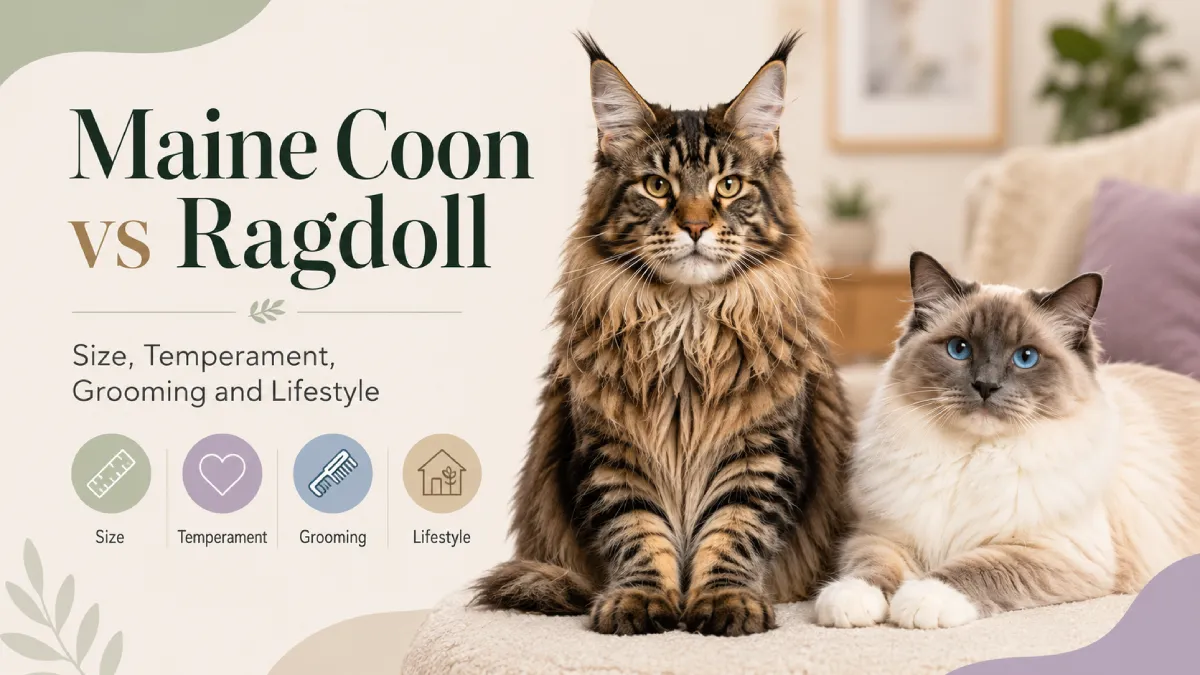
A large female Ragdoll can outweigh a smaller Maine Coon, and body structure also changes how size looks. Maine Coons have a long rectangular frame, large paws, a shaggy coat and a large tail. Ragdolls also have long substantial bodies, but their softer coat and pointed appearance create a different visual impression.
Avoid viral “giant Maine Coon” examples when comparing normal adults. Use body condition, muscle condition and the actual frame of the individual cat rather than trying to make either breed reach a particular impressive number.
Growth and Maturation
Both breeds mature slowly.
TICA says Maine Coons do not typically reach full maturity until around four years, while its detailed breed information describes development extending over several years. CFA also describes Maine Coons as slow-maturing.
Ragdolls also develop gradually. TICA says they may take up to about four years to reach full physical size, while colour continues developing during the early years. CFA describes full coat and colour as continuing to develop into maturity.
For either breed, slow maturation is not an excuse to overfeed a young cat in an attempt to make it grow larger.
Appearance
The easiest visual differences involve the head, coat and colouring.
Maine Coon
A Maine Coon typically has:
- a long rectangular body
- a visibly square muzzle
- large tufted ears
- large expressive eyes
- a long flowing tail
- a rugged shaggy coat
CFA emphasises balance and specifically states that no anatomical feature should be exaggerated simply to increase size.
Ragdoll
A Ragdoll typically has:
- a long substantial body
- a modified wedge-shaped head with softer contours
- blue eyes
- a pointed colour pattern
- a silky semi-long coat
- colourpoint, mitted or bicolour patterning
All recognised Ragdolls are blue-eyed pointed cats, although the exact point colours and white patterns vary.
Coat Differences
The coats look similarly long in photographs but are not identical.
The Maine Coon coat is heavy and shaggy, shorter over the shoulders and longer around the stomach, hindquarters and ruff. CFA describes the texture as silky while TICA notes that coat-maintenance needs can vary by individual.
The Ragdoll coat is moderately long and soft, with abundant guard hairs but relatively little woolly undercoat in the CFA standard. That structure can make routine maintenance comparatively straightforward for a semi-longhaired breed, although tangles still occur.
So if coat predictability matters, the Ragdoll often has the edge. A Maine Coon’s grooming workload can vary more significantly with coat texture.
Maine Coon vs Ragdoll Grooming
Both breeds need regular hands-on coat care.
CFA recommends combing a Maine Coon several times per week to manage loose fur, mats and hair ingestion, although individual coat texture changes the workload.
For Ragdolls, TICA recommends regular weekly combing or more frequent care as needed, with particular attention during shedding periods and around areas such as the armpits.
A useful summary is:
Ragdoll: generally moderate, fairly predictable semi-long-coat maintenance.
Maine Coon: moderate overall, but potentially more variable and sometimes more intensive.
Neither should be chosen by someone expecting a long-haired cat that never needs combing.
For the full coat, nail, dental and hygiene routine, use Pawnium’s Cat Grooming Guide.
Shedding
Both breeds shed.
TICA specifically describes seasonal changes in the Ragdoll coat, including increased shedding during parts of the year. Maine Coon grooming recommendations similarly include loose-coat management to control shedding.
The amount you see around the house will still vary according to:
- individual coat density
- season
- indoor environment
- grooming routine
- health
Do not use “Ragdolls have little undercoat” to claim that they are non-shedding.
Hairballs
Longer coats increase the amount of loose fur available for swallowing during self-grooming.
Cornell specifically identifies long-haired breeds, including Maine Coons, as having increased hairball risk and recommends regular brushing and combing to reduce loose fur available for ingestion.
The same practical principle applies to Ragdolls: loose coat removed by a comb is coat the cat cannot swallow later.
Repeated vomiting, repeated unproductive retching or appetite changes should not simply be labelled “normal hairballs” because either cat has long fur.
Maine Coon vs Ragdoll Temperament
The biggest practical difference in Maine Coon vs Ragdoll temperament is usually one of intensity rather than friendliness.
Maine Coons are generally social, gentle and playful. TICA describes them as companions that often follow their people but are not necessarily lap cats, while CFA notes a fairly independent side alongside social interaction.
Ragdolls generally trend calmer and more placid. CFA describes them as gentle, sociable and affectionate, while TICA places them toward the quieter, lower-activity end of breed behaviour.
That does not mean:
Maine Coon = hyperactive
or:
Ragdoll = motionless.
Both still need daily play and normal feline enrichment.
Activity
If you actively want a more involved play partner, the Maine Coon often has the stronger fit.
CFA describes the breed as easy-going yet active, while TICA notes that many retain playful behaviour throughout life.
Ragdolls generally have a calmer adult activity style, although TICA explicitly notes that kittens and young adults can be rambunctious and adults still require interactive play to maintain healthy body condition.
A lower activity tendency is not the same as being sedentary.
Play
Both breeds commonly respond well to interactive play.
Maine Coons often enjoy:
- wand games
- chasing
- retrieving if the individual chooses
- food puzzles
- exploration
- short training sessions
Ragdolls can enjoy the same activities but may prefer shorter or lower-intensity sessions as adults. TICA still recommends interactive toys and cat trees for them.
FelineVMA advises that all indoor cats should have opportunities for play and normal predatory-type behaviour, regardless of breed.
Climbing
A Maine Coon generally has a stronger reputation for climbing and environmental exploration, so large, stable vertical territory is particularly useful.
Ragdolls should not be treated as cats that “cannot jump.” TICA recommends cat trees and suitable scratching/resting structures for the breed.
For both, equipment must fit a genuinely large adult cat.
A platform that comfortably holds a five-pound kitten may become too small once the cat reaches maturity.
Vocalisation
Maine Coons are commonly associated with chirps and trills rather than constant loud meowing. CFA and TICA both mention this communication style, although individual frequency varies.
Ragdolls generally trend quieter and are not considered a particularly talkative breed by TICA.
If household noise is a major concern, the Ragdoll may have a slight breed-level advantage—but neither breed is guaranteed to be quiet.
Affection
Both are generally affectionate, but the way affection appears can differ.
A Maine Coon may follow people, sit nearby, participate in household activity and seek interaction without necessarily choosing the lap.
A Ragdoll generally trends strongly people-oriented and affectionate. CFA describes the breed as loving without necessarily being demanding.
The important distinction is that affection does not equal handling tolerance.
Handling and Being Carried
This section is especially important for the Ragdoll.
The breed’s name came from historic claims that the founding cats became limp when held. CFA explicitly says this behaviour is not typical of most modern Ragdolls.
Therefore, do not choose a Ragdoll because you want a cat that can be carried around whenever you wish.
Maine Coons also vary greatly in handling preference.
For both breeds:
cat approaches and stays voluntarily → continue
cat wants down → put the cat down
Breed reputation should never override individual consent.
Children
Both breeds are commonly described by the registries as capable of living successfully with children, but that is a tendency rather than a guarantee.
The more useful selection questions are:
- Does this individual cat tolerate normal household noise?
- Does it enjoy or merely endure handling?
- Can the child respect when the cat walks away?
- Does the cat have safe retreat areas?
A large body does not make rough handling harmless.
Living With Other Cats
Both breeds can live successfully in multi-cat households.
TICA describes Maine Coons and Ragdolls as commonly tolerant of other cats, but a breed description cannot predict whether two specific individuals will share resources comfortably.
FelineVMA emphasises that each cat in a multi-cat home needs adequate environmental resources and that individual relationships still matter.
Do not obtain a second cat purely because one breed is described as social.
Living With Dogs
Both breeds are also commonly reported as compatible with cat-friendly dogs.
The dog’s behaviour remains the deciding factor.
A relaxed Ragdoll or confident Maine Coon should still have:
- escape routes
- dog-free rest areas
- vertical refuge
- gradual introductions
Breed friendliness does not make chasing or cornering acceptable.
Apartment Living
Both breeds can live in apartments if the home is genuinely equipped for a large cat.
FelineVMA recommends safe resting places, appropriate toileting resources, play, foraging opportunities and vertical territory for indoor cats.
Maine Coon
Potentially very workable, but account for:
- larger litter boxes
- sturdy climbing furniture
- more active play
- room for exploration
Ragdoll
The generally lower-key activity tendency may make apartment life somewhat easier, but a Ragdoll still needs:
- vertical options
- play
- large equipment
- scratching
- social interaction
Do not select an apartment breed based only on activity. Body size matters too.
First-Time Owners
Either breed can work for a first-time cat owner who has realistic expectations.
A Ragdoll may appear easier because adult activity is generally lower and the coat often has less woolly undercoat. But first-time owners can still be surprised by the large adult size, shedding, social needs and HCM-screening responsibilities.
A Maine Coon may suit a first-time owner who actively wants more play, exploration and climbing and does not mind a less predictable shaggy-coat workload.
The more useful question is not:
Which breed is easier?
It is:
Which set of daily responsibilities would I still be comfortable doing several years from now?
Feeding
Neither breed needs a special “large-cat” feeding quantity simply because it is capable of reaching a substantial adult weight.
Food intake should be adjusted to the individual cat’s:
- age
- activity
- neuter status
- food calorie density
- health
- body condition
Large-breed weight ranges should never become targets owners intentionally feed toward.
For actual food amounts and portion adjustment, Pawnium’s Cat Feeding Guide should carry the detailed feeding intent.
Weight Management
Both breeds can hide excess body fat beneath substantial coats.
Ragdoll breed information specifically emphasises maintaining body condition through interactive play, and Maine Coons should likewise be evaluated as large-framed cats rather than assumed to need maximum body weight.
Use hands-on body-condition assessment rather than appearance alone.
A cat can be:
large + healthy
or:
large + overweight.
Those are not the same thing.
Health Screening
This is one of the most important differences when choosing a breeder.
Maine Coon
A Maine Coon-associated MYBPC3 A31P variant is linked with increased HCM risk, and UC Davis provides a DNA test for that specific mutation. UC Davis also offers breed-specific testing for spinal muscular atrophy, while PK-deficiency screening is considered appropriate for Maine Coons.
CFA also notes the use of orthopedic screening such as hip radiography in responsible Maine Coon breeding programmes.
Ragdoll
Ragdolls have their own breed-associated HCM variant, MYBPC3 R820W, for which UC Davis provides a specific DNA test. Importantly, UC Davis states that this assay detects that particular Ragdoll-associated mutation—it does not test for every possible cause of feline HCM.
DNA Testing Is Not the Whole HCM Story
Cornell identifies echocardiography as the gold standard for diagnosing feline HCM, and FelineVMA supports preventive testing such as echocardiographic screening where HCM is relevant in breeding.
Therefore, when comparing breeders, ask:
Which breed-specific DNA tests were done?
and:
What cardiac imaging or other health screening is used?
A vague “HCM clear” statement is not enough information.
TICA also recommends asking for actual health and genetic records for both parents rather than relying on verbal assurances.
Grooming Commitment
If grooming workload is your main deciding factor, the Ragdoll often has a modest practical advantage.
Its silky coat with relatively little woolly undercoat tends to be more predictable, although it still needs regular combing and can tangle around friction areas.
The Maine Coon’s shaggy coat can range from relatively easy to considerably denser and more maintenance-intensive. CFA therefore recommends frequent combing to manage shedding, mats and swallowed loose hair.
Neither should be classed as low-grooming.
A Maine Coon May Suit You More If…
A Maine Coon may be the stronger match when you want:
- a generally more exploratory and playful adult companion
- a cat likely to make substantial use of climbing furniture
- an affectionate cat that may prefer following or sitting nearby over constant lap contact
- chirps, trills and interactive household behaviour
- a rugged-looking coat and broad range of traditional colours
- a household where regular play is welcome
- no objection to potentially variable long-coat maintenance
The breed is less likely to fit if you specifically want a very low-key cat with minimal interest in climbing or if large-cat equipment and variable coat work are difficult to accommodate.
A Ragdoll May Suit You More If…
A Ragdoll may be the stronger match when you want:
- a generally calmer adult activity style
- a strongly people-oriented companion
- a silky semi-long coat with relatively predictable maintenance
- a quieter vocal tendency
- distinctive blue eyes and pointed colouring
- a large cat that still enjoys play without usually being among the most intense breeds
It is a weaker match if your main reason for choosing the breed is the expectation that every Ragdoll will go limp, tolerate prolonged carrying or behave like a passive stuffed toy. CFA specifically warns against relying on that historic stereotype.
FAQs
Which is bigger, a Maine Coon or a Ragdoll?
Both are large breeds with overlapping adult sizes. TICA currently lists Maine Coon males somewhat higher on average than Ragdoll males, but individual variation is substantial and a particular Ragdoll can outweigh a particular Maine Coon.
Which is calmer, a Maine Coon or a Ragdoll?
Ragdolls generally have the lower-key adult activity tendency. Maine Coons tend to remain more playful and exploratory. Neither description predicts every individual cat, and both breeds require regular play.
Which needs more grooming?
The Maine Coon often has the more variable coat and may require more frequent combing. Ragdolls also need regular grooming, but their silky coat and relatively limited woolly undercoat can make routine care somewhat more predictable.
Are Ragdolls more affectionate than Maine Coons?
Both breeds are generally people-oriented. Maine Coons often show affection by following or staying near people, while Ragdolls commonly have a strongly affectionate, sociable tendency. Individual behaviour matters more than ranking one breed as universally more loving.
Do all Ragdolls enjoy being carried?
No. CFA states that the limp-when-held behaviour that inspired the breed’s name is not typical of most modern Ragdolls. Handling preference should always be assessed individually.
Which breed is better for an apartment?
Either can live successfully in a suitably enriched apartment. Ragdolls’ generally lower activity may make them somewhat easier to accommodate, while Maine Coons may place more emphasis on climbing and exploration. Both still need large-cat equipment, vertical space, scratching and play.