How to Stop Cat Scratching Furniture Without Punishment
If you want to know how to stop cat scratching furniture, the goal should not be to stop scratching itself. Scratching is normal feline behaviour used for claw maintenance, stretching and visual and scent communication. The more effective approach is to discover what your cat likes about the sofa, carpet or doorframe, provide a similar approved scratching surface in the same area, and reward the cat for using it.
Orientation, material, height, stability and location all matter. Meanwhile, temporary furniture protection can prevent further damage while the new habit develops. Punishment, yelling and spray bottles can increase fear and interfere with learning, so they are poor substitutes for environmental management and positive reinforcement.
Direct Answer
To redirect furniture scratching, place a tall, stable scratcher or suitable horizontal pad directly beside the surface your cat already uses. Match its preferred texture and orientation, reward scratching on the approved surface immediately, and temporarily protect the furniture. Provide several scratching options where the cat naturally spends time instead of punishing normal scratching behaviour.
Why Cats Need to Scratch
Understanding why cats scratch furniture makes the solution much easier.
FelineVMA describes scratching as a normal species-typical behaviour that serves several functions, including claw maintenance and scent and visual marking. A sofa arm may simply provide the height, resistance, texture and prominent location the cat wants from a scratching site.
Scratching Provides a Full-Body Stretch
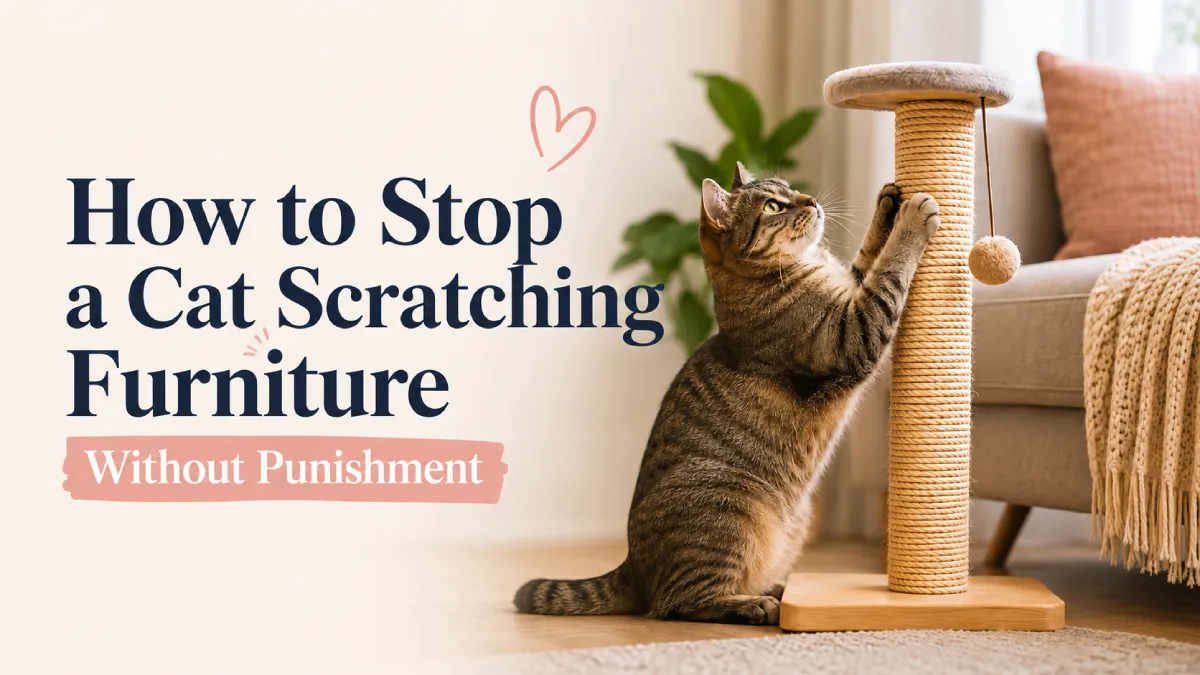
Watch a cat use a vertical surface and you will often see the forelegs extend high while the body lengthens behind them.
That stretching component is one reason a short scratching post can fail even when its material appears suitable. Veterinary behaviour guidance recommends vertical posts tall enough for a cat to extend fully while scratching.
Scratching Helps Maintain the Claws
Scratching contributes to normal claw maintenance.
Feline veterinary guidance describes scratching as helping maintain claw health, while the FelineVMA declawing education materials note that it helps remove the outer portion of the nail and supports normal claw function.
Regular nail trimming can reduce how sharp the tips become and may reduce damage to furniture, but nail trimming does not remove the behavioural need to scratch.
Scratching Leaves Visual and Scent Information
A scratched surface does more than sharpen claws.
The visible lines themselves provide a visual signal, while scent is deposited from the paws. That helps explain why cats often prefer noticeable scratching locations instead of a post hidden in an unused corner.
This also explains why simply buying a scratching post is not always enough. It needs to fulfil the functions the furniture currently fulfils.
Do Not Try to Suppress Scratching Completely
Scratching is not a bad habit that needs to be removed from the cat.
Feline environmental guidelines emphasise allowing cats appropriate opportunities to perform normal behaviours. When those needs are not accommodated, perfectly normal feline behaviour can become undesirable from the owner’s perspective.
A better goal is:
keep scratching → change where scratching happens.
That shift is the foundation of successful furniture protection.
First Identify Where Your Cat Already Scratches
Before buying new equipment, inspect the house.
Write down every regular target:
- sofa arm
- sofa back
- carpet
- stair edge
- doorframe
- bed frame
- chair
- wall covering
- rug
Location itself provides useful information.
FelineVMA notes that scratching sites are often located in areas cats actually use, including near resting places, doors, windows and socially important parts of the home.
The existing target is therefore your clue to the scratcher the cat may accept.
Does Your Cat Prefer Vertical Scratching?
If your cat stands and stretches upward against:
- sofa arms
- chair backs
- doorframes
- walls
start with a vertical scratcher.
It should be tall enough for the cat to extend its forelegs and body comfortably and stable enough not to wobble or fall when significant force is applied.
A small lightweight post beside a full-height sofa is often not an equivalent alternative.
Some Cats Prefer Horizontal Scratching
A cat that repeatedly scratches:
- carpets
- rugs
- floor mats
- flat cardboard
may prefer a horizontal surface.
FelineVMA specifically recognises vertical, horizontal and angled preferences, and notes that individual preferences can change over a cat’s lifetime.
Do not keep buying vertical towers if the cat repeatedly tells you it prefers the floor.
Offer a broad scratching pad instead.
Material Preference Matters
Cats also differ in substrate preference.
Common approved scratching materials include:
- sisal or rope
- cardboard
- fabric
- wood-type surfaces
FelineVMA lists carpet, wood, rope and cardboard among commonly preferred scratching substrates, while AAHA recommends initially providing more than one texture to identify the individual cat’s preference.
This is why the Scratching Preference Test later in this article is more useful than automatically recommending one universal “best scratching post.”
Height Matters for Vertical Scratchers
For a vertical post, the cat should be able to stretch upward without reaching the top immediately.
Veterinary behaviour guidance consistently recommends scratchers that allow the cat to extend its body fully.
If the cat ignores a low post and continues using the sofa arm, test a taller alternative before concluding that it “doesn’t like scratching posts.”
Stability Can Make or Break the Setup
A scratching surface should remain stable when the cat pulls against it.
AAHA specifically recommends stabilising posts because movement or tipping can discourage use.
Before placing it:
- hold the post near the top,
- pull firmly in different directions,
- check whether the base slides or tips.
If you would not trust it during a full-body pull, improve the base or use another scratcher.
Placement Is Often More Important Than Owners Expect
A perfect scratcher in the wrong place can still fail.
Current FelineVMA guidance recommends putting scratchers in places where cats spend time and particularly where scratching already occurs. Locations near sleeping areas can also be useful because many cats scratch after waking.
Do not begin by hiding the new scratcher behind furniture.
Initially, convenience to the cat matters more than convenience to the room design.
What to Do About Sofa Scratching
For a cat scratching the sofa, place the replacement directly beside—or even temporarily in front of—the damaged section.
If the cat scratches vertically, match it with a tall vertical surface. If it works on the horizontal edge, test a horizontal or angled pad instead.
FelineVMA specifically recommends putting a tall sturdy scratcher or cat tree at the sofa location while protecting the existing furniture.
Once the new scratching location is established, you can experiment with gradually adjusting placement if needed.
Doorframe Scratching
Doorframes can be especially attractive because they are:
- vertical
- stable
- prominent
- frequently passed
That combination closely matches several characteristics of an effective scratching site.
A wall-mounted or securely fixed vertical scratcher near the preferred frame may therefore be more successful than a short freestanding post across the room. Prominent placement is consistent with the marking function of scratching.
Do not block an important doorway in a way that makes the cat feel trapped or interferes with movement through the home.
Carpet Scratching Needs a Horizontal Alternative
If the carpet is the main target, trying only vertical sisal posts may solve nothing.
Test:
- flat cardboard scratcher
- horizontal sisal pad
- low angled scratcher
- another safe material with enough resistance
Place it directly over or beside the preferred carpet location during training.
The objective is to reproduce orientation + texture + location, not merely add more cat furniture.
Put the Approved Scratcher Beside the Existing Target
This is one of the most important practical steps.
Current FelineVMA guidance specifically recommends placing the appropriate scratcher in the location the cat is already scratching.
So if the sofa arm is being shredded:
bad setup:
post in spare bedroom
better setup:
stable post directly beside sofa arm
Once the cat reliably selects the post, long-term placement can be reassessed.
Reward the Behaviour You Want
Effective scratching post training does not require physically forcing the cat’s paws onto the post.
Instead, watch for voluntary use.
As soon as the cat scratches the approved surface, provide a reward the cat actually values, such as:
- small food reward
- play
- petting
- praise
FelineVMA recommends immediate positive reinforcement for scratching an appropriate surface and notes that individual cats value different rewards.
The sequence becomes:
scratch approved surface → good consequence
which increases the chance that behaviour will be repeated.
Make the Furniture Temporarily Less Useful for Scratching
Furniture protection can help while the preferred alternative becomes established.
Current FelineVMA guidance recommends options such as furniture protectors or covering a target area with a throw blanket while placing an appropriate scratcher nearby.
Useful management can include:
- fitted sofa protector
- temporary smooth protective panel
- throw covering the scratched section
- temporarily blocking access when practical
Avoid turning the area into a frightening trap.
Notably, the current FelineVMA behaviour toolkit specifically advises against double-sided sticky tape as a punishment-based deterrent, even though older behaviour resources sometimes recommended aversive surfaces.
Nail Maintenance Can Reduce Damage
Regular claw trimming can blunt the sharp tips and reduce snagging and furniture damage.
Both FelineVMA and AAHA include claw trimming among alternatives to declawing.
If you are unsure how to trim claws safely, ask a veterinary professional to demonstrate the technique.
Do not cut deeply into the nail or force prolonged restraint if the cat becomes frightened.
Synthetic nail caps are another option recognised by veterinary organisations for selected cats, but they still do not eliminate the need for appropriate scratching opportunities.
Improve the Rest of the Environment Too
Scratching should not be viewed in isolation from the rest of the cat’s environment.
Appropriate enrichment can include:
- play
- climbing
- hiding
- observation areas
- food-search activities
- multiple resting sites
- predictable positive interaction
Environmental-needs guidance emphasises supporting normal behaviour throughout the home rather than addressing each undesirable behaviour only after it develops.
Pawnium’s Why Do Cats Like Boxes? can provide additional hiding and enrichment ideas. That page is already mapped to /why-do-cats-like-boxes/ in the Pawnium cluster.
Multi-Cat Homes Need Multiple Scratching Choices
One scratching post may be inadequate in a home with several cats.
AAHA recommends providing enough scratching opportunities for all household cats, while FelineVMA notes that scent-marked resources should be distributed through the home.
Separate options also matter when one cat:
- guards an area
- blocks access
- repeatedly watches another cat
- occupies the only preferred scratcher
Do not require socially tense cats to share one important resource.
Stress and Resource Distribution Can Affect Scratching
Scratching itself is normal, but an increase in scratching may occur when a cat is distressed.
FelineVMA specifically identifies increased scratching as a potential sign of distress and recommends evaluating the environment rather than punishing the behaviour.
Look for wider changes such as:
- conflict between cats
- new animals
- household moves
- restricted access to resources
- increased hiding
- appetite changes
- altered social behaviour
Pawnium’s Cat Body Language can help distinguish relaxed scratching from behaviour occurring alongside tension or defensive posture. The Body Language URL is confirmed in Pawnium’s content library.
Why Punishment Is Counterproductive
Do not:
- yell
- hit
- spray water
- chase the cat
- deliberately frighten it near the scratching area
FelineVMA states that punishment can increase fear and stress, interfere with learning and damage the human-cat relationship. Verbal punishment can also inadvertently provide attention to the unwanted behaviour.
Punishment also fails to answer the cat’s basic problem:
Where am I supposed to scratch instead?
Redirection does.
Declawing Is Not a Behavioural Shortcut
Declawing is much more than trimming or permanently removing the nail.
FelineVMA describes onychectomy as amputation of the third phalanx of each affected digit and strongly opposes elective declawing. Its position statement identifies potential acute and long-term complications including pain, infection, nerve trauma, lameness and chronic neuropathic pain.
AAHA likewise states that declawing is no longer supported as a reasonable solution to unwanted scratching and recommends alternatives such as suitable scratchers, positive reinforcement, nail trimming, nail caps and furniture protection.
Furniture scratching should therefore be addressed by changing the environment and teaching an acceptable alternative—not surgically removing normal feline anatomy.
Sudden or Excessive Scratching Deserves More Context
A lifelong sofa scratcher that chooses the same location every morning is different from a cat whose scratching suddenly increases across multiple areas.
FelineVMA advises that increased scratching can signal distress and that any significant change from normal behaviour deserves further attention.
Also watch for a change in how the cat scratches.
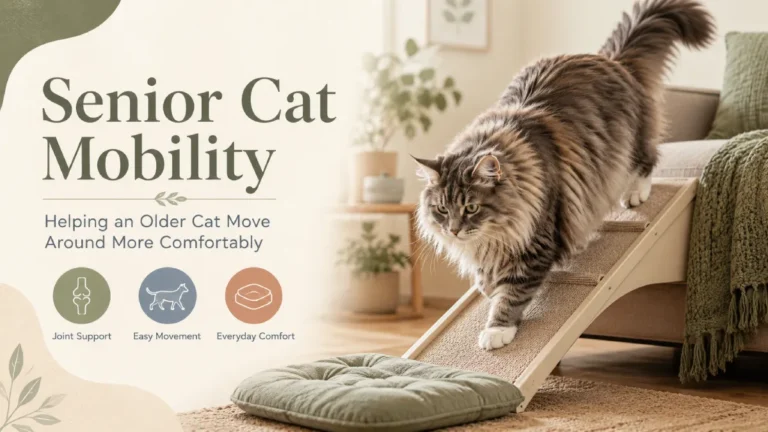
FelineVMA notes that scratching orientation preferences may change with age, including when degenerative joint disease affects comfort. For example, a cat that used to stretch vertically but abruptly begins using only low horizontal surfaces may deserve mobility assessment rather than being labelled stubborn.
Consider veterinary assessment if increased or altered scratching occurs alongside:
- reduced jumping
- stiffness
- altered gait
- increased hiding
- appetite changes
- grooming changes
- aggression or withdrawal
- other substantial behaviour changes
Pawnium’s Cat Health Check at Home can help record changes in mobility, grooming, appetite and routine before a veterinary appointment.
When Professional Behaviour Support Is Useful
Consider qualified feline behaviour support when:
- several appropriate scratchers have been offered but the cat consistently avoids them
- destruction is creating serious conflict in the household
- scratching has escalated alongside anxiety or intercat tension
- attempts at redirection have stalled
- the household is considering declawing because other strategies feel unsuccessful
Start with a veterinarian when there has been a sudden behaviour change, pain or mobility concern. Current FelineVMA guidance specifically recommends medical assessment for changes from a cat’s usual behaviour.
A behaviour professional can then help refine environmental management and reinforcement if the problem is primarily behavioural.
FAQs
Why does my cat scratch the couch when it has a scratching post?
The post may not match the couch’s orientation, material, stability or location. A short post hidden away from the living area may be less useful to the cat than a tall, stable sofa arm in a socially important location. Test several scratcher types and place the best match directly beside the existing target.
How do I stop my cat scratching the couch corners?
First identify whether the cat is stretching vertically or working along the horizontal edge. Place an appropriate scratcher against the exact corner being used, temporarily protect the upholstery and immediately reward use of the alternative.
Should I move my cat to the scratching post when it scratches furniture?
Redirection is useful, but avoid grabbing or physically forcing the paws along the post. Encourage voluntary interaction with the scratcher and reward the cat immediately when it uses the correct surface. Positive reinforcement is recommended over punishment or forced handling.
Why does my cat scratch after waking up?
Cats commonly stretch and scratch after resting. FelineVMA specifically recommends placing scratching opportunities near preferred sleeping areas because scratching often follows waking.
Will trimming my cat’s nails stop furniture scratching?
No. Trimming can reduce sharpness and damage, but scratching serves behavioural functions beyond nail length, including stretching and scent/visual communication. Keep suitable scratching surfaces available even when claws are regularly maintained.
Is declawing the easiest way to stop destructive scratching?
No. FelineVMA strongly opposes elective declawing and describes it as amputation of the third phalanx, with potential acute and chronic complications. Veterinary organisations recommend environmental management, appropriate scratchers, reinforcement and claw-management alternatives instead.