
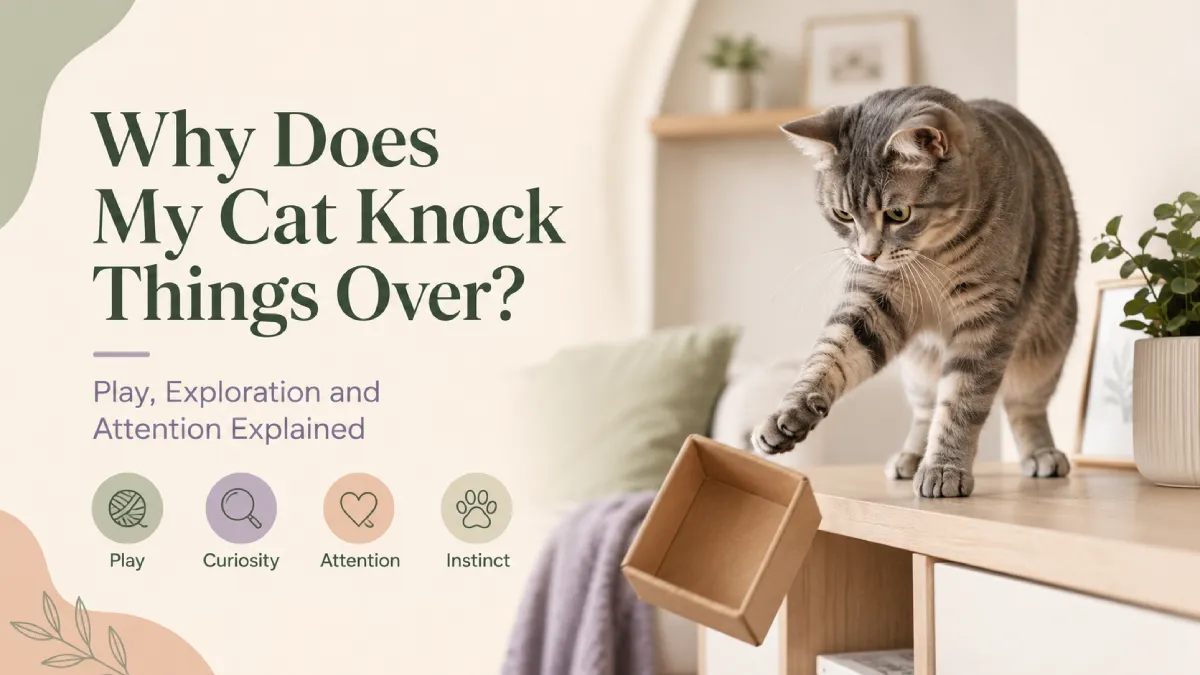
Why Does My Cat Knock Things Over? Play, Exploration and Attention Explained
If you’re wondering why does my cat knock things over, there may be more than one explanation. Cats investigate objects with their paws, and moving an item can make it more interesting. Batting, pushing and chasing also overlap with normal object play and hunting-style behaviour. In some households, knocking something down can additionally become an effective way to make a person react.
The practical answer is not to label the cat naughty. Look at what gets knocked over, what happens immediately beforehand and what follows. Then provide safer outlets while removing breakable, toxic or swallowable objects from places the cat can reach.
Direct Answer
Cats may knock objects over while exploring them with a paw, during object play, because movement makes an item interesting, or because previous knocking has reliably produced human attention. Younger cats may be particularly active object players. Management works best by combining safe enrichment with prevention: secure hazardous objects, offer appropriate toys and avoid accidentally rewarding destructive knocking.
Paw-Based Exploration
Cats use their paws to interact with objects around them.
A cat may reach toward something, tap it, pull it closer or push it away. If the object rolls, swings or falls, that creates additional movement to investigate.
This does not mean the cat understands:
“If I push this vase, it will fall and annoy my owner.”
Often, the immediate behaviour is better understood as investigation followed by a consequence.
VCA specifically notes that cats knocking items from shelves and tables can be connected with their normal hunting and play needs.
Knocking Can Be Part of Play
Normal feline object play can include:
- batting
- grabbing
- chasing
- pouncing
- biting
- clawing
- carrying
FelineVMA describes these behaviours as normal components of object play that mimic parts of hunting.
A lightweight pen rolling across a desk can therefore become much more interesting once the cat touches it.
The same cat may ignore an identical pen sitting motionless on the floor.
Movement Makes Objects More Interesting
Objects that react when touched can reinforce further investigation.
A cat may tap something and discover that it:
- rolls
- spins
- swings
- slides
- falls
- makes noise
That movement can then trigger more pawing.
This helps explain why a cat knocking things off a table may repeatedly choose small movable objects rather than a heavy object that does nothing when touched.
Providing legitimate toys that roll, move or dispense food can redirect some of that interest toward safer targets.
Hunting-Style Interest May Be Part of the Pattern
Domestic-cat play retains many movements also used during prey pursuit.
AAHA/AAFP notes that kittens develop predatory-type play through watching, swatting, chasing, pouncing and catching. FelineVMA similarly describes hunting-style object play as a normal environmental need.
That does not mean your cat believes a bottle cap is a mouse.
It means small moving objects can provide opportunities for familiar chase-and-capture behaviours.
Pawnium’s Why Does My Cat Bring Me Toys? owns the deeper topic of carrying, retrieving and hunting-style toy behaviour.
Human Attention Can Become Part of the Behaviour
Cats learn from consequences.
Imagine this sequence:
cat pushes pen → pen falls → owner gets up immediately → owner talks to cat
If that consistently happens, knocking something down can become a reliable way to produce interaction.
VCA specifically notes that cats can learn that knocking things over brings a person running.
That does not mean every incident is attention-seeking.
Look for repetition: does your cat watch you before pushing the item, then wait for your reaction?
Boredom Is Possible, but Do Not Assume It
Insufficient stimulation can contribute to unwanted household behaviour, and AAHA recommends providing cats with varied physical and mental enrichment.
But avoid:
“Your cat knocks things over because it is bored.”
A well-enriched cat may still enjoy moving objects.
A more useful question is:
Does the cat have enough appropriate opportunities to do the same kinds of things safely?
That includes:
- chase
- pounce
- bat
- manipulate
- climb
- search for food
- investigate new safe objects
Younger Cats May Do It More
Kittens have a particularly strong play drive.
AAHA/AAFP notes that kittens spend considerable time practising predatory-type movements, with object play becoming increasingly prominent during development.
A young cat exploring every shelf is therefore not unusual.
Still, age is not an excuse to leave:
- medication
- glass
- toxic plants
- button batteries
within reach.
Management should make normal curiosity safer rather than relying on the kitten to understand household hazards.
Why Cats Knock Items From Shelves
Shelves combine several attractive features:
- elevation
- an observation point
- interesting objects
- movable items near an edge
Feline environmental guidance recommends safe vertical space because climbing and perching are normal feline needs.
The solution is therefore not necessarily to stop the cat from using every shelf.
Instead, separate:
cat-accessible vertical territory
from
valuable or dangerous display space.
Give the cat secure perches while making fragile shelves inaccessible or removing risky objects.
What If My Cat Knocks Over the Water Bowl?
Some cats paw at water or move the bowl during investigation or play.
If the bowl is repeatedly overturned, focus first on maintaining reliable water access.
Try:
- a heavier, stable bowl
- several water stations
- a wider base
- placing the bowl where vigorous play is less likely to hit it
- testing a fountain if the individual cat prefers moving water
Cornell recommends keeping fresh water readily accessible and providing multiple water sources when useful. Individual cats can differ in their preferences for bowls and fountains.
Repeatedly tipping water is mainly a behaviour problem until it results in inadequate access to drinking water.
Food-Related Objects May Be Different
If the cat pushes:
- treat containers
- food packaging
- empty dishes
- containers that smell like food
food-seeking may be part of the context rather than simple object play.
That interpretation is strongest when the behaviour repeatedly targets food-associated objects and occurs around meal times.
Do not automatically reward it by immediately opening the container.
If food-related knocking becomes frequent, review whether the cat’s normal feeding routine and enrichment are appropriate.
Plants Need a Safety Check
A plant pot being knocked over creates two separate concerns:
- broken or spilled material
- possible plant ingestion
Not every houseplant is safe for cats. Merck and ASPCA both maintain veterinary toxicology resources covering poisonous houseplants. True lilies are particularly dangerous to cats and can cause severe kidney injury after exposure.
Do not rely on placing a toxic plant “slightly higher” if your cat routinely climbs shelves.
Confirm that every accessible plant is cat-safe or make the plant genuinely inaccessible.
Dangerous Objects Should Not Be Used as Training Tests
Management comes before training when the consequence could be serious.
Do not leave a dangerous item on a counter to see whether your cat has “learned not to touch it.”
Remove or secure:
- toxic materials
- glass
- medication
- batteries
- sharp objects
- small swallowable items
Feline environmental management aims to give cats safe ways to express normal behaviour rather than depending on punishment after the hazard has already been reached.
Keep Glass Away From Accessible Edges
A drinking glass or decorative object can become dangerous once pushed from height.
Broken glass creates obvious risks of:
- paw cuts
- mouth injury
- fragments remaining on the floor
If your cat is breaking things regularly, move fragile objects into closed cabinets or onto truly inaccessible shelving.
Use cat-accessible shelves for safe objects and resting space instead.
This is more reliable than repeatedly trying to correct the cat after something has broken.
Medication Should Be Locked Away
Medication should not remain loose on:
- countertops
- bedside tables
- shelves
- pill organisers a cat can knock down
Merck notes that pets commonly gain access to human prescription medications from countertops, pill containers and packages, and recommends storing medicines where pets cannot reach them. Some human medications are highly toxic to cats.
If you think your cat has swallowed human medication, contact a veterinarian or veterinary poison service promptly.
Do not try to treat the exposure yourself.
Batteries Need Special Attention
Button batteries and other household batteries should be stored securely.
Batteries can cause serious injury when swallowed, lodged or damaged. Disc batteries can cause burns even without being punctured, while damaged alkaline batteries can leak corrosive material.
Keep:
- spare batteries
- loose button cells
- battery-powered toys with insecure compartments
out of reach.
If a battery may have been chewed or swallowed, seek veterinary advice promptly rather than waiting for symptoms.
Small Objects Can Become Swallowing Hazards
Not every object a cat bats across the floor remains a toy.
Very small items can potentially be swallowed.
VCA recommends avoiding toys small enough to be accidentally ingested because gastrointestinal obstruction can result. String-like toys also require supervision because ingested strings can cause serious intestinal problems.
Audit shelves for things such as:
- small plastic pieces
- loose craft materials
- tiny children’s toys
- string or ribbon
- detachable toy parts
Size and construction matter as much as whether the cat enjoys batting the item.
Provide Things the Cat Is Allowed to Knock Around
A useful management strategy is not:
“Stop touching everything.”
It is:
“These objects are safe to manipulate instead.”
Good options can include appropriately sized:
- balls
- toy mice
- lightweight cat toys
- treat-dispensing toys
- sturdy cardboard enrichment
AAHA specifically recommends enrichment that encourages manipulation, chasing and problem-solving.
Pawnium’s Why Do Cats Like Boxes? provides additional low-cost hiding, exploration and ambush-play ideas.
Puzzle Toys Add Manipulation With a Purpose
Puzzle feeders can be especially useful for cats that like:
- pushing
- rolling
- pawing
- fishing objects out of spaces
AAHA describes food puzzles as a way to encourage problem-solving and hunting-style manipulation.
Start with an easy puzzle.
The cat should be able to obtain its food successfully rather than becoming frustrated or receiving inadequate nutrition.
Puzzle feeding is enrichment, not a punishment for touching household objects.
Interactive Play Matters Too
Independent toys are useful, but interactive play gives the cat a moving target that responds in a controlled way.
Wand toys can allow:
watch → stalk → chase → pounce → capture
while keeping claws and teeth away from the owner’s hands.
AAHA and FelineVMA both recommend regular opportunities for predatory-style play as part of feline enrichment.
If your cat’s object play turns into full-speed racing, Pawnium’s Why Does My Cat Get the Zoomies? owns the deeper discussion of sudden running and activity bursts.
Secure Dangerous Objects Instead of Testing Willpower
To stop a cat knocking things over where safety matters, environmental management is usually the first step.
Consider:
- closed medication cabinets
- latched battery storage
- closed display cabinets for glass
- removing toxic plants
- moving small objects into drawers
- securing unstable lamps or electronics
- keeping dangerous food and chemicals inaccessible
Then give the cat legal alternatives.
Prevention works even when you are not in the room.
Avoid Punishment
Do not respond by:
- hitting
- yelling
- spraying water
- deliberately frightening the cat
FelineVMA states that punishment can increase fear and stress, impair learning and damage the human-animal relationship. Even verbal punishment can accidentally provide attention to the unwanted behaviour.
Instead:
- make dangerous targets unavailable
- provide better alternatives
- reward appropriate play or stationing
- avoid creating a dramatic reaction when a harmless item is pushed
AAHA’s current cat-training guidance similarly recommends teaching cats what to do instead through positive reinforcement.
When a Sudden Change Deserves Attention
A cat that has casually pushed pens off a desk for years presents a different picture from a previously quiet cat that suddenly begins knocking objects over repeatedly while also acting restless or disoriented.
AAHA/AAFP recommends paying attention to changes in behaviour, particularly as cats mature and age, rather than assuming new behaviour is simply personality.
Consider veterinary assessment if a new pattern occurs with:
- confusion
- major activity changes
- reduced sleep
- altered appetite
- weight change
- increased thirst
- mobility problems
- unusual vocalisation
- other substantial changes from the cat’s baseline
Pawnium’s Cat Health Check at Home is designed to help owners record those broader trends without attempting to diagnose the cause.
FAQs
Why does my cat look at me before knocking something over?
Your reaction may have become part of the behaviour. If pushing an object consistently makes you approach, speak or offer food, the cat may learn that knocking produces attention. That does not mean attention explains every incident, so also consider play and object exploration.
Does my cat knock things over because it is bored?
Possibly, but boredom should not be diagnosed from this behaviour alone. Inadequate enrichment can contribute to unwanted behaviours, while some appropriately enriched cats simply enjoy manipulating objects. Review play, climbing, food enrichment and safe exploratory opportunities rather than assuming boredom automatically.
How do I stop my cat pushing things off counters?
Remove dangerous and valuable objects, offer safer items the cat can manipulate, increase appropriate interactive play and avoid creating a large attention reward when a harmless object falls. Reward desirable alternatives such as playing with toys or resting on an approved perch.
Why does my cat knock over its water?
The cat may be pawing at the water or bowl during exploration or play. Use a stable bowl and make sure fresh water remains continuously accessible. Multiple water stations or a fountain may suit some cats, although preferences vary.
Are small objects safe for cats to bat around?
Only if they are large and durable enough that they cannot easily be swallowed or broken into dangerous pieces. VCA advises avoiding toys small enough to cause accidental ingestion or intestinal obstruction.
Should I spray my cat with water when it knocks something down?
No. FelineVMA advises against punishment because it can create fear, stress and damage to the human-cat relationship without teaching the desired alternative behaviour. Management, redirection and positive reinforcement are safer approaches.