
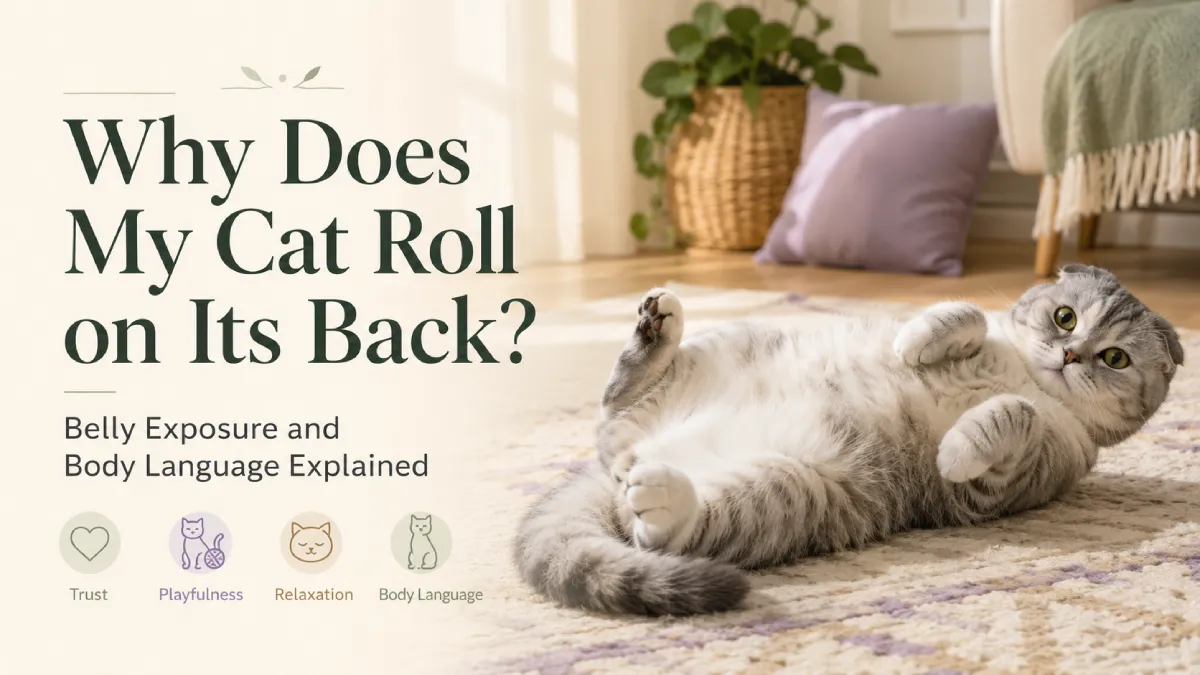
Why Does My Cat Roll on Its Back? Belly Exposure and Body Language Explained
If you’re wondering why does my cat roll on its back, look beyond the exposed belly. Cats may roll over while relaxing, greeting a familiar person, stretching, playing or seeking interaction. In another context, a cat on its back can be defensive, with claws and hind legs positioned to protect itself.
The safest interpretation comes from the entire body. Relaxed muscles, neutral ears and quiet paws tell a very different story from flattened ears, a thrashing tail, tense muscles and extended claws. Most importantly, showing the belly does not automatically mean the cat wants its stomach touched.
Direct Answer
A cat may roll onto its back because it feels relaxed, is greeting you, wants interaction, is stretching or playing. But belly-up posture can also occur defensively. Check the ears, tail, eyes, muscle tension and paws before responding, and do not assume an exposed belly is an invitation for a belly rub.
Belly Exposure Does Not Always Mean “Rub My Belly”
This is one of the most common misunderstandings in feline body language.
Cats Protection notes that a relaxed cat may expose its abdomen while feeling comfortable around a familiar person, but the belly is still a vulnerable and sensitive area. For many cats, showing it is not an invitation to touch it.
If you immediately reach for the stomach, the cat may:
- grab your hand
- kick with the hind legs
- bite
- scratch
- roll away
- leave
That reaction does not necessarily mean the cat “changed its mind.” The owner may simply have misread what the original posture meant.
Relaxed Rolling
A relaxed roll is usually easiest to recognise from the rest of the body.
Possible clues include:
- loose muscles
- relaxed or forward ears
- soft facial expression
- paws resting loosely
- little or no forceful tail movement
- comfortable stretching
- willingness to remain nearby
Cats Protection and VCA both include rolling onto the back among postures that can occur when a cat is comfortable or relaxed.
A relaxed cat may remain on its back for a moment, roll onto one side or simply get up and continue with another activity.
Rolling Can Be Part of a Greeting
If your cat rolls over when it sees you, timing is particularly useful.
Cats Protection’s 2026 behaviour guidance notes that rolling onto the back is commonly seen when cats greet familiar people, including after the owner returns home. It may occur alongside excitement, attention-seeking or simply relaxed social interaction.
So when your cat runs toward you, flops over and rolls on the floor after you’ve been away, a social greeting is a reasonable interpretation.
That still does not mean:
“Please rub my stomach.”
A head or cheek interaction may be better tolerated.
Sometimes the Cat Is Simply Stretching
Rolling and stretching often overlap.
A cat that has just:
- woken from sleep
- moved from a curled position
- entered a sunny resting area
- settled on a comfortable floor
may roll onto one side or back while extending the legs and body.
Cats Protection specifically lists stretching and comfortable resting among possible reasons cats roll onto their backs.
This behaviour may not require any human response.
Rolling Can Be Playful
Play can also put a cat on its back.
A playful cat may:
- roll sideways
- grab a toy
- kick it with the hind feet
- reach upward with the front paws
- roll back onto its feet
- chase the toy again
Feline play includes predatory components such as chasing, pouncing, grabbing and kicking. VCA recommends directing that activity toward toys rather than encouraging the cat to attack hands.
The belly-up position during play therefore should not automatically be interpreted as passive submission.
Could Scent Marking Be Part of the Behaviour?
Possibly—but this needs qualification.
Cats communicate through scent and can deposit facial and body scent by rubbing against people and objects. FelineVMA describes face and body rubbing as part of normal scent communication.
If rolling includes:
- rubbing the cheeks against the floor
- rubbing the head along furniture
- pressing the sides of the body against a surface
scent communication may be part of the larger behaviour sequence.
But rolling onto the back by itself does not prove that the cat is scent marking.
Avoid explanations such as:
“Your cat rolls on the floor to mark everything as its territory.”
The evidence supports rubbing as scent communication more clearly than rolling itself.
Why Does My Cat Roll Around on Certain Surfaces?
Surface choice can provide additional context.
Cats may roll on:
- rugs
- beds
- warm flooring
- sunny areas
- objects carrying interesting smells
- surfaces containing catnip
Cats Protection includes relaxation, stretching and catnip response among possible contexts for repeated floor rolling.
If a cat repeatedly rubs its head or body against a particular surface during the roll, scent investigation or scent deposition may also be involved.
The surface itself can therefore matter.
Rolling After You Return Home
When a cat approaches, rolls onto the floor and exposes the belly after you’ve been out, greeting behaviour is particularly plausible.
Cats Protection describes this pattern as a common greeting after separation from a familiar person.
A useful response is to pause and observe what the cat asks for next.
It may:
- rub against your legs
- stand up and approach
- solicit head strokes
- walk toward food
- begin playing
- simply roll around
Let that next behaviour guide the interaction rather than treating the exposed stomach as the only signal.
Rolling During Play
Belly-up play often involves much more movement than relaxed rolling.
Look for:
- reaching toward a toy
- playful grabbing
- hind-leg kicking
- rapid transitions between lying and standing
- chasing after the toy when it moves away
Cats Protection notes that when cats grab a hand and bunny-kick after rolling onto their backs, hunting-related play may have been redirected onto the person’s hand. It recommends using appropriate toys instead.
A kicker toy or wand toy is safer than encouraging a cat to wrestle directly with human hands.
Belly-Up Can Also Be Defensive
This is the most important exception to the “belly means trust” interpretation.
VCA notes that a cat anticipating conflict may roll onto its back with its claws extended, positioning itself to defend against an approaching animal or person.
In that situation, being on the back does not mean:
- relaxed
- submissive
- requesting affection
The position gives the cat access to:
- front claws
- teeth
- powerful hind legs
so it can defend itself.
If the posture looks defensive, stop approaching and give the cat space.
Watch the Claws and Hind Legs
Paw position provides important context.
More Relaxed
You may see:
- loosely curled paws
- relaxed legs
- little muscular tension
AAHA/AAFP notes that relaxed cats may hold the paws comfortably curled against the body rather than remaining prepared for escape or defence.
Playful
The cat may:
- reach for a toy
- grab it
- bunny-kick it
- release and chase again
Defensive
You may see:
- claws extended
- legs positioned toward the threat
- tense hindquarters
- readiness to kick or strike
In this context, do not reach toward the cat.
Ear Position Helps Clarify the Roll
Ears add another layer.
Relaxed
Ears may remain:
- neutral
- forward
- softly positioned
Increasingly Uncomfortable
Ears may rotate:
- sideways
- backward
- flatter toward the head
AAHA/AAFP identifies sideways or flattened ears among signs that can accompany increasing arousal, fear or distress.
So:
belly exposed + neutral ears
is different from:
belly exposed + flattened ears + claws ready.
Tail Movement Can Signal Rising Arousal
Tail movement is especially useful when the cat appears to change during interaction.
A quiet or loosely resting tail can accompany relaxed posture.
Increasing:
- twitching
- flicking
- swishing
- forceful tail movement
can accompany rising arousal or agitation. AAHA/AAFP notes that tail movement may increase in rate and intensity as distress rises.
Pawnium’s Cat Tail Positions and Meanings should own the full tail-language explanation rather than duplicating it here. The URL is already part of Pawnium’s mapped cat-behaviour cluster.
Do Not Interpret the Pupils Alone
Wide pupils can accompany fear or high arousal, but pupil size also changes with lighting.
That means:
dilated pupils ≠ automatically defensive
and
small pupils ≠ automatically relaxed.
Instead combine pupils with:
- ear position
- tail movement
- posture
- paws
- what happened immediately before
AAHA/AAFP specifically recommends evaluating feline body signals together rather than relying on one feature.
Read the Full Body, Not Just the Belly
A useful formula is:
Belly position + ears + eyes + tail + paws + muscle tension + situation
rather than:
Belly exposed = trust.
For example:
Cat A
- lying loosely on back
- ears forward
- paws soft
- tail resting
- just greeted owner
Relaxed social interaction fits the context.
Cat B
- lying on back
- ears flat
- body rigid
- claws extended
- tail thrashing
- another animal approaching
Defensive behaviour is much more plausible.
Pawnium’s Cat Body Language guide should own the deeper whole-body interpretation. That page is already established within Pawnium’s Cat Care cluster.
How Should You Respond When Your Cat Rolls Over?
Start by not immediately touching the belly.
Instead:
- Pause.
- Look at the whole body.
- Let the cat decide whether to approach further.
- If it seems relaxed and seeks contact, try a preferred area such as the cheeks, chin or head.
- Stop if the body becomes tense or the tail begins moving more intensely.
Cats Protection recommends head or cheek strokes for many cats that expose the belly rather than assuming they want their stomach touched.
Some individual cats genuinely do enjoy belly contact. The important point is to learn that individual cat’s preferences rather than assuming all cats do.
Signs Your Cat May Want Interaction
Possible clues include:
- approaching you
- rubbing against you
- remaining loose-bodied
- head-butting or cheek rubbing
- staying nearby after you offer your hand
- soliciting head or cheek contact
FelineVMA emphasises individual preferences and recommends letting cats initiate and control human-cat interaction where practical.
Even then, the preferred interaction may be:
head rub
rather than:
belly rub.
Signs Your Cat Wants Space
Stop or avoid contact if you notice:
- ears flattening or rotating back
- tail lashing
- body becoming tense
- paws reaching defensively
- claws extending
- grabbing your hand
- hissing or growling
- attempting to move away
AAHA/AAFP stresses that feline signals asking for a break should be respected before discomfort escalates.
If petting commonly changes from relaxed interaction to grabbing or biting, Pawnium’s Why Does My Cat Lick Me Then Bite Me? provides the deeper interaction/overstimulation context. That supporting page is already mapped in the Pawnium Cat Care cluster.
When Unusual Rolling Deserves Closer Attention
Most voluntary rolling in an otherwise normal cat is behavioural.
What matters is a change from the individual cat’s normal pattern.
Monitor More Closely If
Your cat:
- suddenly rolls much more than usual
- repeatedly rubs or scratches the skin
- becomes unusually vocal
- seems uncomfortable when getting up
- stops a longstanding relaxed rolling habit
- has other behavioural changes
Cats Protection notes that an ordinarily relaxed cat that suddenly stops rolling may sometimes be uncomfortable, painful, frightened or stressed. It also advises veterinary assessment for significant unexplained behaviour change.
An unspayed female may also roll more frequently while in heat, usually alongside other reproductive behaviours such as increased vocalisation, rubbing and presentation of the hindquarters.
Seek Veterinary Assessment Promptly If the “Rolling” Looks Involuntary
Do not confuse playful floor rolling with a cat that is losing control of its balance.
Veterinary neurological references identify repeated involuntary rolling or falling alongside signs such as:
- head tilt
- inability to stand normally
- circling
- loss of balance
- abnormal rapid eye movement
- weakness
- marked disorientation
as potential neurological or vestibular signs requiring veterinary assessment.
That is a completely different situation from a relaxed cat choosing to flop onto its back.
FAQs
Does a Cat Showing Its Belly Mean It Trusts Me?
In a relaxed social context, exposing a vulnerable abdomen can indicate that the cat feels comfortable enough to adopt that posture around you. However, belly-up posture can also occur during play or defence, so context matters. It also does not automatically mean the cat wants its belly touched.
Why Does My Cat Roll Over Every Time It Sees Me?
If the behaviour happens during a relaxed approach or after you’ve been away, greeting or learned attention-seeking may fit the context. Cats Protection specifically describes rolling over as a common greeting toward familiar humans.
Why Does My Cat Show Its Belly and Then Bite Me?
The cat may have been relaxed but not requesting belly contact, or touching may have increased arousal. If the cat grabs the hand and bunny-kicks, play or hunting-related behaviour may also become redirected toward the hand. Use a toy and stop touching when body tension increases.
Why Does My Cat Roll Around on the Floor?
Possible contexts include relaxing, stretching, greeting, attention, play or response to catnip. If rolling is new, excessive or accompanied by pain, skin irritation, balance problems or another major change, seek veterinary advice.
Is a Cat on Its Back Being Submissive?
Not necessarily. A cat can lie on its back while relaxed, but VCA also describes a defensive belly-up posture in which the claws are ready to strike. Avoid using the dog-like idea of “submission” as the default interpretation.
How Do I Know Whether My Cat Wants a Belly Rub?
There is no universal signal guaranteeing it. Many cats prefer the head and cheeks even when they expose the belly. If your individual cat enjoys belly contact, its body should remain relaxed and it should be free to move away; stop at the first sign of tension or avoidance.


