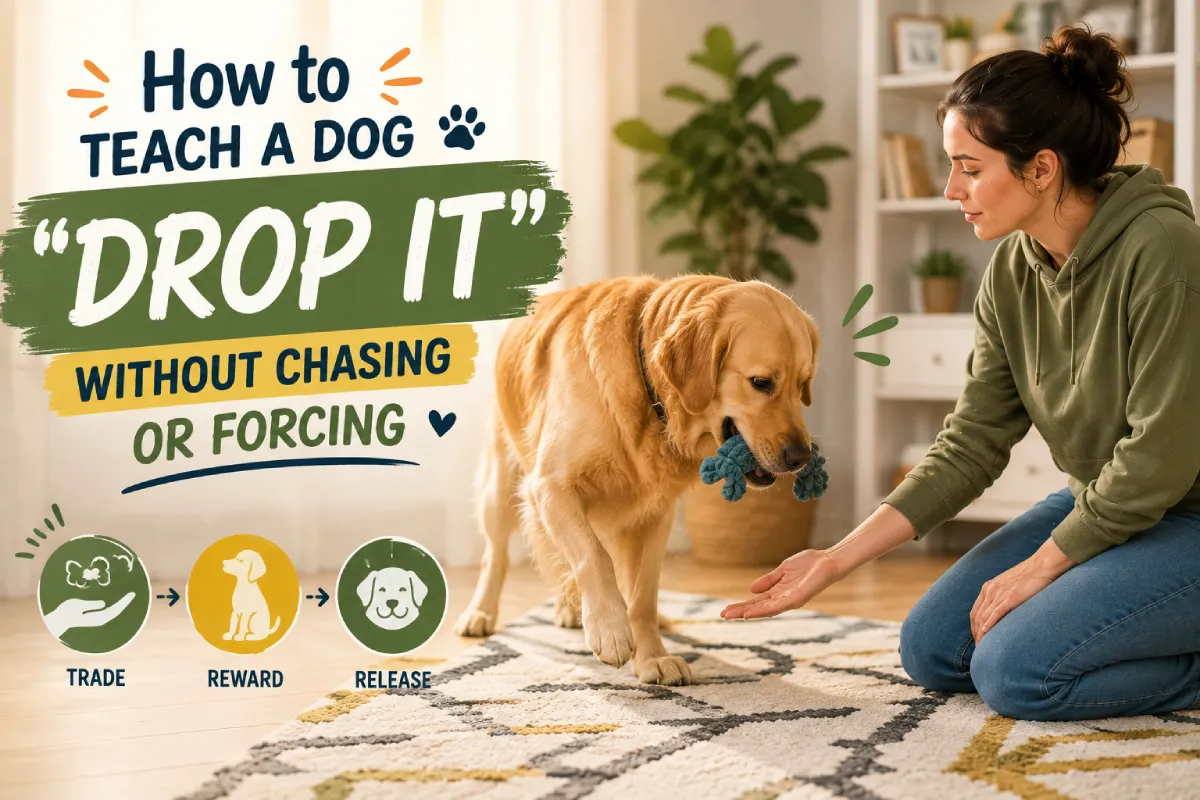
How to Teach a Dog “Drop It” Without Chasing or Forcing
Few domestic showdowns are as universally stressful as watching your dog scoop up a forbidden, expensive, or potentially dangerous item—be it a muddy shoe, a television remote, a rogue sock, or a discarded chicken bone—and watching them bolt across the room. Instinct often drives pet parents to panic, shout, lunge forward, and attempt to pry the object directly from the dog’s jaws using physical force. This adversarial approach almost always backfires, turning a simple training moment into a high-stakes game of keep-away or triggering defensive resource guarding.
Mastering how to teach a dog drop it is one of the most vital safety skills in canine education. Whether you are addressing the dog drop-it command, struggling because your puppy will not drop toy items willingly, frustrated when your dog runs away with objects, learning how to properly teach dog to release an item, mastering the famous trade game for dogs, or navigating delicate signs of dog resource guarding objects, this comprehensive pillar guide provides a force-free, cooperative roadmap to object release.
Direct Answer
Teaching a dog to “drop it” relies on cooperation, positive reinforcement, and the economic principle of the “trade game.” Instead of forcefully prying items from your dog’s mouth—which teaches them that humans are thieves who steal their prizes—you teach them that voluntarily releasing an object results in an immediate, superior reward. By starting with low-value toys, pairing the release with a clear verbal cue, utilizing two-toy exchanges or high-value food trades, and consistently returning the original item after the reward, you transform relinquishing objects from a terrifying loss into a win-win exchange.
What “Drop It” Means
To a dog, possession is nine-tenths of the law. When they pick up an item, their immediate biological inclination is to protect it. “Drop it” is a cooperative cue that means: “Open your mouth and let go of what you are holding right now, and you will instantly receive something even better (and often get your original item right back).”
It is crucial to understand why physical confrontation fails. Do not recommend grabbing objects directly from the dog’s mouth. Do not recommend chasing the dog. Do not recommend physical force. Explain that stealing items can worsen if it consistently starts an exciting chase.
When you sprint after a dog holding a stolen shoe, their brain interprets your frantic pursuit as the ultimate high-speed game of tag. The running, shouting, and lunging amplify their adrenaline, cementing the stolen object as the most valuable trophy in the world.
Difference Between “Drop It” and “Leave It”
Pet owners frequently confuse these two foundational commands, but they serve completely different mechanical functions in safety training:
-
“Leave It” is preventative: It tells the dog not to touch or pick up an item they are approaching or looking at. The item is still outside their mouth. (Explore the comprehensive masterclass in our Leave-it command guide).
-
“Drop It” is reactive: It tells the dog to release an item currently held inside their mouth. The transaction happens after possession has already occurred.
Choosing Starting Objects and Higher-Value Rewards
Success in drop-it training depends entirely on math: the value of the reward must mathematically outweigh the value of the object currently in the dog’s mouth.
-
Choosing a Low-Value Starting Object: Do not start training by trying to take your dog’s favorite squeaky plush toy or a coveted chew bone. Start with a boring, neutral item—such as an old tennis ball, a thick rope toy, or a plain rubber toy that they like well enough but do not obsess over.
-
Choosing a Higher-Value Reward: Your training currency must be extraordinary. Use aromatic, high-value food items that your dog rarely receives during everyday life—such as cubes of roasted chicken, warm steak, pieces of hot dog, or squirt cheese from a tube.
Step-by-Step Training Protocol: Teaching the Trade
1. Teaching the Trade (The Foundation)
-
Initiate a play session with your chosen low-value starting object (e.g., a tennis ball). Let your dog hold it in their mouth.
-
Hold your high-value treat (e.g., chicken) directly in front of your dog’s nose without saying anything yet.
-
Because the food smells overwhelmingly delicious, your dog will naturally open their mouth to eat the treat, dropping the ball in the process.
-
The exact millisecond the ball falls from their mouth, mark the release with a cheerful “Yes!” or a click, and feed them the treat.
2. Adding the Verbal Cue
Once your dog is reliably dropping the object the moment they smell the food:
-
Just a split second before you present the food to their nose, say your crisp verbal cue: “Drop it.”
-
Present the food, allow them to drop the item, mark with “Yes!”, and deliver the reward.
-
With repetition, the dog learns that the sound of the words “Drop it” predicts the appearance of high-value food, creating a powerful conditioned reflex.
3. Returning the Toy After the Reward
One of the biggest mistakes owners make is making “drop it” mean the end of all fun. If every time a dog drops a toy, the human takes the toy away forever, the dog will quickly learn to hide or swallow items rather than drop them.
-
The Return Rule: For every 5 to 10 practice reps, reward the dog with the treat, and then give the original toy right back to them (or throw it for them to fetch). This teaches them that dropping an item does not mean losing it forever.
4. Teaching with Two Toys (The Equal-Exchange Method)
For high-energy retrieving dogs, food is not always the best motivator; another toy is.
-
Hold two identical tennis balls.
-
Throw Ball A. When your dog runs and picks it up, call them back while enthusiastically squeaking or waving Ball B in your hand.
-
When your dog reaches you wanting Ball B, they will naturally drop Ball A to grab the new toy.
-
The moment Ball A drops, say “Drop it,” reward them by throwing Ball B, and repeat the loop.
5. Teaching During Tug Games
Tug-of-war is an exceptional testing ground for impulse control.
-
While playing tug with a rope toy, freeze your body completely (go limp like a dead tree—never yank the toy back and forth against their teeth, which builds tension).
-
Say “Drop it” and hold a high-value treat right against their nose.
-
Once they let go, mark “Yes!”, feed the treat, and immediately re-engage the tug game as a reward.
Fading Visible Food Rewards and Generalizing Objects
Once your dog reliably drops items when they see food in your hand, you must phase out the visual cue so they respond to the spoken word alone:
-
Fading the Lure: Hold the treat hidden inside your pocket or behind your back. Say “Drop it.” Only produce the treat after the dog has successfully released the object.
-
Practising with Different Objects: Systematically graduate from boring balls to slightly more interesting items (such as plush toys, safe Long-lasting safe dog chews, and finally household items like a clean towel or mitten) to ensure solid generalization.
Behavioral Troubleshooting: Managing Difficult Scenarios
What to Do When the Dog Runs Away
If your dog grabs a forbidden item and sprints across the house:
-
Never chase them. Remember, chasing turns you into a predator in a game of tag.
-
Instead, run away from them in the opposite direction while making high-pitched, excited noises (“Look what I have!”). Your dog’s natural predatory chase instinct will cause them to pivot and chase you, bringing the stolen item right to your feet. Alternatively, open the refrigerator door loudly or squeak a high-value toy to trigger their curiosity.
What to Do When the Dog Clamps Down
If your dog freezes and clamps their jaws shut around an object:
-
Do not pry their jaws open manually, as this risks bite injury and heightens panic.
-
Instead, offer an irresistible olfactory distraction—such as waving a tube of liver paste or holding a piece of roast beef directly under their nose. Olfactory override forces the brain to shift focus from guarding possession to investigating food.
What to Do When the Dog Swallows Objects
If your dog has ingested a non-food item (such as plastic, string, foam, or clothing), do not attempt to induce vomiting at home unless explicitly instructed by a licensed veterinarian. Swallowing linear objects or sharp materials can cause severe internal lacerations or intestinal obstructions.
Unique Content Asset: Trade-Value Chart
Use this structured reference matrix to understand the mechanics of object exchange across varying value tiers:
| Starting Object Category | Item Example | Equal-Value Exchange Method | Higher-Value Exchange Reward | Reward Delivery Method | Is Original Object Returned? |
| Low-Value | Tennis ball, rope toy, old plush toy | Second identical toy (Two-toy method) | Freeze-dried liver or kibble | Hand-delivered direct from pouch | Yes, frequently returned to maintain play drive. |
| Medium-Value | Favorite squeaky toy, stick, durable chew | High-value food treat (Cheese / Chicken) | Warm steak or rotisserie chicken | Hand-fed immediately upon release | Occasionally returned after a short pause. |
| High-Value (Stolen) | Stolen shoe, TV remote, tissue, sock | Ultimate jackpot trade (Stinky tripe / Meat) | Premium high-value wet food spoon | Delivered instantly upon release | No. Stolen illegal items are permanently confiscated. |
| Hazardous / Dangerous | Chicken bone, medication, toxic item | Emergency high-value trade | Multiple high-value treats / Paste | Thrown on floor away from item | Never. Item is secured and safely discarded. |
Age-Specific and Contextual Training
Puppy Drop-It Training
Puppies explore the world entirely through their mouths. Start drop-it games during their first week home. Because puppies lack entrenched possession habits, building trade mechanics early prevents future resource guarding. (Review foundational manners in our Dog-training basics guide).
Adult-Dog Training
Adult rescue dogs or older pets with unknown histories may display initial suspicion during exchanges. Always start with low-value toys and exaggerated rewards, proving to them that giving up an item is a profitable transaction. (Incorporate mental stimulation via Teach dog cool tricks).
Resource Guarding and Safety Warnings
Resource Guarding
Important Warning: Resource guarding is a natural evolutionary behavior where a dog feels threatened that an item will be stolen from them, leading them to protect their possession.
-
Early signs include freezing over an item, stiffening their body, turning their head away, accelerating their eating, or giving a low mutter.
-
Never punish resource guarding. Punishing a dog for growling teaches them to stop giving warning growls, driving them to skip straight to biting without a safety buffer.
When to Seek Professional Help
-
Recommend professional help if the dog freezes, growls, snaps or bites.
-
If your dog displays overt aggression, hard staring, snapping, or biting when you approach them with an item, stop DIY training immediately. Consult a certified professional dog trainer (CPDT-KA) or veterinary behaviorist specializing in positive reinforcement and desensitization protocols.
Objects Owners Should Not Practise With
Never use genuinely dangerous items (such as sharp kitchen knives, glass, cleaning chemicals, or real bones that splinter) for training practice. Always practice with safe, dog-appropriate toys and non-toxic items.
Common Mistakes to Avoid
-
Punishing the dog after they drop an item: If you scold a dog after they finally release a stolen shoe, you teach them that dropping items brings anger.
-
Always taking the toy away permanently: If dropping an item always ends the fun, the dog will refuse to cooperate next time.
-
Chasing the dog: Turning retrieval into a high-speed game of tag.
-
Forcing your hands into their mouth: Violating their physical boundaries and triggering defensive biting.
Seven-Day Drop-It Training Plan
| Day & Phase | Training Focus & Daily Goal | Session Duration | Key Drill & Protocol | Reward Used |
| Day 1 | Foundation Trade (Low-Value) | 5 mins (2x daily) | Present chicken to nose while dog holds tennis ball; mark and reward drop. | Roast chicken / Cheese |
| Day 2 | Adding the Verbal Cue | 5 mins (2x daily) | Say “Drop it” a split second before presenting the food lure. | High-value treats |
| Day 3 | The Two-Toy Method | 10 mins (2x daily) | Practice trading one toy for an identical second toy during play. | Second toy + Praise |
| Day 4 | Fading Visible Food | 10 mins (2x daily) | Hide food in pocket; say “Drop it”; produce reward only after release. | Hidden treats |
| Day 5 | Tug-Game Impulse Control | 10 mins (daily) | Practice dropping tug rope on cue, followed by immediate tug resumption. | Treat + Tug resume |
| Day 6 | Generalizing Objects | 10 mins (daily) | Practice dropping varied items (mittens, plush toys, old shoes). | Jackpot treats |
| Day 7 | Real-World Review | 15 mins (daily) | Test reliability with unexpected items in calm indoor settings. | Ultimate rewards |
Emergency Situations and Veterinary Care
If your dog manages to ingest a dangerous object, toxic food (check our guides on Counter-surfing guide prevention), or sharp material, do not wait. Contact your veterinarian or an emergency animal hospital immediately. (For general health safety tracking, observe physical stress signs using our Dog body-language guide).
Frequently Asked Questions
Why does my dog run away when they take something?
Running away is usually driven by a fear that you will steal their prize, or because previous encounters turned into an exciting game of chase where you pursued them.
Is it safe to take an object straight out of my dog’s mouth?
Generally, no. Forcing your hands into a dog’s mouth risks severe bite injuries and teaches them to guard possessions fiercely. Always use trade games.
What should I do if my dog growls when I approach their toy?
Stop moving immediately, back away, and give them space. Growling is a warning sign of resource guarding; consult a professional positive-reinforcement trainer.
Why do some dogs swallow items whole when chased?
If a dog learns that humans chase them to rip items from their jaws, they may panic and swallow the item whole to prevent it from being confiscated.
How do I stop my puppy from stealing socks?
Manage your environment by keeping laundry put away, provide appropriate chew toys, and practice the trade game consistently when they pick up permitted items.
Conclusion
Teaching your dog to “drop it” without chasing or forcing is an exercise in mutual trust, economic exchange, and positive reinforcement. By discarding adversarial tactics like prying mouths or chasing, and instead embracing the trade game, two-toy exchanges, and high-value rewards, you teach your dog that cooperating with you is always the most profitable choice. Take your next step by grabbing your treat pouch, picking up a neutral tennis ball, and starting your first cooperative drop-it session today!
Expert Review Note
This article was reviewed and approved by a certified professional dog trainer (CPDT-KA) specializing in resource guarding mitigation, impulse control, and positive reinforcement methodology.