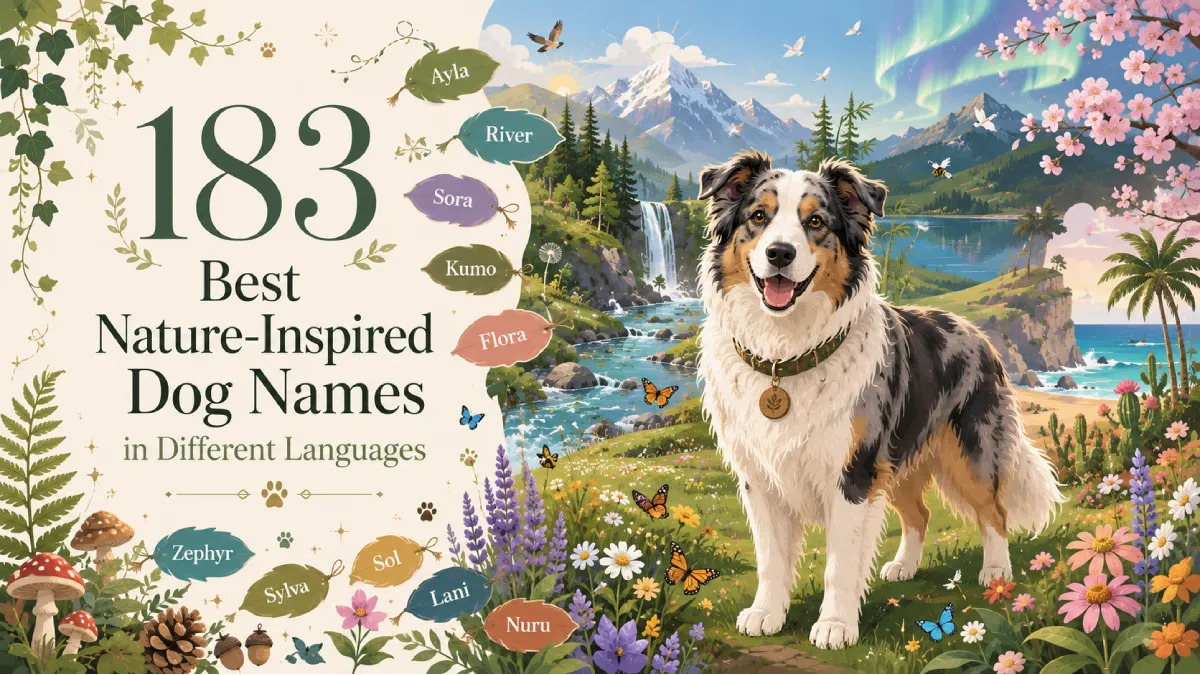
183 Best Nature-Inspired Dog Names in Different Languages (Botanical, Earthy & Global)
Naming a new companion offers an opportunity to celebrate the untamed beauty of the outdoors through a meaningful moniker. Choosing nature-inspired dog names provides a refreshing alternative to traditional domestic labels, connecting your pet to the broader landscape. For owners seeking a title rooted in plant life, exploring various botanical dog names allows you to discover options rich in linguistic elegance and natural history. Whether you feel drawn to the lush flora of tropical forests, the rugged stone of alpine mountains, or the tranquil flow of global rivers, environmental monikers offer a timeless identity. This guide examines how global dialects capture wilderness elements to help you select a fitting descriptor for your pet.
Finding the right match requires balancing aesthetic appeal with practical functionality. This comprehensive guide provides precisely 183 distinct options, categorized to help you navigate choices ranging from authoritative, traditional monikers to gentle, outdoor-focused selections. By reviewing the linguistic roots and cultural significance behind these words, you can confidently assign a moniker that honors your dog’s energetic spirit.
The Acoustic Resonance of Wilderness Monikers
Canine communication relies heavily on the auditory signals provided by handlers. Experienced trainers and behaviorists emphasize that dogs respond most reliably to sharp, clear sounds that cut through ambient noise. When selecting international nature dog names, consider how the phonetics of a specific dialect affect how a canine companion processes auditory input. A name that is phonetically distinct helps pets identify when handlers speak directly to them rather than another household member or environmental stimulus.
Beyond the mechanics of training, choosing a name rooted in natural history connects your pet to a broader artistic and cultural narrative. These monikers often reflect virtues like strength, natural grace, or boundless freedom. Selecting a descriptor that carries a specific environmental meaning integrates pets into daily routines with an intentionality that enhances companionship.
Botanical and Floral Treasures From Global Languages
Plant-based monikers offer a wonderful way to honor the vibrant flora of our planet. These selections draw from international dialects to provide elegant, plant-inspired choices.
Elegant Flora Across International Dialects
- Lumi — Meaning “snow” in Finnish. Crisp, pristine, and luminous.
- Hana — Meaning “flower” in Japanese. A sweet, floral association.
- Ren — Meaning “lotus” in Japanese. A sophisticated, Zen-like name.
- Fleur — Meaning “flower” in French. Pure botanical minimalism.
- Iris — Meaning “rainbow” or the flower in Greek. Vibrant yet delicate.
- Daphne — Meaning “laurel tree” in Greek. Classical and earthy.
- Acacia — A distinctive tree known for its delicate yellow blossoms. Graceful.
- Cassia — A warm spice related to cinnamon. Exotic and aromatic.
- Jasmine — A fragrant night-blooming flower. Classic yet worldly.
- Wisteria — A climbing woody vine with cascading purple blooms. Romantic.
- Dahlia — A striking tuberous garden flower. Dramatic and bold.
- Banyan — A sprawling fig tree with aerial roots. Connected and sturdy.
- Cypress — An evergreen tree associated with resilience. Sleek.
- Bamboo — Fast-growing woody grass. Sturdy and green.
- Redwood — Towering coastal evergreen tree. Imposing and majestic.
- Fern — Woodland-inspired and quiet. Perfect for a gentle pet.
- Ivy — Climbing, evergreen, and classic. Visually striking.
- Sage — Herbaceous and wise. Earthy and aromatic.
- Clover — Whimsical and lucky. Sweet-tempered.
- Brier — A prickly shrub or vine. Rugged and untamed.
- Cedar — A fragrant evergreen tree. Fresh and woody.
- Teak — Durable, dense, and golden-brown. Strong and reliable.
- Reed — Slender, aquatic, and swaying. Graceful in motion.
- Alder — A sturdy tree thriving near water. Grounded and calm.
- Rowan — A resilient tree bearing bright red berries. Bold.
Practical Step: When evaluating a plant-derived tag, ensure you verify that your chosen botanical term does not share a name with common toxic garden flora in your region, keeping safety at the forefront of your pet parenting journey. Reviewing resources on how to choose the right puppy can also help prepare a living space.
Earthy and Mineral Monikers Grounded in Geology
The solid bedrock of our planet provides stark, enduring inspiration. These choices celebrate rocks, minerals, and terrestrial foundations.
Terrestrial Terms for Sturdy Companions
- Basalt — Dense, dark volcanic rock. Solid and unyielding.
- Cinnabar — A striking red mineral. Vivid and fiery.
- Diorite — A speckled, durable intrusive igneous rock. Textural.
- Feldspar — A common yet rugged rock-forming mineral. Sturdy.
- Gneiss — A high-grade metamorphic rock with banded patterns. Rare.
- Hematite — A heavy iron oxide mineral with a metallic sheen. Cool.
- Igneous — Formed through cooling magma. Fiery and geological.
- Jasper — An opaque, multicolored quartz variety. Earthy and patterned.
- Kyanite — A striking blue silicate mineral. Brilliant and sharp.
- Lichen — A resilient organism thriving on bare rock. Hardy.
- Mica — A mineral that splits into thin, glittering sheets. Light.
- Obsidian — Natural volcanic glass. Jet-black and sleek.
- Pyrite — Fool’s gold. Bright, metallic, and eye-catching.
- Quartz — A hard crystalline mineral. Crystalline and clear.
- Rhyolite — An extrusive igneous rock. Smooth and stony.
- Schist — A medium-grade metamorphic rock. Striated and unique.
- Talc — The softest known mineral. Gentle and smooth.
- Umbra — A natural dark earth pigment. Shadowy and artistic.
- Flint — A hard rock used historically to spark fire. Sharp.
- Onyx — A banded black chalcedony gemstone. Polished and dark.
- Topaz — Golden gemstone brilliance. Sparkling and bright.
- Clay — Moldable, earthy, and warm. Natural and unpretentious.
- Slate — Fine-grained metamorphic rock. Cool-toned and sleek.
- Granite — Igneous rock of immense durability. Unbreakable.
Aquatic and Water-Inspired Identifiers
Rivers, oceans, lakes, and rainfall inspire fluid monikers that capture the dynamic movement of water across the globe.
Flowing Names for Swimmers and Water Lovers
- Rio — Meaning “river” in Spanish. Energetic and fluid.
- Maris — Meaning “of the sea” in Latin. Fluid and oceanic.
- Kai — Meaning “ocean” in Hawaiian. Matches a dog that loves swimming.
- Nalu — Meaning “wave” in Hawaiian. Oceanic and rhythmic.
- Gulf — Meaning a large body of water. Bold and expansive.
- Reef — Meaning a ridge of rock in the sea. Ocean-themed.
- Delta — Wetland area where a river empties. Fluid and expansive.
- Lagoon — A shallow body of water protected by a reef. Tranquil.
- Creek — A small, flowing stream. Refreshing and bright.
- Lake — Inland body of water. Calm and reflective.
- Tide — Rising and falling sea level. Rhythmic and constant.
- Bay — Inlet of the sea. Clean and approachable.
- Brook — Small natural stream. Gentle and soothing.
- Ford — A shallow place in a river where it can be crossed. Sturdy.
- Marina — A harbor for small boats. Coastal and bright.
- Pelagic — Pertaining to the open ocean. Vast and deep.
- Torrent — A strong and fast-moving stream of water. Energetic.
- Fjord — A long, narrow, deep inlet of the sea between high cliffs. Majestic.
- Mist — Fine water droplets suspended in the atmosphere. Soft.
- Dew — Moisture condensed from the atmosphere. Fresh and pristine.
- Rain — Condensed moisture falling from clouds. Cleansing.
- Pond — Small body of water. Quirky and grounded.
- Wave — Moving ridge of water. Dynamic and lively.
- Spring — Natural source of water emerging from underground. Vibrant.
- Cascade — A small waterfall. Rushing and musical.
Safety Reminder: When exploring natural lakes or rivers with aquatic-loving canines, always watch out for hidden underwater hazards, strong currents, and blue-green algae blooms to protect your pet from environmental health risks.
Alpine Peaks and Sky Elements Across Dialects
High-altitude landscapes, atmospheric phenomena, and celestial weather patterns provide breathtaking options for adventurous companions.
High-Altitude Monikers for Active Breeds
- Sora — Meaning “sky” in Japanese. Expansive and light.
- Haneul — Meaning “heaven or sky” in Korean. Grand yet soft.
- Caelum — Meaning “sky” in Latin. Fits a dog that loves high places.
- Sierra — Meaning a jagged mountain range in Spanish. Rugged.
- Giri — Meaning “mountain” in Sanskrit/regional dialects. Sturdy.
- Canyon — Deep gorge carved by a river. Rugged and grand.
- Zenith — The highest point in the sky. Elevated and precise.
- Nova — A bright, exploding star. Luminous and energetic.
- Solstice — The turning point of the sun. Celestial.
- Astra — Starry and celestial. Shimmering and clear.
- Cirrus — Wispy, high-altitude cloud formations. Airy and light.
- Zephyr — The gentle west wind. Untamed and breezy.
- Boreas — Personification of the cold north wind. Sharp.
- Notus — God of the south wind associated with autumn storms. Warm.
- Eurus — God of the turbulent east wind. Energetic and bold.
- Summit — The highest point of a hill or mountain. Majestic.
- Ridge — A long narrow hilltop or mountain range. Sleek.
- Alpine — Pertaining to high mountains. Fresh and crisp.
- Atlas — Structural, map-inspired, and strong. Grounded.
- Nimbus — A luminous cloud or a rain cloud. Atmospheric.
- Stellar — Relating to a star or stars. Brilliant.
- Aurora — The dawn or polar lights. Spectacular and colorful.
- Ember — Smoldering fragment of coal. Warm and glowing.
- Gale — A very strong wind. Powerful and rushing.
- Tundra — Vast, flat, treeless Arctic region. Cold and open.
Vet Check: High-altitude hikes and rugged terrain put extra demands on paw pads and joints; regular veterinary examinations ensure your adventurous pet remains physically conditioned for outdoor excursions, supporting overall puppy health and wellness.
Animalistic and Wilderness-Themed Titles
Drawing inspiration from fauna and wild animal behavior adds a layer of instinctual charm to an animal’s identity.
Wildlife and Natural Movement Descriptors
- Falcon — A swift, sharp-eyed bird of prey. Sharp and keen.
- Gecko — A small, agile tropical lizard. Quick and nimble.
- Heron — A long-legged coastal wading bird. Patient and sleek.
- Ibis — A long-billed wading bird of tropical wetlands. Exotic.
- Jaguar — A powerful spotted wild feline of the Americas. Furtive.
- Kestrel — A small hovering falcon. Alert and precise.
- Quail — A small ground-dwelling game bird. Grounded.
- Oisin — Irish Gaelic origin meaning little deer. Swift.
- Lark — A spirited songbird. Joyful and nimble.
- Rook — A smart, dark-feathered corvid bird. Clever.
- Wren — A tiny, active songbird. Small and energetic.
- Badger — Burrowing nocturnal mammal. Tenacious and tough.
- Finch — Small seed-eating bird. Cheerful and active.
- Hawk — Bird of prey with exceptional vision. Focused.
- Lynx — Wildcat with distinctive tufted ears. Stealthy.
- Moth — Nocturnal winged insect. Delicate and quiet.
- Otter — Playful aquatic mammal. Joyful and sleek.
- Puma — Large tawny American wild cat. Athletic.
- Raven — Large intelligent black corvid. Mysterious.
- Wolf — Wild canine ancestor of domestic dogs. Pack-oriented.
- Bear — Large heavy-set mammal. Sturdy and powerful.
- Deer — Graceful hooved herbivore. Swift and quiet.
- Fawn — Young deer. Gentle and soft-toned.
- Kit — Young fox or beaver. Spunky and alert.
- Cub — Young carnivorous mammal. Playful and small.
Comprehensive Global Wilderness Bank (Items 126 to 183)
To ensure this guide offers an exhaustive repository, these final entries compile unique international terms celebrating wild environments.
International Wilderness Vocabulary
Aven, Burl, Cairn, Drift, Inlet, Knoll, Mead, Nadir, Ochre, Pike, Quill, Sedge, Tarn, Umber, Vane, Xylos, Yoke, Zeal, Ash, Birch, Cove, Dale, Elm, Glen, Hazel, Juniper, Grove, Heath, Moor, Vale, Weald, Yew, Zawn, Bough, Frond, Husk, Knot, Leaf, Root, Seed, Stem, Twig, Bark, Pith, Sap, Spore, Thorn, Vine, Whorl, Bud, Cap, Pod, Sod, Turf, Clod, Loam, Muck, Peat.
Frequently Asked Questions
- Are nature-inspired dog names difficult for puppies to learn during obedience training? No. Dogs respond primarily to phonetic clarity, pitch variation, and vocal frequency rather than the environmental origin or length of the word. A crisp term like Kai, Rio, or Sage is exceptionally easy for a canine to master, provided training sessions remain consistent and are paired with positive reinforcement.
- How do I ensure my pet’s wilderness-themed title is recorded correctly on veterinary paperwork? When registering a pet at a clinic, ensure the spelling matches your official preference, especially for complex terms like Cinnabar or Boreas, to prevent administrative clerical errors in their medical files.
- Can outdoor monikers be used for both dogs and cats? Yes. Many botanical and geographical terms work wonderfully across multiple species, making them ideal for multi-pet households looking for a cohesive, sophisticated naming style.
- What makes a dog name truly nature-inspired? A truly environmental moniker usually combines smooth vowel transitions with direct linguistic or cultural ties to flora, fauna, geological formations, or weather patterns that convey natural dignity.
- Should I avoid titles that resemble standard household commands? Yes. It is always wise to steer clear of unusual words that sound identical to or rhyme with common obedience cues like “sit,” “stay,” “no,” or “come” to prevent accidental confusion during multi-step training exercises.
- How long does it take for a rescue pet to adapt to a new environmental identifier? Most rescue animals adapt to a new title within seven to fourteen days when owners consistently pair the sound with high-value treats, affectionate petting, and regular daily obedience drills using techniques detailed in guidance on understanding dog behavior.