German Shepherd Feeding Guide: Puppy to Adult Nutrition
A German Shepherd feeding guide should not assign every dog the same number of cups. A growing puppy, an active working adult, a neutered household companion and an older German Shepherd with declining muscle may all need substantially different calorie intakes. AAHA recommends individualized nutrition based on life stage, body weight, body and muscle condition, health, lifestyle and the diet being fed rather than breed alone.
The most practical method is to choose a complete and balanced food appropriate for the dog’s life stage, check its calories per cup, can or gram, use the manufacturer’s feeding instructions as a starting point, then adjust according to weight trend and body condition. AAFCO specifically states that feeding directions are guidelines that may need modification for an individual animal.
Quick Answer
How much to feed a German Shepherd depends on age, weight, body condition, activity, health, reproductive status, treats and the calorie density of the food. Puppies need measured portions that support controlled large-breed growth. Adults need enough energy to maintain ideal condition, while senior portions should change according to activity, muscle condition, weight trend and medical needs.
Why Body Condition Matters More Than a Cup Number
Two German Shepherds can weigh the same but have very different body composition.
AAHA recommends assessing body weight together with body condition score and muscle condition score. On the commonly used nine-point system, a BCS around 4–5/9 is generally considered ideal; unexplained weight change, BCS below 4/9 or above 5/9, or muscle loss should prompt closer nutritional assessment.
This makes body condition more useful than asking whether your dog eats exactly three cups, four cups or another fixed amount.
A useful home check asks:
- Can you feel the ribs without pressing through a heavy fat layer?
- Is there a visible waist from above?
- Is body fat increasing?
- Is muscle being lost?
- Is weight stable, rising or falling?
Long-coated German Shepherds can be visually misleading, so hands-on body-condition assessment and periodic veterinary scoring are particularly useful.
Puppy Feeding
GSD puppy feeding should prioritize controlled development rather than maximum growth speed.
Puppies require a diet nutritionally adequate for growth. FDA explains that AAFCO nutritional adequacy profiles separate growth/reproduction from adult maintenance because growing dogs have different nutrient needs.
For a German Shepherd puppy:
- choose a complete and balanced growth diet appropriate for a dog expected to become large
- measure daily food
- divide it into scheduled meals
- monitor growth and body condition
- count treats and training food
- adjust portions as the puppy develops
VCA’s veterinary nutrition guidance stresses that healthy puppy growth should be neither excessively rapid nor too slow and recommends portion feeding because amounts can be adjusted according to growth rate and body condition.
Track physical development alongside Pawnium’s /german-shepherd-growth-chart/.
Large-Breed Puppy Considerations
German Shepherd puppies should not be deliberately pushed toward a heavier weight.
Large-breed puppy nutrition requires particular attention to energy intake and skeletal development. AAHA recommends feeding an appropriate growth diet until skeletal maturity and notes that some larger dogs may not reach skeletal maturity until around 15–16 months.
VCA also emphasizes moderate, controlled growth for large breeds and notes that measured feeding can help reduce excessive weight gain without reducing eventual adult size.
Do not add extra calories simply because:
- another puppy of the same age weighs more
- an online growth table shows a higher number
- your adolescent German Shepherd looks lanky
- you want a larger adult dog
Adult frame is strongly influenced by genetics. Overfeeding changes calorie intake and body condition; it does not safely redesign genetic adult size.
Feeding Frequency
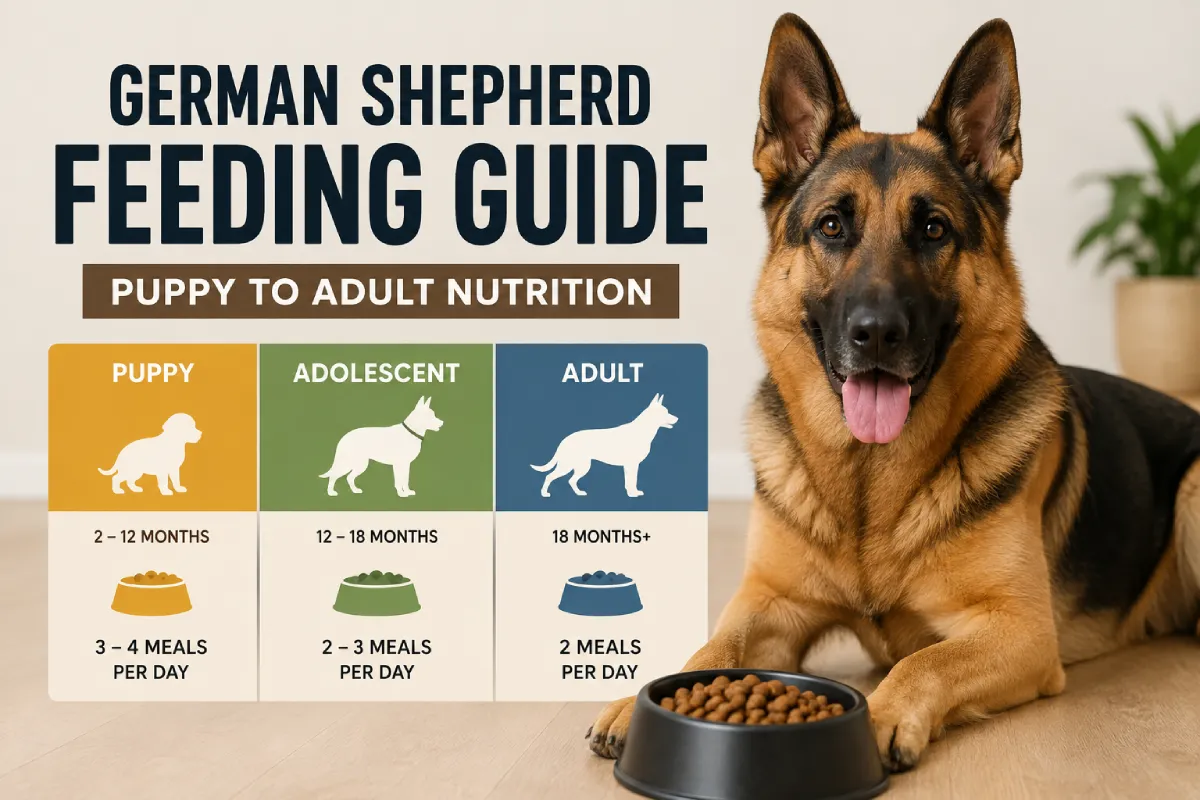
Young puppies generally do better when their daily ration is divided into several scheduled meals.
Veterinary nutrition guidance commonly recommends measured puppy meals two to three times daily, with frequency adjusted according to age and body condition.
As the dog matures, the daily total can usually be divided into a practical household schedule rather than provided as one very large meal.
This is particularly relevant for German Shepherds because Merck lists the breed among dogs at increased risk for gastric dilatation-volvulus, or GDV, and identifies once-daily feeding among associated risk factors. Guidance for higher-risk dogs includes feeding multiple smaller meals rather than one large meal.
The important number is the total daily calorie intake. Dividing the same calories into meals does not create additional calories.
Adult Feeding
Once skeletal growth is complete, the feeding goal changes from supporting development to maintaining a healthy adult body composition.
A food labelled as complete and balanced for adult maintenance is designed for this life stage. The correct amount is whichever measured intake keeps the individual dog at an appropriate weight and BCS while meeting its nutritional needs.
An adult German Shepherd’s portion may need adjustment when:
- activity increases or decreases
- the dog is spayed or neutered
- body weight changes
- treats increase
- a new food has different calorie density
- health status changes
AAHA uses different starting energy factors for intact, neutered, inactive and working dogs, but it explicitly describes those as general estimates that must be adjusted by monitoring body weight and condition.
This is why a universal German Shepherd food portion is not reliable.
Senior Feeding
There is no one birthday when every German Shepherd needs a special “senior” ration.
AAHA defines senior status according to the later portion of a dog’s expected lifespan rather than one universal age, and there is no specific AAFCO senior nutrient profile. An older dog doing well on an appropriate complete adult-maintenance diet does not necessarily need to change foods simply because it has become older.
What does need closer attention is:
- body weight
- muscle condition
- activity
- appetite
- mobility
- chronic disease
Maintenance energy requirements generally decrease over a dog’s lifetime, while older dogs may also lose lean body mass. Senior feeding therefore has to balance preventing excess fat with preserving muscle and supporting any medical needs.
Do not automatically reduce food just because a German Shepherd is old if the dog is already losing weight or muscle.
Dry Food
Dry food can be an appropriate main diet when its nutritional adequacy statement matches the dog’s life stage.
The number of cups required depends heavily on calorie density. AAFCO requires the calorie statement to include kilocalories per kilogram and a familiar unit such as kcal per cup.
This means:
one cup of Food A may not equal one cup of Food B nutritionally or calorically.
Measure dry food consistently, and recalculate the amount if you change products rather than automatically feeding the same number of cups.
Wet Food
Wet food can also be used when it is complete and balanced for the appropriate life stage.
FDA notes that canned foods contain much more moisture than typical dry foods, so the two forms should not be compared simply from the percentages on the guaranteed analysis.
For portion planning, look at:
- calories per can, tray or gram
- nutritional adequacy statement
- life stage
- amount actually fed
- body-condition response
There is no evidence-based rule that every German Shepherd should eat dry food or every German Shepherd should eat wet food. Veterinary nutrition guidance emphasizes choosing a complete, appropriate diet for the individual animal.
Mixed Feeding
Mixed feeding means using both wet and dry food.
The key mistake to avoid is calculating a full dry-food ration and then adding wet food on top as though it contains no calories.
Count:
dry calories + wet calories + treats + chews + training rewards
as one daily total.
If you increase the wet-food portion, the amount of dry food often needs to change accordingly.
The same principle applies when adding toppers or other calorie-containing extras.
Food Calorie Density
Calorie density explains why there cannot be one universal German Shepherd feeding chart measured only in cups.
Pet-food calorie statements are expressed in kcal/kg and usually kcal per familiar unit, such as a cup or can. A veterinarian can then use the dog’s age, weight, activity and other factors to estimate an appropriate starting intake.
For example, if you change to a food containing more calories per cup, feeding the same volume can substantially increase total daily intake even though the bowl looks identical.
For an individual German Shepherd, use the daily calorie calculator for dogs to get a starting energy estimate, then use the kcal per cup, can or gram on the food label to work out the corresponding portion.
A calorie estimate is a starting point—not a guarantee of the final feeding amount.
Treats
Treat calories are part of the diet.
AAHA identifies more than about 10% of total daily calories from non-complete foods such as treats, table foods and chews as a nutritional risk factor. VCA gives the same general 90/10 framework for treats.
This includes:
- biscuits
- dental chews
- pieces of meat or cheese
- table food
- food used to give medication
- long-lasting edible chews
A dog receiving many extras can gain weight even when its measured meal portion appears reasonable.
Training Rewards
German Shepherd puppies and adults may receive frequent food rewards during training.
Those rewards should not simply become unlimited extra calories.
Practical options include:
- reserving some of the dog’s normal daily kibble for training
- using very small reward pieces
- counting higher-calorie treats in the daily total
- reassessing meals on days with unusually heavy reward use
AAHA’s treat-calorie guidance applies to training food just as it does to snacks.
Training success does not require turning every repetition into a large calorie addition.
Active Working Dogs
A German Shepherd doing regular protection work, search work, service work, demanding sport or sustained field activity may have very different energy needs from a household companion.
AAHA’s energy-estimation framework distinguishes light, moderate and heavy work, illustrating how widely energy requirements can vary with workload.
Current veterinary nutrition guidance for working dogs likewise emphasizes that there is no one best working-dog food. Dogs with genuinely high daily energy expenditure may benefit from more energy-dense diets, but the choice should consider medical history, dietary history, workload and physical examination.
For an active dog, track:
- body weight
- BCS
- muscle condition
- performance
- recovery
- stool quality
- seasonal workload changes
Do not increase calories because German Shepherds are stereotyped as “high-energy.” Increase them when the individual dog’s actual workload and body-condition trend support it.
Lower-Activity Household Dogs
A German Shepherd living primarily as a companion may need substantially less energy than a working dog of the same weight.
AAHA’s general estimates use lower energy factors for inactive or obesity-prone dogs than for actively working animals, but actual portions still need to be adjusted by monitoring BCS and weight.
Common reasons portions become excessive include:
- activity decreasing without food being adjusted
- continuing puppy-sized calorie intake into adulthood
- high treat use
- several family members feeding separately
- measuring by eye
Breed reputation should not determine the calorie allowance. Actual lifestyle should.
Weight Gain
Gradual weight gain often means total calorie intake is exceeding current energy use, although medical contributors can also exist.
Look for:
- ribs becoming harder to feel
- loss of waist
- BCS rising above the desired range
- reduced activity
- extra treats
- a change to a more calorie-dense food
AAHA considers BCS above 5/9 a reason for closer nutritional assessment.
Do not drastically cut a dog’s food without considering whether the remaining amount still provides adequate nutrients. Significant weight-loss plans are better designed with veterinary guidance, and therapeutic weight-management diets may be appropriate when substantial calorie restriction is required.
Weight Loss
Unexplained weight loss should not automatically trigger a large increase in food.
First record:
- actual daily calories
- appetite
- BCS
- muscle condition
- stool quality
- vomiting
- activity
- recent diet changes
AAHA lists unexplained weight change, BCS below 4/9 and muscle loss as nutritional risk factors requiring further assessment.
Persistent loss can reflect inadequate intake, increased energy demand, gastrointestinal problems or medical disease. The scale alone cannot tell you which.
Food Transitions
Switch foods gradually when practical rather than abruptly changing the entire ration.
Current veterinary guidance recommends introducing a new diet slowly over roughly a week or longer, and some dogs may benefit from an even slower change when gastrointestinal tolerance is a concern.
A practical transition gradually increases the proportion of the new food while reducing the old.
Slow the transition and contact your veterinarian if the change is accompanied by persistent:
- vomiting
- diarrhoea
- reduced appetite
- marked discomfort
Use Pawnium’s Food Transition Guide for the full step-by-step schedule.
Digestive Sensitivity: Do Not Diagnose It From Breed
Do not assume that every German Shepherd has a “sensitive stomach.”
Some individual dogs experience recurrent loose stool, vomiting, flatulence or poor food tolerance, but those signs deserve an individual assessment rather than being automatically attributed to the breed.
AAHA considers altered gastrointestinal function—including vomiting, diarrhoea, reduced stool quality, nausea, flatulence and constipation—a nutritional risk factor that may warrant a more detailed evaluation.
If gastrointestinal signs persist:
- record the current diet
- record treats and chews
- note recent food transitions
- monitor weight
- discuss the pattern with your veterinarian
Do not cycle repeatedly through multiple “sensitive” foods without understanding what is causing the problem.
Feeding Around Exercise
German Shepherds are among the breeds Merck lists as being at increased risk for GDV, a life-threatening condition in which the stomach dilates and twists. Risk is multifactorial, and feeding practices are only one part of the picture.
For higher-risk dogs, Merck’s preventive guidance includes:
- multiple smaller meals instead of one large meal
- reducing stress around feeding
- restricting vigorous exercise around meals
There is not one universally proven minute-by-minute waiting period suitable for every dog, so avoid turning this into an exact stopwatch rule.
More importantly, know GDV warning signs such as:
- repeated unproductive retching
- sudden restlessness
- excessive drooling
- enlarging abdomen
- marked distress
These require immediate veterinary care.
Manufacturer Feeding Guidance
Food-package instructions are useful as a starting estimate.
AAFCO requires complete and balanced foods to provide feeding directions appropriate to the animal’s weight and life stage, but also states that those instructions may need to be modified for the individual pet.
Use the package like this:
- Check the nutritional adequacy statement.
- Confirm the appropriate life stage.
- Find calories per cup, can or gram.
- Locate the suggested starting amount.
- Measure the portion consistently.
- Include treats in the total.
- Monitor weight and BCS.
- Adjust when necessary.
Use Pawnium’s Dog Food Label Guide for a deeper explanation of adequacy statements, guaranteed analysis and calorie information.
Veterinary Diets
A therapeutic veterinary diet is not simply a “better” version of ordinary dog food.
These diets are purpose-formulated around particular nutritional goals. AAHA recommends choosing therapeutic diets according to the diagnosed condition, relevant nutrients of concern and the needs of the individual patient.
Examples of situations where a veterinary diet might be considered include specific:
- gastrointestinal disorders
- urinary conditions
- kidney disease
- food-responsive disease
- obesity-management plans
- other diagnosed medical conditions
Do not choose a therapeutic diet purely because your German Shepherd belongs to a particular breed.
AAFCO also notes that veterinary medical foods may carry directions such as “use only as directed by your veterinarian.”
When to Seek Professional Nutrition Advice
Ask your veterinarian for a detailed nutritional assessment when your German Shepherd has:
- abnormal puppy growth
- persistent weight gain
- unexplained weight loss
- BCS below 4/9 or above 5/9
- muscle loss
- recurrent vomiting or diarrhoea
- major appetite changes
- a chronic disease
- very demanding athletic or working requirements
- several supplements or unconventional foods
- a need for a therapeutic diet
A board-certified veterinary nutrition specialist is particularly useful for medically complex dogs or when an owner wants to feed a home-prepared diet. AAHA notes that many home-prepared recipes available online or in books are not nutritionally complete and recommends specialist formulation.
FAQs
How much should I feed my German Shepherd each day?
There is no single cup amount suitable for every German Shepherd. Start with the food’s feeding guidance and calorie density, then adjust according to life stage, body weight, BCS, activity, treats and weight trend.
How many meals per day should a German Shepherd puppy eat?
Growing puppies are commonly fed measured food two to three times per day, with the exact frequency adjusted according to age and body condition.
Does my German Shepherd need breed-specific food?
Not automatically. AAHA notes that breed-specific foods may have particular design features, but nutritional recommendations should ultimately be based on the individual dog and the nutrient profile of the diet.
Should I feed my German Shepherd more because it looks skinny?
Check body condition and weight trend first. Adolescent German Shepherds can look lanky during growth, while true BCS below 4/9 or unexplained loss deserves a nutritional and veterinary assessment rather than automatic overfeeding.
Can German Shepherds eat both wet and dry food?
Yes, provided the overall feeding plan is appropriate and nutritionally complete. Count the calories from both foods toward the same daily total rather than feeding a full ration of each. There is no single food format that is best for every dog.
Should an older German Shepherd automatically switch to senior food?
No. There is no standardized AAFCO senior nutrient profile, and AAHA advises that an older dog doing well on an appropriate complete adult diet does not automatically need to change foods solely because of age.