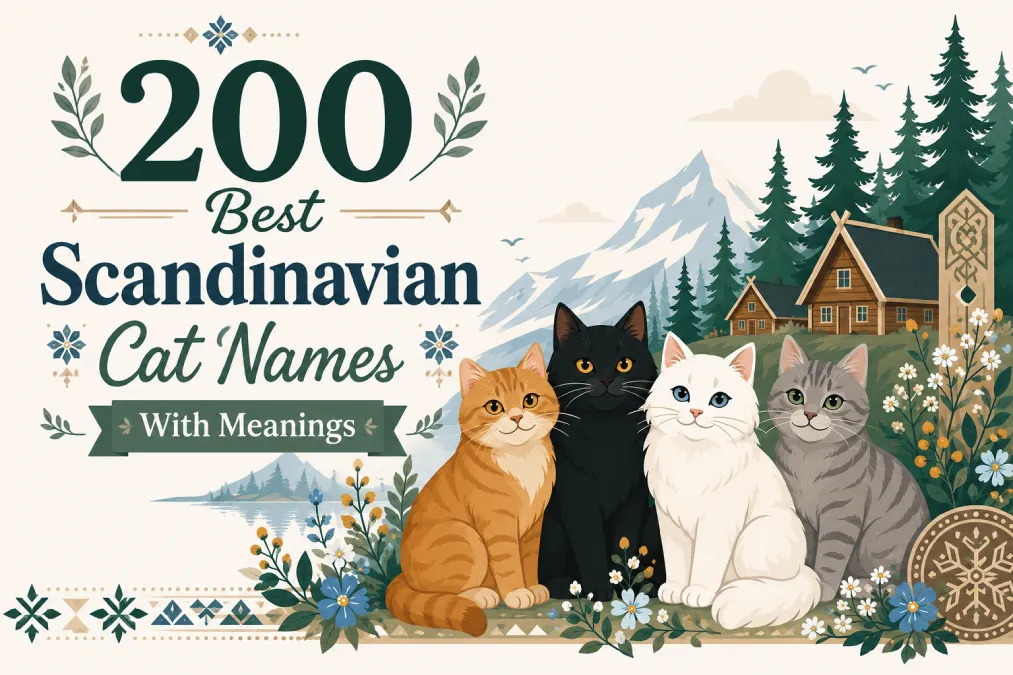
200 Best Scandinavian Cat Names With Meanings (Viking, Norse & Cute Ideas)
Selecting a moniker for a newly adopted feline is a significant milestone that shapes how you communicate with your companion daily. For pet parents seeking options that stand out from conventional choices, Scandinavian cat names offer a remarkable blend of sharp phonetics, deep cultural history, and aesthetic charm. Whether you are welcoming a robust Norwegian Forest Cat into your home or simply appreciate Nordic cultural heritage, the languages of Northern Europe provide incredibly distinctive vocabulary.
This extensive collection features exactly 200 unique identifiers, ranging from fierce Viking cat names to endearing Swedish lifestyle terms. By exploring the literal translations of ancient mythological figures, breathtaking winter landscapes, and traditional regional titles, you can find an option that perfectly matches your pet’s physical appearance, breed traits, and distinct personality.
The Linguistic Charm of Nordic Cultural Heritage
The languages of Sweden, Denmark, and Norway share rich Old Norse roots that heavily feature crisp consonants and distinct vowel sounds. Feline hearing is highly receptive to hard sounds like “K,” “T,” and “R,” making these Northern European words highly effective for capturing an animal’s attention during training or mealtime.
Choosing a word from this region also allows owners to reflect their personal interests in history, mythology, or geography. Instead of relying on standard domestic labels, utilizing a translated title gives your companion an identifier that commands respect at the veterinary clinic and serves as an excellent conversation starter with guests.
Strong Scandinavian Cat Names Male Felines Suit
Traditional masculine titles from the Nordic region often originate from ancient kings, historical warriors, and revered chieftains. These robust selections project quiet confidence, making them highly suitable for reliable, steady companions or large, muscular breeds.
- Arne — Meaning “eagle.” A majestic title for an observant feline that prefers perching on high shelves.
- Björn — Meaning “bear.” Highly appropriate for a massive, thick-coated companion with a lumbering walk.
- Casper — Meaning “treasurer.” A classic Danish option for a highly valued family pet.
- Dag — Meaning “daylight.” Fits a bright, early-rising kitten that wakes the household enthusiastically.
- Einar — Meaning “lone warrior.” Suits an independent, highly capable mouser that patrols the garden alone.
- Finn — Meaning “fair” or “from Finland.” An excellent, short sound for a pale-colored or white feline.
- Gunnar — Meaning “brave soldier.” Matches a fearless, adventurous pet that investigates new environments immediately.
- Harald — Meaning “commander.” A regal choice for a dominant male that clearly manages the household dynamics.
- Ivar — Meaning “bow warrior.” A sharp, historic name popularized by legendary Viking sagas.
- Jari — Meaning “helmeted warrior.” Fits a tough, sturdy domestic shorthair with a broad head.
- Kåre — Meaning “curly.” A brilliant, literal descriptor for a Rex breed featuring a distinctly wavy coat.
- Leif — Meaning “heir” or “descendant.” A widely recognized historic title honoring the famous Nordic explorer.
- Magnus — Meaning “great.” Suited to an impressively large, imposing breed like a Maine Coon.
- Nils — Meaning “victory of the people.” A friendly, approachable sound for a highly social neighborhood cat.
- Olaf — Meaning “ancestor’s relic.” A traditional, deeply historic label for a reliable and calm companion.
- Pål — Meaning “small.” An ironic, humorous choice for a giant breed or a perfectly fitting title for a tiny rescue kitten.
- Roar — Meaning “fame and spear.” A uniquely spelled Norwegian option that visually aligns with feline vocalizations.
- Sigurd — Meaning “victorious advisor.” Matches an intelligent, vocal animal that constantly follows you around the house.
- Torsten — Meaning “Thor’s stone.” A solid, unshakeable identifier for a heavy-set, relaxed pet.
- Ulf — Meaning “wolf.” Fits a grey, wild-looking tabby or a highly vocal animal that loves to yowl.
- Viggo — Meaning “battle.” A punchy, two-syllable word ideal for a highly energetic, competitive play-fighter.
- Aksel — Meaning “father of peace.” Suited to a mild-mannered, deeply relaxed therapy animal.
- Bengt — Meaning “blessed.” An older, traditional Swedish choice for a deeply loved senior adoption.
- Espen — Meaning “god bear.” A majestic, mythical-sounding moniker for a heavy-coated, impressive feline.
- Frode — Meaning “wise and learned.” Matches a quiet, observant pet that carefully watches daily routines.
- Gustav — Meaning “staff of the gods.” A regal, royal title that complements a pampered, well-groomed gentleman.
- Henrik — Meaning “ruler of the home.” An incredibly accurate descriptor for an assertive cat that demands meals on time.
- Jens — Meaning “God is gracious.” A snappy, single-syllable word that cuts through household noise effectively.
- Knud — Meaning “knot.” A historical royal title for a sturdy, compact, and muscular companion.
- Lars — Meaning “crowned with laurel.” Fits a triumphant, successful hunter that proudly brings toys to your feet.
- Mikkel — Meaning “who is like God.” A popular Danish equivalent to Michael, offering a soft, friendly rhythm.
- Rasmus — Meaning “beloved.” A highly affectionate label for a devoted lap cat that refuses to leave your side.
- Sören — Meaning “stern.” Matches a serious, unamused feline with a permanently grumpy facial expression.
- Stellan — Meaning “calm.” Ideal for a peaceful, non-reactive animal that easily handles loud environments.
- Sven — Meaning “youth.” An endearing, forever-young marker for a companion that retains kitten-like energy for years.
- Tore — Meaning “thunder warrior.” A loud, booming association for a deep-chested, highly vocal cat.
- Vidar — Meaning “forest warrior.” Fits an earthy, outdoor-focused feline that thrives in heavily wooded backyards.
- Bo — Meaning “to live” or “dwell.” The ultimate minimalist identifier, perfect for quick, urgent recall commands.
- Rune — Meaning “secret lore.” A mysterious, quiet label for a stealthy animal that hides in shadowy corners.
- Erik — Meaning “eternal ruler.” A universally recognized Viking moniker that commands immediate respect.
Warrior Names and Old Norse Roots
Many of the titles listed above trace their origins directly back to the Viking Age. Because these societies highly valued bravery, physical strength, and strategic intelligence, their naming conventions frequently incorporated elements of battle, wild animals, and natural forces. Applying one of these historic identifiers to a modern pet creates a delightful contrast, particularly when paired with a highly independent or athletic feline.
Pet Owner Note: When selecting a robust, historic moniker, observe how the word feels to say multiple times in succession. If a title feels too heavy or formal for daily use, consider creating a shorter nickname (like “Siggy” for Sigurd) for casual household interactions.
Elegant Scandinavian Cat Names Female Pets Embody
Feminine titles from this region often blend soft, melodic endings with meanings rooted in strength and resilience. These graceful selections offer a refined alternative for aesthetically pleasing, intelligent, or gentle-natured queens.
- Astrid — Meaning “divinely beautiful.” A universally recognized, classic choice honoring a physically striking animal.
- Britta — Meaning “exalted one.” Fits a confident, highly valued female that expects premium treatment.
- Dagny — Meaning “new day.” An uplifting, positive marker for a rescue feline starting a healthy new chapter.
- Ebba — Meaning “strong.” A brief, punchy word that suits a resilient, sturdy, and capable mouser.
- Elin — Meaning “light.” A brilliant naming idea for a bright-eyed, early-rising companion.
- Gerda — Meaning “protector.” Matches a territorial, watchful queen that guards her favorite sleeping spots fiercely.
- Helga — Meaning “holy” or “sacred.” An older, deeply traditional sounding title that suits an older, wiser rescue.
- Ida — Meaning “industrious.” Suited to an active, busy feline that constantly patrols the perimeter of the house.
- Ingrid — Meaning “beautiful goddess.” A stately, commanding title that works beautifully for an elegant, long-haired breed.
- Jorunn — Meaning “love of horses.” A quirky, traditional option for an animal raised on a rural farm property.
- Kari — Meaning “pure.” A crisp, highly accurate marker for a pure white or flawlessly groomed companion.
- Linnea — Meaning “twinflower.” A delicate, floral association for a sweet-natured, loving female.
- Malin — Meaning “high tower.” Fits a highly agile pet that insists on sleeping on top of the kitchen cabinets.
- Nora — Meaning “honor.” A short, melodic option that cuts through background noise effectively.
- Runa — Meaning “secret tradition.” Matches a mysterious, quiet feline that observes the room from a distance.
- Saga — Meaning “seeing one” or “story.” A popular Swedish moniker for an expressive animal with a rich personal history.
- Signe — Meaning “new victory.” An uplifting, positive choice for a pet that has overcome significant early health challenges.
- Siri — Meaning “beautiful victory.” A sharp, fast-paced sound that is remarkably easy for a kitten to learn.
- Tove — Meaning “beautiful Thor.” Blends feminine elegance with ancient mythological strength.
- Ulrika — Meaning “wolf power.” Suits a fierce, highly independent female with a strong prey drive.
- Viveka — Meaning “war fortress.” A highly secure, vigilant animal that thoroughly inspects all household visitors.
- Ylva — Meaning “she-wolf.” An excellent descriptive match for a grey, silver, or wolf-sable coated feline.
- Asta — Meaning “divine beauty.” A brief, airy sound suitable for a lightly built, graceful pet.
- Berit — Meaning “glorious.” Fits a show-quality animal with an impeccable pedigree and flawless conformation.
- Carin — Meaning “pure.” A smooth, flowing label for an agreeable, easygoing lap cat.
- Dorthe — Meaning “gift of God.” A deeply meaningful title acknowledging the gift of adopting a shelter animal.
- Elsa — Meaning “pledged to God.” A globally recognized name that beautifully suits a winter-white feline.
- Frida — Meaning “peace.” Ideal for a calm, non-reactive therapy animal that soothes anxious individuals.
- Grete — Meaning “pearl.” Suited to a highly valued, delicate, and aesthetically perfect small breed.
- Hanne — Meaning “gracious.” Matches a perfectly behaved, polite companion that waits patiently for her meals.
- Inga — Meaning “guarded by Ing.” A historic, protective title for a deeply loyal shadow cat.
- Jytte — Meaning “from Judea.” A unique, traditional Danish choice with a distinct, sharp pronunciation (YOO-teh).
- Kirsten — Meaning “follower of Christ.” A soft, highly familiar sound that easily translates to English-speaking homes.
- Lene — Meaning “bright.” An excellent marker for a warm-toned, golden-eyed cat that loves basking in sunlight.
- Mette — Meaning “pearl.” A snappy, short Danish variation that works brilliantly for recall training.
- Pernille — Meaning “rock.” A solid, unshakeable identifier for a dependable, calm-tempered female.
- Randi — Meaning “shield shrine.” A defensive, robust moniker for a cat that actively protects her kittens.
- Stine — Meaning “Christian.” A deeply traditional, melodic abbreviation commonly used in Norway and Denmark.
- Trine — Meaning “pure.” A bouncy, cheerful option for a permanently happy pet with a constantly vibrating purr.
- Signy — Meaning “new victory.” A prominent figure in Norse legend, fitting for a brave, adventurous queen.
Shieldmaiden Titles for Strong Queens
In Nordic history and folklore, shieldmaidens were women who chose to fight as warriors alongside men. When looking for female Scandinavian cat names, drawing inspiration from these fierce historical figures provides a fantastic alternative to overly delicate or traditional pet labels. These identifiers perfectly suit assertive, confident felines who establish themselves as the undisputed rulers of their territory.
Naming Checklist: Before finalizing your female cat’s new title, write it out to see how it looks on paper. Ensure the spelling is intuitive enough that your local veterinary clinic will not accidentally misspell it on important medical records or microchip databases.
Mythological and Norse Mythology Cat Names
The ancient pantheon of Northern Europe is filled with dramatic legends, powerful deities, and fascinating magical creatures. Utilizing these mythological references provides a pet with an incredibly sophisticated, educated, and storied aura.
- Odin — The Allfather and god of wisdom. A grand, highly imposing title for a highly intelligent, one-eyed, or senior cat.
- Thor — The god of thunder. Fits a heavy-footed, deeply vocal, and powerfully built companion perfectly.
- Loki — The trickster god. The ultimate, highly accurate descriptor for a mischievous kitten that constantly knocks objects off tables.
- Freya — The goddess of love, beauty, and cats. The most culturally appropriate female name, as her chariot was pulled by two large felines.
- Frigg — The queen of Asgard. A stately, commanding title that works well for a dignified, maternal queen.
- Balder — The god of light and purity. Suits a gentle, beloved, pure white companion that brings joy to everyone.
- Tyr — The one-handed god of war. An excellent, honorable moniker for an adventurous rescue cat missing a limb.
- Heimdall — The watchman of the gods. Matches a highly observant pet that sits by the window guarding the house all day.
- Skadi — The goddess of winter and hunting. A fierce, chilly title for a highly capable mouser that loves playing in the snow.
- Sif — The goddess of earth with golden hair. Ideal for a golden-toned tabby, Somali, or any rich-furred companion.
- Idun — The keeper of the apples of youth. An endearing, forever-young marker for a playful, highly energetic animal.
- Njord — The god of the sea and wind. Fits a water-loving breed or a cat that enjoys sitting in drafty, breezy windows.
- Bragi — The god of poetry. A refined, cultured label for a highly vocal cat that seems to sing or trill continuously.
- Forseti — The god of justice. Suited to a fair, balanced, and deeply calm feline that breaks up fights between other pets.
- Ullr — The god of snowshoes and archery. A tough, winter-ready identifier for a cold-weather breed with massive paws.
- Vali — A son of Odin known for his rapid growth. Matches a massively large kitten that outgrows its collars monthly.
- Vili — A brother of Odin who helped create the world. A quick, sharp-sounding, and unique historical reference.
- Ve — Another brother of Odin. An incredibly brief, single-syllable word highly effective for emergency recall.
- Hod — The blind god of winter. A sweet, deeply meaningful title for a visually impaired or blind rescue adoption.
- Hermod — The messenger of the gods. Fits a fast, nimble feline that darts rapidly from room to room.
- Hel — The ruler of the underworld. A dark, edgy label for a solid black, mysterious, or slightly standoffish pet.
- Fenrir — The giant mythological wolf. An ironic, badass choice for a massive, fiercely independent Maine Coon.
- Jörmungandr — The Midgard serpent. A hilarious, overly dramatic title for a long, slender, noodle-like animal.
- Sleipnir — Odin’s eight-legged horse. Fits a highly coordinated, fast-running cat that moves with incredible speed.
- Yggdrasil — The world tree. A grand, sweeping label for an earthy, grounded cat that absolutely loves climbing wooden cat towers.
- Asgard — The realm of the gods. An authoritative, wealthy-sounding identifier for a regal, imposing male.
- Midgard — The realm of humans. A stable, grounded name for a highly adaptable, realistic, and easygoing companion.
- Valhalla — The hall of the slain. A majestic, beautiful-sounding word that commands attention when spoken aloud.
- Valkyrie — The choosers of the slain. A fierce, powerful title for a female cat with a highly predatory hunting drive.
- Mjölnir — Thor’s magical hammer. Matches a heavy, solid, and incredibly sturdy feline that hits the floor loudly when jumping.
- Gungnir — Odin’s spear. A sharp, pointed-sounding word ideal for a sleek, slender, and fast-reacting sight-hunter.
- Huginn — Meaning “thought,” one of Odin’s ravens. Fits an incredibly smart, problem-solving, solid black companion.
- Muninn — Meaning “memory,” Odin’s other raven. A thoughtful, memory-driven pet that attaches strongly to routine.
- Geri — One of Odin’s wolves (meaning “greedy”). A remarkably honest, accurate label for a highly food-motivated glutton.
- Freki — Odin’s other wolf (meaning “ravenous”). Perfect for the rescue cat that constantly begs for wet food at the refrigerator.
- Sköll — The wolf that chases the sun. Fits a bright, golden-eyed cat with relentless, chasing energy.
- Hati — The wolf that chases the moon. A dark, nocturnal companion that becomes highly active during the midnight hours.
- Ratatosk — The squirrel of Yggdrasil. A deeply silly, endearing option for a highly hyperactive, chattering pet.
- Níðhöggr — The dragon at the roots of the world tree. A dark, intense mythology reference for a fierce, territorial animal.
- Nanna — The goddess of joy and peace. A comforting, gentle association for a therapy pet that naturally soothes its owners.
Important for Multi-Pet Homes: If you already own a dog or cat with an “O” vowel sound (like “Bo” or “Chloe”), avoid selecting a mythological title like “Thor” or “Odin.” Animals rely heavily on the primary vowel sounds to distinguish their own identifier, and similar rhythms can cause confusion.
Cute Scandinavian Cat Names Inspired by Nature
The natural landscapes of Sweden, Norway, and Denmark are famously rugged, heavily forested, and heavily blanketed in snow. Translating environmental elements into cute Scandinavian cat names creates beautiful, highly descriptive labels.
- Fjord — A deep, narrow sea inlet. A strong, uniquely spelled word that honors breathtaking coastal geography.
- Snö — Meaning “snow.” A visually accurate, crisp title for a pure white or heavily frosted feline.
- Is — Meaning “ice.” A short, sharp identifier for a cool, aloof pet or one with striking pale blue eyes.
- Vinter — Meaning “winter.” A cold-weather association perfect for a thick-coated, double-layered breed.
- Berg — Meaning “mountain.” An imposing, literal choice for a giant breed that physically commands a room.
- Skog — Meaning “forest.” Fits an earthy, outdoor-focused animal that thrives hiding in your indoor houseplants.
- Björk — Meaning “birch tree.” A uniquely textured, sharp sound for a pale, slender, and graceful companion.
- Gran — Meaning “fir tree.” Matches a sturdy, reliable, and grounded pet with a deeply calm personality.
- Furu — Meaning “pine.” A soft, rolling two-syllable word that is incredibly easy to call out in the house.
- Dal — Meaning “valley.” A peaceful, gentle name for a quiet, mild-mannered lap cat.
- Älv — Meaning “river.” Suited to a smooth-moving, highly adaptable animal that gracefully flows over furniture.
- Sjö — Meaning “lake.” A brief, beautiful-sounding descriptor for a calm, serene, and reflective feline.
- Hav — Meaning “sea.” A vast, broad title for a massive, powerful, or deep-blue colored breed.
- Sol — Meaning “sun.” An uplifting, bright label for an orange tabby that brings immense daily happiness.
- Måne — Meaning “moon.” A popular, recognizable label for a pale-coated pet that prefers evening activity.
- Stjärna — Meaning “star.” Appropriate for an incredibly talented, standout feline that has captured your heart entirely.
- Natt — Meaning “night.” A sleek, mysterious title for a solid black, stealthy, and shadow-like animal.
- Dag — Meaning “day.” Matches a highly active, daytime-focused companion that sleeps soundly through the night.
- Morgon — Meaning “morning.” Fits the vocal, demanding feline that acts as your daily alarm clock.
- Kväll — Meaning “evening.” A dusky, twilight-inspired option for a grey or muted tortoiseshell cat.
- Moln — Meaning “cloud.” A visually accurate, crisp title for a highly fluffy, soft-coated, and airy pet.
- Regn — Meaning “rain.” A soothing, calming word for a gentle, sensitive, and quiet rescue adoption.
- Vind — Meaning “wind.” Matches a fast, lightly built feline that seems to float effortlessly when running.
- Storm — Meaning “storm.” Fits a chaotic, highly energetic kitten that leaves a trail of messy toys behind it.
- Åska — Meaning “thunder.” A deep, rumbling association for a cat with an exceptionally loud, vibrating purr.
- Blixt — Meaning “lightning.” Suited to an exceptionally fast, high-energy pet that darts in a blur.
- Frost — Meaning “frost.” A crisp, chilling, and beautiful name for a white-tipped or pale silver tabby.
- Isbjörn — Meaning “polar bear.” A deeply silly, heavy-sounding title for a massive, pure white, fluffy companion.
- Räv — Meaning “fox.” Fits a sly, clever, bushy-tailed Somali or Abyssinian with reddish hues perfectly.
- Varg — Meaning “wolf.” An excellent descriptive match for a wild-looking, fiercely independent breed.
- Lo — Meaning “lynx.” A highly appropriate, literal translation for a Maine Coon or any cat with distinct ear tufts.
- Örn — Meaning “eagle.” Matches a highly observant, strategic pet that watches targets from high perches.
- Falk — Meaning “falcon.” A sharp, intense word ideal for a fast-reacting, highly driven bird-watcher.
- Uggla — Meaning “owl.” Fits a wise-looking, large-eyed feline that silently observes everything you do.
- Svan — Meaning “swan.” A delicate, exceptionally elegant choice for a pristine white, graceful queen.
- Fjäril — Meaning “butterfly.” Matches a light-footed, dainty animal with large, expressive ears.
- Blomma — Meaning “flower.” A universally recognized, soft title honoring a physically beautiful female.
- Ros — Meaning “rose.” A classic, floral association for a sweet-natured, affectionate lap cat.
- Lilja — Meaning “lily.” A refined, cultured option for an impeccably behaved, delicate companion.
- Vår — Meaning “spring.” A lively, bouncing marker for a kitten filled with new energy and boundless curiosity.
Winter-Inspired Pet Names for Fluffy Breeds
If you share your home with a breed native to cold climates—such as the majestic Norwegian Forest Cat or the thick-coated Siberian—highlighting their environmental heritage makes perfect sense. Utilizing terms related to ice, snow, and frosty weather pays direct homage to the evolutionary traits that gave these animals their spectacular, double-layered coats and tufted paws.
-
Snö — Meaning “snow.” A visually accurate, crisp title for a pure white or heavily frosted feline.
-
Is — Meaning “ice.” A short, sharp identifier for a cool, aloof pet or one with striking pale blue eyes.
-
Vinter — Meaning “winter.” A cold-weather association perfect for a thick-coated, double-layered breed.
-
Frost — Meaning “frost.” A crisp, chilling, and beautiful name for a white-tipped or pale silver tabby.
-
Isbjörn — Meaning “polar bear.” A deeply silly, heavy-sounding title for a massive, pure white, fluffy companion.
-
Moln — Meaning “cloud.” A visually accurate, crisp title for a highly fluffy, soft-coated, and airy pet.
-
Kall — Meaning “cold.” Fits a cool-tempered, independent, and striking feline that loves chilly weather.
-
Glaciär — Meaning “glacier.” Matches a massive, unmovable, and majestic long-haired breed.
-
Snöflinga — Meaning “snowflake.” Beautiful and delicate, suiting a cat with distinct, intricate white markings.
-
Nordvind — Meaning “north wind.” Suits a fast, thick-coated pet that loves running in drafty areas.
Training Note: When teaching a nature-inspired title, use the specific word consistently right before placing the food bowl on the floor. The positive association with meals dramatically speeds up auditory recall and name recognition.
Unique Scandinavian Cat Names and Everyday Words
Sometimes, translating an everyday lifestyle concept, food item, or basic color yields the most endearing pet identifier. These unique Scandinavian cat names are incredibly quirky, highly descriptive, and effortlessly fun to use daily.
- Hygge — The Danish concept of coziness. The ultimate descriptor for a pet that loves snuggling under warm blankets.
- Fika — The Swedish coffee break. An endearing, highly social label for a companion that insists on joining you for breakfast.
- Lagom — Meaning “just the right amount.” Fits a highly balanced, emotionally stable, and easygoing feline perfectly.
- Köttbulle — Meaning “meatball.” An undeniably cute, rounded word for a remarkably chubby, food-motivated kitten.
- Lingon — Meaning “lingonberry.” A tart, sweet, and punchy two-syllable word suitable for a reddish-coated pet.
- Kanel — Meaning “cinnamon.” A fantastic, aromatic-sounding choice for a brown, warm-toned, or tortoiseshell animal.
- Socker — Meaning “sugar.” Matches a pure white, incredibly sweet-natured, and affectionate family pet.
- Kaffe — Meaning “coffee.” An incredibly accurate title for a tiny, hyperactive, dark-coated cat that vibrates with energy.
- Mjölk — Meaning “milk.” A smooth, relaxed, and literal descriptor for a creamy-white or pale feline.
- Ost — Meaning “cheese.” A deeply silly, endearing option for a goofy, slightly clumsy companion that makes the family laugh.
- Bröd — Meaning “bread.” A quirky, comforting name for a pleasantly plump cat that loves to “loaf” on the floor.
- Äpple — Meaning “apple.” A fresh, crisp identifier for a sweet and universally loved pet.
- Päron — Meaning “pear.” A funny, visually descriptive title for a bottom-heavy, pleasantly plump animal.
- Bär — Meaning “berry.” A highly minimalist, bouncy word that is easy to call out in a busy household.
- Lax — Meaning “salmon.” A hilarious, ironic moniker for a feline absolutely obsessed with seafood treats.
- Sill — Meaning “herring.” Fits a sleek, silver-coated, fast-moving cat with a high prey drive.
- Fisk — Meaning “fish.” A straightforward, deeply literal translation that serves as a highly unique identifier.
- Svart — Meaning “black.” A highly accurate, literal label for a solid dark, panther-like feline companion.
- Vit — Meaning “white.” A crisp, single-syllable word that is remarkably easy for a kitten to learn quickly.
- Grå — Meaning “grey.” A sleek, mysterious title for a solid ash, slate, or silver-colored rescue animal.
- Röd — Meaning “red.” A strong, punchy color reference for a rich mahogany, ginger, or orange tabby.
- Blå — Meaning “blue.” Ideal for a grey/blue breed like the Russian Blue or a cat with striking azure eyes.
- Gul — Meaning “yellow.” Fits a bright, sunny, blonde-toned feline with a zesty, active demeanor.
- Grön — Meaning “green.” A unique, nature-inspired color choice highlighting a pet with brilliant emerald eyes.
- Brun — Meaning “brown.” An earthy, solid label for a chocolate-coated or dark Havana Brown feline.
- Orange — Meaning “orange.” (Spelled identically in Swedish but pronounced oh-RANSCH). Perfect for your classic marmalade tabby.
- Rosa — Meaning “pink.” Fits a hairless breed like a Sphynx that displays naturally rosy, warm skin.
- Lila — Meaning “purple.” A regal, royal color association for a pampered, highly spoiled indoor pet.
- Guld — Meaning “gold.” A wealthy, luxurious title for a highly prized, golden-hued, and glowing animal.
- Silver — Meaning “silver.” A sophisticated, metallic descriptor for a shimmering, grey-tipped, or shaded feline.
- Koppar — Meaning “copper.” A highly descriptive marker for a metallic, red-coated, or rust-colored companion.
- Liten — Meaning “small.” A highly descriptive, literal label for a tiny, fragile-looking, or stunted rescue pet.
- Stor — Meaning “big.” An imposing, literal choice for a massively oversized, heavy-boned feline.
- Söt — Meaning “sweet.” Matches a mild-mannered, highly sensitive cat that responds best to gentle handling.
- Snabb — Meaning “fast.” A punchy, sharp word ideal for a quick-reacting, highly alert, and agile mouser.
- Tass — Meaning “paw.” An adorable, bouncy word for a polydactyl cat or one with oversized, fluffy feet.
- Svans — Meaning “tail.” Fits an animal with a remarkably long, expressive, or constantly twitching tail.
- Nos — Meaning “nose.” A quirky, highly specific anatomical reference for a pet that constantly sniffs everything.
- Katt — Meaning “cat.” The literal, straightforward translation that sounds highly exotic and sophisticated to English ears.
- Mjao — Meaning “meow.” A deeply ironic, hilarious onomatopoeia that acknowledges your companion’s vocal nature perfectly.
Swedish, Danish, and Norwegian Vocabulary
Using common regional vocabulary as a pet moniker guarantees that your animal will not share a title with the neighbor’s pets. While a Swedish family might find naming a cat “Köttbulle” highly amusing and mundane, in an American or British home, the word sounds entirely exotic, intentional, and culturally engaging.
Safety Reminder: Regardless of the translated word you choose, ensure the final title is clearly engraved on a metal collar tag alongside your current phone number. In the event your pet slips outside, clear identification remains their best ticket home.
Selecting the Perfect Title for Your Feline
Narrowing down a list of 200 diverse options requires a practical approach that balances emotional resonance with everyday household usability. A successful identifier must function well when your pet is hiding under the sofa, during a frantic veterinary visit, and as a term of endearment during evening cuddles.
Observe your newly adopted companion during its first few days at home before committing permanently. A cat that sleeps constantly might not suit an aggressive, battle-ready title like “Viggo,” while a bold, fearless tabby will effortlessly carry a strong historical moniker like “Odin” or “Björn.” Let their natural disposition guide your final decision.
Frequently Asked Questions
Do cats respond well to Old Norse and Swedish words?
Yes, they respond exceptionally well. Northern European dialects rely heavily on hard consonants (like K, T, and P) and clear vowels, which perfectly match the high-frequency sounds that feline ears are naturally tuned to hear from across a room.
Are Viking cat names too harsh or aggressive for a pet?
While the meanings often relate to war, wolves, or ancient weapons, the phonetic pronunciation of these words is frequently quite smooth and melodic. Titles like Ivar, Leif, or Tove sound incredibly sophisticated rather than aggressive when used in daily conversation.
Can I use a human Scandinavian name for my animal?
Absolutely. Assigning traditional human titles to animals is a highly common and endearing practice globally. Identifiers like Lars, Astrid, or Elsa grant a pet a sense of dignity and solidify their status as a fully integrated, respected member of the family household.
How do I pronounce special characters like å, ä, and ö?
For daily pet ownership, absolute linguistic perfection is not necessary. Generally, “å” sounds like the “o” in born, “ä” sounds like the “e” in bed, and “ö” sounds similar to the “i” in bird. However, using a simplified, Anglicized pronunciation works perfectly fine, as your companion only cares about the consistent sound you use to call them.
Do I need a Nordic breed to use a Scandinavian cat name?
No, there are no strict rules limiting European vocabulary to specific pedigrees. A domestic shorthair from a local shelter can carry a majestic title like “Freya” or a fun word like “Fika” just as easily as an imported Norwegian Forest Cat.
Finalizing Your Nordic Companion’s Title
Bringing a new feline into your life is a significant commitment, and finding an identifier that accurately reflects their unique spirit makes the transition highly rewarding. Exploring Scandinavian cat names provides an incredible variety of elegant, tough, and adorable options that stand out beautifully from standard, repetitive choices.
By reviewing the historical meanings, ancient mythological roots, and nature-inspired concepts detailed above, you can confidently select a word that honors Northern European culture while remaining highly functional for everyday recall. Choose three favorites from this collection, test them out loud with your family this week, and observe which specific sound naturally captures your new companion’s attention.