
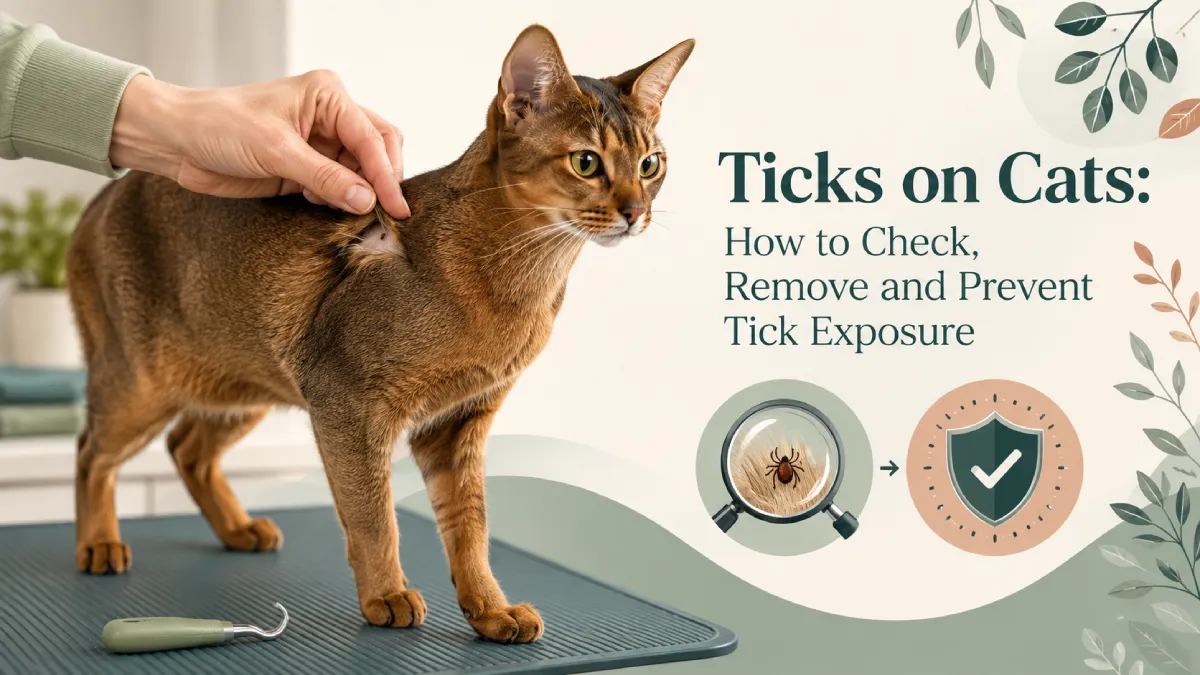
Ticks on Cats: How to Check, Remove & Prevent Them
Ticks are blood-feeding parasites that can attach to cats after outdoor exposure or be carried into a household by other animals. Distribution changes with geography and climate, so local risk can evolve over time. Regular coat checks and cat-specific preventive products are safer than waiting until a tick is noticed.
Direct answer
Check cats that may encounter ticks by running your fingers through the coat and inspecting common attachment sites. If a tick is attached, remove it with an appropriate tick-removal tool or fine-tipped tweezers using steady traction close to the skin, or ask a veterinary professional for help. Never burn, crush or coat an attached tick with household chemicals.
Where cats encounter ticks
Cats can encounter ticks in grass, brush, woodland edges, gardens and other outdoor environments. Other pets can also transport unattached ticks indoors. Keeping cats indoors lowers exposure but does not make tick encounters impossible in every household.
Common attachment sites
Ticks often attach where the skin is easier to access. Check around the head, ears and neck, under collars or harnesses, armpits, groin, between toes and around the tail base. Long-haired cats need careful parting of the coat.
What an attached tick looks like
An attached tick can resemble a small rounded or oval lump fixed to the skin. Legs may be visible close to the attachment point. As a tick feeds, its body can enlarge. Do not assume every dark bump is a tick; skin tags, nipples, scabs and masses can be mistaken for one.
Tick versus skin lump
If you cannot identify legs or a clear attachment point, do not pull aggressively. A veterinarian can distinguish a tick from a skin lesion and prevent accidental injury from attempting to remove normal tissue.
Safe removal principles
- Use a purpose-made tick tool or fine-tipped tweezers.
- Part the fur so the attachment site is visible.
- Grasp the tick as close to the skin as possible without squeezing the body.
- Pull upward with steady, controlled pressure rather than twisting unpredictably.
- Clean the skin and wash your hands after removal.
- Monitor the bite site and the cat for unusual changes.
What not to do
- Do not burn the tick with a match or hot object.
- Do not cover it with petroleum jelly, essential oils, alcohol or household chemicals.
- Do not crush an engorged tick with bare fingers.
- Do not use a dog tick product unless it is specifically labelled as safe for cats.
Tick-control products and cat-specific safety
Use only products specifically labelled for cats at the correct age and weight. Cats have species-specific sensitivity to some insecticides used in dog products. Product selection should also reflect local tick species, travel and lifestyle.
Seasonal versus year-round risk
CAPC currently supports year-round tick control because ticks can remain active outside traditional seasonal windows and geographic distributions change. Local veterinary advice is useful because tick pressure is not identical in every region.
Tick-borne disease
Ticks can transmit infectious agents, but the diseases affecting cats vary by region and tick species. A tick bite does not automatically mean disease transmission occurred. Record the exposure and contact a veterinarian if illness develops.
Changes after a tick bite
Monitor for fever, reduced appetite, lethargy, lameness, pallor, breathing changes or another new illness after tick exposure. These signs are nonspecific and require veterinary assessment rather than online diagnosis.
When veterinary care is appropriate
Seek help if the tick cannot be removed safely, the mouthparts appear retained with significant inflammation, the bite site becomes infected, multiple ticks are present, the cat appears unwell or the cat has been exposed in a region with important tick-borne disease risk.
How to perform a whole-body tick check
Use both sight and touch. Run the fingertips slowly against the direction of hair growth, then part the coat over any small bump. Work systematically from head to tail so areas are not missed, and use good lighting for dark-coated cats.
Keep sessions short if the cat becomes uncomfortable. A tick check should not involve forceful restraint or repeatedly handling a painful area.
Why ears and toes deserve extra attention
Ticks often attach around thin skin or protected folds. The edges and base of the ears, between the toes and around the nail beds can hide small ticks that are difficult to see until they enlarge. Check carefully after walks, outdoor enclosure time or travel through tick habitat.
What to do after removal
Inspect the bite site for remaining visible material, then clean the skin gently according to veterinary advice. Wash hands and disinfect the removal tool. If local disease surveillance or the veterinarian recommends identification, save the tick in a sealed container rather than crushing it.
What if part of the tick appears to remain?
Mouthparts can occasionally break during removal and cause localized inflammation. Do not dig into the skin with a needle or blade. If the area becomes swollen, painful or infected, let a veterinary professional examine it.
Why tick-borne disease risk changes by location
The tick species that infest cats and the pathogens they carry differ between regions. CAPC notes that distribution is dynamic, meaning travel history matters even when the home area has historically had low risk. Tell the veterinarian where the cat has travelled when illness follows a tick exposure.
Cat-specific prevention choices
Feline tick preventives come in different formulations and durations. The right choice depends on age, weight, health, other parasite risks and how reliably the owner can administer the product. Do not combine multiple products unless a veterinarian has confirmed the combination is safe.
Why seeing an attached tick does not always mean prevention failed
Some systemic products require the tick to attach and feed before it is exposed to the active ingredient. An attached tick may already be dying. Repeated heavy infestation can also reflect intense environmental pressure rather than simple product failure.
Tick Exposure Record
- ☐ Date tick found
- ☐ Body location
- ☐ Approximate size/appearance
- ☐ Removed completely or veterinary help needed
- ☐ Recent travel or outdoor location recorded
- ☐ Current tick-prevention product recorded
- ☐ Bite site monitored
- ☐ New illness reported promptly
How to remove an attached tick safely
If you are comfortable removing a tick at home, use fine-tipped tweezers or a veterinary-recommended tick-removal tool. Part the fur, grasp the tick as close to the skin as practical and apply steady controlled traction according to the tool instructions. Avoid squeezing the swollen body.
After removal, place the tick in a sealed container or bag if your veterinarian may want to identify it, and clean the skin gently. Wash your hands. If your cat will not remain safely still, the tick is in a difficult location, or you are unsure whether the object is a tick, ask a veterinary team to remove it.
Do not burn, smother or chemically coat an attached tick
Methods such as applying petroleum jelly, nail polish, alcohol, essential oils, household chemicals or a flame are not recommended. They can injure the cat, delay removal or expose the cat to toxic substances.
Do not crush an attached tick with your fingers. If the tick is removed, dispose of it securely so people and animals are not exposed.
What if the mouthparts seem to remain in the skin?
Do not dig aggressively into the cat’s skin with needles or sharp tools. Small retained mouthparts can cause local irritation, and digging can create additional injury or infection.
If you are unsure whether the whole tick was removed or the site becomes swollen, painful, draining or increasingly red, contact your veterinarian.
What to watch for after a tick bite
Many tick bites leave only a small local reaction, but monitor the cat for changes in the days and weeks after exposure. Useful observations include appetite, activity, walking, temperature if measured by a professional, breathing, gum colour and any new swelling or pain.
Seek veterinary advice for unexplained fever, lethargy, reduced appetite, lameness, weakness, pale gums, breathing changes or another significant illness after known tick exposure. These signs do not prove a tick-borne disease, but the exposure history can help the veterinarian select appropriate testing.
Why local tick risk changes over time
Tick distribution is not static. CAPC updates its guidance and forecasts because climate, wildlife movement, travel and changing habitats can alter where particular tick species and pathogens occur.
That is why a prevention plan based only on what was common in your area several years ago may become outdated. Review prevention with your veterinarian when you move, travel frequently, add outdoor access or notice new tick activity locally.
Travel can change a cat’s tick exposure
A cat that rarely encounters ticks at home may face different risks during camping trips, relocation, boarding or travel to another region. Tell your veterinarian where the cat will be going so the prevention plan can account for destination risk as well as home risk.
Check cats after travel even when they receive prevention, because no product should be treated as a reason to stop performing physical checks after likely exposure.
Why dog tick products are not a safe shortcut
Use only products labelled for cats and appropriate for the individual cat’s age and weight. Some canine parasite products contain ingredients or concentrations that can be dangerous to cats.
Do not cut down a dog dose, share a collar, or assume that a product is safe because the packaging mentions both fleas and ticks. Read the species label and follow veterinarian guidance.
For a major feline-specific hazard, see Permethrin Poisoning in Cats.
Tick prevention in multi-pet homes
Dogs can bring ticks into the same household environment used by cats. Each pet should have an appropriate prevention plan rather than sharing products. Check sleeping areas, bedding and commonly used resting spaces when household pets have repeated tick exposure.
If one pet is treated with a topical dog product that is toxic to cats, follow label precautions about separation and contact. Ask the veterinarian how long cats must be kept away from the treated dog.
Keep a record when you remove a tick
Record the date, where the tick was attached, recent travel and which preventive product the cat was using. A clear photograph can be useful if the tick is discarded.
If illness appears later, this information gives the veterinarian a better exposure timeline and can help determine whether tick-borne testing is relevant.
Check the skin without causing unnecessary stress
Run your fingers slowly through the coat and part the fur in small sections. Stop if the cat becomes distressed rather than wrestling them through a complete examination. A second short check later can be more useful than forcing handling.
For long-haired cats, use good lighting and a comb where appropriate so small attached ticks are easier to distinguish from scabs or skin tags.
Tick checks are still useful when prevention is used
No preventive product should be treated as a reason to stop looking for attached ticks after likely exposure. Physical checks can identify ticks early, reveal changes in local exposure and help you notice skin irritation around attachment sites.
Record repeated tick findings and discuss them at preventive visits. A pattern of exposure may justify changing the product, application routine or environmental management rather than treating each tick as an isolated event.
Use the map below during post-exposure checks.
Cat Tick Check Body Map
| Area to check | What to do |
|---|---|
| Ears and head | Part fur and inspect skin folds |
| Neck / under collar or harness | Remove equipment and feel the skin |
| Armpits | Check warm protected folds |
| Groin | Inspect gently without forcing the cat |
| Toes | Look between digits and around nail beds |
| Tail base | Part dense fur and feel for attached parasites |
FAQs
Can indoor cats get ticks?
Yes. Risk is lower when cats remain indoors, but ticks can be carried inside by other pets or people and cats may escape.
Should I twist a tick off a cat?
Follow the instructions for the removal tool being used. With fine-tipped tweezers, steady upward traction close to the skin is commonly recommended.
Can I put alcohol or oil on an attached tick?
Do not coat or burn an attached tick. Mechanical removal with an appropriate tool is preferred.
Can dog tick medicine be used on cats?
Only if that exact product is explicitly labelled for cats. Never assume a dog-only product is safe.
Do all tick bites cause disease?
No. Transmission risk depends on the tick, pathogen, region and duration of attachment. Monitor the cat and seek veterinary advice for illness.