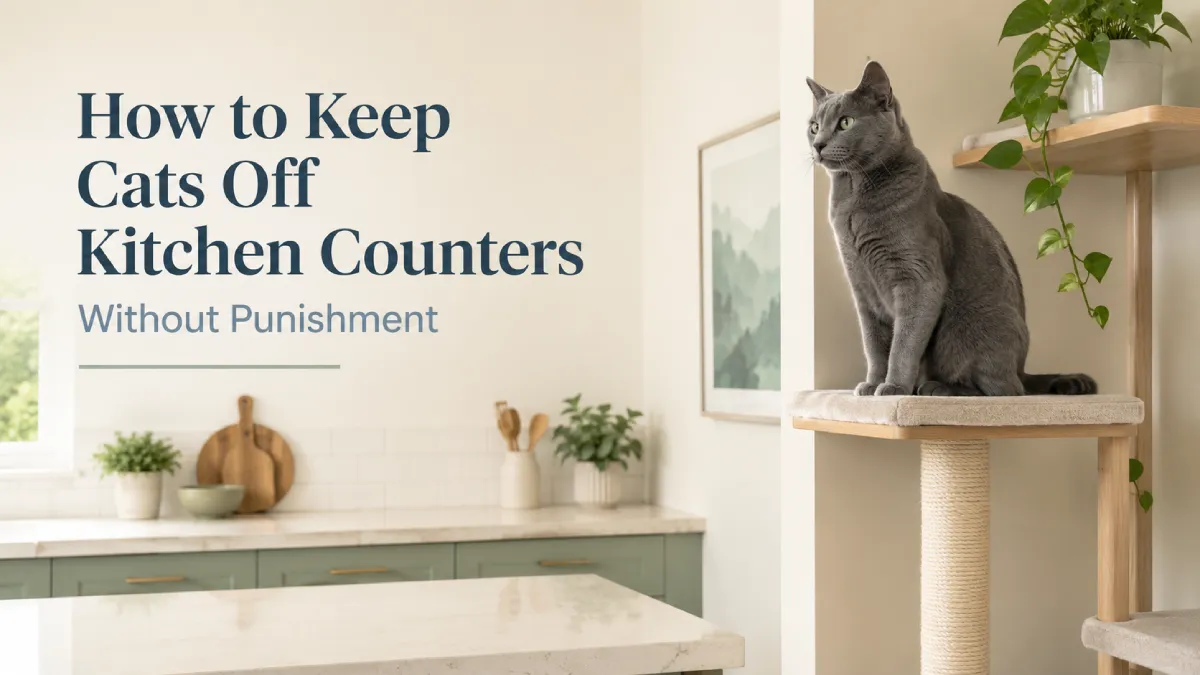
How to Keep Cats Off Kitchen Counters Without Punishment
A cat jumping onto the kitchen counter is usually getting something worthwhile from the behavior. The counter may provide height, food smells, a warm surface, a good view of household activity or attention from people. That means the most effective solution is not punishment but changing what the counter offers while providing a better place for the cat to go.
To keep cats off counters, remove food rewards, clean residue promptly, secure rubbish, provide an attractive elevated alternative and reinforce the cat for using that location. During cooking or food preparation, use practical management so the cat cannot repeatedly rehearse the behavior while you are busy.
Direct Answer
Keep counters consistently free of food, clean away rewarding smells, secure rubbish and give your cat a suitable elevated perch nearby. Teach and reward a station behavior on that perch. Prevent access when necessary during cooking, and make sure everyone in the household follows the same rules. Avoid spray bottles, yelling and frightening deterrents because they can create fear without teaching where the cat should go instead.
Why Do Cats Jump on Kitchen Counters?
Counter surfing is rarely random. The counter may satisfy several feline needs at once.
Before trying to train your cat off counters, identify what makes the location valuable.
Height
Cats often value elevated resting and observation areas.
From a kitchen counter, a cat may be able to:
- see more of the room
- watch people moving around
- avoid activity at floor level
- rest in a location that feels secure
AAHA/AAFP feline environmental guidance emphasizes the importance of plentiful, thoughtfully distributed resources, including appropriate resting locations. An elevated alternative is therefore more useful than simply removing access to the counter without replacing what the cat values.
Food Smells
Kitchens repeatedly predict food.
A counter may contain:
- crumbs
- used plates
- food packaging
- cooking residue
- ingredients waiting to be prepared
Even occasional success can make checking the counter worthwhile.
If a cat finds chicken once, licks a plate another time and receives a treat to encourage them to jump down later, counter surfing can continue because the area has a history of producing food.
Observation
Your cat may simply want to watch what you are doing.
FelineVMA specifically notes that cats may use counters because they lack a suitable perch near their caregivers.
If the counter provides the best view of cooking, washing dishes and family activity, offer another elevated location with a similar view but without direct access to food-preparation surfaces.
Attention
Attention can also reinforce counter jumping.
A cat jumps up and suddenly everyone:
- talks to them
- walks toward them
- picks them up
- offers food to lure them down
Even attention intended to stop the behavior may contribute to a predictable interaction.
The better strategy is to make the alternative location more rewarding before the cat reaches the counter.
Warm Surfaces
Cats often seek warm resting areas.
A sunny counter, spot near an appliance or recently warmed area may therefore be especially attractive.
If warmth appears to be part of the motivation, provide an appropriate warm resting option elsewhere. FelineVMA suggests safe warm alternatives such as a sunny perch or an appropriately designed commercial heated cat bed or mat rather than unsafe heating devices.
Remove Food Reinforcement From the Counter
The most important environmental change is simple: stop allowing the counter to produce food.
Do not leave accessible:
- meat
- bread
- open food containers
- dirty plates
- pet food
- food scraps
Also avoid tossing a treat onto the floor every time the cat jumps up. Although the intention is to make the cat get down, the sequence may become:
Jump onto counter → person produces food.
Instead, reward the cat for choosing the approved station before counter jumping occurs.
Clean Away Food Residue
A counter that looks clean to you may still smell interesting to a cat.
After preparing food:
- remove scraps
- clear used dishes
- wipe food-preparation areas
- put ingredients away
- clean spills promptly
Use household cleaning products according to their label directions and keep the cat away from products or wet surfaces where exposure could be unsafe.
Secure Rubbish and Food Waste
Counter training will be harder if nearby rubbish provides an alternative source of food.
Use a bin that the cat cannot easily open or knock over.
Also secure:
- compost containers
- recycling containing food residue
- food packaging
- bags containing scraps
The objective is to make the kitchen consistently unrewarding for scavenging rather than occasionally providing a jackpot.
Provide a Legal Elevated Alternative
Telling a cat “do not go up” is less useful than providing an appropriate answer to “where can I go instead?”
The ideal alternative should be:
- stable
- comfortable
- high enough to be appealing
- positioned where the cat can observe household activity
- far enough from the counter that it does not become a launch point onto it
Cat Tree Near the Appropriate Area
A tall cat tree near the kitchen entrance or dining area can allow your cat to watch without occupying the food-preparation surface.
Do not position it so close that the top platform creates an easy bridge directly onto the counter.
Make the perch valuable by:
- placing familiar bedding there
- rewarding voluntary use
- occasionally initiating appropriate interaction there
Wall Shelf
A securely installed cat shelf can work when floor space is limited.
It should be:
- stable
- appropriately sized
- easy for the individual cat to access
- away from cooking hazards
Consider age and mobility. A senior cat or a cat with reduced jumping ability may need intermediate steps or a lower alternative.
Window Perch
A window perch can be highly rewarding when the counter is mainly being used as an observation point.
Choose a secure window and make sure screens, frames and surrounding areas are safe.
For a broader household safety review, see How to Cat-Proof Your Home.
Teach a Station Behavior
A station is a specific approved location where the cat learns that staying there is worthwhile.
This might be:
- a cat-tree platform
- a stool away from food preparation
- a mat on an appropriate elevated surface
- a window perch
Positive reinforcement can help turn that location into the cat’s preferred kitchen observation spot.
For the general training principles behind shaping, capturing and rewards, use How to Train a Cat.
Step 1: Reward Looking at the Station
Begin in a quiet period when you are not actively cooking.
Reward your cat for noticing or approaching the station.
Step 2: Reward Going Onto It
As the cat begins interacting with the location, reinforce:
- placing paws on it
- climbing onto it
- standing or sitting there
Step 3: Build Duration
Once your cat willingly goes to the station, begin rewarding short periods of remaining there.
Increase duration gradually rather than expecting a long stay immediately.
Step 4: Add a Cue
When the cat is predictably going to the location, add a simple cue such as:
“Place” or “Station.”
Give the cue before the behavior, then reinforce successful use of the perch.
Reward the Alternative Location
The approved perch needs to compete successfully with the kitchen counter.
Rewards might include:
- a small food reward
- preferred social interaction
- brief play
- access to the view or resting location itself
FelineVMA emphasizes that the most effective reward varies between individual cats. Food is convenient, but it is not automatically the strongest reinforcer for every cat.
Whenever practical, notice and reward your cat for choosing the correct location without first jumping onto the counter.
Prevent Access During Food Preparation
Training is difficult when the environment is simultaneously providing powerful food rewards.
During intensive cooking, practical management may be necessary.
Depending on your home and cat, this can mean:
- closing the kitchen door
- using another secure cat-safe room temporarily
- providing a food puzzle or play activity elsewhere
- placing the cat at their trained station before preparation begins
Do not repeatedly pick up and remove the cat after they have already reached food. Preventing rehearsal is usually easier than interrupting it repeatedly.
Consistency Among Household Members Matters
One person cannot train the counter to be unrewarding while another person feeds the cat from it.
Agree on household rules such as:
- no feeding from countertops
- no allowing the cat to lick plates
- no handouts during food preparation
- reward the approved station instead
If several people respond differently, the cat may continue checking because the behavior still works sometimes.
Manage Nighttime Counter Access
Some cats explore countertops mainly when people are asleep.
This often means the environment itself remains rewarding even without human attention.
Before bed:
- remove all food
- clear dirty dishes
- wipe food residue
- secure rubbish
- put away fragile or dangerous objects
If nighttime access creates a serious safety problem, use an appropriate physical barrier such as a closed kitchen door where your home’s design allows it.
Do not rely on frightening the cat when you are present if the counter remains rewarding whenever you leave.
Kitchen Safety Matters Even While Training
Counter surfing is not only a hygiene or convenience issue. Kitchens contain hazards that make management important while training is still in progress.
Hot Stovetops
Prevent access to active burners and recently heated cooking surfaces.
A cat does not need to understand the risk for the surface to cause injury.
Do not assume that successfully training the cat for several weeks means they will never investigate the stove again.
Knives and Sharp Tools
Do not leave knives or other sharp preparation tools where a cat could:
- step onto them
- knock them down
- pull nearby objects onto them
Put sharp equipment away promptly after use.
Cleaning Chemicals
Store cleaning chemicals securely and use them according to label instructions.
Keep cats away from:
- open containers
- chemical spills
- freshly treated surfaces where the product requires drying or rinsing
- accessible cleaning buckets
Do not intentionally place irritating chemicals, essential oils or other potentially harmful substances on counters as cat deterrents.
Why Spray Bottles Are Poor Training Tools
Spraying water may interrupt a cat at that moment, but interruption is not the same as teaching.
FelineVMA specifically advises against squirt bottles for counter behavior because punishment can create fear-anxiety and interfere with learning.
The cat may learn:
“Jumping up is risky when this person is nearby.”
instead of:
“The cat tree is where I should go.”
Some cats simply wait until nobody is present and then return to the counter because the original food or height reward remains.
Why Startling Devices Can Create Fear
Noise makers, startling mats and other aversive devices may suppress behavior temporarily, but they can also make the environment unpredictable or frightening.
FelineVMA notes that punishment and fear can interfere with learning and contribute to additional unwanted behavior.
A better plan addresses the reason the counter is attractive:
- remove food reinforcement
- prevent access when necessary
- provide an appropriate elevated alternative
- reinforce use of that alternative
This teaches an actual replacement behavior.
If Your Cat Keeps Jumping on the Counter
Reassess the environment rather than assuming the cat is deliberately disobeying you.
Ask:
- Is food still being left out sometimes?
- Does the counter provide the best view?
- Is the alternative perch actually attractive?
- Is someone feeding the cat from the kitchen?
- Does jumping produce attention?
- Does the problem happen at predictable times?
Behavior that continues is usually still being reinforced somehow or the replacement behavior is not yet valuable enough.
When Increased Food Seeking Needs Investigation
A cat repeatedly checking counters because food has historically been available there can be a learned behavior.
A genuine new increase in appetite is different.
Contact your veterinarian if increased food seeking is new or persistent, particularly when it occurs with:
- weight loss
- muscle loss
- increased thirst
- increased urination
- vomiting
- diarrhea
- other noticeable behavior or health changes
Hyperthyroidism and diabetes are two conditions that can produce increased appetite together with weight loss or other systemic changes, but appetite alone cannot diagnose either disease.
Cornell lists weight loss, increased appetite, thirst and urination among common signs of feline hyperthyroidism, while veterinary diabetes references also recognize increased appetite with weight loss, increased thirst and increased urination as a possible pattern.
If your cat suddenly seems far more food-focused than before, see Why Is My Cat Always Hungry?.
Counter Behaviour Audit
Use this audit to identify what may be keeping counter surfing rewarding. Complete it before changing the training plan and review it again if progress stalls.
| Question | Yes / No | What to Review |
|---|---|---|
| Is food ever available on the counter? | _____ | Remove accessible food consistently, including scraps and dirty dishes. |
| Are rewarding food smells or residue left behind? | _____ | Clean preparation surfaces and food spills promptly. |
| Is a better elevated perch available? | _____ | Provide a stable, attractive perch with a useful view of household activity. |
| Does jumping onto the counter produce owner attention? | _____ | Reward the approved station before counter jumping occurs rather than creating an exciting reaction afterward. |
| Does the behavior occur at a particular time of day? | _____ | Look for patterns around cooking, meals, nighttime exploration or household routines. |
| Could the feeding schedule contribute to food-seeking? | _____ | Review measured daily intake and meal distribution without automatically adding calories. |
| Has an alternative station been trained? | _____ | Teach and reinforce a clear approved location near the activity the cat wants to observe. |
The audit is not a scoring system. Its purpose is to identify which parts of the environment still make the counter more rewarding than the approved alternative.
A Simple Counter-Training Routine
- Clear all accessible food from the counter.
- Clean food residue and secure rubbish.
- Set up an attractive elevated perch away from the counter.
- Practice station training when the kitchen is quiet.
- Reward the cat for choosing the station.
- Use the station before food preparation begins.
- Prevent counter access when active cooking makes training impractical.
- Keep household responses consistent.
- Review the Counter Behaviour Audit if progress stops.
This approach combines management with training rather than expecting one cue to overcome an environment that continues to reward counter surfing.
Understanding the Behavior Instead of Punishing It
Jumping onto an elevated surface, seeking food and observing household activity are understandable feline behaviors. The household problem comes from where those behaviors are occurring, not from the cat needing punishment.
A useful behavior plan changes the environment and gives the cat another way to meet the same need.
For broader context on why cats repeat behaviors that work for them, see Cat Behavior Explained.
FAQs
How do I keep my cat off the kitchen counter permanently?
There is no method that guarantees a cat will never jump onto a counter again. Make the counter consistently unrewarding, provide a more attractive elevated location, reinforce the alternative and manage access when necessary. Continued consistency is more reliable than punishment.
Why does my cat keep jumping on the counter when there is no food?
Food is only one possible reward. Your cat may value the height, view, warmth, proximity to you or attention produced by jumping up. Identify what the counter provides and offer a suitable alternative that meets the same need.
Should I spray my cat with water to keep them off counters?
No. Current FelineVMA guidance advises against squirt bottles because punishment can create fear and interfere with learning. Instead, remove the reward from the counter and reinforce an appropriate perch or station.
How do I keep my cat off the table while we eat?
Clear the table of unattended food, train an alternative perch before mealtimes and reward the cat for remaining there. If necessary, use a physical barrier or another secure room during meals while training is still developing.
Why does my cat jump onto the counter every time I cook?
Cooking combines food smells, activity and attention, making the kitchen especially rewarding. Set up the cat’s station before food preparation begins, reinforce it and prevent access to food-preparation surfaces when you cannot actively train.
Should I worry if my cat has suddenly become obsessed with food?
A new or pronounced increase in appetite deserves attention, especially when accompanied by weight loss, increased thirst or urination, vomiting, diarrhea or other changes. Do not assume every increase in food seeking is simply a training problem; discuss persistent changes with your veterinarian.
Bottom Line
The most effective way to keep cats off counters is to change what the environment teaches them.
Remove food and residue, secure rubbish, provide a desirable elevated perch and reward your cat for using it. Teach a clear station behavior and use practical management during cooking or other times when counter access would be unsafe.
Avoid spray bottles, yelling and frightening deterrents. They may interrupt the behavior without solving the reason it occurs. If food-seeking has increased suddenly or appears alongside weight loss, thirst, urination changes or other symptoms, involve your veterinarian rather than treating it solely as a behavior problem.