How Many Litter Boxes Per Cat: Placement and Multi-Cat Setup Guide
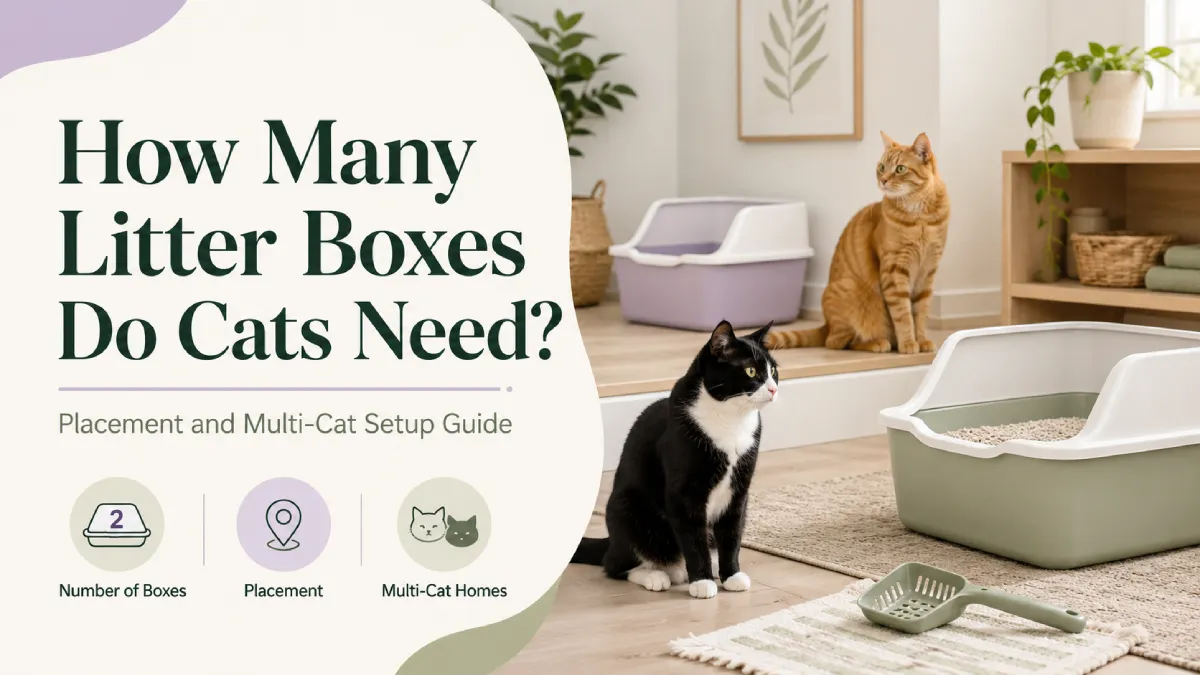
A useful starting answer to how many litter boxes per cat is one box for each cat plus one additional box. That means two boxes for one cat, three for two cats and four for three cats. However, number alone is not enough. Boxes need to be distributed in genuinely separate, accessible locations so another cat cannot control access to every toileting option.
Good litter-box design also considers quiet placement, an escape route, distance from food and water, easy entry and enough space for the individual cat. In a multi-level home, at least one toileting option should be available on each level that the cat regularly uses.
Direct Answer
Use one litter box per cat plus one extra as a practical starting point. For one cat, that usually means two boxes; for two cats, three boxes. Place them in separate, quiet, easy-to-access areas rather than side by side. A good box should also provide an easy exit so another cat cannot trap or block the user.
Why the Number of Boxes Matters
A litter box is an environmental resource, just like food, water, hiding places and resting areas.
Cats living together do not necessarily form one harmonious social group. Some share space comfortably, while others avoid each other or access shared resources at different times. AAFP/ISFM environmental guidance recommends distributing important resources so cats do not have to compete for access.
More toileting choices can help when:
- one box is temporarily dirty
- one cat prefers a different location
- another cat is resting near one route
- social tension develops
- a cat does not want to travel to another floor
- one box becomes difficult to enter
The goal is not simply to own the correct number of plastic trays. It is to provide usable choices.
Single-Cat Homes
Even a single cat can benefit from more than one toileting location.
The common rule gives:
1 cat → 2 litter boxes
AAFP/ISFM environmental guidance recommends offering cats choices for important resources and specifically gives multiple toileting locations as an example.
A second box may be especially useful if:
- the home has more than one floor
- one room is sometimes closed
- the cat has mobility limitations
- the cat shows a strong location preference
- one box needs cleaning or replacement
This does not mean every single-cat apartment must be reorganised around two giant trays regardless of space. The principle is accessible choice, with two appropriately located boxes being the preferred starting setup where practical.
How Many Litter Boxes for Two Cats?
For litter boxes for two cats, the usual recommendation is:
2 cats → 3 litter boxes
Do not assume two bonded cats will always happily share one box simply because they sleep or play together.
Socially affiliated cats may tolerate sharing resources more readily, but households can contain more than one feline social group, and adequate separate resources reduce opportunities for conflict.
If the cats avoid each other, guard routes or repeatedly use different areas of the home, three boxes may still be only a starting point.
Multi-Cat Households
For a larger multi-cat litter box setup, begin with:
| Cats | Practical Starting Number |
|---|---|
| 1 | 2 boxes |
| 2 | 3 boxes |
| 3 | 4 boxes |
| 4 | 5 boxes |
| 5 | 6 boxes |
The alternative guideline, when feline social groups are clearly understood, is one box for each social group plus an additional box. However, identifying social relationships accurately can be difficult, so the simple cats-plus-one rule remains easier for most households to implement.
More boxes may be needed if one or more cats cannot comfortably reach the available locations.
Why Several Boxes in One Spot May Still Function Like One Resource
Three boxes lined up beside each other are not equivalent to three independent toileting choices.
AAFP/ISFM house-soiling guidance explains that cats can perceive adjacent boxes as one large toileting area. Boxes should therefore be separated into different locations whenever possible.
Consider this setup:
Laundry room: box 1 + box 2 + box 3
versus:
Bedroom area: box 1
Quiet hallway alcove: box 2
Second floor: box 3
The second arrangement provides more meaningful environmental choice.
If all boxes can be controlled by another cat standing at one doorway, the household technically owns several trays but may functionally offer only one accessible resource.
Where to Put Litter Boxes
Good cat litter box placement balances privacy with access.
AAHA/AAFP guidance recommends multiple quiet locations that are convenient to reach and provide an escape route if needed.
Think:
quiet + accessible + visible exit + separate from competing resources.
Choose Quiet Areas
Cats generally prefer toileting locations away from excessive household traffic.
Useful options may include:
- quiet spare-room corners
- calm bathroom areas
- accessible hallway alcoves
- low-traffic home-office areas
A location should feel private without becoming a trap.
Avoid interpreting “quiet” as:
put the box into the deepest, smallest closet.
If another cat can sit outside that closet and control the only exit, the location may be quiet for humans but poor for the cat.
Provide an Escape Route
This becomes especially important in multi-cat homes.
AAFP/ISFM guidance warns against locations where another cat can corner the litter-box user or block entry and exit.
Before choosing a spot, imagine your cat inside the box.
Ask:
Can another cat sit between this box and the rest of the room?
Can the user see an approaching cat?
Can it leave without passing within inches of another animal?
If not, reconsider the placement.
Avoid Loud Appliances
A litter box directly beside a washer, dryer or another machine that starts suddenly can be an unpleasant setup for some cats.
AAHA’s current litter-box guidance advises against placement beside loud appliances and other stressful locations.
This does not mean every laundry room is automatically unsuitable.
If the machines are distant from the box, rarely startling and the cat confidently uses the location, context matters. But the tray should not be squeezed beside an appliance that suddenly bangs, spins or vibrates while the cat is eliminating.
Keep Boxes Away From Food and Water
Cats should not be forced to toilet next to where they eat or drink.
AAFP/ISFM environmental guidance recommends physical separation between toileting areas and other key resources, while house-soiling guidance specifically advises keeping food and water away from litter boxes.
Avoid setups such as:
food bowl → 30 cm gap → litter tray
when the home allows better separation.
Multi-Level Homes
A cat should not have to travel several flights of stairs every time it needs to eliminate.
AAFP/ISFM guidance recommends at least one litter box on each level of a multi-level home.
For example, a two-cat, three-box household might use:
ground floor: one box
upper floor: two separated boxes
rather than placing all three in one basement room.
This becomes even more important for:
- senior cats
- cats with arthritis
- cats recovering from illness
- kittens
- cats with other mobility limitations
Box Size Matters Too
Having enough boxes does not help much if they are all too small.
AAFP/ISFM house-soiling guidance recommends a rectangular box approximately 1.5 times the cat’s body length from the nose to the base of the tail. Research has also found preference for larger trays over smaller commercial alternatives.
The cat should have enough room to:
- enter fully
- turn around
- dig
- posture comfortably
- eliminate
- cover waste
- leave without squeezing
Many standard commercial trays are smaller than this guideline.
Large Cats Need Larger Boxes
A large cat should not be expected to fit comfortably into the same compact tray sold for a small kitten.
Storage containers and other large, smooth-sided plastic trays are sometimes used when conventional litter boxes are too small.
For a larger cat, prioritise usable internal space over the product label saying “large litter box.”
Covered Versus Uncovered Boxes
There is no evidence that every cat universally prefers the same style.
A controlled study comparing large covered and uncovered boxes found no overall population-level preference; most cats used both, while a minority showed individual preferences.
That makes a flexible recommendation stronger than:
“Never use covered boxes.”
An uncovered box can have practical advantages:
- easier owner monitoring
- easier scooping
- less trapped odour
- greater visual awareness
- potentially simpler exits
A covered box may still suit an individual cat if it is large enough, clean and easy to enter and exit.
In a tense multi-cat household, pay particular attention to whether the design makes it harder for the cat inside to monitor approaching animals.
Entry Height
The front of the box needs to match the cat using it.
A young, agile adult may comfortably step over a higher wall. A kitten, arthritic senior or cat recovering from illness may not.
AAHA/AAFP guidance specifically recommends easy-entry boxes for kittens and seniors, and house-soiling guidance notes that lowering one side can make access easier for older cats or those with degenerative joint disease.
The useful design is often:
low front entry + enough surrounding wall height to contain litter.
Senior Cats
Senior cats may need more convenient toileting options even if they previously used the same setup for years.
A box that once worked perfectly may become difficult if the cat develops:
- joint pain
- stiffness
- weakness
- reduced vision
- reluctance to use stairs
AAHA recommends easy-to-access boxes close to a senior cat’s core living areas and notes that avoiding stairs can help cats with mobility problems.
Do not assume a senior cat suddenly toileting downstairs instead of walking upstairs is being stubborn.
Kittens
Kittens also need easy entry.
AAHA/AAFP guidance advises using edges low enough for kittens to enter and exit comfortably and offering appropriate litter-box choices early.
Keep the box:
- easy to find
- easy to climb into
- away from frightening noise
- close enough to the kitten’s main living area
As the kitten grows, reassess box size.
Cats With Mobility Problems
Mobility limits can occur at any age.
If walking or climbing is difficult, place an accessible box where the cat spends most of its time and reduce unnecessary barriers. Feline nursing and senior-care guidance both emphasise matching litter-box height and accessibility to the individual cat’s physical abilities.
Practical modifications can include:
- low entrance
- stable non-slip approach
- box on the same floor
- clear route
- enough room to turn comfortably
If the cat suddenly struggles to enter a previously accepted box, investigate the mobility change rather than only buying another litter brand.
Litter Preference Matters
Box count and location are only part of the setup.
Cats can have individual preferences for:
- litter texture
- scent
- depth
- box design
AAHA/AAFP guidance recommends providing separate boxes when testing different litter options so the cat can demonstrate a preference. Unscented clumping litter is commonly preferred, but individual cats should still be considered individually.
Do not change:
box location + box style + litter material
all at once if you are trying to work out what a particular cat prefers.
Territorial Conflict Can Affect Litter-Box Access
Intercat tension is not always dramatic.
One cat does not have to attack another beside the box for access to become stressful.
Subtle resource conflict can include:
- staring
- blocking a hallway
- sitting near the box entrance
- following another cat
- waiting outside a room
- controlling access to stairs
Environmental guidelines recommend physically separating key resources so cats can avoid competition and access what they need without passing other social groups.
This is a major reason where boxes are placed can matter as much as how many boxes are owned.
Resource Guarding and Blocking
Imagine three litter boxes in a basement.
To use any of them, every cat must pass through one narrow staircase.
If one confident cat routinely rests at the top of those stairs, the other cat may effectively lose access to all three boxes.
A better multi-cat litter box setup distributes resources through different routes and locations.
Your placement audit should therefore ask:
Can one cat control all access points?
If yes, add or relocate resources.
Cleaning Still Matters, but It Is a Separate Question
Even a perfectly placed box can become unattractive when dirty.
However, this page should not reproduce Pawnium’s full cleaning schedule.
The dedicated How Often Should You Clean a Litter Box? article owns:
- daily scooping
- full litter replacement
- box washing
- cleaning products
- deep-clean frequency
That exact Pawnium URL is established in the preceding litter-box hygiene article.
For this page, the only necessary principle is:
every available litter box needs to remain clean enough to be a genuinely usable resource.
Adding a New Cat Changes the Resource Setup
Do not bring home a new cat and immediately expect the newcomer to share the resident cat’s only litter tray.
Environmental guidance recommends separate resources for different feline social groups, and unfamiliar cats should be introduced gradually rather than simply placed together.
During the introduction process, the newcomer should have access to its own toileting resources in its initial space.
As access to the home expands, maintain enough separated boxes for both cats rather than removing all duplicate resources immediately.
For the complete transition process, Pawnium’s How to Introduce Two Cats article should own the step-by-step introduction. The URL is confirmed in the content library.
Sudden Litter-Box Avoidance Needs Investigation
If a cat that normally uses the box suddenly begins urinating or defecating elsewhere, do not immediately assume:
“I need more litter boxes.”
Box number and placement should certainly be checked, but medical causes, pain, litter preferences and social/environmental changes may also contribute.
AAHA/AAFP guidance recommends veterinary attention for new house-soiling because medical conditions can underlie the behaviour, especially in mature and senior cats.
Also do not label inappropriate elimination as spite or revenge.
When Medical Evaluation Is Appropriate
Contact your veterinarian when litter-box avoidance is:
- sudden
- persistent
- associated with pain
- accompanied by blood in urine or stool
- associated with much larger urine volumes
- accompanied by increased thirst
- associated with diarrhoea or constipation
- accompanied by reduced appetite or other illness signs
- occurring in a senior cat with a new mobility change
For a persistent increase in drinking and urine volume, route readers to Cat Drinking and Peeing More Than Usual. Pawnium’s library confirms that permalink.
Seek Urgent Veterinary Care for Repeated Straining With Little or No Urine
Repeated litter-box visits with straining and only tiny amounts—or no urine—are different from simply using the box frequently.
Urinary obstruction can be life-threatening and requires immediate veterinary treatment, particularly in male cats.
The detailed urinary-frequency differential belongs elsewhere, not on this placement page.
FAQs
How many litter boxes should one cat have?
Two is the standard starting recommendation: one box for the cat plus one additional box. Having separate toileting choices is particularly useful in larger or multi-level homes.
Do two cats really need three litter boxes?
Three is the usual recommendation. Socially compatible cats may share some resources comfortably, but having three boxes in separate locations reduces dependence on a single toileting resource and gives both cats more choice.
Can I put several litter boxes next to each other?
It is better to separate them. AAFP/ISFM guidance notes that cats may perceive boxes placed beside one another as one large toileting area rather than independent resources.
Where is the best place for a litter box?
Choose a quiet, accessible area away from food and water, loud appliances and places where another animal can trap or block the cat. The cat should be able to approach and leave comfortably.
Do cats prefer covered or uncovered litter boxes?
There is no universal answer. One controlled study found no overall preference when large covered and uncovered boxes were kept equally clean, although some individual cats preferred one style.
Does a senior cat need a special litter box?
Often, easier access becomes more important. A low entrance, convenient location and avoiding unnecessary stair use can help cats with reduced mobility. A sudden change in litter-box habits should still be medically investigated rather than assumed to be normal ageing.