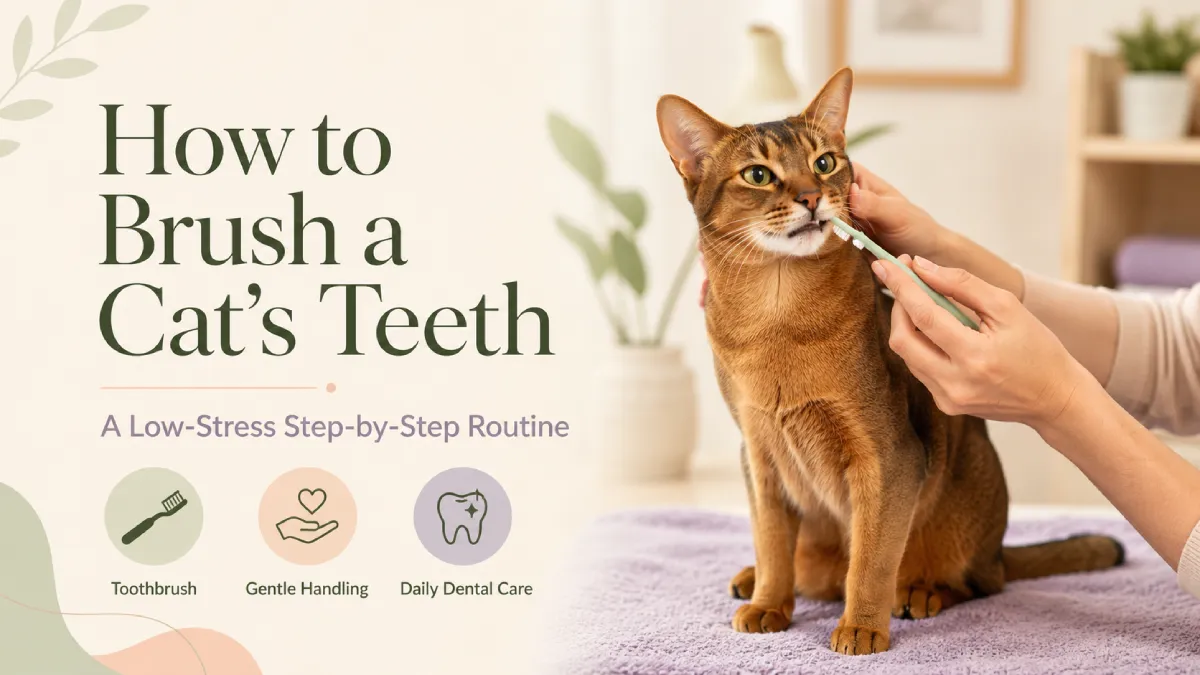
How to Brush Cat Teeth: A Low-Stress Step-by-Step Routine
Learning how to brush cat teeth safely is mostly about building cooperation before trying to clean the entire mouth. Start by helping your cat accept face touching and a gentle lip lift, then introduce cat-safe toothpaste, finger contact and finally a soft toothbrush. You usually only need access to the outer surfaces of the teeth; there is no need to force the mouth wide open.
Regular brushing helps disrupt plaque before it hardens, but it cannot scrape away established tartar or reverse periodontal damage. If your cat has painful red gums, significant bad breath, drooling, difficulty eating or obvious mouth discomfort, veterinary dental examination should come before home brushing.
Direct Answer
Use a soft cat toothbrush or suitable finger brush with cat-safe toothpaste. Gradually teach your cat to accept face touching, lip lifting and contact with the outer teeth. Begin with only a few teeth, use gentle movements around the gumline, reward cooperation and build up slowly. Daily brushing is the ideal preventive goal when the cat comfortably accepts it.
Why Home Dental Care Matters
Plaque begins forming on tooth surfaces quickly and continually reforms after it is removed. If it remains undisturbed, minerals in saliva contribute to its hardening into calculus, commonly called tartar. Plaque bacteria at and below the gumline can then contribute to gingivitis and periodontal disease.
This is why professional dental treatment and home care serve different purposes. A veterinary cleaning can address existing disease and hardened deposits, while home plaque control helps slow the cycle between professional assessments. AAHA describes daily brushing as the most effective home method for reducing plaque accumulation.
Plaque and Tartar Are Not the Same Thing
Plaque is a soft bacterial biofilm that builds on tooth surfaces. It is the material brushing is designed to disrupt.
Tartar or calculus is mineralised, hardened material that develops when plaque remains on the teeth. Once it has hardened, ordinary home tooth brushing is not an appropriate way to remove it. AAHA specifically states that brushing removes plaque rather than established calculus.
This distinction matters because an owner may see brown deposits and assume that brushing harder will scrape them away. It will not.
What Brushing Can Do
Regular brushing can:
- mechanically disrupt plaque on accessible tooth surfaces
- reduce the rate of plaque accumulation
- support healthier gums as part of preventive care
- give owners repeated opportunities to notice changes in the mouth
- complement veterinary dental examinations and professional treatment
The 2025 FelineVMA oral-health guidance encourages caregivers to participate actively in preventive home dental care, and its current client guidance specifically recommends regular plaque removal through brushing or wiping.
What Brushing Cannot Do
Home brushing cannot:
- safely remove established tartar
- clean disease hidden deep below the gumline
- diagnose tooth resorption
- repair a broken tooth
- reverse loss of periodontal attachment or bone
- replace dental radiographs
- make a painful diseased mouth healthy by itself
AAHA notes that proper assessment below the gumline, dental radiographs and treatment require professional veterinary dental care under anesthesia. Cornell likewise explains that periodontitis involves irreversible destruction of supporting tissues once disease progresses to that stage.
Do not scrape tartar at home with dental instruments.
Choosing a Cat Toothbrush
A useful cat toothbrush needs to be soft enough for delicate gums and small enough to manoeuvre comfortably along the outer tooth surfaces.
Options include:
- small pet toothbrushes
- angled feline toothbrushes
- very soft small-headed brushes
- finger brushes
VCA recommends soft brushes and notes that several designs are made specifically for cats.
The best brush is not necessarily the most elaborate one. It is the one that safely reaches the gumline while your cat remains comfortable.
Finger Brushes
A finger brush slides over a fingertip and can feel less intrusive to some cats because there is no long handle approaching the face.
AAHA includes finger brushes as an alternative for animals uncomfortable with conventional brushes, while VCA also lists them among feline brushing options.
However, a finger brush places your finger close to the teeth. Do not use one if the cat is painful, defensive or likely to bite.
Soft Toothbrushes
A small soft-bristled toothbrush often provides better plaque-removing contact than simply smearing toothpaste on the teeth.
Avoid stiff or medium bristles. VCA warns that harder brushes can irritate sensitive gums.
Use light pressure. Home brushing is plaque control, not scrubbing.
Use Cat-Safe Toothpaste
Choose toothpaste specifically formulated for pets and appropriate for cats.
Pet toothpastes are designed to be swallowed because animals do not rinse and spit after brushing. Flavour can also make training easier, since some cats find poultry, seafood or other veterinary toothpaste flavours rewarding.
Never Use Human Toothpaste
Human toothpaste should not be used for cats.
AAHA and VCA both warn that human formulations may contain ingredients unsuitable or potentially toxic when swallowed by pets. Cats inevitably ingest some toothpaste during brushing, so use a veterinary/pet formulation.
Do not substitute:
- human toothpaste
- whitening toothpaste
- homemade abrasive pastes
- baking soda mixtures
for a feline dental product.
Build Cooperation Before You Brush
Start With Mouth Handling
A cat that has never had its mouth handled should not suddenly be expected to tolerate a toothbrush moving around every tooth.
Begin at the easiest level:
face touch → reward
Then gradually progress only while your cat remains relaxed. VCA recommends teaching acceptance of face and mouth touching before introducing the brushing process itself.
Let the Cat Taste the Toothpaste
Before using the brush, offer a small taste of the selected cat toothpaste.
The purpose at this stage is not cleaning. It is simply:
toothpaste appears → pleasant experience
Cornell’s training programme similarly begins by allowing the cat to smell and taste feline toothpaste before moving to tooth contact and a toothbrush.
If the cat dislikes one flavour, ask your veterinary team about another suitable option rather than holding the cat still and applying it anyway.
Practise Touching the Lips
Once face handling is comfortable, briefly touch the lip.
Then:
- touch the lip
- reward
- gently raise it for a moment
- reward
- stop
The mouth does not need to be forced open. VCA specifically notes that the mouth can remain closed while the lip is gently lifted for brushing.
Progress to the Outer Teeth
When the cat comfortably accepts a lip lift, touch one or two outer tooth surfaces using a clean finger, soft gauze or another veterinarian-approved introductory method.
Keep the first sessions extremely short.
VCA recommends starting with only a few teeth for nervous animals rather than attempting the entire mouth immediately.
Introduce the Brush Separately
Let the cat investigate the brush before brushing.
You can place a small amount of approved toothpaste on it and allow the cat to lick the paste off. Only after the brush itself becomes familiar should you begin moving it along the teeth.
Begin With Only a Few Teeth
Start with teeth that are easy to reach.
Lift the lip and make a few gentle movements along the outer surfaces near the gumline.
That may be the whole session.
Completing three comfortable teeth today is more useful than forcing the entire mouth and making tomorrow’s session harder.
Gradually Increase the Session
As your cat becomes comfortable, extend brushing to more teeth over days or weeks.
Cornell and VCA both describe gradual training rather than expecting immediate full-mouth cooperation.
Progress should depend on the cat’s response, not an arbitrary training deadline.
Focus on the Outer Tooth Surfaces
For most cats, home brushing can focus on the outer surfaces, particularly around the gumline.
VCA states that it is generally unnecessary to force the mouth open to reach the inner surfaces; the outer tooth surfaces are the practical priority for home brushing.
A practical brushing motion is:
lift lip → angle soft bristles toward tooth/gum margin → make gentle short or circular movements → move to next accessible tooth.
Do not repeatedly scrub inflamed gum tissue.
Reward Participation
Finish with something the individual cat values:
- a small treat
- favourite play
- petting if welcomed
- another predictable positive interaction
FelineVMA’s current oral-health education recommends patience, positive reinforcement and breaks when the caregiver or cat becomes stressed.
The cat should learn:
mouth handling predicts something safe and worthwhile.
How Often Should You Brush Cat Teeth?
Daily brushing is the ideal preventive target when your cat comfortably accepts it. Both current AAHA guidance and FelineVMA client education recommend daily brushing because plaque continually reforms.
That does not mean you should restrain a frightened cat every day to meet a number.
If you are still training, focus on progressing toward regular brushing through comfortable short sessions. A veterinarian can also help design a realistic home-care plan if daily brushing is not currently achievable.
What If My Cat Resists Brushing?
If your cat:
- pulls away
- becomes tense
- repeatedly turns its head away
- paws at you
- growls
- hisses
- attempts to bite
stop or return to an easier stage.
Do not force the mouth open.
A cat that objects to lip handling may simply need slower training, but a cat that previously tolerated brushing and suddenly resists may be experiencing oral pain. Painful gingivitis and other feline dental diseases can make brushing uncomfortable.
Other Home Dental-Care Options
Dental Diets
Some dental diets have evidence for reducing plaque, tartar or both.
They are not all equivalent. The Veterinary Oral Health Council lists specific feline diets that have earned its Seal of Acceptance for particular plaque or tartar claims.
Ask your veterinarian whether a dental diet suits your cat’s overall nutritional and medical needs before changing food solely for dental reasons.
Dental Treats
Some feline dental treats have evidence supporting tartar or plaque-control claims, while a product merely being labelled “dental” does not establish effectiveness.
VOHC currently lists accepted feline treats with specific plaque or tartar claims.
Treats are an adjunct, not a treatment for painful dental disease.
Water Additives
Some water additives may help reduce plaque accumulation, but again, product-specific evidence matters.
VOHC lists certain feline water additives that have met its criteria for stated oral-health claims.
Do not assume every additive marketed for “fresh breath” has evidence for plaque control.
Also make sure any product does not discourage your cat from drinking normally.
Look at the Evidence Behind the Product
For diets, treats, wipes, gels or water additives, look for meaningful evidence rather than relying on packaging language.
The VOHC Seal of Acceptance indicates that a specific product has met VOHC standards for reducing plaque, tartar or both according to its approved claim. VOHC maintains a separate accepted-products list for cats.
This does not mean every VOHC product is equally appropriate for every cat, and it does not mean a dental product can treat established periodontal disease.
Signs That Need More Than Home Brushing
Bad Breath
Persistent unpleasant breath should not simply be covered with toothpaste, treats or a water additive.
FelineVMA lists bad breath among signs that warrant attention, while Cornell identifies periodontal disease as a common cause of persistent feline halitosis.
Pawnium’s dedicated Why Does My Cat Have Bad Breath? page owns the full symptom-based discussion. Its URL and search intent are already established in the Pawnium library.
Red or Bleeding Gums
Red, swollen or bleeding gums can occur with gingivitis and other oral disease.
Do not respond by brushing harder.
AAHA warns that brushing already inflamed gingiva can cause pain and create aversion to future home care.
Tooth Pain
Stop if handling appears painful.
Signs that may accompany oral pain include:
- sudden resistance to brushing
- pawing at the mouth
- chewing differently
- dropping food
- avoiding harder food
- withdrawal when the mouth is touched
Cornell notes that feline dental disease can be painful even when obvious signs are subtle.
Drooling
Excessive drooling can accompany painful oral disease and warrants veterinary assessment when new or unexplained. FelineVMA and AAHA both include drooling among important dental warning signs.
Do not try to resolve persistent drooling by repeatedly brushing the mouth.
Difficulty Eating
Difficulty chewing, dropping food, reduced appetite or refusing food can occur with dental pain.
Because cats can also stop eating for many non-dental reasons, the symptom should not be diagnosed from the mouth alone. Cornell notes that dental disease can lead to reduced food intake, while Pawnium already has a separate appetite-loss pathway.
Link readers with broader appetite changes to Why Is My Cat Not Eating?, whose Pawnium URL is already confirmed.
When Professional Dental Care Is Needed
Home brushing supports prevention. It does not replace professional veterinary dentistry.
Arrange a veterinary dental examination when you notice:
- persistent bad breath
- red, swollen or bleeding gums
- visible heavy tartar
- mouth pain
- drooling
- chewing difficulty
- food dropping
- appetite changes
- loose or broken teeth
- facial swelling
- sudden refusal to tolerate normal mouth handling
A complete dental evaluation may require anesthesia so the veterinarian can safely probe around the teeth, take dental radiographs and examine disease hidden below the gumline. Professional scaling removes deposits from areas a toothbrush cannot treat.
For broader changes in grooming, activity, appetite and general health, Pawnium’s Cat Health Check at Home can help owners record changes before a veterinary visit. The URL is established in Pawnium’s existing content map.
FAQs
Do I really need to brush my cat’s teeth every day?
Daily brushing is the ideal preventive goal because plaque continually reforms, and both AAHA and current FelineVMA guidance recommend daily home brushing when the cat comfortably accepts it. If you are still training your cat, work gradually toward regular brushing rather than forcing a daily full-mouth session.
Can I use my own toothbrush on my cat?
Use a small, soft brush that comfortably fits the cat’s mouth. A feline/pet toothbrush is usually the simplest choice, although VCA notes that very soft appropriately sized alternatives may work for some cats. Avoid medium or hard bristles.
Can brushing remove brown tartar from my cat’s teeth?
No. Brushing is designed to disrupt plaque. Established mineralised calculus/tartar requires veterinary dental assessment and professional removal rather than aggressive home scraping.
What if my cat will only let me brush a few teeth?
That is a useful starting point. Brush the accessible outer teeth briefly, reward cooperation and gradually increase coverage over later sessions. VCA specifically recommends beginning with only a few teeth when the cat is uncertain.
Should I keep brushing if my cat’s gums bleed?
No. Red, inflamed or bleeding gums may be painful and deserve veterinary examination. AAHA warns that brushing inflamed gingiva can cause pain and worsen aversion to future dental care.
Are dental treats enough if my cat refuses brushing?
They can provide supportive plaque or tartar control when the specific product has evidence, but they are not equivalent to brushing and cannot treat existing dental disease. Look for products with an appropriate VOHC feline claim and discuss the overall plan with your veterinarian.