
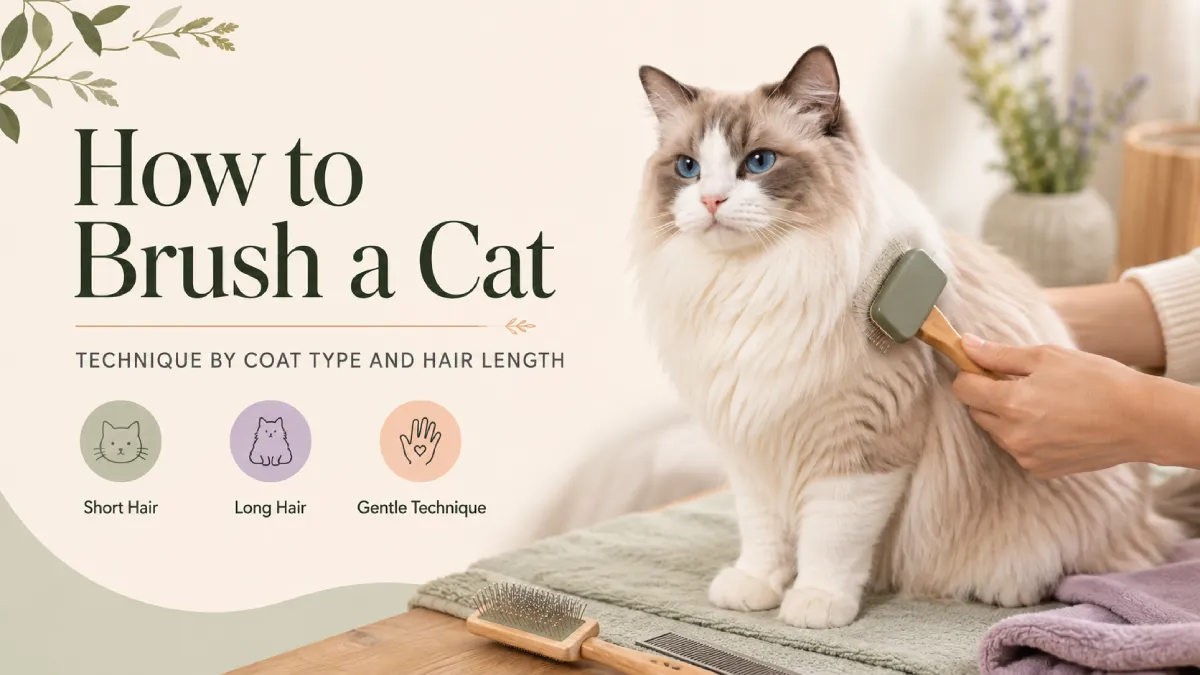
How to Brush a Cat: Technique by Coat Type and Hair Length
Learning how to brush a cat is less about making a certain number of strokes and more about matching the technique to the cat’s coat and comfort. A short-haired cat may do well with a soft brush or rubber grooming tool, while a medium or long coat often needs a comb that can reach beyond the surface layer.
Start when your cat is relaxed, let the brush become familiar, use gentle strokes in the direction of the coat and stop if the cat walks away or becomes uncomfortable. Brushing should remove loose fur and help you inspect the coat—not become a battle to remove as much hair as possible. Cornell notes that regular brushing or combing can remove loose hair, reduce swallowed fur and provide an opportunity to monitor the skin.
Direct Answer
The best way to brush a cat is to start with a calm cat and a coat-appropriate tool, make a few gentle strokes in the direction the fur grows, and gradually extend the session only while the cat remains comfortable. Do not pull through tangles, repeatedly scrape the same area or restrain the cat simply to finish grooming.
Why Brushing Can Be Useful
Regular brushing can do more than collect hair from the sofa.
It can help:
- remove loose fur
- reduce loose hair swallowed during self-grooming
- identify tangles before they become mats
- reveal fleas or flea debris
- expose lumps or skin changes
- make changes in coat quality easier to notice
Cornell specifically identifies removal of loose hair, reduced hair ingestion and skin monitoring as useful benefits of brushing.
Brushing does not treat dermatitis, infection, allergies or another underlying skin disorder. If the coat or skin looks abnormal, more brushing is not automatically the solution.
Choose a Calm, Secure Location
Begin somewhere the cat already feels comfortable.
A good brushing location is:
- quiet
- stable
- free from sudden interruptions
- somewhere the cat can leave voluntarily
A bed, rug, sofa or familiar grooming mat may work better than placing a nervous cat on an unfamiliar high table.
Cats Protection recommends introducing grooming gradually with as little restraint as possible.
Avoid positioning the cat where leaving would involve a dangerous jump.
Start When the Cat Is Relaxed
Timing matters.
A cat that is:
- resting calmly
- voluntarily sitting near you
- seeking social contact
is generally a better candidate than a cat that is racing around, eating, hiding or already irritated.
Your first goal is not to complete the whole coat. It is to establish that the brush predicts a safe, manageable experience.
Let the Cat Investigate the Brush First
Do not immediately bring an unfamiliar tool down onto the cat’s back.
Place it nearby and allow the cat to:
- look at it
- sniff it
- approach it
- move away again
Cats Protection recommends letting kittens explore grooming tools before gradually building short sessions with rewards. The same principle can help an adult cat that has little brushing experience.
Begin With Very Short Sessions
For a cat new to grooming, the first session might consist of only a few strokes.
A useful progression is:
- show the brush
- reward calm investigation
- make one gentle stroke
- pause
- make another stroke if the cat remains relaxed
- reward
- finish before the cat becomes frustrated
FelineVMA’s cooperative-care guidance supports shaping care behaviours in small steps and replacing forceful physical restraint with voluntary participation where possible.
Which Direction Should You Brush?
For routine home grooming, start by brushing in the direction the fur naturally grows.
This usually means working from:
head and shoulders → along the back → toward the rear
rather than repeatedly dragging a tool against the coat.
Cats Protection advises following the direction of the fur during touch, and brushing against the natural direction can be uncomfortable for some cats.
Long or dense coats may need to be worked in smaller sections so the comb reaches through the coat, but that does not mean aggressively backcombing the hair.
Start With Areas the Cat Already Likes Being Touched
Many cats are more accepting of contact around the:
- cheeks
- head
- neck
- shoulders
- upper back
than around the belly or hindquarters. Vet-reviewed grooming guidance similarly identifies the head, neck and shoulders as commonly tolerated areas.
Starting with an easy area makes it more likely that the session remains positive.
Treat Sensitive Areas Differently
Commonly sensitive areas can include:
- belly
- armpits
- rear legs
- paws
- tail
- base of the tail
- lower back, particularly if painful or stiff
Individual preference matters. One cat may enjoy lower-back grooming while another immediately turns to watch the brush.
Cats Protection cautions that the belly, underarms, legs and lower back are among areas many cats are less comfortable having touched.
Do not assume resistance is disobedience. Pain is also possible.
How to Brush a Short-Haired Cat
To brush a short-haired cat, you usually do not need to penetrate several centimetres of coat.
VCA recommends stiff-bristle brushes for some short coats or sparse undercoats, while Cats Protection lists ordinary brushes and grooming mitts as suitable options for many short-haired cats.
A simple routine is:
- start around the shoulders
- brush toward the tail
- use smooth, light strokes
- remove accumulated fur from the tool
- inspect the skin as you work
- stop while the cat is still comfortable
Rubber grooming tools can also work well for cats that dislike the feel of metal pins.
Medium-Haired Cats Need More Depth
A medium coat can appear smooth on top while loose fur and small tangles develop underneath.
Use a brush for surface coat if the cat likes it, then check the coat with a longer-toothed comb.
VCA recommends long-toothed metal combs or brushes with suitable tines for medium and longer coats because they can remove loose hair and work through minor tangles more effectively than a surface-only brush.
Pay closer attention to:
- behind the ears
- armpits
- chest
- backs of the legs
- belly
How to Brush a Long-Haired Cat
To brush a long-haired cat, the main challenge is reaching through the coat without pulling the skin.
Work in manageable sections rather than repeatedly brushing only the visible outer surface.
A practical sequence is:
- begin with an easy area such as the neck or shoulders
- gently separate a small section of coat
- brush loose surface hair
- pass a long-toothed comb through the section
- stop when the comb meets significant resistance
- inspect mat-prone areas
- continue only while the cat remains relaxed
Long-haired cats commonly require much more frequent attention because tangles can progress into mats. Both VCA and Cats Protection recommend daily grooming for many long coats.
Do not yank a comb through a knot.
Dense and Double Coats
Some cats have a substantial soft undercoat beneath the outer guard hairs.
During heavier shedding, loose undercoat can accumulate within the coat even when the top looks normal.
VCA notes that specific combs can help remove clumps of already loose undercoat during seasonal shedding.
The goal is loose-fur removal, not aggressive coat stripping.
Avoid repeatedly dragging a sharp or high-resistance deshedding blade across the same area simply because hair continues coming out.
Comb Versus Brush: They Do Different Jobs
A brush and comb are not always interchangeable.
Brushes are often useful for:
- surface loose fur
- shorter coats
- introducing grooming
- cats that enjoy the sensation
Combs are useful for:
- checking beneath longer hair
- finding small tangles
- separating medium or long coats
- determining whether the coat is actually tangle-free
A long-haired cat can look beautifully brushed on the surface while still having tight tangles underneath.
Slicker Brushes
A slicker brush contains numerous fine pins and may help with loose coat in some medium- or long-haired cats.
It needs careful handling.
Do not:
- press the pins hard against the skin
- repeatedly scrape one area
- brush over open sores
- use it to rip through a tight mat
A slicker should be cat-appropriate in size and pin design, rather than automatically using a tool because it was marketed for a dog.
If the cat flinches when the tool touches normal skin, choose something gentler.
Grooming Combs
A metal grooming comb can be particularly valuable for medium and long coats.
VCA recommends long-toothed metal combs for removing loose hair and smoothing smaller tangles in longer coats.
Use the comb slowly.
If the teeth stop abruptly:
do not pull harder.
Back out, separate the hairs gently and determine whether you have found a simple tangle or an established mat.
Rubber Grooming Tools
Rubber grooming mitts or brushes can be useful for some short-haired cats because the sensation may feel closer to ordinary stroking than a rigid metal tool.
Cats Protection specifically lists grooming mitts among useful choices for short-haired cats.
They can be particularly useful during early brush training, although they may not be enough for deep or long coats.
Undercoat Tools
An undercoat comb can be useful when a dense-coated cat is actively shedding.
Choose a tool designed to move through feline coat gently and focus on fur that is already ready to release.
VCA supports the use of appropriate undercoat combs for loose seasonal undercoat but also stresses gentle technique and avoiding excessive pulling.
Do not measure success by the size of the fur pile.
More hair removed does not automatically mean better grooming.
How Much Pressure Should You Use?
There is no useful universal force measurement for brushing.
Use only enough pressure for the tool to contact and move through the fur without:
- dragging the skin
- scratching the skin
- causing redness
- making the cat flinch
- repeatedly catching hair
VCA’s guidance is simple: grooming tools should be used gently and excessive pulling on tangles should be avoided.
If you need significant force, stop and reassess the tool or the coat.
Removing Loose Fur Without Over-Brushing
Loose hair should collect naturally as you move through the coat.
You do not need to keep brushing until absolutely no hair appears on the tool.
During shedding periods, some cats will continue releasing hair even after a reasonable grooming session.
Use the cat’s skin and comfort as your stopping point—not the amount of hair still available to remove.
Check the Skin as You Brush
Part the coat occasionally and look at the skin beneath it.
Watch for:
- redness
- scaling
- sores
- crusts
- bald areas
- excessive oiliness
- wounds
- abnormal pigmentation
- painful spots
Cornell recommends using routine coat care as an opportunity to monitor the skin for parasites and signs of disease.
Do not repeatedly brush an irritated area in an attempt to “clean it up.”
Look for Fleas and Flea Dirt
Brushing can reveal evidence of fleas even when you do not immediately see a live flea.
A flea comb may collect:
- fleas
- small dark debris
- flea feces, often called flea dirt
Cornell notes that a fine-toothed comb can help detect fleas and their dark fecal material. Merck describes flea dirt as flea feces containing digested blood.
If you suspect fleas, discuss an appropriate cat-safe parasite-control plan with your veterinarian. Some products intended for dogs can be dangerous to cats.
Use Grooming to Notice Lumps
As your fingers move through the coat, note any new:
- bump
- thickened area
- swelling
- crust
- tender spot
VCA recommends using regular grooming to detect unusual lumps, bumps, parasites or sensitive areas.
A brush cannot tell you what a lump is.
Record its location and arrange veterinary assessment if you find a new or changing abnormality.
Check for Mats Before Pulling Through Them
A mat is more than ordinary loose coat. It is tangled hair that has tightened into a dense mass.
If you meet resistance:
- stop pulling
- inspect with your fingers
- determine whether the tangle is loose
- only work it gently if it separates without discomfort
Severe or extensive matting should be handled professionally. VCA warns against using scissors because feline skin can be caught and cut during mat removal.
The dedicated Matted Cat Fur article should own the full mat-removal decision process.
If the Cat Walks Away, the Session Is Over
This rule simplifies a lot of grooming problems.
If the cat gets up and leaves:
do not follow it with the brush.
Cats Protection advises stopping contact when a cat chooses to move away, and FelineVMA’s cooperative-care framework is built around voluntary participation rather than forcing the animal to remain in position.
You can try again later.
A half-finished coat is safer than teaching the cat that brushing means being trapped.
Use Rewards to Build Better Brushing
Rewards can make future sessions easier.
Depending on the individual cat, useful reinforcement may include:
- a small treat
- gentle social interaction
- favourite play
- access to a preferred activity
FelineVMA recommends identifying what the individual cat finds rewarding and delivering reinforcement promptly after the behaviour you want to strengthen.
A simple pattern is:
one or two calm brush strokes → reward → pause
Then gradually increase the amount of grooming.
How Often Should You Brush a Cat?
There is no single schedule for every cat.
A reasonable starting point is:
- short coat: often around once weekly
- medium coat: enough to prevent tangles and manage loose coat
- long coat: often daily
- dense coat: adjust during heavier shedding
- senior or mobility-limited cat: according to how well the cat still self-grooms
Cats Protection suggests roughly weekly grooming for many short-haired cats and daily grooming for long-haired cats, while VCA similarly states that long, silky or curly coats often require daily brushing.
Frequency should increase if mats are developing between sessions.
Seasonal Shedding Can Change the Routine
Some cats shed more heavily at certain times of year, while indoor cats may shed smaller amounts across much of the year.
VCA notes that coat and environmental conditions can produce heavier seasonal undercoat shedding in some cats.
During a heavier shed:
- shorten the time between sessions if useful
- remove loose coat gently
- check that the skin remains comfortable
- do not turn the session into aggressive deshedding
Pawnium’s future Cat Shedding Guide should own the deeper normal-versus-excessive shedding discussion.
Senior Cats Need a Gentler Approach
Older cats may have difficulty grooming areas they previously managed themselves.
Cornell notes that older cats can benefit from increased brushing support as self-grooming declines, while reduced flexibility or joint pain can make some areas sensitive.
For a senior cat:
- use lighter handling
- allow more breaks
- watch the lower back and hips
- check whether nails or coat are becoming neglected
- notice whether grooming tolerance has changed
A newly unkempt coat or sudden dislike of brushing may be a health clue, not simply ageing.
When Brushing Appears Painful
Stop brushing an area if your cat suddenly:
- cries or vocalises
- flinches strongly
- bites when that specific area is touched
- guards part of the body
- tries urgently to escape
- has red or broken skin
- has tight painful mats
Pain during routine handling can be associated with skin disease, matting, injury, arthritis or another underlying problem. A grooming tool cannot determine the cause. Cornell notes that changes in grooming can occur with pain, while older cats may become unable to maintain their coat because of reduced mobility.
Arrange veterinary assessment when pain is new, persistent or accompanied by another physical or behavioural change.
FAQs
What is the best way to brush a cat that hates brushing?
Start with the smallest possible step. Let the cat inspect the brush, touch it briefly to an already tolerated area, reward calm behaviour and end the session early. Do not hold the cat down to finish. Cooperative-care guidance supports gradually shaping voluntary participation instead of using restraint.
Should I brush my cat against the direction of the fur?
For routine home grooming, begin in the direction the coat grows. Many cats dislike touch against the normal direction of the hair. Long coats can be gently sectioned so a comb reaches the deeper coat without repeatedly brushing backwards.
How do I know whether my cat needs a comb or a brush?
Short coats often do well with a brush or rubber grooming tool. Medium and long coats usually benefit from a longer-toothed comb that can check below the surface and detect tangles. The individual cat’s coat and tolerance still matter.
Can I brush a cat every day?
Yes, when daily grooming suits the coat and the cat remains comfortable. Daily grooming is commonly recommended for many long-haired cats. A healthy short-haired cat may require much less. Avoid repeatedly brushing irritated skin simply to maintain a schedule.
Does brushing help with hairballs?
It can reduce the amount of loose hair the cat swallows during self-grooming, which may reduce hairball formation. It cannot guarantee that a cat will never produce a hairball, and recurrent retching or vomiting should not automatically be blamed on hair.
What should I do if I find a mat while brushing?
Stop pulling on it. A small loose tangle may sometimes be gently separated, but tight, large or painful mats should receive professional help. Avoid scissors because the cat’s skin may be caught within or pulled up into the mat.


