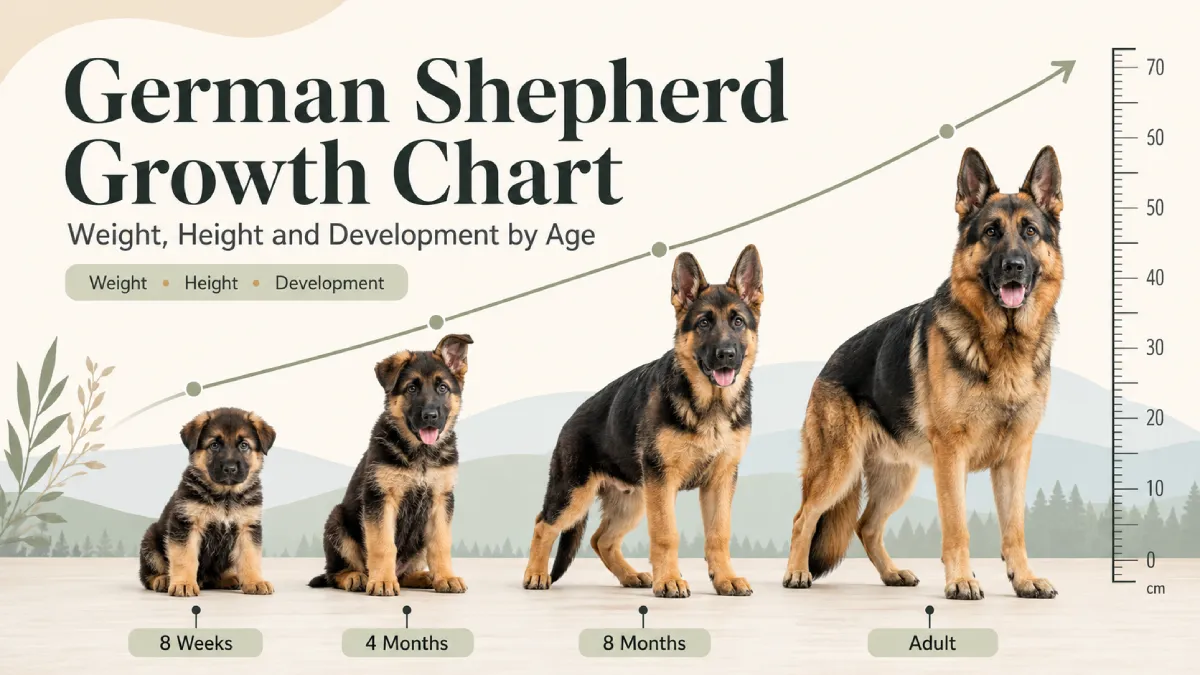
German Shepherd Growth Chart: Weight, Height and Development by Age
A German Shepherd growth chart is most useful for tracking your puppy’s own weight, height and body-condition trend rather than trying to make every German Shepherd reach one number at the same age. The German Shepherd Dog Club of America sets adult height at 24–26 inches for males and 22–24 inches for females, while AKC breed data lists typical adult weights of 65–90 pounds for males and 50–70 pounds for females.
Those adult figures provide context, not puppy targets. Veterinary growth research shows considerable variation among healthy dogs, which is why repeated measurements and body condition are more useful than judging a puppy from one age-and-weight number. If you are more interested in your German Shepherd’s individual progress than a breed average, you can track your puppy’s growth over time using their own recorded weights.
Quick Answer
German Shepherds are large-breed dogs, so most continue substantial physical growth through the first year and may not reach adult size until roughly 12–18 months. Behavioural maturity can take longer. Track serial weight, height and body condition, keep the puppy lean, and avoid adding extra calories simply to match an online growth-chart average.
German Shepherd Growth Chart
There is no GSDCA or AKC breed standard assigning a required puppy weight or height for every month. The safest chart therefore separates development stage from individual measurements.
| Age | Physical Development | Weight Guidance | Height Guidance |
|---|---|---|---|
| Birth–8 weeks | Very rapid early growth, nursing, weaning and early development | Follow breeder/veterinary records and steady individual gain | Not useful as an adult-size target |
| 8–12 weeks | Rapid skeletal growth after moving to a new home | Establish baseline weight and BCS | Optional baseline measurement |
| 3–6 months | Fast increases in frame, limb length and body size | Follow personal growth curve; avoid excessive gain | Height may change quickly |
| 6–9 months | Large adolescent frame; still actively growing | Monitor ribs, waist and trend | Considerable height growth may remain |
| 9–12 months | Growth begins becoming less dramatic | Do not assume adult weight is reached | May look near adult height but still be developing |
| 12–18 months | Later skeletal and physical maturation | Gradually approaching mature weight | Many large dogs reach adult size within this period |
| 18+ months | Filling out, muscle and mature proportions | Maintain lean adult condition | Height should become relatively stable |
| Adult reference | Mature German Shepherd | Male: 65–90 lb; Female: 50–70 lb typical AKC range | Male: 24–26 in; Female: 22–24 in GSDCA standard |
Adult height comes directly from the German Shepherd Dog Club of America standard. AKC’s current breed-comparison data supplies the commonly published adult weight ranges.
Use the puppy rows to answer:
“Is my dog following a sensible individual trajectory?”
not:
“How do I make my puppy reach a certain weight this month?”
Early Puppy Development
During the first weeks of life, growth involves much more than size. Puppies progress through nursing, sensory development, mobility, interaction with littermates and eventual weaning.
The exact body weight of one puppy may differ substantially from another, even within the same general breed-size category. Research used to create evidence-based canine growth charts found enough individual variation that repeated trajectories are more informative than isolated measurements.
Breeder records and early veterinary weights are therefore valuable because they establish the puppy’s own starting pattern.
8 to 12 Weeks
Around this stage, many puppies are entering their new homes and beginning a period of rapid physical and behavioural change.
AKC describes 8–16 weeks as an especially important social-development period for German Shepherd puppies. Physically, this is also a useful time to establish baseline weight, body condition and, if desired, height.
Record the measurement instead of comparing it obsessively with another puppy.
A German Shepherd that is healthy, appropriately lean and following a steady curve does not need to be made heavier simply because a littermate weighs more.
3 to 6 Months
The German Shepherd puppy’s frame can change dramatically during this period.
You may notice:
- longer legs
- increasing height
- a more elongated body
- changing proportions
- rapid increases on the scale
Large-breed nutrition guidance emphasises controlled, healthy growth, not the fastest possible gain. Excess calories can increase both growth rate and body fat and place additional stress on developing bones and joints.
A somewhat lanky adolescent appearance is not automatically evidence that the puppy needs more food.
6 to 9 Months
At six to nine months, a GSD can look surprisingly large while remaining physically immature.
AKC places German Shepherds in an extended developmental period, and general veterinary guidance notes that large-breed dogs continue growing well beyond the ages when small and medium dogs have largely finished.
Keep monitoring:
- weight
- visible waist
- rib coverage
- activity
- movement
- food intake
Do not let the puppy’s adult-like height create the impression that its skeleton is finished developing.
9 to 12 Months
Height gain may begin slowing, but the dog is still developing.
Large-breed dogs are often only approaching adult size at one year rather than being completely mature. VCA places typical adult size for large breeds broadly between 12 and 18 months.
This is therefore not a good time to deliberately “fill out” a lean adolescent by dramatically increasing calories.
Weight should increase because the dog is developing—not because excess fat is being added.
12 to 18 Months
This is an important transition from obvious puppy growth toward adult physical size.
AAHA notes that some large dogs may not achieve skeletal maturity until around 15–16 months, and broader large-breed veterinary guidance places full skeletal maturity roughly within the 12–18-month range.
Your individual GSD may reach near-adult height before its chest, muscle and general adult proportions have fully developed.
Continue tracking condition rather than treating the first birthday as an automatic physical finish line.
Continued Maturation
Physical size and behavioural maturity should be kept separate.
AKC’s German Shepherd-specific guidance notes that the breed may not reach an adult level of behavioural maturity until around two or even three years, with males often taking longer than females.
That does not mean the dog continues getting taller for three years.
Instead, later changes may involve:
- mature musculature
- broader adult proportions
- conditioning
- coordination
- behavioural self-control
So when owners ask when do German Shepherds stop growing, it helps to clarify whether they mean height, weight, muscle or behaviour.
Male Versus Female Differences
Sex creates a meaningful difference in adult size.
The GSDCA standard gives desired adult height as:
| Sex | Desired Adult Height |
|---|---|
| Male | 24–26 inches |
| Female | 22–24 inches |
AKC’s current breed data lists typical adult weight as:
| Sex | Typical Adult Weight |
|---|---|
| Male | 65–90 lb |
| Female | 50–70 lb |
These ranges should not be converted into month-by-month puppy targets.
A healthy female will generally be smaller than a healthy male, and considerable variation still exists within each sex.
Height Versus Body Weight
Height and weight do not develop at exactly the same rate.
A young German Shepherd may become tall and long-legged before developing the muscle, chest and mature body composition of an adult. That is why an adolescent dog can look skinny compared with a fully mature German Shepherd without necessarily being underweight.
The GSDCA standard itself describes the adult breed as strong, agile and well muscled rather than bulky or soft.
Evaluate weight alongside body condition instead of deciding that a tall puppy must also be heavy.
Genetics
Genetics help determine:
- adult frame
- height
- bone structure
- mature weight
- growth pattern
But genes do not produce an exact guaranteed weight at six months or a precise adult weight.
Evidence-based canine growth research found substantial individual variability between healthy dogs, reinforcing the value of personal growth curves rather than one universal chart.
The size and build of healthy parents can provide context, but they are still not a mathematical prediction.
Bone Development
Puppy bones lengthen through areas called growth plates.
Growth plates are softer developing cartilage rather than mature adult bone, making them more vulnerable to injury while the puppy is growing. Once physical growth is complete, they close and harden.
This is one reason large-breed puppies need sensible exercise and controlled growth.
Trying to produce a larger puppy faster does not create stronger bones.
Muscle Development
Muscle development continues alongside—and later partly after—the most dramatic skeletal growth.
The German Shepherd adult standard emphasises muscular fitness and balance rather than bulk.
Appropriate muscle develops through:
- normal movement
- play
- age-appropriate walks
- gradually increasing activity
- good nutrition
It should not be built by pushing a young puppy through intense conditioning designed for a physically mature working dog.
Appropriate Puppy Body Condition
Scale weight alone is not enough.
AAHA recommends evaluating body weight together with body condition score and muscle condition. On the commonly used nine-point system, scores around 4–5/9 represent the ideal range.
At a healthy condition, you should generally be able to:
- feel the ribs without a thick layer of fat
- see a waist from above
- see a sensible abdominal contour
A veterinarian can show you how to score your own puppy accurately.
Large-breed puppies generally benefit from staying lean rather than being encouraged to develop a heavy “adult-looking” body early.
Nutrition
German Shepherd puppies should receive nutrition appropriate for growth and their eventual large adult size.
VCA advises feeding large-breed puppies in a way that promotes healthy rather than excessively rapid growth. Too many calories can speed growth and increase fat accumulation, while large-breed diets are formulated with developing skeletal needs in mind.
AAHA likewise recommends growth-appropriate diets until skeletal maturity, noting that some larger dogs continue needing growth-stage nutrition beyond their first birthday.
Do not add large amounts of extra food or mineral supplements simply to make the puppy larger.
Use Pawnium’s Dog Feeding Guide for the broader nutrition discussion.
Exercise
German Shepherd puppies benefit from physical activity, exploration and play, but developing joints should not be treated like those of a mature working dog.
VCA advises avoiding forced strenuous activities such as:
- long-distance jogging
- long hikes
- repetitive high jumping
- competitive agility-style impact
until sufficient maturity. Self-regulated play and appropriate walks remain useful during development.
Use Pawnium’s Puppy Exercise Chart for the age-specific activity framework.
Avoiding Forced Rapid Growth
A bigger puppy is not automatically a healthier puppy.
Overfeeding large-breed puppies can accelerate growth and increase excess body weight, placing more stress on immature bones and joints. Veterinary nutrition guidance therefore distinguishes optimal growth from maximum possible growth.
Do not increase calories simply because:
- another German Shepherd weighs more
- an online chart shows a larger number
- the puppy looks lanky
- you want the dog to reach the top of the adult range
Adult frame is heavily influenced by genetics. Excess calories mostly increase growth speed and body fat; they do not safely redesign the puppy’s genetic size.
How to Weigh Your German Shepherd
For consistent home records:
- Use the same scale when possible.
- Weigh under similar conditions each time.
- Record the date and exact age.
- Record body condition beside the weight.
- Compare several measurements rather than reacting to one number.
Evidence-based veterinary growth charts work by plotting repeated weights over time, not judging puppies from a single measurement.
Once your GSD is too large for a household scale, veterinary or pet-store scales may be easier to use accurately.
Tracking Height
Measure height at the withers, the top of the shoulder area used in breed standards.
The GSDCA standard specifies adult height at the top of the highest point of the shoulder blade.
For better consistency:
- Place the dog on a flat surface.
- Have the dog stand naturally.
- Measure vertically from the floor to the withers.
- Use the same method each time.
- Record the age with the measurement.
Do not worry about measuring every week. Height data are most useful as occasional trend information alongside weight and body condition.
Growth Plates Overview
Growth plates drive longitudinal bone growth during puppy development.
Because they are still developing, they are more susceptible to stress and injury than mature adult bone. VCA recommends delaying prolonged high-impact exercise until maturity and allowing puppies more self-regulated activity instead.
Large-breed dogs generally take longer to achieve skeletal maturity than smaller breeds. Veterinary references place this broadly around 12–18 months for large dogs, with individual variation.
You cannot determine whether every growth plate has closed simply because your German Shepherd looks adult-sized.
Signs Growth Deserves Veterinary Assessment
Discuss your puppy’s growth with your veterinarian if you notice:
- unexplained weight loss
- weight repeatedly moving away from its previous growth trend
- body condition below about 4/9 or above 5/9
- poor appetite
- persistent vomiting or diarrhoea
- loss of muscle
- rapidly increasing body fat
- persistent limping
- recurring bone or limb pain
- difficulty walking normally
AAHA identifies unexplained weight changes, BCS outside the ideal range and muscle loss as nutritional risk factors requiring further assessment.
German Shepherd Dogs are also among the breeds commonly affected by panosteitis, a painful growth-associated condition seen particularly in young large-breed dogs. Persistent or shifting lameness should therefore be examined rather than dismissed as “just growing pains.”
Bring your weight-and-height records to the appointment. A sequence of measurements usually gives the veterinary team more useful information than a single comment that the puppy seems too small or too large.
FAQs
How much should a German Shepherd puppy weigh at each age?
There is no official GSDCA month-by-month puppy weight standard. Healthy puppies vary by sex, genetics and individual growth trajectory. Repeated weights, body condition and veterinary growth curves provide more useful information than one mandatory weight for every age.
How big do German Shepherds get?
GSDCA lists desired adult height as 24–26 inches for males and 22–24 inches for females. AKC breed data lists typical adult weight at 65–90 pounds for males and 50–70 pounds for females.
When do German Shepherds stop growing?
German Shepherds are large-breed dogs. Most large breeds approach adult physical size around 12–18 months, although body composition can continue maturing afterward. German Shepherd behavioural maturity may take until roughly two or three years.
Is a 1-year-old German Shepherd fully grown?
Not necessarily. A one-year-old GSD may be close to adult height but still be completing skeletal growth and developing mature muscle and body proportions. Large-breed skeletal maturity commonly extends beyond the first birthday.
Should I feed my German Shepherd more if it is below an online growth chart?
Not solely for that reason. Large-breed puppies should be fed for controlled healthy growth and appropriate body condition rather than pushed toward an internet average. Excess calories can encourage overly rapid growth and excess fat.
Why does my German Shepherd puppy look skinny and lanky?
Adolescent large-breed dogs can become tall before they fully develop adult muscle and body proportions. Check body condition rather than appearance alone. If ribs are excessively prominent, weight is falling, appetite is poor or the puppy is not following its previous growth trend, veterinary assessment is appropriate.